Blog

  • Design for Amiability: Lessons from Vienna

    Design for Amiability: Lessons from Vienna

    Today’s web is not always an amiable place. Sites greet you with a popover that demands assent to their cookie policy, and leave you with Taboola ads promising “One Weird Trick!” to cure your ailments. Social media sites are tuned for engagement, and few things are more engaging than a fight. Today it seems that people want to quarrel; I have seen flame wars among birders.  

    These tensions are often at odds with a site’s goals. If we are providing support and advice to customers, we don’t want those customers to wrangle with each other. If we offer news about the latest research, we want readers to feel at ease; if we promote upcoming marches, we want our core supporters to feel comfortable and we want curious newcomers to feel welcome. 

    In a study for a conference on the History of the Web, I looked to the origins of Computer Science in Vienna (1928-1934)  for a case study of the importance of amiability in a research community and the disastrous consequences of its loss. That story has interesting implications for web environments that promote amiable interaction among disparate, difficult (and sometimes disagreeable) people.

    The Vienna Circle

    Though people had been thinking about calculating engines and thinking machines from antiquity, Computing really got going in Depression-era Vienna.  The people who worked out the theory had no interest in building machines; they wanted to puzzle out the limits of reason in the absence of divine authority. If we could not rely on God or Aristotle to tell us how to think, could we instead build arguments that were self-contained and demonstrably correct? Can we be sure that mathematics is consistent? Are there things that are true but that cannot be expressed in language? 

    The core ideas were worked out in the weekly meetings (Thursdays at 6) of a group remembered as the Vienna Circle. They got together in the office of Professor Moritz Schlick at the University of Vienna to discuss problems in philosophy, math, and language. The intersection of physics and philosophy had long been a specialty of this Vienna department, and this work had placed them among the world leaders.  Schlick’s colleague Hans Hahn was a central participant, and by 1928 Hahn brought along his graduate students Karl Menger and Kurt Gödel. Other frequent participants included philosopher Rudolf Carnap, psychologist Karl Popper, economist Ludwig von Mises (brought by his brother Frederick, a physicist),  graphic designer Otto Neurath (inventor of infographics), and architect Josef Frank (brought by his physicist brother, Phillip).  Out-of-town visitors often joined, including the young Johnny von Neumann, Alfred Tarski, and the irascible Ludwig Wittgenstein. 

    When Schlick’s office grew too dim, participants adjourned to a nearby café for additional discussion with an even larger circle of participants.  This convivial circle was far from unique.  An intersecting circle–Neurath, von Mises, Oskar Morgenstern–established the Austrian School of free-market economics. There were theatrical circles (Peter Lorre, Hedy Lamarr, Max Reinhardt), and literary circles. The café was where things happened.

    The interdisciplinarity of the group posed real challenges of temperament and understanding. Personalities were often a challenge. Gödel was convinced people were trying to poison him. Architect Josef Frank depended on contracts for public housing, which Mises opposed as wasteful. Wittgenstein’s temper had lost him his job as a secondary school teacher, and for some of these years he maintained a detailed list of whom he was willing to meet. Neurath was eager to detect muddled thinking and would interrupt a speaker with a shouted “Metaphysics!” The continuing amity of these meetings was facilitated by the personality of their leader, Moritz Schlick, who would be remembered as notably adept in keeping disagreements from becoming quarrels.

    In the Café

    The Viennese café of this era was long remembered as a particularly good place to argue with your friends, to read, and to write. Built to serve an imperial capital, the cafés found themselves with too much space and too few customers now that the Empire was gone. There was no need to turn tables: a café could only survive by coaxing customers to linger. Perhaps they would order another coffee, or one of their friends might drop by. One could play chess, or billiards, or read newspapers from abroad. Coffee was invariably served with a glass of purified spring water, still a novelty in an era in which most water was still unsafe to drink. That water glass would be refilled indefinitely. 

    In the basement of one café, the poet Jura Soyfer staged “The End Of The World,” a musical comedy in which Professor Peep has discovered a comet heading for earth.

    Prof. Peep: The comet is going to destroy everybody!

    Hitler:  Destroying everybody is my business.

    Of course, coffee can be prepared in many ways, and the Viennese café developed a broad vocabulary to represent precisely how one preferred to drink it: melange, Einspänner, Brauner, Schwarzer, Kapuziner. This extensive customization, with correspondingly esoteric conventions of service, established the café as a comfortable and personal third space, a neutral ground in which anyone who could afford a coffee would be welcome. Viennese of this era were fastidious in their use of personal titles, of which an abundance were in common use. Café waiters greeted regular customers with titles too, but were careful to address their patrons with titles a notch or two greater than they deserved. A graduate student would be Doktor, an unpaid postdoc Professor.  This assurance mattered all the more because so many members of the Circle (and so many other Viennese) came from elsewhere: Carnap from Wuppertal, Gödel from Brno, von Neumann from Budapest. No one was going to make fun of your clothes, mannerisms, or accent. Your friends wouldn’t be bothered by the pram in the hall. Everyone shared a Germanic Austrian literary and philosophical culture, not least those whose ancestors had been Eastern European Jews who knew that culture well, having read all about it in books.

    The amiability of the café circle was enhanced by its openness. Because the circle sometimes extended to architects and actors, people could feel less constrained to admit shortfalls in their understanding. It was soon discovered that marble tabletops made a useful surface for pencil sketches, serving all as an improvised and accessible blackboard.

    Comedies like “The End Of The World” and fictional newspaper sketches or feuilletons of writers like Joseph Roth and Stefan Zweig served as a second defense against disagreeable or churlish behavior. The knowledge that, if one got carried away, a parody of one’s remarks might shortly appear in Neue Freie Presse surely helped Professor Schlick keep matters in hand.

    The End Of Red Vienna

    Though Austria’s government drifted to the right after the War, Vienna’s city council had been Socialist, dedicated to public housing based on user-centered design, and embracing  ambitious programs of public outreach and adult education. In 1934 the Socialists lost a local election, and this era soon came to its end as the new administration focused on the imagined threat of the International Jewish Conspiracy. Most members of the Circle fled within months: von Neumann to Princeton, Neurath to Holland and Oxford, Popper to New Zealand, Carnap to Chicago. Prof. Schlick was murdered on the steps of the University by a student outraged by his former association with Jews.  Jura Soyfer, who wrote “The End Of The World,” died in Buchenwald.

    In 1939, von Neumann finally convinced Gödel to accept a job in Princeton. Gödel was required to pay large fines to emigrate. The officer in charge of these fees would look back on this as the best posting of his career; his name was Eichmann.

    Design for Amiability

    An impressive literature recounts those discussions and the environment that facilitated the development of computing. How can we design for amiability?  This is not just a matter of choosing rounded typefaces and a cheerful pastel palette. I believe we may identify eight distinct issues that exert design forces in usefully amiable directions.

    Seriousness: The Vienna Circle was wrestling with a notoriously difficult book—Wittgenstein’s Tractus Logico-Philosophicus—and a catalog of outstanding open questions in mathematics. They were concerned with consequential problems, not merely scoring points for debating. Constant reminders that the questions you are considering matter—not only that they are consequential or that those opposing you are scoundrels—help promote amity.

    Empiricism: The characteristic approach of the Vienna Circle demanded that knowledge be grounded either in direct observation or in rigorous reasoning. Disagreement, when it arose, could be settled by observation or by proof. If neither seemed ready to hand, the matter could not be settled. On these terms, one can seldom if ever demolish an opposing argument, and trolling is pointless.

    Abstraction: Disputes grow worse when losing the argument entails lost face or lost jobs. The Vienna Circle’s focus on theory—the limits of mathematics, the capability of language—promoted amity. Without seriousness, abstraction could have been merely academic, but the limits of reason and the consistency of mathematics were clearly serious.

    Formality: The punctilious demeanor of waiters and the elaborated rituals of coffee service helped to establish orderly attitudes amongst the argumentative participants. This stands in contrast to the contemptuous sneer that now dominates social media.  

    Schlamperei: Members of the Vienna Circle maintained a global correspondence, and they knew their work was at the frontier of research. Still, this was Vienna, at the margins of Europe: old-fashioned, frumpy, and dingy. Many participants came from even more obscure backwaters. Most or all harbored the suspicion that they were really schleppers, and a tinge of the ridiculous helped to moderate tempers. The director of “The End Of The World” had to pass the hat for money to purchase a moon for the set, and thought it was funny enough to write up for publication.

    Openness: All sorts of people were involved in discussion, anyone might join in. Each week would bring different participants. Fluid borders reduce tension, and provide opportunities to broaden the range of discussion and the terms of engagement. Low entrance friction was characteristic of the café: anyone could come, and if you came twice you were virtually a regular. Permeable boundaries and café culture made it easier for moderating influences to draw in raconteurs and storytellers to defuse awkward moments, and Vienna’s cafés had no shortage of humorists. Openness counteracts the suspicion that promoters of amiability are exerting censorship.

    Parody: The environs of the Circle—the university office and the café—were unmistakably public. There were writers about, some of them renowned humorists. The prospect that one’s bad taste or bad behavior might be ridiculed in print kept discussion within bounds. The sanction of public humiliation, however, was itself made mild by the veneer of fiction; even if you got a little carried away and a character based on you made a splash in some newspaper fiction, it wasn’t the end of the world.

    Engagement: The subject matter was important to the participants, but it was esoteric: it did not matter very much to their mothers or their siblings. A small stumble or a minor humiliation could be shrugged off in ways that major media confrontations cannot.

    I believe it is notable that this environment was designed to promote amiability through several different voices.  The café waiter flattered each newcomer and served everyone, and also kept out local pickpockets and drunks who would be mere disruptions. Schlick and other regulars kept discussion moving and on track. The fiction writers and raconteurs—perhaps the most peripheral of the participants—kept people in a good mood and reminded them that bad behavior could make anyone ridiculous.  Crucially, each of these voices were human: you could reason with them. Algorithmic or AI moderators, however clever, are seldom perceived as reasonable. The café circles had no central authority or Moderator against whom everyone’s resentments might be focused. Even after the disaster of 1934, what people remembered were those cheerful arguments.

  • 20 Movies With Alternate Endings Most People Never Saw

    20 Movies With Alternate Endings Most People Never Saw

    Not every movie ends the way you think it does. In fact, many films have alternate endings that were filmed, tested, or even released in different versions around the world, but most audiences never got to see them. Sometimes these endings are darker, sometimes more hopeful, and other times they completely change the meaning of the story. Whether they were cut for pacing, tone, or studio decisions, they remain one of the most fascinating “what ifs” in cinema. Here are 20 movies with alternate endings most people never saw, and how they could have changed everything.

    The post 20 Movies With Alternate Endings Most People Never Saw appeared first on Den of Geek.

    At first glance, the first promo for the Marvel Special Presentation starring the Punisher is classic Frank Castle. The image consists almost entirely of a close-up of Jon Bernthal as Frank, his sad eyes peering out from a weathered, bearded face, shot in grainy black and white. Unhealed cuts and dried blood mark his visage, suggesting that Frank has been out there once again, punishing the guilty.

    But two things jump out to the eagle-eyed viewer. First is the release date May 12, 2026, which tells us the special will hit Disney+ just two and a half months before Frank teams up with Peter Parker on July 31 in Spider-Man: Brand New Day. The second is the title, The Punisher: One Last Kill, which promises some good ol’ Punisher-style heroic murder, but just one. Together, those elements suggest that maybe Punisher’s going to put his lethal ways behind him before he gets to hang out with more family-friendly MCU stars like Spider-Man and the Hulk.

    To fans of Bernthal’s take on Frank Castle, that change seems drastic and potentially even wildly out of character. Bernthal debuted as Frank in the season 2 premiere of the Netflix series Daredevil in 2016. As Daredevil, along with his friends Karen Page and Foggy Nelson, investigates the brutal killings of various gangs in Hell’s Kitchen, they meet the Punisher, a one-man army. Although Daredevil also stands against these gangs, and certainly deals out plenty of physical punishment himself, his Catholic beliefs prevent him from actually killing his enemies, which Frank considers weak and counter-productive.

    cnx.cmd.push(function() {
    cnx({
    playerId: “106e33c0-3911-473c-b599-b1426db57530”,

    }).render(“0270c398a82f44f49c23c16122516796”);
    });

    In a powerful sequence taken directly from the comics, Punisher knocks out Daredevil and chains him to a wall. Frank takes sniper aim on a criminal that Matt wants to prosecute through the legal system and offers Daredevil a choice: either pull the trigger on the gun strapped to his hand and shoot the Punisher or let Frank kill the criminal.

    That interaction defines this version of the Punisher. Throughout the rest of Daredevil‘s second season, and across the two seasons of the Punisher Netflix series, Frank Castle is the hero who kills people, the one who was so pushed over the edge by the murder of his children that he understands anything less than eradication to be a half-measure in the fight against evil. Frank even seemed to be holding that position in the MCU, as he only stopped killing in the finale of Daredevil: Born Again at Matt’s insistence.

    Frank plays that role well in the weird, R-rated corner of the Netflix Marvel shows, and in the TV-MA world of Born Again, which is largely separate from the rest of the MCU. But Spider-Man: Brand New Day is securely an MCU show, one that has Spider-Man, the Hulk, and seems to be introducing the X-Men. The movie probably can’t handle a hero who thinks that bad guys need to be shot to death.

    One Last Kill might present a turning point for Frank. Whatever happens in the special, a single stand-alone episode set between Born Again‘s first season and Brand New Day, he may come to realize that killing does not in fact solve everything.

    The Punisher: One Last Kill streams on Disney+ on May 12, 2026.

    The post Punisher Special Will Give Frank Castle One Last Kill Before Spider-Man Team-Up appeared first on Den of Geek.

  • 15 Games That Were Delayed Forever, But Then Delivered

    15 Games That Were Delayed Forever, But Then Delivered

    Some video games feel like they’re stuck in development forever. Years go by, release dates come and go, and expectations start to fade or turn into skepticism. In many cases, these long delays signal trouble behind the scenes, and players begin to assume the worst. But every so often, a game finally arrives and proves that the wait was worth it. Whether it was due to ambition, technical challenges, or constant reworking, these titles managed to overcome their troubled development cycles and deliver something memorable. Here are 15 games that were delayed forever, but then delivered.

    The post 15 Games That Were Delayed Forever, But Then Delivered appeared first on Den of Geek.

    At first glance, the first promo for the Marvel Special Presentation starring the Punisher is classic Frank Castle. The image consists almost entirely of a close-up of Jon Bernthal as Frank, his sad eyes peering out from a weathered, bearded face, shot in grainy black and white. Unhealed cuts and dried blood mark his visage, suggesting that Frank has been out there once again, punishing the guilty.

    But two things jump out to the eagle-eyed viewer. First is the release date May 12, 2026, which tells us the special will hit Disney+ just two and a half months before Frank teams up with Peter Parker on July 31 in Spider-Man: Brand New Day. The second is the title, The Punisher: One Last Kill, which promises some good ol’ Punisher-style heroic murder, but just one. Together, those elements suggest that maybe Punisher’s going to put his lethal ways behind him before he gets to hang out with more family-friendly MCU stars like Spider-Man and the Hulk.

    To fans of Bernthal’s take on Frank Castle, that change seems drastic and potentially even wildly out of character. Bernthal debuted as Frank in the season 2 premiere of the Netflix series Daredevil in 2016. As Daredevil, along with his friends Karen Page and Foggy Nelson, investigates the brutal killings of various gangs in Hell’s Kitchen, they meet the Punisher, a one-man army. Although Daredevil also stands against these gangs, and certainly deals out plenty of physical punishment himself, his Catholic beliefs prevent him from actually killing his enemies, which Frank considers weak and counter-productive.

    cnx.cmd.push(function() {
    cnx({
    playerId: “106e33c0-3911-473c-b599-b1426db57530”,

    }).render(“0270c398a82f44f49c23c16122516796”);
    });

    In a powerful sequence taken directly from the comics, Punisher knocks out Daredevil and chains him to a wall. Frank takes sniper aim on a criminal that Matt wants to prosecute through the legal system and offers Daredevil a choice: either pull the trigger on the gun strapped to his hand and shoot the Punisher or let Frank kill the criminal.

    That interaction defines this version of the Punisher. Throughout the rest of Daredevil‘s second season, and across the two seasons of the Punisher Netflix series, Frank Castle is the hero who kills people, the one who was so pushed over the edge by the murder of his children that he understands anything less than eradication to be a half-measure in the fight against evil. Frank even seemed to be holding that position in the MCU, as he only stopped killing in the finale of Daredevil: Born Again at Matt’s insistence.

    Frank plays that role well in the weird, R-rated corner of the Netflix Marvel shows, and in the TV-MA world of Born Again, which is largely separate from the rest of the MCU. But Spider-Man: Brand New Day is securely an MCU show, one that has Spider-Man, the Hulk, and seems to be introducing the X-Men. The movie probably can’t handle a hero who thinks that bad guys need to be shot to death.

    One Last Kill might present a turning point for Frank. Whatever happens in the special, a single stand-alone episode set between Born Again‘s first season and Brand New Day, he may come to realize that killing does not in fact solve everything.

    The Punisher: One Last Kill streams on Disney+ on May 12, 2026.

    The post Punisher Special Will Give Frank Castle One Last Kill Before Spider-Man Team-Up appeared first on Den of Geek.

  • 10 Times a Movie Did Everything Right and Still Flopped

    10 Times a Movie Did Everything Right and Still Flopped

    Not every great movie finds its audience right away. Sometimes a film can have strong performances, a compelling story, and even critical acclaim, yet still fail at the box office. Whether it’s poor marketing, bad timing, or simply being ahead of its time, these movies did almost everything right and still couldn’t draw a crowd. Over the years, many of them have been re-evaluated and gained loyal followings, proving that success isn’t always immediate. Here are 10 times a movie did everything right and still flopped when it mattered most.

    The post 10 Times a Movie Did Everything Right and Still Flopped appeared first on Den of Geek.

    At first glance, the first promo for the Marvel Special Presentation starring the Punisher is classic Frank Castle. The image consists almost entirely of a close-up of Jon Bernthal as Frank, his sad eyes peering out from a weathered, bearded face, shot in grainy black and white. Unhealed cuts and dried blood mark his visage, suggesting that Frank has been out there once again, punishing the guilty.

    But two things jump out to the eagle-eyed viewer. First is the release date May 12, 2026, which tells us the special will hit Disney+ just two and a half months before Frank teams up with Peter Parker on July 31 in Spider-Man: Brand New Day. The second is the title, The Punisher: One Last Kill, which promises some good ol’ Punisher-style heroic murder, but just one. Together, those elements suggest that maybe Punisher’s going to put his lethal ways behind him before he gets to hang out with more family-friendly MCU stars like Spider-Man and the Hulk.

    To fans of Bernthal’s take on Frank Castle, that change seems drastic and potentially even wildly out of character. Bernthal debuted as Frank in the season 2 premiere of the Netflix series Daredevil in 2016. As Daredevil, along with his friends Karen Page and Foggy Nelson, investigates the brutal killings of various gangs in Hell’s Kitchen, they meet the Punisher, a one-man army. Although Daredevil also stands against these gangs, and certainly deals out plenty of physical punishment himself, his Catholic beliefs prevent him from actually killing his enemies, which Frank considers weak and counter-productive.

    cnx.cmd.push(function() {
    cnx({
    playerId: “106e33c0-3911-473c-b599-b1426db57530”,

    }).render(“0270c398a82f44f49c23c16122516796”);
    });

    In a powerful sequence taken directly from the comics, Punisher knocks out Daredevil and chains him to a wall. Frank takes sniper aim on a criminal that Matt wants to prosecute through the legal system and offers Daredevil a choice: either pull the trigger on the gun strapped to his hand and shoot the Punisher or let Frank kill the criminal.

    That interaction defines this version of the Punisher. Throughout the rest of Daredevil‘s second season, and across the two seasons of the Punisher Netflix series, Frank Castle is the hero who kills people, the one who was so pushed over the edge by the murder of his children that he understands anything less than eradication to be a half-measure in the fight against evil. Frank even seemed to be holding that position in the MCU, as he only stopped killing in the finale of Daredevil: Born Again at Matt’s insistence.

    Frank plays that role well in the weird, R-rated corner of the Netflix Marvel shows, and in the TV-MA world of Born Again, which is largely separate from the rest of the MCU. But Spider-Man: Brand New Day is securely an MCU show, one that has Spider-Man, the Hulk, and seems to be introducing the X-Men. The movie probably can’t handle a hero who thinks that bad guys need to be shot to death.

    One Last Kill might present a turning point for Frank. Whatever happens in the special, a single stand-alone episode set between Born Again‘s first season and Brand New Day, he may come to realize that killing does not in fact solve everything.

    The Punisher: One Last Kill streams on Disney+ on May 12, 2026.

    The post Punisher Special Will Give Frank Castle One Last Kill Before Spider-Man Team-Up appeared first on Den of Geek.

  • 15 Oscars Losers Everyone Remembers More Than the Winner

    15 Oscars Losers Everyone Remembers More Than the Winner

    Winning an Oscar is supposed to cement a movie’s place in history, but that’s not always how it plays out. Sometimes, the films that lose end up leaving a much bigger cultural impact than the ones that take home the award. Whether it’s because they aged better, reached wider audiences, or simply became more iconic over time, these “losers” are often the ones people still talk about years later. In many cases, the decision still sparks debate among fans and critics alike. Here are 15 Oscar losers that everyone remembers more than the winner.

    The post 15 Oscars Losers Everyone Remembers More Than the Winner appeared first on Den of Geek.

    At first glance, the first promo for the Marvel Special Presentation starring the Punisher is classic Frank Castle. The image consists almost entirely of a close-up of Jon Bernthal as Frank, his sad eyes peering out from a weathered, bearded face, shot in grainy black and white. Unhealed cuts and dried blood mark his visage, suggesting that Frank has been out there once again, punishing the guilty.

    But two things jump out to the eagle-eyed viewer. First is the release date May 12, 2026, which tells us the special will hit Disney+ just two and a half months before Frank teams up with Peter Parker on July 31 in Spider-Man: Brand New Day. The second is the title, The Punisher: One Last Kill, which promises some good ol’ Punisher-style heroic murder, but just one. Together, those elements suggest that maybe Punisher’s going to put his lethal ways behind him before he gets to hang out with more family-friendly MCU stars like Spider-Man and the Hulk.

    To fans of Bernthal’s take on Frank Castle, that change seems drastic and potentially even wildly out of character. Bernthal debuted as Frank in the season 2 premiere of the Netflix series Daredevil in 2016. As Daredevil, along with his friends Karen Page and Foggy Nelson, investigates the brutal killings of various gangs in Hell’s Kitchen, they meet the Punisher, a one-man army. Although Daredevil also stands against these gangs, and certainly deals out plenty of physical punishment himself, his Catholic beliefs prevent him from actually killing his enemies, which Frank considers weak and counter-productive.

    cnx.cmd.push(function() {
    cnx({
    playerId: “106e33c0-3911-473c-b599-b1426db57530”,

    }).render(“0270c398a82f44f49c23c16122516796”);
    });

    In a powerful sequence taken directly from the comics, Punisher knocks out Daredevil and chains him to a wall. Frank takes sniper aim on a criminal that Matt wants to prosecute through the legal system and offers Daredevil a choice: either pull the trigger on the gun strapped to his hand and shoot the Punisher or let Frank kill the criminal.

    That interaction defines this version of the Punisher. Throughout the rest of Daredevil‘s second season, and across the two seasons of the Punisher Netflix series, Frank Castle is the hero who kills people, the one who was so pushed over the edge by the murder of his children that he understands anything less than eradication to be a half-measure in the fight against evil. Frank even seemed to be holding that position in the MCU, as he only stopped killing in the finale of Daredevil: Born Again at Matt’s insistence.

    Frank plays that role well in the weird, R-rated corner of the Netflix Marvel shows, and in the TV-MA world of Born Again, which is largely separate from the rest of the MCU. But Spider-Man: Brand New Day is securely an MCU show, one that has Spider-Man, the Hulk, and seems to be introducing the X-Men. The movie probably can’t handle a hero who thinks that bad guys need to be shot to death.

    One Last Kill might present a turning point for Frank. Whatever happens in the special, a single stand-alone episode set between Born Again‘s first season and Brand New Day, he may come to realize that killing does not in fact solve everything.

    The Punisher: One Last Kill streams on Disney+ on May 12, 2026.

    The post Punisher Special Will Give Frank Castle One Last Kill Before Spider-Man Team-Up appeared first on Den of Geek.

  • Nine Unsettling Movie Facts We Never Noticed

    Nine Unsettling Movie Facts We Never Noticed

    Movies often hide details that viewers barely notice, but once spotted, they can completely change the way we experience a film. These subtle, unsettling elements include visual cues, background details, or intentional creative choices that hint at darker themes. Sometimes they’re too quick to catch, sometimes too subtle to register consciously, but they add layers of meaning and tension that most audiences miss. From eerie coincidences to deliberate production choices, these hidden facts reveal just how carefully filmmakers craft unease. Here are 10 unsettling movie facts we never noticed, but that make films even creepier when discovered.

    The post Nine Unsettling Movie Facts We Never Noticed appeared first on Den of Geek.

    At first glance, the first promo for the Marvel Special Presentation starring the Punisher is classic Frank Castle. The image consists almost entirely of a close-up of Jon Bernthal as Frank, his sad eyes peering out from a weathered, bearded face, shot in grainy black and white. Unhealed cuts and dried blood mark his visage, suggesting that Frank has been out there once again, punishing the guilty.

    But two things jump out to the eagle-eyed viewer. First is the release date May 12, 2026, which tells us the special will hit Disney+ just two and a half months before Frank teams up with Peter Parker on July 31 in Spider-Man: Brand New Day. The second is the title, The Punisher: One Last Kill, which promises some good ol’ Punisher-style heroic murder, but just one. Together, those elements suggest that maybe Punisher’s going to put his lethal ways behind him before he gets to hang out with more family-friendly MCU stars like Spider-Man and the Hulk.

    To fans of Bernthal’s take on Frank Castle, that change seems drastic and potentially even wildly out of character. Bernthal debuted as Frank in the season 2 premiere of the Netflix series Daredevil in 2016. As Daredevil, along with his friends Karen Page and Foggy Nelson, investigates the brutal killings of various gangs in Hell’s Kitchen, they meet the Punisher, a one-man army. Although Daredevil also stands against these gangs, and certainly deals out plenty of physical punishment himself, his Catholic beliefs prevent him from actually killing his enemies, which Frank considers weak and counter-productive.

    cnx.cmd.push(function() {
    cnx({
    playerId: “106e33c0-3911-473c-b599-b1426db57530”,

    }).render(“0270c398a82f44f49c23c16122516796”);
    });

    In a powerful sequence taken directly from the comics, Punisher knocks out Daredevil and chains him to a wall. Frank takes sniper aim on a criminal that Matt wants to prosecute through the legal system and offers Daredevil a choice: either pull the trigger on the gun strapped to his hand and shoot the Punisher or let Frank kill the criminal.

    That interaction defines this version of the Punisher. Throughout the rest of Daredevil‘s second season, and across the two seasons of the Punisher Netflix series, Frank Castle is the hero who kills people, the one who was so pushed over the edge by the murder of his children that he understands anything less than eradication to be a half-measure in the fight against evil. Frank even seemed to be holding that position in the MCU, as he only stopped killing in the finale of Daredevil: Born Again at Matt’s insistence.

    Frank plays that role well in the weird, R-rated corner of the Netflix Marvel shows, and in the TV-MA world of Born Again, which is largely separate from the rest of the MCU. But Spider-Man: Brand New Day is securely an MCU show, one that has Spider-Man, the Hulk, and seems to be introducing the X-Men. The movie probably can’t handle a hero who thinks that bad guys need to be shot to death.

    One Last Kill might present a turning point for Frank. Whatever happens in the special, a single stand-alone episode set between Born Again‘s first season and Brand New Day, he may come to realize that killing does not in fact solve everything.

    The Punisher: One Last Kill streams on Disney+ on May 12, 2026.

    The post Punisher Special Will Give Frank Castle One Last Kill Before Spider-Man Team-Up appeared first on Den of Geek.

  • Punisher Special Will Give Frank Castle One Last Kill Before Spider-Man Team-Up

    Punisher Special Will Give Frank Castle One Last Kill Before Spider-Man Team-Up

    At first glance, the first promo for the Marvel Special Presentation starring the Punisher is classic Frank Castle. The image consists almost entirely of a close-up of Jon Bernthal as Frank, his sad eyes peering out from a weathered, bearded face, shot in grainy black and white. Unhealed cuts and dried blood mark his visage, […]

    The post Punisher Special Will Give Frank Castle One Last Kill Before Spider-Man Team-Up appeared first on Den of Geek.

    At first glance, the first promo for the Marvel Special Presentation starring the Punisher is classic Frank Castle. The image consists almost entirely of a close-up of Jon Bernthal as Frank, his sad eyes peering out from a weathered, bearded face, shot in grainy black and white. Unhealed cuts and dried blood mark his visage, suggesting that Frank has been out there once again, punishing the guilty.

    But two things jump out to the eagle-eyed viewer. First is the release date May 12, 2026, which tells us the special will hit Disney+ just two and a half months before Frank teams up with Peter Parker on July 31 in Spider-Man: Brand New Day. The second is the title, The Punisher: One Last Kill, which promises some good ol’ Punisher-style heroic murder, but just one. Together, those elements suggest that maybe Punisher’s going to put his lethal ways behind him before he gets to hang out with more family-friendly MCU stars like Spider-Man and the Hulk.

    To fans of Bernthal’s take on Frank Castle, that change seems drastic and potentially even wildly out of character. Bernthal debuted as Frank in the season 2 premiere of the Netflix series Daredevil in 2016. As Daredevil, along with his friends Karen Page and Foggy Nelson, investigates the brutal killings of various gangs in Hell’s Kitchen, they meet the Punisher, a one-man army. Although Daredevil also stands against these gangs, and certainly deals out plenty of physical punishment himself, his Catholic beliefs prevent him from actually killing his enemies, which Frank considers weak and counter-productive.

    cnx.cmd.push(function() {
    cnx({
    playerId: “106e33c0-3911-473c-b599-b1426db57530”,

    }).render(“0270c398a82f44f49c23c16122516796”);
    });

    In a powerful sequence taken directly from the comics, Punisher knocks out Daredevil and chains him to a wall. Frank takes sniper aim on a criminal that Matt wants to prosecute through the legal system and offers Daredevil a choice: either pull the trigger on the gun strapped to his hand and shoot the Punisher or let Frank kill the criminal.

    That interaction defines this version of the Punisher. Throughout the rest of Daredevil‘s second season, and across the two seasons of the Punisher Netflix series, Frank Castle is the hero who kills people, the one who was so pushed over the edge by the murder of his children that he understands anything less than eradication to be a half-measure in the fight against evil. Frank even seemed to be holding that position in the MCU, as he only stopped killing in the finale of Daredevil: Born Again at Matt’s insistence.

    Frank plays that role well in the weird, R-rated corner of the Netflix Marvel shows, and in the TV-MA world of Born Again, which is largely separate from the rest of the MCU. But Spider-Man: Brand New Day is securely an MCU show, one that has Spider-Man, the Hulk, and seems to be introducing the X-Men. The movie probably can’t handle a hero who thinks that bad guys need to be shot to death.

    One Last Kill might present a turning point for Frank. Whatever happens in the special, a single stand-alone episode set between Born Again‘s first season and Brand New Day, he may come to realize that killing does not in fact solve everything.

    The Punisher: One Last Kill streams on Disney+ on May 12, 2026.

    The post Punisher Special Will Give Frank Castle One Last Kill Before Spider-Man Team-Up appeared first on Den of Geek.

  • Is Project Hail Mary This Year’s Sinners in the Oscars Race?

    Is Project Hail Mary This Year’s Sinners in the Oscars Race?

    It may have taken a legion of vampires, blues music that transcends time and place, and, you know, the incredible talent of Ryan Coogler and his cast, but Sinners broke Oscar nomination records and took home five wins. Even more impressive is the fact that Sinners had such success despite hitting theaters in April, nearly […]

    The post Is Project Hail Mary This Year’s Sinners in the Oscars Race? appeared first on Den of Geek.

    At first glance, the first promo for the Marvel Special Presentation starring the Punisher is classic Frank Castle. The image consists almost entirely of a close-up of Jon Bernthal as Frank, his sad eyes peering out from a weathered, bearded face, shot in grainy black and white. Unhealed cuts and dried blood mark his visage, suggesting that Frank has been out there once again, punishing the guilty.

    But two things jump out to the eagle-eyed viewer. First is the release date May 12, 2026, which tells us the special will hit Disney+ just two and a half months before Frank teams up with Peter Parker on July 31 in Spider-Man: Brand New Day. The second is the title, The Punisher: One Last Kill, which promises some good ol’ Punisher-style heroic murder, but just one. Together, those elements suggest that maybe Punisher’s going to put his lethal ways behind him before he gets to hang out with more family-friendly MCU stars like Spider-Man and the Hulk.

    To fans of Bernthal’s take on Frank Castle, that change seems drastic and potentially even wildly out of character. Bernthal debuted as Frank in the season 2 premiere of the Netflix series Daredevil in 2016. As Daredevil, along with his friends Karen Page and Foggy Nelson, investigates the brutal killings of various gangs in Hell’s Kitchen, they meet the Punisher, a one-man army. Although Daredevil also stands against these gangs, and certainly deals out plenty of physical punishment himself, his Catholic beliefs prevent him from actually killing his enemies, which Frank considers weak and counter-productive.

    cnx.cmd.push(function() {
    cnx({
    playerId: “106e33c0-3911-473c-b599-b1426db57530”,

    }).render(“0270c398a82f44f49c23c16122516796”);
    });

    In a powerful sequence taken directly from the comics, Punisher knocks out Daredevil and chains him to a wall. Frank takes sniper aim on a criminal that Matt wants to prosecute through the legal system and offers Daredevil a choice: either pull the trigger on the gun strapped to his hand and shoot the Punisher or let Frank kill the criminal.

    That interaction defines this version of the Punisher. Throughout the rest of Daredevil‘s second season, and across the two seasons of the Punisher Netflix series, Frank Castle is the hero who kills people, the one who was so pushed over the edge by the murder of his children that he understands anything less than eradication to be a half-measure in the fight against evil. Frank even seemed to be holding that position in the MCU, as he only stopped killing in the finale of Daredevil: Born Again at Matt’s insistence.

    Frank plays that role well in the weird, R-rated corner of the Netflix Marvel shows, and in the TV-MA world of Born Again, which is largely separate from the rest of the MCU. But Spider-Man: Brand New Day is securely an MCU show, one that has Spider-Man, the Hulk, and seems to be introducing the X-Men. The movie probably can’t handle a hero who thinks that bad guys need to be shot to death.

    One Last Kill might present a turning point for Frank. Whatever happens in the special, a single stand-alone episode set between Born Again‘s first season and Brand New Day, he may come to realize that killing does not in fact solve everything.

    The Punisher: One Last Kill streams on Disney+ on May 12, 2026.

    The post Punisher Special Will Give Frank Castle One Last Kill Before Spider-Man Team-Up appeared first on Den of Geek.

  • Designing for the Unexpected

    Designing for the Unexpected

    I’m not sure when I first heard this quote, but it’s something that has stayed with me over the years. How do you create services for situations you can’t imagine? Or design products that work on devices yet to be invented?

    Flash, Photoshop, and responsive design

    When I first started designing websites, my go-to software was Photoshop. I created a 960px canvas and set about creating a layout that I would later drop content in. The development phase was about attaining pixel-perfect accuracy using fixed widths, fixed heights, and absolute positioning.

    Ethan Marcotte’s talk at An Event Apart and subsequent article “Responsive Web Design” in A List Apart in 2010 changed all this. I was sold on responsive design as soon as I heard about it, but I was also terrified. The pixel-perfect designs full of magic numbers that I had previously prided myself on producing were no longer good enough.

    The fear wasn’t helped by my first experience with responsive design. My first project was to take an existing fixed-width website and make it responsive. What I learned the hard way was that you can’t just add responsiveness at the end of a project. To create fluid layouts, you need to plan throughout the design phase.

    A new way to design

    Designing responsive or fluid sites has always been about removing limitations, producing content that can be viewed on any device. It relies on the use of percentage-based layouts, which I initially achieved with native CSS and utility classes:

    .column-span-6 {
      width: 49%;
      float: left;
      margin-right: 0.5%;
      margin-left: 0.5%;
    }
    
    
    .column-span-4 {
      width: 32%;
      float: left;
      margin-right: 0.5%;
      margin-left: 0.5%;
    }
    
    .column-span-3 {
      width: 24%;
      float: left;
      margin-right: 0.5%;
      margin-left: 0.5%;
    }

    Then with Sass so I could take advantage of @includes to re-use repeated blocks of code and move back to more semantic markup:

    .logo {
      @include colSpan(6);
    }
    
    .search {
      @include colSpan(3);
    }
    
    .social-share {
      @include colSpan(3);
    }

    Media queries

    The second ingredient for responsive design is media queries. Without them, content would shrink to fit the available space regardless of whether that content remained readable (The exact opposite problem occurred with the introduction of a mobile-first approach).

    Media queries prevented this by allowing us to add breakpoints where the design could adapt. Like most people, I started out with three breakpoints: one for desktop, one for tablets, and one for mobile. Over the years, I added more and more for phablets, wide screens, and so on. 

    For years, I happily worked this way and improved both my design and front-end skills in the process. The only problem I encountered was making changes to content, since with our Sass grid system in place, there was no way for the site owners to add content without amending the markup—something a small business owner might struggle with. This is because each row in the grid was defined using a div as a container. Adding content meant creating new row markup, which requires a level of HTML knowledge.

    Row markup was a staple of early responsive design, present in all the widely used frameworks like Bootstrap and Skeleton.

    1 of 7
    2 of 7
    3 of 7
    4 of 7
    5 of 7
    6 of 7
    7 of 7

    Another problem arose as I moved from a design agency building websites for small- to medium-sized businesses, to larger in-house teams where I worked across a suite of related sites. In those roles I started to work much more with reusable components. 

    Our reliance on media queries resulted in components that were tied to common viewport sizes. If the goal of component libraries is reuse, then this is a real problem because you can only use these components if the devices you’re designing for correspond to the viewport sizes used in the pattern library—in the process not really hitting that “devices that don’t yet exist”  goal.

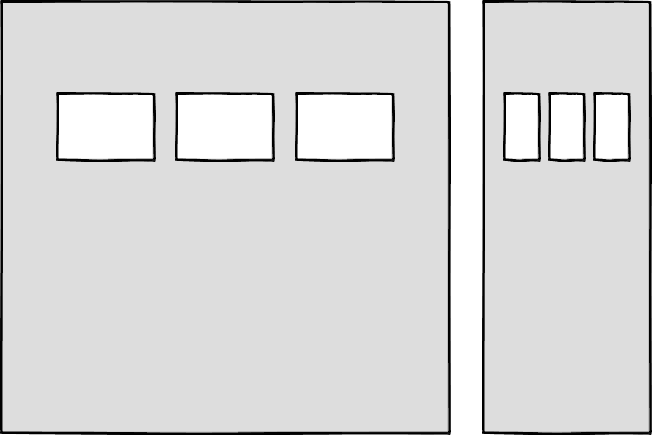
    Then there’s the problem of space. Media queries allow components to adapt based on the viewport size, but what if I put a component into a sidebar, like in the figure below?

    Container queries: our savior or a false dawn?

    Container queries have long been touted as an improvement upon media queries, but at the time of writing are unsupported in most browsers. There are JavaScript workarounds, but they can create dependency and compatibility issues. The basic theory underlying container queries is that elements should change based on the size of their parent container and not the viewport width, as seen in the following illustrations.

    One of the biggest arguments in favor of container queries is that they help us create components or design patterns that are truly reusable because they can be picked up and placed anywhere in a layout. This is an important step in moving toward a form of component-based design that works at any size on any device.

    In other words, responsive components to replace responsive layouts.

    Container queries will help us move from designing pages that respond to the browser or device size to designing components that can be placed in a sidebar or in the main content, and respond accordingly.

    My concern is that we are still using layout to determine when a design needs to adapt. This approach will always be restrictive, as we will still need pre-defined breakpoints. For this reason, my main question with container queries is, How would we decide when to change the CSS used by a component? 

    A component library removed from context and real content is probably not the best place for that decision. 

    As the diagrams below illustrate, we can use container queries to create designs for specific container widths, but what if I want to change the design based on the image size or ratio?

    In this example, the dimensions of the container are not what should dictate the design; rather, the image is.

    It’s hard to say for sure whether container queries will be a success story until we have solid cross-browser support for them. Responsive component libraries would definitely evolve how we design and would improve the possibilities for reuse and design at scale. But maybe we will always need to adjust these components to suit our content.

    CSS is changing

    Whilst the container query debate rumbles on, there have been numerous advances in CSS that change the way we think about design. The days of fixed-width elements measured in pixels and floated div elements used to cobble layouts together are long gone, consigned to history along with table layouts. Flexbox and CSS Grid have revolutionized layouts for the web. We can now create elements that wrap onto new rows when they run out of space, not when the device changes.

    .wrapper {
      display: grid;
      grid-template-columns: repeat(auto-fit, 450px);
      gap: 10px;
    }

    The repeat() function paired with auto-fit or auto-fill allows us to specify how much space each column should use while leaving it up to the browser to decide when to spill the columns onto a new line. Similar things can be achieved with Flexbox, as elements can wrap over multiple rows and “flex” to fill available space. 

    .wrapper {
      display: flex;
      flex-wrap: wrap;
      justify-content: space-between;
    }
    
    .child {
      flex-basis: 32%;
      margin-bottom: 20px;
    }

    The biggest benefit of all this is you don’t need to wrap elements in container rows. Without rows, content isn’t tied to page markup in quite the same way, allowing for removals or additions of content without additional development.

    This is a big step forward when it comes to creating designs that allow for evolving content, but the real game changer for flexible designs is CSS Subgrid. 

    Remember the days of crafting perfectly aligned interfaces, only for the customer to add an unbelievably long header almost as soon as they’re given CMS access, like the illustration below?

    Subgrid allows elements to respond to adjustments in their own content and in the content of sibling elements, helping us create designs more resilient to change.

    .wrapper {
      display: grid;
      grid-template-columns: repeat(auto-fit, minmax(150px, 1fr));
         grid-template-rows: auto 1fr auto;
      gap: 10px;
    }
    
    .sub-grid {
      display: grid;
      grid-row: span 3;
      grid-template-rows: subgrid; /* sets rows to parent grid */
    }

    CSS Grid allows us to separate layout and content, thereby enabling flexible designs. Meanwhile, Subgrid allows us to create designs that can adapt in order to suit morphing content. Subgrid at the time of writing is only supported in Firefox but the above code can be implemented behind an @supports feature query. 

    Intrinsic layouts 

    I’d be remiss not to mention intrinsic layouts, the term created by Jen Simmons to describe a mixture of new and old CSS features used to create layouts that respond to available space. 

    Responsive layouts have flexible columns using percentages. Intrinsic layouts, on the other hand, use the fr unit to create flexible columns that won’t ever shrink so much that they render the content illegible.

    fr units is a way to say I want you to distribute the extra space in this way, but…don’t ever make it smaller than the content that’s inside of it.

    —Jen Simmons, “Designing Intrinsic Layouts”

    Intrinsic layouts can also utilize a mixture of fixed and flexible units, allowing the content to dictate the space it takes up.

    What makes intrinsic design stand out is that it not only creates designs that can withstand future devices but also helps scale design without losing flexibility. Components and patterns can be lifted and reused without the prerequisite of having the same breakpoints or the same amount of content as in the previous implementation. 

    We can now create designs that adapt to the space they have, the content within them, and the content around them. With an intrinsic approach, we can construct responsive components without depending on container queries.

    Another 2010 moment?

    This intrinsic approach should in my view be every bit as groundbreaking as responsive web design was ten years ago. For me, it’s another “everything changed” moment. 

    But it doesn’t seem to be moving quite as fast; I haven’t yet had that same career-changing moment I had with responsive design, despite the widely shared and brilliant talk that brought it to my attention. 

    One reason for that could be that I now work in a large organization, which is quite different from the design agency role I had in 2010. In my agency days, every new project was a clean slate, a chance to try something new. Nowadays, projects use existing tools and frameworks and are often improvements to existing websites with an existing codebase. 

    Another could be that I feel more prepared for change now. In 2010 I was new to design in general; the shift was frightening and required a lot of learning. Also, an intrinsic approach isn’t exactly all-new; it’s about using existing skills and existing CSS knowledge in a different way. 

    You can’t framework your way out of a content problem

    Another reason for the slightly slower adoption of intrinsic design could be the lack of quick-fix framework solutions available to kick-start the change. 

    Responsive grid systems were all over the place ten years ago. With a framework like Bootstrap or Skeleton, you had a responsive design template at your fingertips.

    Intrinsic design and frameworks do not go hand in hand quite so well because the benefit of having a selection of units is a hindrance when it comes to creating layout templates. The beauty of intrinsic design is combining different units and experimenting with techniques to get the best for your content.

    And then there are design tools. We probably all, at some point in our careers, used Photoshop templates for desktop, tablet, and mobile devices to drop designs in and show how the site would look at all three stages.

    How do you do that now, with each component responding to content and layouts flexing as and when they need to? This type of design must happen in the browser, which personally I’m a big fan of. 

    The debate about “whether designers should code” is another that has rumbled on for years. When designing a digital product, we should, at the very least, design for a best- and worst-case scenario when it comes to content. To do this in a graphics-based software package is far from ideal. In code, we can add longer sentences, more radio buttons, and extra tabs, and watch in real time as the design adapts. Does it still work? Is the design too reliant on the current content?

    Personally, I look forward to the day intrinsic design is the standard for design, when a design component can be truly flexible and adapt to both its space and content with no reliance on device or container dimensions.

    Content first 

    Content is not constant. After all, to design for the unknown or unexpected we need to account for content changes like our earlier Subgrid card example that allowed the cards to respond to adjustments to their own content and the content of sibling elements.

    Thankfully, there’s more to CSS than layout, and plenty of properties and values can help us put content first. Subgrid and pseudo-elements like ::first-line and ::first-letter help to separate design from markup so we can create designs that allow for changes.

    Instead of old markup hacks like this—

    First line of text with different styling...

    —we can target content based on where it appears.

    .element::first-line {
      font-size: 1.4em;
    }
    
    .element::first-letter {
      color: red;
    }

    Much bigger additions to CSS include logical properties, which change the way we construct designs using logical dimensions (start and end) instead of physical ones (left and right), something CSS Grid also does with functions like min(), max(), and clamp().

    This flexibility allows for directional changes according to content, a common requirement when we need to present content in multiple languages. In the past, this was often achieved with Sass mixins but was often limited to switching from left-to-right to right-to-left orientation.

    In the Sass version, directional variables need to be set.

    $direction: rtl;
    $opposite-direction: ltr;
    
    $start-direction: right;
    $end-direction: left;

    These variables can be used as values—

    body {
      direction: $direction;
      text-align: $start-direction;
    }

    —or as properties.

    margin-#{$end-direction}: 10px;
    padding-#{$start-direction}: 10px;

    However, now we have native logical properties, removing the reliance on both Sass (or a similar tool) and pre-planning that necessitated using variables throughout a codebase. These properties also start to break apart the tight coupling between a design and strict physical dimensions, creating more flexibility for changes in language and in direction.

    margin-block-end: 10px;
    padding-block-start: 10px;

    There are also native start and end values for properties like text-align, which means we can replace text-align: right with text-align: start.

    Like the earlier examples, these properties help to build out designs that aren’t constrained to one language; the design will reflect the content’s needs.

    Fixed and fluid 

    We briefly covered the power of combining fixed widths with fluid widths with intrinsic layouts. The min() and max() functions are a similar concept, allowing you to specify a fixed value with a flexible alternative. 

    For min() this means setting a fluid minimum value and a maximum fixed value.

    .element {
      width: min(50%, 300px);
    }

    The element in the figure above will be 50% of its container as long as the element’s width doesn’t exceed 300px.

    For max() we can set a flexible max value and a minimum fixed value.

    .element {
      width: max(50%, 300px);
    }

    Now the element will be 50% of its container as long as the element’s width is at least 300px. This means we can set limits but allow content to react to the available space. 

    The clamp() function builds on this by allowing us to set a preferred value with a third parameter. Now we can allow the element to shrink or grow if it needs to without getting to a point where it becomes unusable.

    .element {
      width: clamp(300px, 50%, 600px);
    }

    This time, the element’s width will be 50% (the preferred value) of its container but never less than 300px and never more than 600px.

    With these techniques, we have a content-first approach to responsive design. We can separate content from markup, meaning the changes users make will not affect the design. We can start to future-proof designs by planning for unexpected changes in language or direction. And we can increase flexibility by setting desired dimensions alongside flexible alternatives, allowing for more or less content to be displayed correctly.

    Situation first

    Thanks to what we’ve discussed so far, we can cover device flexibility by changing our approach, designing around content and space instead of catering to devices. But what about that last bit of Jeffrey Zeldman’s quote, “…situations you haven’t imagined”?

    It’s a very different thing to design for someone seated at a desktop computer as opposed to someone using a mobile phone and moving through a crowded street in glaring sunshine. Situations and environments are hard to plan for or predict because they change as people react to their own unique challenges and tasks.

    This is why choice is so important. One size never fits all, so we need to design for multiple scenarios to create equal experiences for all our users.

    Thankfully, there is a lot we can do to provide choice.

    Responsible design 

    “There are parts of the world where mobile data is prohibitively expensive, and where there is little or no broadband infrastructure.”

    I Used the Web for a Day on a 50 MB Budget

    Chris Ashton

    One of the biggest assumptions we make is that people interacting with our designs have a good wifi connection and a wide screen monitor. But in the real world, our users may be commuters traveling on trains or other forms of transport using smaller mobile devices that can experience drops in connectivity. There is nothing more frustrating than a web page that won’t load, but there are ways we can help users use less data or deal with sporadic connectivity.

    The srcset attribute allows the browser to decide which image to serve. This means we can create smaller ‘cropped’ images to display on mobile devices in turn using less bandwidth and less data.

    Image alt text

    The preload attribute can also help us to think about how and when media is downloaded. It can be used to tell a browser about any critical assets that need to be downloaded with high priority, improving perceived performance and the user experience. 


    There’s also native lazy loading, which indicates assets that should only be downloaded when they are needed.

    …

    With srcset, preload, and lazy loading, we can start to tailor a user’s experience based on the situation they find themselves in. What none of this does, however, is allow the user themselves to decide what they want downloaded, as the decision is usually the browser’s to make. 

    So how can we put users in control?

    The return of media queries 

    Media queries have always been about much more than device sizes. They allow content to adapt to different situations, with screen size being just one of them.

    We’ve long been able to check for media types like print and speech and features such as hover, resolution, and color. These checks allow us to provide options that suit more than one scenario; it’s less about one-size-fits-all and more about serving adaptable content. 

    As of this writing, the Media Queries Level 5 spec is still under development. It introduces some really exciting queries that in the future will help us design for multiple other unexpected situations.

    For example, there’s a light-level feature that allows you to modify styles if a user is in sunlight or darkness. Paired with custom properties, these features allow us to quickly create designs or themes for specific environments.

    @media (light-level: normal) {
      --background-color: #fff;
      --text-color: #0b0c0c;  
    }
    
    @media (light-level: dim) {
      --background-color: #efd226;
      --text-color: #0b0c0c;
    }

    Another key feature of the Level 5 spec is personalization. Instead of creating designs that are the same for everyone, users can choose what works for them. This is achieved by using features like prefers-reduced-data, prefers-color-scheme, and prefers-reduced-motion, the latter two of which already enjoy broad browser support. These features tap into preferences set via the operating system or browser so people don’t have to spend time making each site they visit more usable. 

    Media queries like this go beyond choices made by a browser to grant more control to the user.

    Expect the unexpected

    In the end, the one thing we should always expect is for things to change. Devices in particular change faster than we can keep up, with foldable screens already on the market.

    We can’t design the same way we have for this ever-changing landscape, but we can design for content. By putting content first and allowing that content to adapt to whatever space surrounds it, we can create more robust, flexible designs that increase the longevity of our products. 

    A lot of the CSS discussed here is about moving away from layouts and putting content at the heart of design. From responsive components to fixed and fluid units, there is so much more we can do to take a more intrinsic approach. Even better, we can test these techniques during the design phase by designing in-browser and watching how our designs adapt in real-time.

    When it comes to unexpected situations, we need to make sure our products are usable when people need them, whenever and wherever that might be. We can move closer to achieving this by involving users in our design decisions, by creating choice via browsers, and by giving control to our users with user-preference-based media queries. 

    Good design for the unexpected should allow for change, provide choice, and give control to those we serve: our users themselves.

  • Voice Content and Usability

    Voice Content and Usability

    We’ve been having conversations for thousands of years. Whether to convey information, conduct transactions, or simply to check in on one another, people have yammered away, chattering and gesticulating, through spoken conversation for countless generations. Only in the last few millennia have we begun to commit our conversations to writing, and only in the last few decades have we begun to outsource them to the computer, a machine that shows much more affinity for written correspondence than for the slangy vagaries of spoken language.

    Computers have trouble because between spoken and written language, speech is more primordial. To have successful conversations with us, machines must grapple with the messiness of human speech: the disfluencies and pauses, the gestures and body language, and the variations in word choice and spoken dialect that can stymie even the most carefully crafted human-computer interaction. In the human-to-human scenario, spoken language also has the privilege of face-to-face contact, where we can readily interpret nonverbal social cues.

    In contrast, written language immediately concretizes as we commit it to record and retains usages long after they become obsolete in spoken communication (the salutation “To whom it may concern,” for example), generating its own fossil record of outdated terms and phrases. Because it tends to be more consistent, polished, and formal, written text is fundamentally much easier for machines to parse and understand.

    Spoken language has no such luxury. Besides the nonverbal cues that decorate conversations with emphasis and emotional context, there are also verbal cues and vocal behaviors that modulate conversation in nuanced ways: how something is said, not what. Whether rapid-fire, low-pitched, or high-decibel, whether sarcastic, stilted, or sighing, our spoken language conveys much more than the written word could ever muster. So when it comes to voice interfaces—the machines we conduct spoken conversations with—we face exciting challenges as designers and content strategists.

    Voice Interactions

    We interact with voice interfaces for a variety of reasons, but according to Michael McTear, Zoraida Callejas, and David Griol in The Conversational Interface, those motivations by and large mirror the reasons we initiate conversations with other people, too (). Generally, we start up a conversation because:

    • we need something done (such as a transaction),
    • we want to know something (information of some sort), or
    • we are social beings and want someone to talk to (conversation for conversation’s sake).

    These three categories—which I call transactional, informational, and prosocial—also characterize essentially every voice interaction: a single conversation from beginning to end that realizes some outcome for the user, starting with the voice interface’s first greeting and ending with the user exiting the interface. Note here that a conversation in our human sense—a chat between people that leads to some result and lasts an arbitrary length of time—could encompass multiple transactional, informational, and prosocial voice interactions in succession. In other words, a voice interaction is a conversation, but a conversation is not necessarily a single voice interaction.

    Purely prosocial conversations are more gimmicky than captivating in most voice interfaces, because machines don’t yet have the capacity to really want to know how we’re doing and to do the sort of glad-handing humans crave. There’s also ongoing debate as to whether users actually prefer the sort of organic human conversation that begins with a prosocial voice interaction and shifts seamlessly into other types. In fact, in Voice User Interface Design, Michael Cohen, James Giangola, and Jennifer Balogh recommend sticking to users’ expectations by mimicking how they interact with other voice interfaces rather than trying too hard to be human—potentially alienating them in the process ().

    That leaves two genres of conversations we can have with one another that a voice interface can easily have with us, too: a transactional voice interaction realizing some outcome (“buy iced tea”) and an informational voice interaction teaching us something new (“discuss a musical”).

    Transactional voice interactions

    Unless you’re tapping buttons on a food delivery app, you’re generally having a conversation—and therefore a voice interaction—when you order a Hawaiian pizza with extra pineapple. Even when we walk up to the counter and place an order, the conversation quickly pivots from an initial smattering of neighborly small talk to the real mission at hand: ordering a pizza (generously topped with pineapple, as it should be).

    Alison: Hey, how’s it going?

    Burhan: Hi, welcome to Crust Deluxe! It’s cold out there. How can I help you?

    Alison: Can I get a Hawaiian pizza with extra pineapple?

    Burhan: Sure, what size?

    Alison: Large.

    Burhan: Anything else?

    Alison: No thanks, that’s it.

    Burhan: Something to drink?

    Alison: I’ll have a bottle of Coke.

    Burhan: You got it. That’ll be $13.55 and about fifteen minutes.

    Each progressive disclosure in this transactional conversation reveals more and more of the desired outcome of the transaction: a service rendered or a product delivered. Transactional conversations have certain key traits: they’re direct, to the point, and economical. They quickly dispense with pleasantries.

    Informational voice interactions

    Meanwhile, some conversations are primarily about obtaining information. Though Alison might visit Crust Deluxe with the sole purpose of placing an order, she might not actually want to walk out with a pizza at all. She might be just as interested in whether they serve halal or kosher dishes, gluten-free options, or something else. Here, though we again have a prosocial mini-conversation at the beginning to establish politeness, we’re after much more.

    Alison: Hey, how’s it going?

    Burhan: Hi, welcome to Crust Deluxe! It’s cold out there. How can I help you?

    Alison: Can I ask a few questions?

    Burhan: Of course! Go right ahead.

    Alison: Do you have any halal options on the menu?

    Burhan: Absolutely! We can make any pie halal by request. We also have lots of vegetarian, ovo-lacto, and vegan options. Are you thinking about any other dietary restrictions?

    Alison: What about gluten-free pizzas?

    Burhan: We can definitely do a gluten-free crust for you, no problem, for both our deep-dish and thin-crust pizzas. Anything else I can answer for you?

    Alison: That’s it for now. Good to know. Thanks!

    Burhan: Anytime, come back soon!

    This is a very different dialogue. Here, the goal is to get a certain set of facts. Informational conversations are investigative quests for the truth—research expeditions to gather data, news, or facts. Voice interactions that are informational might be more long-winded than transactional conversations by necessity. Responses tend to be lengthier, more informative, and carefully communicated so the customer understands the key takeaways.

    Voice Interfaces

    At their core, voice interfaces employ speech to support users in reaching their goals. But simply because an interface has a voice component doesn’t mean that every user interaction with it is mediated through voice. Because multimodal voice interfaces can lean on visual components like screens as crutches, we’re most concerned in this book with pure voice interfaces, which depend entirely on spoken conversation, lack any visual component whatsoever, and are therefore much more nuanced and challenging to tackle.

    Though voice interfaces have long been integral to the imagined future of humanity in science fiction, only recently have those lofty visions become fully realized in genuine voice interfaces.

    Interactive voice response (IVR) systems

    Though written conversational interfaces have been fixtures of computing for many decades, voice interfaces first emerged in the early 1990s with text-to-speech (TTS) dictation programs that recited written text aloud, as well as speech-enabled in-car systems that gave directions to a user-provided address. With the advent of interactive voice response (IVR) systems, intended as an alternative to overburdened customer service representatives, we became acquainted with the first true voice interfaces that engaged in authentic conversation.

    IVR systems allowed organizations to reduce their reliance on call centers but soon became notorious for their clunkiness. Commonplace in the corporate world, these systems were primarily designed as metaphorical switchboards to guide customers to a real phone agent (“Say Reservations to book a flight or check an itinerary”); chances are you will enter a conversation with one when you call an airline or hotel conglomerate. Despite their functional issues and users’ frustration with their inability to speak to an actual human right away, IVR systems proliferated in the early 1990s across a variety of industries (, PDF).

    While IVR systems are great for highly repetitive, monotonous conversations that generally don’t veer from a single format, they have a reputation for less scintillating conversation than we’re used to in real life (or even in science fiction).

    Screen readers

    Parallel to the evolution of IVR systems was the invention of the screen reader, a tool that transcribes visual content into synthesized speech. For Blind or visually impaired website users, it’s the predominant method of interacting with text, multimedia, or form elements. Screen readers represent perhaps the closest equivalent we have today to an out-of-the-box implementation of content delivered through voice.

    Among the first screen readers known by that moniker was the Screen Reader for the BBC Micro and NEEC Portable developed by the Research Centre for the Education of the Visually Handicapped (RCEVH) at the University of Birmingham in 1986 (). That same year, Jim Thatcher created the first IBM Screen Reader for text-based computers, later recreated for computers with graphical user interfaces (GUIs) ().

    With the rapid growth of the web in the 1990s, the demand for accessible tools for websites exploded. Thanks to the introduction of semantic HTML and especially ARIA roles beginning in 2008, screen readers started facilitating speedy interactions with web pages that ostensibly allow disabled users to traverse the page as an aural and temporal space rather than a visual and physical one. In other words, screen readers for the web “provide mechanisms that translate visual design constructs—proximity, proportion, etc.—into useful information,” writes Aaron Gustafson in A List Apart. “At least they do when documents are authored thoughtfully” ().

    Though deeply instructive for voice interface designers, there’s one significant problem with screen readers: they’re difficult to use and unremittingly verbose. The visual structures of websites and web navigation don’t translate well to screen readers, sometimes resulting in unwieldy pronouncements that name every manipulable HTML element and announce every formatting change. For many screen reader users, working with web-based interfaces exacts a cognitive toll.

    In Wired, accessibility advocate and voice engineer Chris Maury considers why the screen reader experience is ill-suited to users relying on voice:

    From the beginning, I hated the way that Screen Readers work. Why are they designed the way they are? It makes no sense to present information visually and then, and only then, translate that into audio. All of the time and energy that goes into creating the perfect user experience for an app is wasted, or even worse, adversely impacting the experience for blind users. ()

    In many cases, well-designed voice interfaces can speed users to their destination better than long-winded screen reader monologues. After all, visual interface users have the benefit of darting around the viewport freely to find information, ignoring areas irrelevant to them. Blind users, meanwhile, are obligated to listen to every utterance synthesized into speech and therefore prize brevity and efficiency. Disabled users who have long had no choice but to employ clunky screen readers may find that voice interfaces, particularly more modern voice assistants, offer a more streamlined experience.

    Voice assistants

    When we think of voice assistants (the subset of voice interfaces now commonplace in living rooms, smart homes, and offices), many of us immediately picture HAL from 2001: A Space Odyssey or hear Majel Barrett’s voice as the omniscient computer in Star Trek. Voice assistants are akin to personal concierges that can answer questions, schedule appointments, conduct searches, and perform other common day-to-day tasks. And they’re rapidly gaining more attention from accessibility advocates for their assistive potential.

    Before the earliest IVR systems found success in the enterprise, Apple published a demonstration video in 1987 depicting the Knowledge Navigator, a voice assistant that could transcribe spoken words and recognize human speech to a great degree of accuracy. Then, in 2001, Tim Berners-Lee and others formulated their vision for a Semantic Web “agent” that would perform typical errands like “checking calendars, making appointments, and finding locations” (, behind paywall). It wasn’t until 2011 that Apple’s Siri finally entered the picture, making voice assistants a tangible reality for consumers.

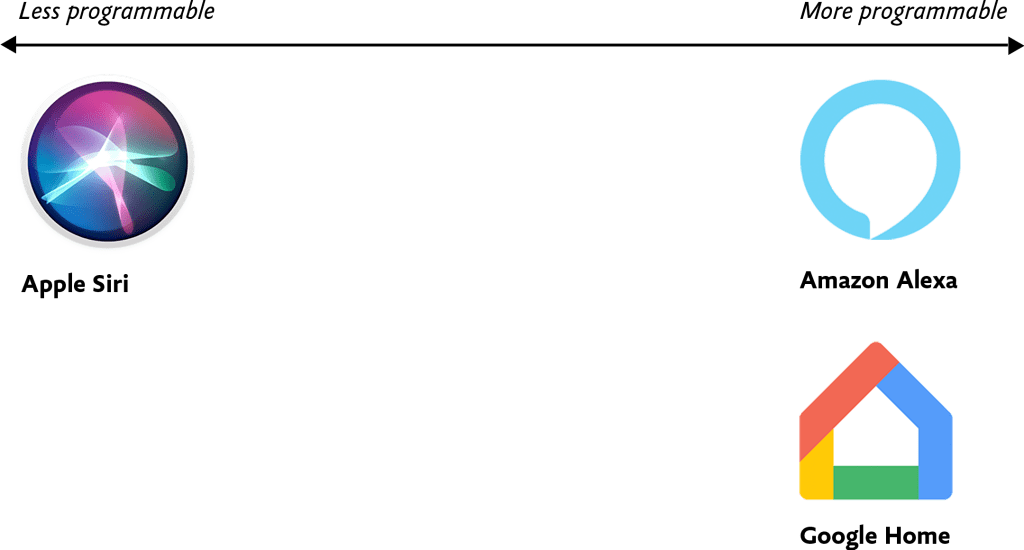
    Thanks to the plethora of voice assistants available today, there is considerable variation in how programmable and customizable certain voice assistants are over others (Fig 1.1). At one extreme, everything except vendor-provided features is locked down; for example, at the time of their release, the core functionality of Apple’s Siri and Microsoft’s Cortana couldn’t be extended beyond their existing capabilities. Even today, it isn’t possible to program Siri to perform arbitrary functions, because there’s no means by which developers can interact with Siri at a low level, apart from predefined categories of tasks like sending messages, hailing rideshares, making restaurant reservations, and certain others.

    At the opposite end of the spectrum, voice assistants like Amazon Alexa and Google Home offer a core foundation on which developers can build custom voice interfaces. For this reason, programmable voice assistants that lend themselves to customization and extensibility are becoming increasingly popular for developers who feel stifled by the limitations of Siri and Cortana. Amazon offers the Alexa Skills Kit, a developer framework for building custom voice interfaces for Amazon Alexa, while Google Home offers the ability to program arbitrary Google Assistant skills. Today, users can choose from among thousands of custom-built skills within both the Amazon Alexa and Google Assistant ecosystems.

    As corporations like Amazon, Apple, Microsoft, and Google continue to stake their territory, they’re also selling and open-sourcing an unprecedented array of tools and frameworks for designers and developers that aim to make building voice interfaces as easy as possible, even without code.

    Often by necessity, voice assistants like Amazon Alexa tend to be monochannel—they’re tightly coupled to a device and can’t be accessed on a computer or smartphone instead. By contrast, many development platforms like Google’s Dialogflow have introduced omnichannel capabilities so users can build a single conversational interface that then manifests as a voice interface, textual chatbot, and IVR system upon deployment. I don’t prescribe any specific implementation approaches in this design-focused book, but in Chapter 4 we’ll get into some of the implications these variables might have on the way you build out your design artifacts.

    Voice Content

    Simply put, voice content is content delivered through voice. To preserve what makes human conversation so compelling in the first place, voice content needs to be free-flowing and organic, contextless and concise—everything written content isn’t.

    Our world is replete with voice content in various forms: screen readers reciting website content, voice assistants rattling off a weather forecast, and automated phone hotline responses governed by IVR systems. In this book, we’re most concerned with content delivered auditorily—not as an option, but as a necessity.

    For many of us, our first foray into informational voice interfaces will be to deliver content to users. There’s only one problem: any content we already have isn’t in any way ready for this new habitat. So how do we make the content trapped on our websites more conversational? And how do we write new copy that lends itself to voice interactions?

    Lately, we’ve begun slicing and dicing our content in unprecedented ways. Websites are, in many respects, colossal vaults of what I call macrocontent: lengthy prose that can extend for infinitely scrollable miles in a browser window, like microfilm viewers of newspaper archives. Back in 2002, well before the present-day ubiquity of voice assistants, technologist Anil Dash defined microcontent as permalinked pieces of content that stay legible regardless of environment, such as email or text messages:

    A day’s weather forcast [sic], the arrival and departure times for an airplane flight, an abstract from a long publication, or a single instant message can all be examples of microcontent. ()

    I’d update Dash’s definition of microcontent to include all examples of bite-sized content that go well beyond written communiqués. After all, today we encounter microcontent in interfaces where a small snippet of copy is displayed alone, unmoored from the browser, like a textbot confirmation of a restaurant reservation. Microcontent offers the best opportunity to gauge how your content can be stretched to the very edges of its capabilities, informing delivery channels both established and novel.

    As microcontent, voice content is unique because it’s an example of how content is experienced in time rather than in space. We can glance at a digital sign underground for an instant and know when the next train is arriving, but voice interfaces hold our attention captive for periods of time that we can’t easily escape or skip, something screen reader users are all too familiar with.

    Because microcontent is fundamentally made up of isolated blobs with no relation to the channels where they’ll eventually end up, we need to ensure that our microcontent truly performs well as voice content—and that means focusing on the two most important traits of robust voice content: voice content legibility and voice content discoverability.

    Fundamentally, the legibility and discoverability of our voice content both have to do with how voice content manifests in perceived time and space.