Category: Blog

Your blog category

  • Design for Amiability: Lessons from Vienna

    Design for Amiability: Lessons from Vienna

    Today’s web is not always an amiable place. Sites greet you with a popover that demands assent to their cookie policy, and leave you with Taboola ads promising “One Weird Trick!” to cure your ailments. Social media sites are tuned for engagement, and few things are more engaging than a fight. Today it seems that people want to quarrel; I have seen flame wars among birders.  

    These tensions are often at odds with a site’s goals. If we are providing support and advice to customers, we don’t want those customers to wrangle with each other. If we offer news about the latest research, we want readers to feel at ease; if we promote upcoming marches, we want our core supporters to feel comfortable and we want curious newcomers to feel welcome. 

    In a study for a conference on the History of the Web, I looked to the origins of Computer Science in Vienna (1928-1934)  for a case study of the importance of amiability in a research community and the disastrous consequences of its loss. That story has interesting implications for web environments that promote amiable interaction among disparate, difficult (and sometimes disagreeable) people.

    The Vienna Circle

    Though people had been thinking about calculating engines and thinking machines from antiquity, Computing really got going in Depression-era Vienna.  The people who worked out the theory had no interest in building machines; they wanted to puzzle out the limits of reason in the absence of divine authority. If we could not rely on God or Aristotle to tell us how to think, could we instead build arguments that were self-contained and demonstrably correct? Can we be sure that mathematics is consistent? Are there things that are true but that cannot be expressed in language? 

    The core ideas were worked out in the weekly meetings (Thursdays at 6) of a group remembered as the Vienna Circle. They got together in the office of Professor Moritz Schlick at the University of Vienna to discuss problems in philosophy, math, and language. The intersection of physics and philosophy had long been a specialty of this Vienna department, and this work had placed them among the world leaders.  Schlick’s colleague Hans Hahn was a central participant, and by 1928 Hahn brought along his graduate students Karl Menger and Kurt Gödel. Other frequent participants included philosopher Rudolf Carnap, psychologist Karl Popper, economist Ludwig von Mises (brought by his brother Frederick, a physicist),  graphic designer Otto Neurath (inventor of infographics), and architect Josef Frank (brought by his physicist brother, Phillip).  Out-of-town visitors often joined, including the young Johnny von Neumann, Alfred Tarski, and the irascible Ludwig Wittgenstein. 

    When Schlick’s office grew too dim, participants adjourned to a nearby café for additional discussion with an even larger circle of participants.  This convivial circle was far from unique.  An intersecting circle–Neurath, von Mises, Oskar Morgenstern–established the Austrian School of free-market economics. There were theatrical circles (Peter Lorre, Hedy Lamarr, Max Reinhardt), and literary circles. The café was where things happened.

    The interdisciplinarity of the group posed real challenges of temperament and understanding. Personalities were often a challenge. Gödel was convinced people were trying to poison him. Architect Josef Frank depended on contracts for public housing, which Mises opposed as wasteful. Wittgenstein’s temper had lost him his job as a secondary school teacher, and for some of these years he maintained a detailed list of whom he was willing to meet. Neurath was eager to detect muddled thinking and would interrupt a speaker with a shouted “Metaphysics!” The continuing amity of these meetings was facilitated by the personality of their leader, Moritz Schlick, who would be remembered as notably adept in keeping disagreements from becoming quarrels.

    In the Café

    The Viennese café of this era was long remembered as a particularly good place to argue with your friends, to read, and to write. Built to serve an imperial capital, the cafés found themselves with too much space and too few customers now that the Empire was gone. There was no need to turn tables: a café could only survive by coaxing customers to linger. Perhaps they would order another coffee, or one of their friends might drop by. One could play chess, or billiards, or read newspapers from abroad. Coffee was invariably served with a glass of purified spring water, still a novelty in an era in which most water was still unsafe to drink. That water glass would be refilled indefinitely. 

    In the basement of one café, the poet Jura Soyfer staged “The End Of The World,” a musical comedy in which Professor Peep has discovered a comet heading for earth.

    Prof. Peep: The comet is going to destroy everybody!

    Hitler:  Destroying everybody is my business.

    Of course, coffee can be prepared in many ways, and the Viennese café developed a broad vocabulary to represent precisely how one preferred to drink it: melange, Einspänner, Brauner, Schwarzer, Kapuziner. This extensive customization, with correspondingly esoteric conventions of service, established the café as a comfortable and personal third space, a neutral ground in which anyone who could afford a coffee would be welcome. Viennese of this era were fastidious in their use of personal titles, of which an abundance were in common use. Café waiters greeted regular customers with titles too, but were careful to address their patrons with titles a notch or two greater than they deserved. A graduate student would be Doktor, an unpaid postdoc Professor.  This assurance mattered all the more because so many members of the Circle (and so many other Viennese) came from elsewhere: Carnap from Wuppertal, Gödel from Brno, von Neumann from Budapest. No one was going to make fun of your clothes, mannerisms, or accent. Your friends wouldn’t be bothered by the pram in the hall. Everyone shared a Germanic Austrian literary and philosophical culture, not least those whose ancestors had been Eastern European Jews who knew that culture well, having read all about it in books.

    The amiability of the café circle was enhanced by its openness. Because the circle sometimes extended to architects and actors, people could feel less constrained to admit shortfalls in their understanding. It was soon discovered that marble tabletops made a useful surface for pencil sketches, serving all as an improvised and accessible blackboard.

    Comedies like “The End Of The World” and fictional newspaper sketches or feuilletons of writers like Joseph Roth and Stefan Zweig served as a second defense against disagreeable or churlish behavior. The knowledge that, if one got carried away, a parody of one’s remarks might shortly appear in Neue Freie Presse surely helped Professor Schlick keep matters in hand.

    The End Of Red Vienna

    Though Austria’s government drifted to the right after the War, Vienna’s city council had been Socialist, dedicated to public housing based on user-centered design, and embracing  ambitious programs of public outreach and adult education. In 1934 the Socialists lost a local election, and this era soon came to its end as the new administration focused on the imagined threat of the International Jewish Conspiracy. Most members of the Circle fled within months: von Neumann to Princeton, Neurath to Holland and Oxford, Popper to New Zealand, Carnap to Chicago. Prof. Schlick was murdered on the steps of the University by a student outraged by his former association with Jews.  Jura Soyfer, who wrote “The End Of The World,” died in Buchenwald.

    In 1939, von Neumann finally convinced Gödel to accept a job in Princeton. Gödel was required to pay large fines to emigrate. The officer in charge of these fees would look back on this as the best posting of his career; his name was Eichmann.

    Design for Amiability

    An impressive literature recounts those discussions and the environment that facilitated the development of computing. How can we design for amiability?  This is not just a matter of choosing rounded typefaces and a cheerful pastel palette. I believe we may identify eight distinct issues that exert design forces in usefully amiable directions.

    Seriousness: The Vienna Circle was wrestling with a notoriously difficult book—Wittgenstein’s Tractus Logico-Philosophicus—and a catalog of outstanding open questions in mathematics. They were concerned with consequential problems, not merely scoring points for debating. Constant reminders that the questions you are considering matter—not only that they are consequential or that those opposing you are scoundrels—help promote amity.

    Empiricism: The characteristic approach of the Vienna Circle demanded that knowledge be grounded either in direct observation or in rigorous reasoning. Disagreement, when it arose, could be settled by observation or by proof. If neither seemed ready to hand, the matter could not be settled. On these terms, one can seldom if ever demolish an opposing argument, and trolling is pointless.

    Abstraction: Disputes grow worse when losing the argument entails lost face or lost jobs. The Vienna Circle’s focus on theory—the limits of mathematics, the capability of language—promoted amity. Without seriousness, abstraction could have been merely academic, but the limits of reason and the consistency of mathematics were clearly serious.

    Formality: The punctilious demeanor of waiters and the elaborated rituals of coffee service helped to establish orderly attitudes amongst the argumentative participants. This stands in contrast to the contemptuous sneer that now dominates social media.  

    Schlamperei: Members of the Vienna Circle maintained a global correspondence, and they knew their work was at the frontier of research. Still, this was Vienna, at the margins of Europe: old-fashioned, frumpy, and dingy. Many participants came from even more obscure backwaters. Most or all harbored the suspicion that they were really schleppers, and a tinge of the ridiculous helped to moderate tempers. The director of “The End Of The World” had to pass the hat for money to purchase a moon for the set, and thought it was funny enough to write up for publication.

    Openness: All sorts of people were involved in discussion, anyone might join in. Each week would bring different participants. Fluid borders reduce tension, and provide opportunities to broaden the range of discussion and the terms of engagement. Low entrance friction was characteristic of the café: anyone could come, and if you came twice you were virtually a regular. Permeable boundaries and café culture made it easier for moderating influences to draw in raconteurs and storytellers to defuse awkward moments, and Vienna’s cafés had no shortage of humorists. Openness counteracts the suspicion that promoters of amiability are exerting censorship.

    Parody: The environs of the Circle—the university office and the café—were unmistakably public. There were writers about, some of them renowned humorists. The prospect that one’s bad taste or bad behavior might be ridiculed in print kept discussion within bounds. The sanction of public humiliation, however, was itself made mild by the veneer of fiction; even if you got a little carried away and a character based on you made a splash in some newspaper fiction, it wasn’t the end of the world.

    Engagement: The subject matter was important to the participants, but it was esoteric: it did not matter very much to their mothers or their siblings. A small stumble or a minor humiliation could be shrugged off in ways that major media confrontations cannot.

    I believe it is notable that this environment was designed to promote amiability through several different voices.  The café waiter flattered each newcomer and served everyone, and also kept out local pickpockets and drunks who would be mere disruptions. Schlick and other regulars kept discussion moving and on track. The fiction writers and raconteurs—perhaps the most peripheral of the participants—kept people in a good mood and reminded them that bad behavior could make anyone ridiculous.  Crucially, each of these voices were human: you could reason with them. Algorithmic or AI moderators, however clever, are seldom perceived as reasonable. The café circles had no central authority or Moderator against whom everyone’s resentments might be focused. Even after the disaster of 1934, what people remembered were those cheerful arguments.
  • Design Dialects: Breaking the Rules, Not the System

    Design Dialects: Breaking the Rules, Not the System

    “Language is not merely a set of unrelated sounds, clauses, rules, and meanings; it is a totally coherent system bound to context and behavior.” — Kenneth L. Pike

    The web has accents. So should our design systems.

    Design Systems as Living Languages

    Design systems aren’t component libraries—they’re living languages. Tokens are phonemes, components are words, patterns are phrases, layouts are sentences. The conversations we build with users become the stories our products tell.

    But here’s what we’ve forgotten: the more fluently a language is spoken, the more accents it can support without losing meaning. English in Scotland differs from English in Sydney, yet both are unmistakably English. The language adapts to context while preserving core meaning. This couldn’t be more obvious to me, a Brazilian Portuguese speaker, who learned English with an American accent, and lives in Sydney.

    Our design systems must work the same way. Rigid adherence to visual rules creates brittle systems that break under contextual pressure. Fluent systems bend without breaking.

    Consistency becomes a prison

    The promise of design systems was simple: consistent components would accelerate development and unify experiences. But as systems matured and products grew more complex, that promise has become a prison. Teams file “exception” requests by the hundreds. Products launch with workarounds instead of system components. Designers spend more time defending consistency than solving user problems.

    Our design systems must learn to speak dialects.

    A design dialect is a systematic adaptation of a design system that maintains core principles while developing new patterns for specific contexts. Unlike one-off customizations or brand themes, dialects preserve the system’s essential grammar while expanding its vocabulary to serve different users, environments, or constraints.

    When Perfect Consistency Fails

    At Booking.com, I learned this lesson the hard way. We A/B-tested everything—color, copy, button shapes, even logo colors. As a professional with a graphic design education and experience building brand style guides, I found this shocking. While everyone fell in love with Airbnb’s pristine design system, Booking grew into a giant without ever considering visual consistency.  

    The chaos taught me something profound: consistency isn’t ROI; solved problems are.

    At Shopify. Polaris () was our crown jewel—a mature design language perfect for merchants on laptops. As a product team, we were expected to adopt Polaris as-is. Then my fulfillment team hit an “Oh, Ship!” moment, as we faced the challenge of building an app for warehouse pickers using our interface on shared, battered Android scanners in dim aisles, wearing thick gloves, scanning dozens of items per minute, many with limited levels of English understanding.

    Task completion with standard Polaris: 0%.

    Every component that worked beautifully for merchants failed completely for pickers. White backgrounds created glare. 44px tap targets were invisible to gloved fingers. Sentence-case labels took too long to parse. Multi-step flows confused non-native speakers.

    We faced a choice: abandon Polaris entirely, or teach it to speak warehouse.

    The Birth of a Dialect

    We chose evolution over revolution. Working within Polaris’s core principles—clarity, efficiency, consistency—we developed what we now call a design dialect:

    ConstraintFluent MoveRationale
    Glare & low lightDark surfaces + light textReduce glare on low-DPI screens
    Gloves & haste90px tap targets (~2cm)Accommodate thick gloves
    MultilingualSingle-task screens, plain languageReduce cognitive load

    Result: Task completion jumped from 0% to 100%. Onboarding time dropped from three weeks to one shift.

    This wasn’t customization or theming—this was a dialect: a systematic adaptation that maintained Polaris’s core grammar while developing new vocabulary for a specific context. Polaris hadn’t failed; it had learned to speak warehouse.

    The Flexibility Framework

    At Atlassian, working on the Jira platform—itself a system within the larger Atlassian system—I pushed for formalizing this insight. With dozens of products sharing a design language across different codebases, we needed systematic flexibility so we built directly into our ways of working. The old model—exception requests and special approvals—was failing at scale.

    We developed the Flexibility Framework to help designers define how flexible they wanted their components to be:

    TierActionOwnership
    ConsistentAdopt unchangedPlatform locks design + code
    OpinionatedAdapt within boundsPlatform provides smart defaults, products customize
    FlexibleExtend freelyPlatform defines behavior, products own presentation

    During a navigation redesign, we tiered every element. Logo and global search stayed Consistent. Breadcrumbs and contextual actions became Flexible. Product teams could immediately see where innovation was welcome and where consistency mattered.

    The Decision Ladder

    Flexibility needs boundaries. We created a simple ladder for evaluating when rules should bend:

    Good: Ship with existing system components. Fast, consistent, proven.

    Better: Stretch a component slightly. Document the change. Contribute improvements back to the system for all to use.

    Best: Prototype the ideal experience first. If user testing validates the benefit, update the system to support it.

    The key question: “Which option lets users succeed fastest?”

    Rules are tools, not relics.

    Unity Beats Uniformity

    Gmail, Drive, and Maps are unmistakably Google—yet each speaks with its own accent. They achieve unity through shared principles, not cloned components. One extra week of debate over button color costs roughly $30K in engineer time.

    Unity is a brand outcome; fluency is a user outcome. When the two clash, side with the user.

    Governance Without Gates

    How do you maintain coherence while enabling dialects? Treat your system like a living vocabulary:

    Document every deviation – e.g., dialects/warehouse.md with before/after screenshots and rationale.

    Promote shared patterns – when three teams adopt a dialect independently, review it for core inclusion.

    Deprecate with context – retire old idioms via flags and migration notes, never a big-bang purge.

    A living dictionary scales better than a frozen rulebook.

    Start Small: Your First Dialect

    Ready to introduce dialects? Start with one broken experience:

    This week: Find one user flow where perfect consistency blocks task completion. Could be mobile users struggling with desktop-sized components, or accessibility needs your standard patterns don’t address.

    Document the context: What makes standard patterns fail here? Environmental constraints? User capabilities? Task urgency?

    Design one systematic change: Focus on behavior over aesthetics. If gloves are the problem, bigger targets aren’t “”breaking the system””—they’re serving the user. Earn the variations and make them intentional.

    Test and measure: Does the change improve task completion? Time to productivity? User satisfaction?

    Show the savings: If that dialect frees even half a sprint, fluency has paid for itself.

    Beyond the Component Library

    We’re not managing design systems anymore—we’re cultivating design languages. Languages that grow with their speakers. Languages that develop accents without losing meaning. Languages that serve human needs over aesthetic ideals.

    The warehouse workers who went from 0% to 100% task completion didn’t care that our buttons broke the style guide. They cared that the buttons finally worked.

    Your users feel the same way. Give your system permission to speak their language.

  • Avengers, Dune, Odyssey and the Rejection of Digital in a Streaming World

    Avengers, Dune, Odyssey and the Rejection of Digital in a Streaming World

    As you might have heard, and despite a few bad actors on social media’s best efforts, Christopher Nolan’s The Odyssey was a hit in its first and second weekends. They respectively marked the biggest opening and drop of his career, in fact. So in the wake of the IMAX spectacle’s gargantuan grosses, which arrived only […]

    The post Avengers, Dune, Odyssey and the Rejection of Digital in a Streaming World appeared first on Den of Geek.

    Those pesky killer tomatoes have been quiet for a while, but like many of our cult franchise faves, they were way overdue for a reboot! Enter this year’s Attack of the Killer Tomatoes: Organic Intelligence, a fifth film in the Killer Tomatoes series that follows a young biotech prodigy developing a revolutionary genetically engineered vegetable designed to solve humanity’s problems. Fortunately, for fans of the original 1978 movie and its sequels, the experiment spirals out of control, unleashing a new generation of killer tomatoes upon us.

    cnx.cmd.push(function() {
    cnx({
    playerId: “106e33c0-3911-473c-b599-b1426db57530”,

    }).render(“0270c398a82f44f49c23c16122516796”);
    });

    We caught up with Organic Intelligence stars Dan Bakkedahl, Myrna Velasco, and Noor Razooky at San Diego Comic-Con and discovered that the killer tomato situation has grown much more serious than we realized…

    Den of Geek: How did this project come to your doorstep, and what was your reaction? Was it like “oh, Attack of the Killer Tomatoes! I remember those!”

    Dan Bakkedahl: Well, I was eight when the original film came out, and of course it was a taboo film. It wasn’t something you could go out and rent. You had to go find it, and as a little kid, you weren’t going to be able to, but it was kind of this forbidden fruit for my whole young life, and then I got a phone call a little over a year ago saying, “They’re doing another chapter of the story? Would you be interested? I said, “Absolutely,” because it was from my childhood. You know, it was something that I remember, and then finding out that it had all been true all along was really kind of the kicker for me when I read the script and realized, “oh, this is an attempt to expose the cover-up, to spread the truth about the dangers.” So I thought, “Well, I’ll take a shot.” I hope this doesn’t affect my career trying to get the truth out there, but do what you have to.

    Myrna Velasco: You know, my whole life I’ve been hearing the grumblings of the Tomato movies as well. My parents were very learned vegetable people, if you will. Not people who are made of vegetables, but people who understand vegetables. My father was a gardener, and I grew up really knowing in the back of my mind that tomatoes are out there, and this role was really kind of thrust upon me. I got the first ask to present what I thought would have been the right way to encounter killer tomatoes as a federal vegetable investigator, and the process as an actor is you go through these auditions and callbacks and whatnot, and I was just told, “This is your job now. This is what you have to do. It is your calling.” So I just took on the mantle and am really trying to make it as clear as possible that these vegetables are out here, and it’s not safe.

    Noor Razooky: I play Dr. Angela in the film. I am a marine biologist. I successfully grow tomatoes in salt water. I was essentially born to play this, considering my entire life, my physics teacher father would only show respect to math and science, so it seemed like that was the path I would have to take. I grew my first tomato at a very young age, through seed and soil, traditionally, and I would check on those tomato plants every single day in my childhood bedroom through the blinds.

    I’d watch its progress until one day I heard the sound of gardeners, and a weed whacker engine was roaring and rumbling and shaking my house, and I thought, “Oh my God, something must have gone wrong.” So I went back to my blinds, and I checked through my childhood window, and my tomato plant had gone. Immediately, visceral reaction. My chest got tight, my fingers started to constrict, my heart rate went up, and I was like, “They have no idea what they have done. They have no idea the retaliation that will come after this chopping, this carnage that happened in my backyard.”

    And so I thought to myself, “the safest way to continue growing tomatoes going forward is in the ocean, where there will be no gardeners chopping it down, I’ll have full control over them,” until we realized that these tomatoes are actually plotting and communicating through almost like a fungal mycelium network, and like Dan said earlier, the truth came to me a little bit later. I was in it for the science, not the conspiracy, until …you know, data doesn’t lie.

    This is starting to sound like your classic The Last of Us situation. That’s very troubling, I would say. You’ve mentioned gardeners a couple of times. Where are they in the context of Attack of the Killer Tomatoes? Are they allies in the fight against the tomatoes, or willing collaborators with them?

    Dan Bakkedahl: Look, from eight to 80, we need as many hands as we can get, you know. So, regardless of what you do for a living, it’s your fight too. This is the fight for humanity. I mean, I would imagine that a gardener is going to have a greater knowledge, but he may also have a greater sympathy for these creatures.

    Noor Razooky: Unknowingly.

    Dan Bakkedahl: Yeah, unknowingly, or you know, it might be a conscious bias. But look, the fact of the matter is, if you want to remain on this planet and you’re human, you’ve got to join the fight.

    Noor Razooky: It’s us against them.

    Chilling stuff. Noor, I don’t want to critique your character’s approach, but bringing tomatoes out into the ocean seems kind of counterproductive. Like, you just create hydroponic tomatoes? If anything, it feels like they’d be stronger.

    Noor Razooky: I mean, essentially, but that brings us back to organic intelligence and the evolution of it. Organic intelligence is something we cannot control. It’s evolved over billions and billions of years through adapting to their environments. So, if these tomato plants are just being cut down by weed whackers, they will simply adapt, roll on into the ocean where there are no weed whackers, where they can immerse themselves in a different ecosystem. So you have to roll with the punches in that sense. AI is man-made, and that’s something we can control. We can unplug it if we want to. But organic intelligence, we cannot unplug it. We have to adapt. We have to become organic with them.

    Okay, I think that all makes perfect sense. Dan, can you tell us about your character, Wilbur Finletter?

    Dan Bakkedahl: Yeah, Wilbur Finletter is one of the original characters in this franchise. One of the original combatants in the fight against the tomatoes in the first film, and of course, in this film we find Wilbur has retired. He’s no longer in that. He’s running a pizza shop along with a couple of his former cohorts, and he thinks it’s done, it’s all over, but he doesn’t know about the evolution. This new wrinkle brings Wilbur and his gang out of retirement. You’re scared when you haven’t done something for a while, like if you haven’t ridden a bike in a long time. Sure, you still know how to ride a bike, but are you still as good at it? That’s really the question. And it turns out it takes a little coaxing for Wilbur and his compatriots to get up to speed. But rest assured, they’re ready for the fight.

    Gotcha. So, Attack of the Killer Tomatoes: Organic Intelligence is the fifth iteration in this series of… 

    Myrna Velasco: ….documentaries? 

    Yes, documentaries. So we’re five in. Why do we keep getting our asses handed to us by these tomatoes?

    Myrna Velasco: Because organic intelligence knows no bounds, and you know, much like The Last of Us, you chop a tomato down, and then at the very least, you get 10 more seeds of the enemy that you have to think about and find, and it’s not easy. It’s not an easy job to eradicate the tomato villainry. It’s not, which is again why we need all hands on deck. We need every single person who is willing and capable to stomp a tomato to please make that your mission as a human being.

    Dan Bakkedahl: And to be clear, it’s not all tomatoes. You know, just look out for the bad ones. That’s really what you do. 

    We don’t want to be bigoted against all the tomatoes, but of the “bad tomatoes,” is it limited to like heirloom? Cherry? Is it a whole wide variety we’re dealing with?

    Myrna Velasco: It’s like with everybody. There’s no type of person that is bad, and there’s no one type of tomato that is bad. It really is just the organic intelligence moves through every tomato. I personally believe, and have research to back up, that they are coaxing tomatoes, as well as potentially other vegetables, into badness, into killing. It’s not every tomato, but every type of tomato has one. 

    Dan Bakkedahl: Just know the warning signs. You know, if you see a tomato in a place that it shouldn’t be, if you’re in a public restroom and there’s a tomato in there, you’re probably looking at a killer tomato. 

    Noor Razooky: They probably came from the toilet. They go through these rooting systems through the pipes, and that’s how they communicate; that’s the evolution of their intelligence and their communication networks.

    Context matters. 

    Dan Bakkedahl: Oh, for sure. If you’re about to eat a burger and there’s a slice on there, dig in. Feel no fear. You got a little salad in front of you, and just a couple of little cherry tomatoes on there. No fear.

    Noor Razooky: Certainly. We’re actually in touch with a lot of universities to start adding courses because it starts with the youth, and that’s where the movement really begins. It’s always about education, awareness, and visibility. So that’s our purpose for this film.

    Myrna Velasco: What really comes to mind is: “If you see something, say something.”

    On the the poster of this harrowing documentary, there’s a lot of our nation’s finest character actors who are all identified just by a project that they starred in, and for you, Dan, it just has your face and says Veep,” which I was very appreciative of because I think that happens to be maybe the funniest thing that’s ever existed in the history of humanity.

    Dan Bakkedahl: Thank you very much.

    There is a line that Roger Furlong delivers in that series that I hear running through my head maybe four or five times a day. He’s speaking to Jonah Ryan, who just got assigned his own Secret Service detail because he’s a presidential candidate, and he says, “You’re still likely to get assassinated, but the killer, may God guide his hand, will just have to work a little harder.” I wanted to hear you laugh at that, and I also wanted to ask what it’s like getting to deliver lines like that.

    Dan Bakkedahl: Well, that show was the thrill of a lifetime. You’d get that script, and they’d change it three times before you’d shoot it. So by the time you’re actually finally shooting it, you’re on like your third or fourth iteration of the line, and then once they get it, they would come over with a piece of paper with a bunch of alts on it and say, “Pick one,” and they’re all delicious and horrible things to say. So you kind of got to guide your own destiny in that way. You got to improvise a little bit. You got to choose a little bit. It was a lovely experience. I mean, it was a really hard job. Comedies don’t normally shoot 16-hour days, but that show did on the regular.

    Comedies aren’t even usually that wordy. 

    Dan Bakkedahl: Well, no, that’s the other thing. It’s 50-page scripts, and it’s usually a minute per page. But with Veep, it was a 30-minute show, and the scripts were regularly 50 pages and longer because of the rapid-fire nature of the dialogue, overlapping almost like Mamet, like talking, talking, talking. I’m talking too, and we’re all talking at the same time. 

    Thank you so much for stopping by and telling me about the dangers of these killer tomatoes. 

    Dan Bakkedahl: If you’re not part of the solution, you’re part of the problem. 

    I’ll get the message out as best I can.

    Attack of the Killer Tomatoes: Organic Intelligence is set for a limited release in New York, Los Angeles, Chicago, and San Diego on August 7.

    The post Attack of the Killer Tomatoes: Organic Intelligence Stars Prepare Us for the War on Vegetables appeared first on Den of Geek.

  • 15 TV Couples Fans Never Rooted For

    15 TV Couples Fans Never Rooted For

    TV writers don’t always get the romance right. While some couples become the heart of a series, others leave fans wondering why they ever got together in the first place. Sometimes the chemistry just isn’t there. Other times, the relationship interrupts a pairing viewers have spent years rooting for, or it changes a dynamic that worked much better as a friendship. These storylines often become some of the most debated parts of otherwise beloved shows, with fans still arguing years later that the romance should never have happened.

    Here are 15 TV couples fans never rooted for.

    The post 15 TV Couples Fans Never Rooted For appeared first on Den of Geek.

    Those pesky killer tomatoes have been quiet for a while, but like many of our cult franchise faves, they were way overdue for a reboot! Enter this year’s Attack of the Killer Tomatoes: Organic Intelligence, a fifth film in the Killer Tomatoes series that follows a young biotech prodigy developing a revolutionary genetically engineered vegetable designed to solve humanity’s problems. Fortunately, for fans of the original 1978 movie and its sequels, the experiment spirals out of control, unleashing a new generation of killer tomatoes upon us.

    cnx.cmd.push(function() {
    cnx({
    playerId: “106e33c0-3911-473c-b599-b1426db57530”,

    }).render(“0270c398a82f44f49c23c16122516796”);
    });

    We caught up with Organic Intelligence stars Dan Bakkedahl, Myrna Velasco, and Noor Razooky at San Diego Comic-Con and discovered that the killer tomato situation has grown much more serious than we realized…

    Den of Geek: How did this project come to your doorstep, and what was your reaction? Was it like “oh, Attack of the Killer Tomatoes! I remember those!”

    Dan Bakkedahl: Well, I was eight when the original film came out, and of course it was a taboo film. It wasn’t something you could go out and rent. You had to go find it, and as a little kid, you weren’t going to be able to, but it was kind of this forbidden fruit for my whole young life, and then I got a phone call a little over a year ago saying, “They’re doing another chapter of the story? Would you be interested? I said, “Absolutely,” because it was from my childhood. You know, it was something that I remember, and then finding out that it had all been true all along was really kind of the kicker for me when I read the script and realized, “oh, this is an attempt to expose the cover-up, to spread the truth about the dangers.” So I thought, “Well, I’ll take a shot.” I hope this doesn’t affect my career trying to get the truth out there, but do what you have to.

    Myrna Velasco: You know, my whole life I’ve been hearing the grumblings of the Tomato movies as well. My parents were very learned vegetable people, if you will. Not people who are made of vegetables, but people who understand vegetables. My father was a gardener, and I grew up really knowing in the back of my mind that tomatoes are out there, and this role was really kind of thrust upon me. I got the first ask to present what I thought would have been the right way to encounter killer tomatoes as a federal vegetable investigator, and the process as an actor is you go through these auditions and callbacks and whatnot, and I was just told, “This is your job now. This is what you have to do. It is your calling.” So I just took on the mantle and am really trying to make it as clear as possible that these vegetables are out here, and it’s not safe.

    Noor Razooky: I play Dr. Angela in the film. I am a marine biologist. I successfully grow tomatoes in salt water. I was essentially born to play this, considering my entire life, my physics teacher father would only show respect to math and science, so it seemed like that was the path I would have to take. I grew my first tomato at a very young age, through seed and soil, traditionally, and I would check on those tomato plants every single day in my childhood bedroom through the blinds.

    I’d watch its progress until one day I heard the sound of gardeners, and a weed whacker engine was roaring and rumbling and shaking my house, and I thought, “Oh my God, something must have gone wrong.” So I went back to my blinds, and I checked through my childhood window, and my tomato plant had gone. Immediately, visceral reaction. My chest got tight, my fingers started to constrict, my heart rate went up, and I was like, “They have no idea what they have done. They have no idea the retaliation that will come after this chopping, this carnage that happened in my backyard.”

    And so I thought to myself, “the safest way to continue growing tomatoes going forward is in the ocean, where there will be no gardeners chopping it down, I’ll have full control over them,” until we realized that these tomatoes are actually plotting and communicating through almost like a fungal mycelium network, and like Dan said earlier, the truth came to me a little bit later. I was in it for the science, not the conspiracy, until …you know, data doesn’t lie.

    This is starting to sound like your classic The Last of Us situation. That’s very troubling, I would say. You’ve mentioned gardeners a couple of times. Where are they in the context of Attack of the Killer Tomatoes? Are they allies in the fight against the tomatoes, or willing collaborators with them?

    Dan Bakkedahl: Look, from eight to 80, we need as many hands as we can get, you know. So, regardless of what you do for a living, it’s your fight too. This is the fight for humanity. I mean, I would imagine that a gardener is going to have a greater knowledge, but he may also have a greater sympathy for these creatures.

    Noor Razooky: Unknowingly.

    Dan Bakkedahl: Yeah, unknowingly, or you know, it might be a conscious bias. But look, the fact of the matter is, if you want to remain on this planet and you’re human, you’ve got to join the fight.

    Noor Razooky: It’s us against them.

    Chilling stuff. Noor, I don’t want to critique your character’s approach, but bringing tomatoes out into the ocean seems kind of counterproductive. Like, you just create hydroponic tomatoes? If anything, it feels like they’d be stronger.

    Noor Razooky: I mean, essentially, but that brings us back to organic intelligence and the evolution of it. Organic intelligence is something we cannot control. It’s evolved over billions and billions of years through adapting to their environments. So, if these tomato plants are just being cut down by weed whackers, they will simply adapt, roll on into the ocean where there are no weed whackers, where they can immerse themselves in a different ecosystem. So you have to roll with the punches in that sense. AI is man-made, and that’s something we can control. We can unplug it if we want to. But organic intelligence, we cannot unplug it. We have to adapt. We have to become organic with them.

    Okay, I think that all makes perfect sense. Dan, can you tell us about your character, Wilbur Finletter?

    Dan Bakkedahl: Yeah, Wilbur Finletter is one of the original characters in this franchise. One of the original combatants in the fight against the tomatoes in the first film, and of course, in this film we find Wilbur has retired. He’s no longer in that. He’s running a pizza shop along with a couple of his former cohorts, and he thinks it’s done, it’s all over, but he doesn’t know about the evolution. This new wrinkle brings Wilbur and his gang out of retirement. You’re scared when you haven’t done something for a while, like if you haven’t ridden a bike in a long time. Sure, you still know how to ride a bike, but are you still as good at it? That’s really the question. And it turns out it takes a little coaxing for Wilbur and his compatriots to get up to speed. But rest assured, they’re ready for the fight.

    Gotcha. So, Attack of the Killer Tomatoes: Organic Intelligence is the fifth iteration in this series of… 

    Myrna Velasco: ….documentaries? 

    Yes, documentaries. So we’re five in. Why do we keep getting our asses handed to us by these tomatoes?

    Myrna Velasco: Because organic intelligence knows no bounds, and you know, much like The Last of Us, you chop a tomato down, and then at the very least, you get 10 more seeds of the enemy that you have to think about and find, and it’s not easy. It’s not an easy job to eradicate the tomato villainry. It’s not, which is again why we need all hands on deck. We need every single person who is willing and capable to stomp a tomato to please make that your mission as a human being.

    Dan Bakkedahl: And to be clear, it’s not all tomatoes. You know, just look out for the bad ones. That’s really what you do. 

    We don’t want to be bigoted against all the tomatoes, but of the “bad tomatoes,” is it limited to like heirloom? Cherry? Is it a whole wide variety we’re dealing with?

    Myrna Velasco: It’s like with everybody. There’s no type of person that is bad, and there’s no one type of tomato that is bad. It really is just the organic intelligence moves through every tomato. I personally believe, and have research to back up, that they are coaxing tomatoes, as well as potentially other vegetables, into badness, into killing. It’s not every tomato, but every type of tomato has one. 

    Dan Bakkedahl: Just know the warning signs. You know, if you see a tomato in a place that it shouldn’t be, if you’re in a public restroom and there’s a tomato in there, you’re probably looking at a killer tomato. 

    Noor Razooky: They probably came from the toilet. They go through these rooting systems through the pipes, and that’s how they communicate; that’s the evolution of their intelligence and their communication networks.

    Context matters. 

    Dan Bakkedahl: Oh, for sure. If you’re about to eat a burger and there’s a slice on there, dig in. Feel no fear. You got a little salad in front of you, and just a couple of little cherry tomatoes on there. No fear.

    Noor Razooky: Certainly. We’re actually in touch with a lot of universities to start adding courses because it starts with the youth, and that’s where the movement really begins. It’s always about education, awareness, and visibility. So that’s our purpose for this film.

    Myrna Velasco: What really comes to mind is: “If you see something, say something.”

    On the the poster of this harrowing documentary, there’s a lot of our nation’s finest character actors who are all identified just by a project that they starred in, and for you, Dan, it just has your face and says Veep,” which I was very appreciative of because I think that happens to be maybe the funniest thing that’s ever existed in the history of humanity.

    Dan Bakkedahl: Thank you very much.

    There is a line that Roger Furlong delivers in that series that I hear running through my head maybe four or five times a day. He’s speaking to Jonah Ryan, who just got assigned his own Secret Service detail because he’s a presidential candidate, and he says, “You’re still likely to get assassinated, but the killer, may God guide his hand, will just have to work a little harder.” I wanted to hear you laugh at that, and I also wanted to ask what it’s like getting to deliver lines like that.

    Dan Bakkedahl: Well, that show was the thrill of a lifetime. You’d get that script, and they’d change it three times before you’d shoot it. So by the time you’re actually finally shooting it, you’re on like your third or fourth iteration of the line, and then once they get it, they would come over with a piece of paper with a bunch of alts on it and say, “Pick one,” and they’re all delicious and horrible things to say. So you kind of got to guide your own destiny in that way. You got to improvise a little bit. You got to choose a little bit. It was a lovely experience. I mean, it was a really hard job. Comedies don’t normally shoot 16-hour days, but that show did on the regular.

    Comedies aren’t even usually that wordy. 

    Dan Bakkedahl: Well, no, that’s the other thing. It’s 50-page scripts, and it’s usually a minute per page. But with Veep, it was a 30-minute show, and the scripts were regularly 50 pages and longer because of the rapid-fire nature of the dialogue, overlapping almost like Mamet, like talking, talking, talking. I’m talking too, and we’re all talking at the same time. 

    Thank you so much for stopping by and telling me about the dangers of these killer tomatoes. 

    Dan Bakkedahl: If you’re not part of the solution, you’re part of the problem. 

    I’ll get the message out as best I can.

    Attack of the Killer Tomatoes: Organic Intelligence is set for a limited release in New York, Los Angeles, Chicago, and San Diego on August 7.

    The post Attack of the Killer Tomatoes: Organic Intelligence Stars Prepare Us for the War on Vegetables appeared first on Den of Geek.

  • 15 TV Shows That Had the Perfect Final Episode

    15 TV Shows That Had the Perfect Final Episode

    A bad finale can completely change how people remember a TV show. Fans have spent years arguing about endings that missed the mark, but the opposite doesn’t get talked about nearly as often. Some series knew exactly when to stop and gave their characters the sendoff they deserved, leaving viewers satisfied instead of frustrated. Those final episodes didn’t rely on shocking twists or fan service. They simply stayed true to what had made the show work in the first place, making them easy to revisit even after all these years.

    Here are TV shows that had the perfect final episode.

    The post 15 TV Shows That Had the Perfect Final Episode appeared first on Den of Geek.

    Those pesky killer tomatoes have been quiet for a while, but like many of our cult franchise faves, they were way overdue for a reboot! Enter this year’s Attack of the Killer Tomatoes: Organic Intelligence, a fifth film in the Killer Tomatoes series that follows a young biotech prodigy developing a revolutionary genetically engineered vegetable designed to solve humanity’s problems. Fortunately, for fans of the original 1978 movie and its sequels, the experiment spirals out of control, unleashing a new generation of killer tomatoes upon us.

    cnx.cmd.push(function() {
    cnx({
    playerId: “106e33c0-3911-473c-b599-b1426db57530”,

    }).render(“0270c398a82f44f49c23c16122516796”);
    });

    We caught up with Organic Intelligence stars Dan Bakkedahl, Myrna Velasco, and Noor Razooky at San Diego Comic-Con and discovered that the killer tomato situation has grown much more serious than we realized…

    Den of Geek: How did this project come to your doorstep, and what was your reaction? Was it like “oh, Attack of the Killer Tomatoes! I remember those!”

    Dan Bakkedahl: Well, I was eight when the original film came out, and of course it was a taboo film. It wasn’t something you could go out and rent. You had to go find it, and as a little kid, you weren’t going to be able to, but it was kind of this forbidden fruit for my whole young life, and then I got a phone call a little over a year ago saying, “They’re doing another chapter of the story? Would you be interested? I said, “Absolutely,” because it was from my childhood. You know, it was something that I remember, and then finding out that it had all been true all along was really kind of the kicker for me when I read the script and realized, “oh, this is an attempt to expose the cover-up, to spread the truth about the dangers.” So I thought, “Well, I’ll take a shot.” I hope this doesn’t affect my career trying to get the truth out there, but do what you have to.

    Myrna Velasco: You know, my whole life I’ve been hearing the grumblings of the Tomato movies as well. My parents were very learned vegetable people, if you will. Not people who are made of vegetables, but people who understand vegetables. My father was a gardener, and I grew up really knowing in the back of my mind that tomatoes are out there, and this role was really kind of thrust upon me. I got the first ask to present what I thought would have been the right way to encounter killer tomatoes as a federal vegetable investigator, and the process as an actor is you go through these auditions and callbacks and whatnot, and I was just told, “This is your job now. This is what you have to do. It is your calling.” So I just took on the mantle and am really trying to make it as clear as possible that these vegetables are out here, and it’s not safe.

    Noor Razooky: I play Dr. Angela in the film. I am a marine biologist. I successfully grow tomatoes in salt water. I was essentially born to play this, considering my entire life, my physics teacher father would only show respect to math and science, so it seemed like that was the path I would have to take. I grew my first tomato at a very young age, through seed and soil, traditionally, and I would check on those tomato plants every single day in my childhood bedroom through the blinds.

    I’d watch its progress until one day I heard the sound of gardeners, and a weed whacker engine was roaring and rumbling and shaking my house, and I thought, “Oh my God, something must have gone wrong.” So I went back to my blinds, and I checked through my childhood window, and my tomato plant had gone. Immediately, visceral reaction. My chest got tight, my fingers started to constrict, my heart rate went up, and I was like, “They have no idea what they have done. They have no idea the retaliation that will come after this chopping, this carnage that happened in my backyard.”

    And so I thought to myself, “the safest way to continue growing tomatoes going forward is in the ocean, where there will be no gardeners chopping it down, I’ll have full control over them,” until we realized that these tomatoes are actually plotting and communicating through almost like a fungal mycelium network, and like Dan said earlier, the truth came to me a little bit later. I was in it for the science, not the conspiracy, until …you know, data doesn’t lie.

    This is starting to sound like your classic The Last of Us situation. That’s very troubling, I would say. You’ve mentioned gardeners a couple of times. Where are they in the context of Attack of the Killer Tomatoes? Are they allies in the fight against the tomatoes, or willing collaborators with them?

    Dan Bakkedahl: Look, from eight to 80, we need as many hands as we can get, you know. So, regardless of what you do for a living, it’s your fight too. This is the fight for humanity. I mean, I would imagine that a gardener is going to have a greater knowledge, but he may also have a greater sympathy for these creatures.

    Noor Razooky: Unknowingly.

    Dan Bakkedahl: Yeah, unknowingly, or you know, it might be a conscious bias. But look, the fact of the matter is, if you want to remain on this planet and you’re human, you’ve got to join the fight.

    Noor Razooky: It’s us against them.

    Chilling stuff. Noor, I don’t want to critique your character’s approach, but bringing tomatoes out into the ocean seems kind of counterproductive. Like, you just create hydroponic tomatoes? If anything, it feels like they’d be stronger.

    Noor Razooky: I mean, essentially, but that brings us back to organic intelligence and the evolution of it. Organic intelligence is something we cannot control. It’s evolved over billions and billions of years through adapting to their environments. So, if these tomato plants are just being cut down by weed whackers, they will simply adapt, roll on into the ocean where there are no weed whackers, where they can immerse themselves in a different ecosystem. So you have to roll with the punches in that sense. AI is man-made, and that’s something we can control. We can unplug it if we want to. But organic intelligence, we cannot unplug it. We have to adapt. We have to become organic with them.

    Okay, I think that all makes perfect sense. Dan, can you tell us about your character, Wilbur Finletter?

    Dan Bakkedahl: Yeah, Wilbur Finletter is one of the original characters in this franchise. One of the original combatants in the fight against the tomatoes in the first film, and of course, in this film we find Wilbur has retired. He’s no longer in that. He’s running a pizza shop along with a couple of his former cohorts, and he thinks it’s done, it’s all over, but he doesn’t know about the evolution. This new wrinkle brings Wilbur and his gang out of retirement. You’re scared when you haven’t done something for a while, like if you haven’t ridden a bike in a long time. Sure, you still know how to ride a bike, but are you still as good at it? That’s really the question. And it turns out it takes a little coaxing for Wilbur and his compatriots to get up to speed. But rest assured, they’re ready for the fight.

    Gotcha. So, Attack of the Killer Tomatoes: Organic Intelligence is the fifth iteration in this series of… 

    Myrna Velasco: ….documentaries? 

    Yes, documentaries. So we’re five in. Why do we keep getting our asses handed to us by these tomatoes?

    Myrna Velasco: Because organic intelligence knows no bounds, and you know, much like The Last of Us, you chop a tomato down, and then at the very least, you get 10 more seeds of the enemy that you have to think about and find, and it’s not easy. It’s not an easy job to eradicate the tomato villainry. It’s not, which is again why we need all hands on deck. We need every single person who is willing and capable to stomp a tomato to please make that your mission as a human being.

    Dan Bakkedahl: And to be clear, it’s not all tomatoes. You know, just look out for the bad ones. That’s really what you do. 

    We don’t want to be bigoted against all the tomatoes, but of the “bad tomatoes,” is it limited to like heirloom? Cherry? Is it a whole wide variety we’re dealing with?

    Myrna Velasco: It’s like with everybody. There’s no type of person that is bad, and there’s no one type of tomato that is bad. It really is just the organic intelligence moves through every tomato. I personally believe, and have research to back up, that they are coaxing tomatoes, as well as potentially other vegetables, into badness, into killing. It’s not every tomato, but every type of tomato has one. 

    Dan Bakkedahl: Just know the warning signs. You know, if you see a tomato in a place that it shouldn’t be, if you’re in a public restroom and there’s a tomato in there, you’re probably looking at a killer tomato. 

    Noor Razooky: They probably came from the toilet. They go through these rooting systems through the pipes, and that’s how they communicate; that’s the evolution of their intelligence and their communication networks.

    Context matters. 

    Dan Bakkedahl: Oh, for sure. If you’re about to eat a burger and there’s a slice on there, dig in. Feel no fear. You got a little salad in front of you, and just a couple of little cherry tomatoes on there. No fear.

    Noor Razooky: Certainly. We’re actually in touch with a lot of universities to start adding courses because it starts with the youth, and that’s where the movement really begins. It’s always about education, awareness, and visibility. So that’s our purpose for this film.

    Myrna Velasco: What really comes to mind is: “If you see something, say something.”

    On the the poster of this harrowing documentary, there’s a lot of our nation’s finest character actors who are all identified just by a project that they starred in, and for you, Dan, it just has your face and says Veep,” which I was very appreciative of because I think that happens to be maybe the funniest thing that’s ever existed in the history of humanity.

    Dan Bakkedahl: Thank you very much.

    There is a line that Roger Furlong delivers in that series that I hear running through my head maybe four or five times a day. He’s speaking to Jonah Ryan, who just got assigned his own Secret Service detail because he’s a presidential candidate, and he says, “You’re still likely to get assassinated, but the killer, may God guide his hand, will just have to work a little harder.” I wanted to hear you laugh at that, and I also wanted to ask what it’s like getting to deliver lines like that.

    Dan Bakkedahl: Well, that show was the thrill of a lifetime. You’d get that script, and they’d change it three times before you’d shoot it. So by the time you’re actually finally shooting it, you’re on like your third or fourth iteration of the line, and then once they get it, they would come over with a piece of paper with a bunch of alts on it and say, “Pick one,” and they’re all delicious and horrible things to say. So you kind of got to guide your own destiny in that way. You got to improvise a little bit. You got to choose a little bit. It was a lovely experience. I mean, it was a really hard job. Comedies don’t normally shoot 16-hour days, but that show did on the regular.

    Comedies aren’t even usually that wordy. 

    Dan Bakkedahl: Well, no, that’s the other thing. It’s 50-page scripts, and it’s usually a minute per page. But with Veep, it was a 30-minute show, and the scripts were regularly 50 pages and longer because of the rapid-fire nature of the dialogue, overlapping almost like Mamet, like talking, talking, talking. I’m talking too, and we’re all talking at the same time. 

    Thank you so much for stopping by and telling me about the dangers of these killer tomatoes. 

    Dan Bakkedahl: If you’re not part of the solution, you’re part of the problem. 

    I’ll get the message out as best I can.

    Attack of the Killer Tomatoes: Organic Intelligence is set for a limited release in New York, Los Angeles, Chicago, and San Diego on August 7.

    The post Attack of the Killer Tomatoes: Organic Intelligence Stars Prepare Us for the War on Vegetables appeared first on Den of Geek.

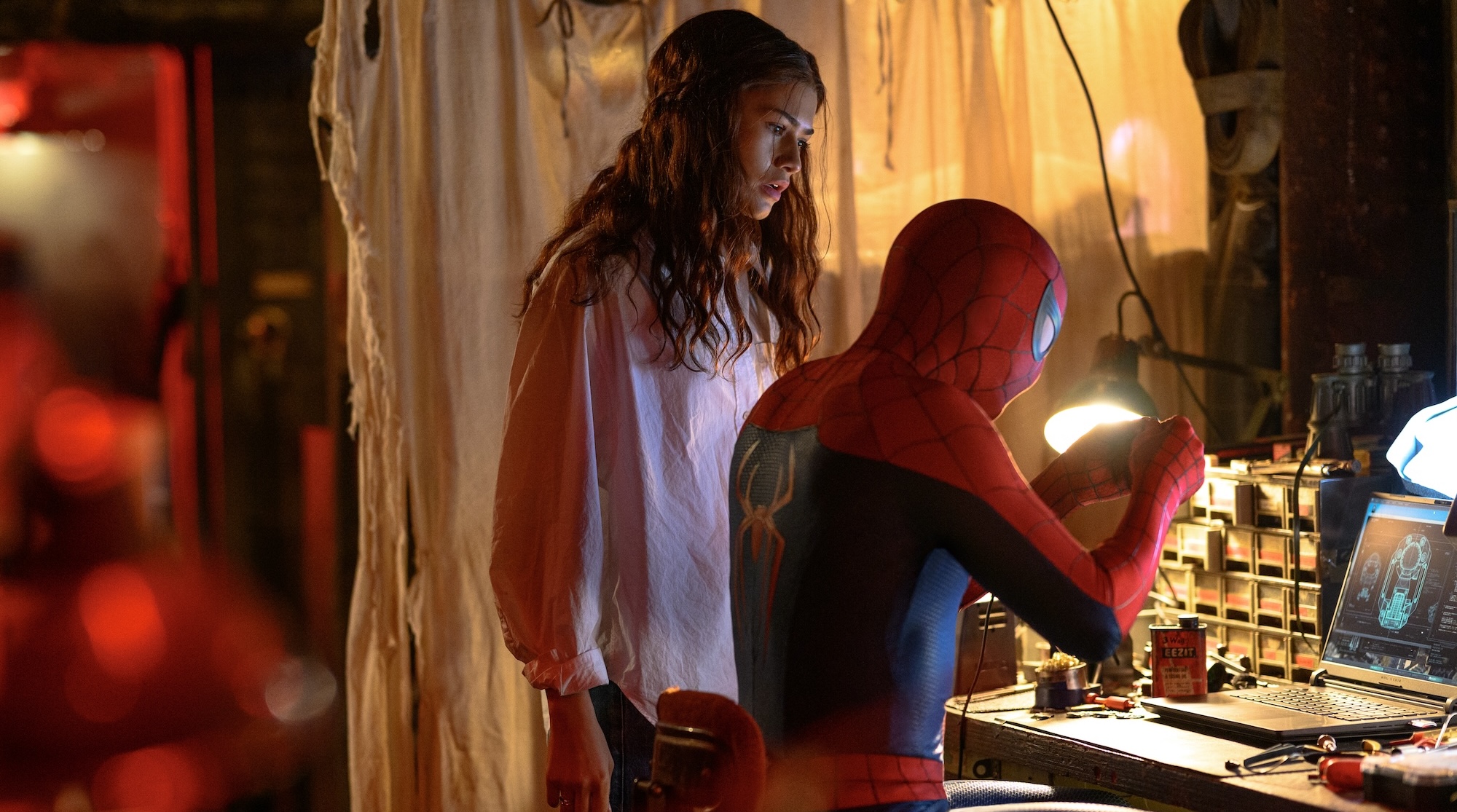
  • Spider-Man: Brand New Day Review – Tom Holland’s Finest Outing in the Mask

    Spider-Man: Brand New Day Review – Tom Holland’s Finest Outing in the Mask

    Of the actors to play Spider-Man on the big screen, Tom Holland has always been the most perfectly cast. A dancer by training, and a gymnast by hobby, he gets the athleticism in a way few other performers have ever attempted. But he also brings the zippy joie de vivre, an exuberance of youth, that […]

    The post Spider-Man: Brand New Day Review – Tom Holland’s Finest Outing in the Mask appeared first on Den of Geek.

    Those pesky killer tomatoes have been quiet for a while, but like many of our cult franchise faves, they were way overdue for a reboot! Enter this year’s Attack of the Killer Tomatoes: Organic Intelligence, a fifth film in the Killer Tomatoes series that follows a young biotech prodigy developing a revolutionary genetically engineered vegetable designed to solve humanity’s problems. Fortunately, for fans of the original 1978 movie and its sequels, the experiment spirals out of control, unleashing a new generation of killer tomatoes upon us.

    cnx.cmd.push(function() {
    cnx({
    playerId: “106e33c0-3911-473c-b599-b1426db57530”,

    }).render(“0270c398a82f44f49c23c16122516796”);
    });

    We caught up with Organic Intelligence stars Dan Bakkedahl, Myrna Velasco, and Noor Razooky at San Diego Comic-Con and discovered that the killer tomato situation has grown much more serious than we realized…

    Den of Geek: How did this project come to your doorstep, and what was your reaction? Was it like “oh, Attack of the Killer Tomatoes! I remember those!”

    Dan Bakkedahl: Well, I was eight when the original film came out, and of course it was a taboo film. It wasn’t something you could go out and rent. You had to go find it, and as a little kid, you weren’t going to be able to, but it was kind of this forbidden fruit for my whole young life, and then I got a phone call a little over a year ago saying, “They’re doing another chapter of the story? Would you be interested? I said, “Absolutely,” because it was from my childhood. You know, it was something that I remember, and then finding out that it had all been true all along was really kind of the kicker for me when I read the script and realized, “oh, this is an attempt to expose the cover-up, to spread the truth about the dangers.” So I thought, “Well, I’ll take a shot.” I hope this doesn’t affect my career trying to get the truth out there, but do what you have to.

    Myrna Velasco: You know, my whole life I’ve been hearing the grumblings of the Tomato movies as well. My parents were very learned vegetable people, if you will. Not people who are made of vegetables, but people who understand vegetables. My father was a gardener, and I grew up really knowing in the back of my mind that tomatoes are out there, and this role was really kind of thrust upon me. I got the first ask to present what I thought would have been the right way to encounter killer tomatoes as a federal vegetable investigator, and the process as an actor is you go through these auditions and callbacks and whatnot, and I was just told, “This is your job now. This is what you have to do. It is your calling.” So I just took on the mantle and am really trying to make it as clear as possible that these vegetables are out here, and it’s not safe.

    Noor Razooky: I play Dr. Angela in the film. I am a marine biologist. I successfully grow tomatoes in salt water. I was essentially born to play this, considering my entire life, my physics teacher father would only show respect to math and science, so it seemed like that was the path I would have to take. I grew my first tomato at a very young age, through seed and soil, traditionally, and I would check on those tomato plants every single day in my childhood bedroom through the blinds.

    I’d watch its progress until one day I heard the sound of gardeners, and a weed whacker engine was roaring and rumbling and shaking my house, and I thought, “Oh my God, something must have gone wrong.” So I went back to my blinds, and I checked through my childhood window, and my tomato plant had gone. Immediately, visceral reaction. My chest got tight, my fingers started to constrict, my heart rate went up, and I was like, “They have no idea what they have done. They have no idea the retaliation that will come after this chopping, this carnage that happened in my backyard.”

    And so I thought to myself, “the safest way to continue growing tomatoes going forward is in the ocean, where there will be no gardeners chopping it down, I’ll have full control over them,” until we realized that these tomatoes are actually plotting and communicating through almost like a fungal mycelium network, and like Dan said earlier, the truth came to me a little bit later. I was in it for the science, not the conspiracy, until …you know, data doesn’t lie.

    This is starting to sound like your classic The Last of Us situation. That’s very troubling, I would say. You’ve mentioned gardeners a couple of times. Where are they in the context of Attack of the Killer Tomatoes? Are they allies in the fight against the tomatoes, or willing collaborators with them?

    Dan Bakkedahl: Look, from eight to 80, we need as many hands as we can get, you know. So, regardless of what you do for a living, it’s your fight too. This is the fight for humanity. I mean, I would imagine that a gardener is going to have a greater knowledge, but he may also have a greater sympathy for these creatures.

    Noor Razooky: Unknowingly.

    Dan Bakkedahl: Yeah, unknowingly, or you know, it might be a conscious bias. But look, the fact of the matter is, if you want to remain on this planet and you’re human, you’ve got to join the fight.

    Noor Razooky: It’s us against them.

    Chilling stuff. Noor, I don’t want to critique your character’s approach, but bringing tomatoes out into the ocean seems kind of counterproductive. Like, you just create hydroponic tomatoes? If anything, it feels like they’d be stronger.

    Noor Razooky: I mean, essentially, but that brings us back to organic intelligence and the evolution of it. Organic intelligence is something we cannot control. It’s evolved over billions and billions of years through adapting to their environments. So, if these tomato plants are just being cut down by weed whackers, they will simply adapt, roll on into the ocean where there are no weed whackers, where they can immerse themselves in a different ecosystem. So you have to roll with the punches in that sense. AI is man-made, and that’s something we can control. We can unplug it if we want to. But organic intelligence, we cannot unplug it. We have to adapt. We have to become organic with them.

    Okay, I think that all makes perfect sense. Dan, can you tell us about your character, Wilbur Finletter?

    Dan Bakkedahl: Yeah, Wilbur Finletter is one of the original characters in this franchise. One of the original combatants in the fight against the tomatoes in the first film, and of course, in this film we find Wilbur has retired. He’s no longer in that. He’s running a pizza shop along with a couple of his former cohorts, and he thinks it’s done, it’s all over, but he doesn’t know about the evolution. This new wrinkle brings Wilbur and his gang out of retirement. You’re scared when you haven’t done something for a while, like if you haven’t ridden a bike in a long time. Sure, you still know how to ride a bike, but are you still as good at it? That’s really the question. And it turns out it takes a little coaxing for Wilbur and his compatriots to get up to speed. But rest assured, they’re ready for the fight.

    Gotcha. So, Attack of the Killer Tomatoes: Organic Intelligence is the fifth iteration in this series of… 

    Myrna Velasco: ….documentaries? 

    Yes, documentaries. So we’re five in. Why do we keep getting our asses handed to us by these tomatoes?

    Myrna Velasco: Because organic intelligence knows no bounds, and you know, much like The Last of Us, you chop a tomato down, and then at the very least, you get 10 more seeds of the enemy that you have to think about and find, and it’s not easy. It’s not an easy job to eradicate the tomato villainry. It’s not, which is again why we need all hands on deck. We need every single person who is willing and capable to stomp a tomato to please make that your mission as a human being.

    Dan Bakkedahl: And to be clear, it’s not all tomatoes. You know, just look out for the bad ones. That’s really what you do. 

    We don’t want to be bigoted against all the tomatoes, but of the “bad tomatoes,” is it limited to like heirloom? Cherry? Is it a whole wide variety we’re dealing with?

    Myrna Velasco: It’s like with everybody. There’s no type of person that is bad, and there’s no one type of tomato that is bad. It really is just the organic intelligence moves through every tomato. I personally believe, and have research to back up, that they are coaxing tomatoes, as well as potentially other vegetables, into badness, into killing. It’s not every tomato, but every type of tomato has one. 

    Dan Bakkedahl: Just know the warning signs. You know, if you see a tomato in a place that it shouldn’t be, if you’re in a public restroom and there’s a tomato in there, you’re probably looking at a killer tomato. 

    Noor Razooky: They probably came from the toilet. They go through these rooting systems through the pipes, and that’s how they communicate; that’s the evolution of their intelligence and their communication networks.

    Context matters. 

    Dan Bakkedahl: Oh, for sure. If you’re about to eat a burger and there’s a slice on there, dig in. Feel no fear. You got a little salad in front of you, and just a couple of little cherry tomatoes on there. No fear.

    Noor Razooky: Certainly. We’re actually in touch with a lot of universities to start adding courses because it starts with the youth, and that’s where the movement really begins. It’s always about education, awareness, and visibility. So that’s our purpose for this film.

    Myrna Velasco: What really comes to mind is: “If you see something, say something.”

    On the the poster of this harrowing documentary, there’s a lot of our nation’s finest character actors who are all identified just by a project that they starred in, and for you, Dan, it just has your face and says Veep,” which I was very appreciative of because I think that happens to be maybe the funniest thing that’s ever existed in the history of humanity.

    Dan Bakkedahl: Thank you very much.

    There is a line that Roger Furlong delivers in that series that I hear running through my head maybe four or five times a day. He’s speaking to Jonah Ryan, who just got assigned his own Secret Service detail because he’s a presidential candidate, and he says, “You’re still likely to get assassinated, but the killer, may God guide his hand, will just have to work a little harder.” I wanted to hear you laugh at that, and I also wanted to ask what it’s like getting to deliver lines like that.

    Dan Bakkedahl: Well, that show was the thrill of a lifetime. You’d get that script, and they’d change it three times before you’d shoot it. So by the time you’re actually finally shooting it, you’re on like your third or fourth iteration of the line, and then once they get it, they would come over with a piece of paper with a bunch of alts on it and say, “Pick one,” and they’re all delicious and horrible things to say. So you kind of got to guide your own destiny in that way. You got to improvise a little bit. You got to choose a little bit. It was a lovely experience. I mean, it was a really hard job. Comedies don’t normally shoot 16-hour days, but that show did on the regular.

    Comedies aren’t even usually that wordy. 

    Dan Bakkedahl: Well, no, that’s the other thing. It’s 50-page scripts, and it’s usually a minute per page. But with Veep, it was a 30-minute show, and the scripts were regularly 50 pages and longer because of the rapid-fire nature of the dialogue, overlapping almost like Mamet, like talking, talking, talking. I’m talking too, and we’re all talking at the same time. 

    Thank you so much for stopping by and telling me about the dangers of these killer tomatoes. 

    Dan Bakkedahl: If you’re not part of the solution, you’re part of the problem. 

    I’ll get the message out as best I can.

    Attack of the Killer Tomatoes: Organic Intelligence is set for a limited release in New York, Los Angeles, Chicago, and San Diego on August 7.

    The post Attack of the Killer Tomatoes: Organic Intelligence Stars Prepare Us for the War on Vegetables appeared first on Den of Geek.

  • 15 Actors Who Became More Famous After 50

    15 Actors Who Became More Famous After 50

    Hollywood often feels obsessed with youth, with the faces in every magazine, blockbuster film or advertisement being a new young celebrity. Life, however, doesn’t work the same way for everyone, and several performers found worldwide fame after what many would consider ‘their prime.’

    Their stories are reminders that persistence can matter just as much as talent, and that a long career doesn’t always mean early fame. These performers became bigger stars after turning 50 than they had ever been before, showing that some of the most memorable chapters in an acting career can arrive surprisingly late.

    The post 15 Actors Who Became More Famous After 50 appeared first on Den of Geek.

    Those pesky killer tomatoes have been quiet for a while, but like many of our cult franchise faves, they were way overdue for a reboot! Enter this year’s Attack of the Killer Tomatoes: Organic Intelligence, a fifth film in the Killer Tomatoes series that follows a young biotech prodigy developing a revolutionary genetically engineered vegetable designed to solve humanity’s problems. Fortunately, for fans of the original 1978 movie and its sequels, the experiment spirals out of control, unleashing a new generation of killer tomatoes upon us.

    cnx.cmd.push(function() {
    cnx({
    playerId: “106e33c0-3911-473c-b599-b1426db57530”,

    }).render(“0270c398a82f44f49c23c16122516796”);
    });

    We caught up with Organic Intelligence stars Dan Bakkedahl, Myrna Velasco, and Noor Razooky at San Diego Comic-Con and discovered that the killer tomato situation has grown much more serious than we realized…

    Den of Geek: How did this project come to your doorstep, and what was your reaction? Was it like “oh, Attack of the Killer Tomatoes! I remember those!”

    Dan Bakkedahl: Well, I was eight when the original film came out, and of course it was a taboo film. It wasn’t something you could go out and rent. You had to go find it, and as a little kid, you weren’t going to be able to, but it was kind of this forbidden fruit for my whole young life, and then I got a phone call a little over a year ago saying, “They’re doing another chapter of the story? Would you be interested? I said, “Absolutely,” because it was from my childhood. You know, it was something that I remember, and then finding out that it had all been true all along was really kind of the kicker for me when I read the script and realized, “oh, this is an attempt to expose the cover-up, to spread the truth about the dangers.” So I thought, “Well, I’ll take a shot.” I hope this doesn’t affect my career trying to get the truth out there, but do what you have to.

    Myrna Velasco: You know, my whole life I’ve been hearing the grumblings of the Tomato movies as well. My parents were very learned vegetable people, if you will. Not people who are made of vegetables, but people who understand vegetables. My father was a gardener, and I grew up really knowing in the back of my mind that tomatoes are out there, and this role was really kind of thrust upon me. I got the first ask to present what I thought would have been the right way to encounter killer tomatoes as a federal vegetable investigator, and the process as an actor is you go through these auditions and callbacks and whatnot, and I was just told, “This is your job now. This is what you have to do. It is your calling.” So I just took on the mantle and am really trying to make it as clear as possible that these vegetables are out here, and it’s not safe.

    Noor Razooky: I play Dr. Angela in the film. I am a marine biologist. I successfully grow tomatoes in salt water. I was essentially born to play this, considering my entire life, my physics teacher father would only show respect to math and science, so it seemed like that was the path I would have to take. I grew my first tomato at a very young age, through seed and soil, traditionally, and I would check on those tomato plants every single day in my childhood bedroom through the blinds.

    I’d watch its progress until one day I heard the sound of gardeners, and a weed whacker engine was roaring and rumbling and shaking my house, and I thought, “Oh my God, something must have gone wrong.” So I went back to my blinds, and I checked through my childhood window, and my tomato plant had gone. Immediately, visceral reaction. My chest got tight, my fingers started to constrict, my heart rate went up, and I was like, “They have no idea what they have done. They have no idea the retaliation that will come after this chopping, this carnage that happened in my backyard.”

    And so I thought to myself, “the safest way to continue growing tomatoes going forward is in the ocean, where there will be no gardeners chopping it down, I’ll have full control over them,” until we realized that these tomatoes are actually plotting and communicating through almost like a fungal mycelium network, and like Dan said earlier, the truth came to me a little bit later. I was in it for the science, not the conspiracy, until …you know, data doesn’t lie.

    This is starting to sound like your classic The Last of Us situation. That’s very troubling, I would say. You’ve mentioned gardeners a couple of times. Where are they in the context of Attack of the Killer Tomatoes? Are they allies in the fight against the tomatoes, or willing collaborators with them?

    Dan Bakkedahl: Look, from eight to 80, we need as many hands as we can get, you know. So, regardless of what you do for a living, it’s your fight too. This is the fight for humanity. I mean, I would imagine that a gardener is going to have a greater knowledge, but he may also have a greater sympathy for these creatures.

    Noor Razooky: Unknowingly.

    Dan Bakkedahl: Yeah, unknowingly, or you know, it might be a conscious bias. But look, the fact of the matter is, if you want to remain on this planet and you’re human, you’ve got to join the fight.

    Noor Razooky: It’s us against them.

    Chilling stuff. Noor, I don’t want to critique your character’s approach, but bringing tomatoes out into the ocean seems kind of counterproductive. Like, you just create hydroponic tomatoes? If anything, it feels like they’d be stronger.

    Noor Razooky: I mean, essentially, but that brings us back to organic intelligence and the evolution of it. Organic intelligence is something we cannot control. It’s evolved over billions and billions of years through adapting to their environments. So, if these tomato plants are just being cut down by weed whackers, they will simply adapt, roll on into the ocean where there are no weed whackers, where they can immerse themselves in a different ecosystem. So you have to roll with the punches in that sense. AI is man-made, and that’s something we can control. We can unplug it if we want to. But organic intelligence, we cannot unplug it. We have to adapt. We have to become organic with them.

    Okay, I think that all makes perfect sense. Dan, can you tell us about your character, Wilbur Finletter?

    Dan Bakkedahl: Yeah, Wilbur Finletter is one of the original characters in this franchise. One of the original combatants in the fight against the tomatoes in the first film, and of course, in this film we find Wilbur has retired. He’s no longer in that. He’s running a pizza shop along with a couple of his former cohorts, and he thinks it’s done, it’s all over, but he doesn’t know about the evolution. This new wrinkle brings Wilbur and his gang out of retirement. You’re scared when you haven’t done something for a while, like if you haven’t ridden a bike in a long time. Sure, you still know how to ride a bike, but are you still as good at it? That’s really the question. And it turns out it takes a little coaxing for Wilbur and his compatriots to get up to speed. But rest assured, they’re ready for the fight.

    Gotcha. So, Attack of the Killer Tomatoes: Organic Intelligence is the fifth iteration in this series of… 

    Myrna Velasco: ….documentaries? 

    Yes, documentaries. So we’re five in. Why do we keep getting our asses handed to us by these tomatoes?

    Myrna Velasco: Because organic intelligence knows no bounds, and you know, much like The Last of Us, you chop a tomato down, and then at the very least, you get 10 more seeds of the enemy that you have to think about and find, and it’s not easy. It’s not an easy job to eradicate the tomato villainry. It’s not, which is again why we need all hands on deck. We need every single person who is willing and capable to stomp a tomato to please make that your mission as a human being.

    Dan Bakkedahl: And to be clear, it’s not all tomatoes. You know, just look out for the bad ones. That’s really what you do. 

    We don’t want to be bigoted against all the tomatoes, but of the “bad tomatoes,” is it limited to like heirloom? Cherry? Is it a whole wide variety we’re dealing with?

    Myrna Velasco: It’s like with everybody. There’s no type of person that is bad, and there’s no one type of tomato that is bad. It really is just the organic intelligence moves through every tomato. I personally believe, and have research to back up, that they are coaxing tomatoes, as well as potentially other vegetables, into badness, into killing. It’s not every tomato, but every type of tomato has one. 

    Dan Bakkedahl: Just know the warning signs. You know, if you see a tomato in a place that it shouldn’t be, if you’re in a public restroom and there’s a tomato in there, you’re probably looking at a killer tomato. 

    Noor Razooky: They probably came from the toilet. They go through these rooting systems through the pipes, and that’s how they communicate; that’s the evolution of their intelligence and their communication networks.

    Context matters. 

    Dan Bakkedahl: Oh, for sure. If you’re about to eat a burger and there’s a slice on there, dig in. Feel no fear. You got a little salad in front of you, and just a couple of little cherry tomatoes on there. No fear.

    Noor Razooky: Certainly. We’re actually in touch with a lot of universities to start adding courses because it starts with the youth, and that’s where the movement really begins. It’s always about education, awareness, and visibility. So that’s our purpose for this film.

    Myrna Velasco: What really comes to mind is: “If you see something, say something.”

    On the the poster of this harrowing documentary, there’s a lot of our nation’s finest character actors who are all identified just by a project that they starred in, and for you, Dan, it just has your face and says Veep,” which I was very appreciative of because I think that happens to be maybe the funniest thing that’s ever existed in the history of humanity.

    Dan Bakkedahl: Thank you very much.

    There is a line that Roger Furlong delivers in that series that I hear running through my head maybe four or five times a day. He’s speaking to Jonah Ryan, who just got assigned his own Secret Service detail because he’s a presidential candidate, and he says, “You’re still likely to get assassinated, but the killer, may God guide his hand, will just have to work a little harder.” I wanted to hear you laugh at that, and I also wanted to ask what it’s like getting to deliver lines like that.

    Dan Bakkedahl: Well, that show was the thrill of a lifetime. You’d get that script, and they’d change it three times before you’d shoot it. So by the time you’re actually finally shooting it, you’re on like your third or fourth iteration of the line, and then once they get it, they would come over with a piece of paper with a bunch of alts on it and say, “Pick one,” and they’re all delicious and horrible things to say. So you kind of got to guide your own destiny in that way. You got to improvise a little bit. You got to choose a little bit. It was a lovely experience. I mean, it was a really hard job. Comedies don’t normally shoot 16-hour days, but that show did on the regular.

    Comedies aren’t even usually that wordy. 

    Dan Bakkedahl: Well, no, that’s the other thing. It’s 50-page scripts, and it’s usually a minute per page. But with Veep, it was a 30-minute show, and the scripts were regularly 50 pages and longer because of the rapid-fire nature of the dialogue, overlapping almost like Mamet, like talking, talking, talking. I’m talking too, and we’re all talking at the same time. 

    Thank you so much for stopping by and telling me about the dangers of these killer tomatoes. 

    Dan Bakkedahl: If you’re not part of the solution, you’re part of the problem. 

    I’ll get the message out as best I can.

    Attack of the Killer Tomatoes: Organic Intelligence is set for a limited release in New York, Los Angeles, Chicago, and San Diego on August 7.

    The post Attack of the Killer Tomatoes: Organic Intelligence Stars Prepare Us for the War on Vegetables appeared first on Den of Geek.

  • 14 of the Funniest Jokes from “Blades of Glory”

    14 of the Funniest Jokes from “Blades of Glory”

    Some comedies rely on clever dialogue, while others get the biggest laughs from complete absurdity. Blades of Glory somehow manages to do both. The movie throws together ridiculous characters, over-the-top rivalries, outrageous costumes, and just enough surprisingly impressive skating to make the whole thing work. Years later, many fans still remember individual scenes long before they remember the competition itself. That’s usually a good sign a comedy got something right.

    Here are 15 of the funniest jokes from Blades of Glory.

    The post 14 of the Funniest Jokes from “Blades of Glory” appeared first on Den of Geek.

    Those pesky killer tomatoes have been quiet for a while, but like many of our cult franchise faves, they were way overdue for a reboot! Enter this year’s Attack of the Killer Tomatoes: Organic Intelligence, a fifth film in the Killer Tomatoes series that follows a young biotech prodigy developing a revolutionary genetically engineered vegetable designed to solve humanity’s problems. Fortunately, for fans of the original 1978 movie and its sequels, the experiment spirals out of control, unleashing a new generation of killer tomatoes upon us.

    cnx.cmd.push(function() {
    cnx({
    playerId: “106e33c0-3911-473c-b599-b1426db57530”,

    }).render(“0270c398a82f44f49c23c16122516796”);
    });

    We caught up with Organic Intelligence stars Dan Bakkedahl, Myrna Velasco, and Noor Razooky at San Diego Comic-Con and discovered that the killer tomato situation has grown much more serious than we realized…

    Den of Geek: How did this project come to your doorstep, and what was your reaction? Was it like “oh, Attack of the Killer Tomatoes! I remember those!”

    Dan Bakkedahl: Well, I was eight when the original film came out, and of course it was a taboo film. It wasn’t something you could go out and rent. You had to go find it, and as a little kid, you weren’t going to be able to, but it was kind of this forbidden fruit for my whole young life, and then I got a phone call a little over a year ago saying, “They’re doing another chapter of the story? Would you be interested? I said, “Absolutely,” because it was from my childhood. You know, it was something that I remember, and then finding out that it had all been true all along was really kind of the kicker for me when I read the script and realized, “oh, this is an attempt to expose the cover-up, to spread the truth about the dangers.” So I thought, “Well, I’ll take a shot.” I hope this doesn’t affect my career trying to get the truth out there, but do what you have to.

    Myrna Velasco: You know, my whole life I’ve been hearing the grumblings of the Tomato movies as well. My parents were very learned vegetable people, if you will. Not people who are made of vegetables, but people who understand vegetables. My father was a gardener, and I grew up really knowing in the back of my mind that tomatoes are out there, and this role was really kind of thrust upon me. I got the first ask to present what I thought would have been the right way to encounter killer tomatoes as a federal vegetable investigator, and the process as an actor is you go through these auditions and callbacks and whatnot, and I was just told, “This is your job now. This is what you have to do. It is your calling.” So I just took on the mantle and am really trying to make it as clear as possible that these vegetables are out here, and it’s not safe.

    Noor Razooky: I play Dr. Angela in the film. I am a marine biologist. I successfully grow tomatoes in salt water. I was essentially born to play this, considering my entire life, my physics teacher father would only show respect to math and science, so it seemed like that was the path I would have to take. I grew my first tomato at a very young age, through seed and soil, traditionally, and I would check on those tomato plants every single day in my childhood bedroom through the blinds.

    I’d watch its progress until one day I heard the sound of gardeners, and a weed whacker engine was roaring and rumbling and shaking my house, and I thought, “Oh my God, something must have gone wrong.” So I went back to my blinds, and I checked through my childhood window, and my tomato plant had gone. Immediately, visceral reaction. My chest got tight, my fingers started to constrict, my heart rate went up, and I was like, “They have no idea what they have done. They have no idea the retaliation that will come after this chopping, this carnage that happened in my backyard.”

    And so I thought to myself, “the safest way to continue growing tomatoes going forward is in the ocean, where there will be no gardeners chopping it down, I’ll have full control over them,” until we realized that these tomatoes are actually plotting and communicating through almost like a fungal mycelium network, and like Dan said earlier, the truth came to me a little bit later. I was in it for the science, not the conspiracy, until …you know, data doesn’t lie.

    This is starting to sound like your classic The Last of Us situation. That’s very troubling, I would say. You’ve mentioned gardeners a couple of times. Where are they in the context of Attack of the Killer Tomatoes? Are they allies in the fight against the tomatoes, or willing collaborators with them?

    Dan Bakkedahl: Look, from eight to 80, we need as many hands as we can get, you know. So, regardless of what you do for a living, it’s your fight too. This is the fight for humanity. I mean, I would imagine that a gardener is going to have a greater knowledge, but he may also have a greater sympathy for these creatures.

    Noor Razooky: Unknowingly.

    Dan Bakkedahl: Yeah, unknowingly, or you know, it might be a conscious bias. But look, the fact of the matter is, if you want to remain on this planet and you’re human, you’ve got to join the fight.

    Noor Razooky: It’s us against them.

    Chilling stuff. Noor, I don’t want to critique your character’s approach, but bringing tomatoes out into the ocean seems kind of counterproductive. Like, you just create hydroponic tomatoes? If anything, it feels like they’d be stronger.

    Noor Razooky: I mean, essentially, but that brings us back to organic intelligence and the evolution of it. Organic intelligence is something we cannot control. It’s evolved over billions and billions of years through adapting to their environments. So, if these tomato plants are just being cut down by weed whackers, they will simply adapt, roll on into the ocean where there are no weed whackers, where they can immerse themselves in a different ecosystem. So you have to roll with the punches in that sense. AI is man-made, and that’s something we can control. We can unplug it if we want to. But organic intelligence, we cannot unplug it. We have to adapt. We have to become organic with them.

    Okay, I think that all makes perfect sense. Dan, can you tell us about your character, Wilbur Finletter?

    Dan Bakkedahl: Yeah, Wilbur Finletter is one of the original characters in this franchise. One of the original combatants in the fight against the tomatoes in the first film, and of course, in this film we find Wilbur has retired. He’s no longer in that. He’s running a pizza shop along with a couple of his former cohorts, and he thinks it’s done, it’s all over, but he doesn’t know about the evolution. This new wrinkle brings Wilbur and his gang out of retirement. You’re scared when you haven’t done something for a while, like if you haven’t ridden a bike in a long time. Sure, you still know how to ride a bike, but are you still as good at it? That’s really the question. And it turns out it takes a little coaxing for Wilbur and his compatriots to get up to speed. But rest assured, they’re ready for the fight.

    Gotcha. So, Attack of the Killer Tomatoes: Organic Intelligence is the fifth iteration in this series of… 

    Myrna Velasco: ….documentaries? 

    Yes, documentaries. So we’re five in. Why do we keep getting our asses handed to us by these tomatoes?

    Myrna Velasco: Because organic intelligence knows no bounds, and you know, much like The Last of Us, you chop a tomato down, and then at the very least, you get 10 more seeds of the enemy that you have to think about and find, and it’s not easy. It’s not an easy job to eradicate the tomato villainry. It’s not, which is again why we need all hands on deck. We need every single person who is willing and capable to stomp a tomato to please make that your mission as a human being.

    Dan Bakkedahl: And to be clear, it’s not all tomatoes. You know, just look out for the bad ones. That’s really what you do. 

    We don’t want to be bigoted against all the tomatoes, but of the “bad tomatoes,” is it limited to like heirloom? Cherry? Is it a whole wide variety we’re dealing with?

    Myrna Velasco: It’s like with everybody. There’s no type of person that is bad, and there’s no one type of tomato that is bad. It really is just the organic intelligence moves through every tomato. I personally believe, and have research to back up, that they are coaxing tomatoes, as well as potentially other vegetables, into badness, into killing. It’s not every tomato, but every type of tomato has one. 

    Dan Bakkedahl: Just know the warning signs. You know, if you see a tomato in a place that it shouldn’t be, if you’re in a public restroom and there’s a tomato in there, you’re probably looking at a killer tomato. 

    Noor Razooky: They probably came from the toilet. They go through these rooting systems through the pipes, and that’s how they communicate; that’s the evolution of their intelligence and their communication networks.

    Context matters. 

    Dan Bakkedahl: Oh, for sure. If you’re about to eat a burger and there’s a slice on there, dig in. Feel no fear. You got a little salad in front of you, and just a couple of little cherry tomatoes on there. No fear.

    Noor Razooky: Certainly. We’re actually in touch with a lot of universities to start adding courses because it starts with the youth, and that’s where the movement really begins. It’s always about education, awareness, and visibility. So that’s our purpose for this film.

    Myrna Velasco: What really comes to mind is: “If you see something, say something.”

    On the the poster of this harrowing documentary, there’s a lot of our nation’s finest character actors who are all identified just by a project that they starred in, and for you, Dan, it just has your face and says Veep,” which I was very appreciative of because I think that happens to be maybe the funniest thing that’s ever existed in the history of humanity.

    Dan Bakkedahl: Thank you very much.

    There is a line that Roger Furlong delivers in that series that I hear running through my head maybe four or five times a day. He’s speaking to Jonah Ryan, who just got assigned his own Secret Service detail because he’s a presidential candidate, and he says, “You’re still likely to get assassinated, but the killer, may God guide his hand, will just have to work a little harder.” I wanted to hear you laugh at that, and I also wanted to ask what it’s like getting to deliver lines like that.

    Dan Bakkedahl: Well, that show was the thrill of a lifetime. You’d get that script, and they’d change it three times before you’d shoot it. So by the time you’re actually finally shooting it, you’re on like your third or fourth iteration of the line, and then once they get it, they would come over with a piece of paper with a bunch of alts on it and say, “Pick one,” and they’re all delicious and horrible things to say. So you kind of got to guide your own destiny in that way. You got to improvise a little bit. You got to choose a little bit. It was a lovely experience. I mean, it was a really hard job. Comedies don’t normally shoot 16-hour days, but that show did on the regular.

    Comedies aren’t even usually that wordy. 

    Dan Bakkedahl: Well, no, that’s the other thing. It’s 50-page scripts, and it’s usually a minute per page. But with Veep, it was a 30-minute show, and the scripts were regularly 50 pages and longer because of the rapid-fire nature of the dialogue, overlapping almost like Mamet, like talking, talking, talking. I’m talking too, and we’re all talking at the same time. 

    Thank you so much for stopping by and telling me about the dangers of these killer tomatoes. 

    Dan Bakkedahl: If you’re not part of the solution, you’re part of the problem. 

    I’ll get the message out as best I can.

    Attack of the Killer Tomatoes: Organic Intelligence is set for a limited release in New York, Los Angeles, Chicago, and San Diego on August 7.

    The post Attack of the Killer Tomatoes: Organic Intelligence Stars Prepare Us for the War on Vegetables appeared first on Den of Geek.

  • 15 Nerds Share Their ‘Fun’ Facts Nobody Asked For

    15 Nerds Share Their ‘Fun’ Facts Nobody Asked For

    Nerds come in all shapes and sizes, bringing up ‘fun facts’ about history, wildlife and everything in between. Reddit users get together from time to time to share their little factoids with the world, letting us know all kinds of things to be all the rage at parties.

    The results ranged from strange animal biology and forgotten history to surprising facts about famous people and unusual scientific discoveries. Some are genuinely useful, others are simply fascinating, but they’re all the kind of trivia that sticks in your brain far longer than expected.

    The post 15 Nerds Share Their ‘Fun’ Facts Nobody Asked For appeared first on Den of Geek.

    Those pesky killer tomatoes have been quiet for a while, but like many of our cult franchise faves, they were way overdue for a reboot! Enter this year’s Attack of the Killer Tomatoes: Organic Intelligence, a fifth film in the Killer Tomatoes series that follows a young biotech prodigy developing a revolutionary genetically engineered vegetable designed to solve humanity’s problems. Fortunately, for fans of the original 1978 movie and its sequels, the experiment spirals out of control, unleashing a new generation of killer tomatoes upon us.

    cnx.cmd.push(function() {
    cnx({
    playerId: “106e33c0-3911-473c-b599-b1426db57530”,

    }).render(“0270c398a82f44f49c23c16122516796”);
    });

    We caught up with Organic Intelligence stars Dan Bakkedahl, Myrna Velasco, and Noor Razooky at San Diego Comic-Con and discovered that the killer tomato situation has grown much more serious than we realized…

    Den of Geek: How did this project come to your doorstep, and what was your reaction? Was it like “oh, Attack of the Killer Tomatoes! I remember those!”

    Dan Bakkedahl: Well, I was eight when the original film came out, and of course it was a taboo film. It wasn’t something you could go out and rent. You had to go find it, and as a little kid, you weren’t going to be able to, but it was kind of this forbidden fruit for my whole young life, and then I got a phone call a little over a year ago saying, “They’re doing another chapter of the story? Would you be interested? I said, “Absolutely,” because it was from my childhood. You know, it was something that I remember, and then finding out that it had all been true all along was really kind of the kicker for me when I read the script and realized, “oh, this is an attempt to expose the cover-up, to spread the truth about the dangers.” So I thought, “Well, I’ll take a shot.” I hope this doesn’t affect my career trying to get the truth out there, but do what you have to.

    Myrna Velasco: You know, my whole life I’ve been hearing the grumblings of the Tomato movies as well. My parents were very learned vegetable people, if you will. Not people who are made of vegetables, but people who understand vegetables. My father was a gardener, and I grew up really knowing in the back of my mind that tomatoes are out there, and this role was really kind of thrust upon me. I got the first ask to present what I thought would have been the right way to encounter killer tomatoes as a federal vegetable investigator, and the process as an actor is you go through these auditions and callbacks and whatnot, and I was just told, “This is your job now. This is what you have to do. It is your calling.” So I just took on the mantle and am really trying to make it as clear as possible that these vegetables are out here, and it’s not safe.

    Noor Razooky: I play Dr. Angela in the film. I am a marine biologist. I successfully grow tomatoes in salt water. I was essentially born to play this, considering my entire life, my physics teacher father would only show respect to math and science, so it seemed like that was the path I would have to take. I grew my first tomato at a very young age, through seed and soil, traditionally, and I would check on those tomato plants every single day in my childhood bedroom through the blinds.

    I’d watch its progress until one day I heard the sound of gardeners, and a weed whacker engine was roaring and rumbling and shaking my house, and I thought, “Oh my God, something must have gone wrong.” So I went back to my blinds, and I checked through my childhood window, and my tomato plant had gone. Immediately, visceral reaction. My chest got tight, my fingers started to constrict, my heart rate went up, and I was like, “They have no idea what they have done. They have no idea the retaliation that will come after this chopping, this carnage that happened in my backyard.”

    And so I thought to myself, “the safest way to continue growing tomatoes going forward is in the ocean, where there will be no gardeners chopping it down, I’ll have full control over them,” until we realized that these tomatoes are actually plotting and communicating through almost like a fungal mycelium network, and like Dan said earlier, the truth came to me a little bit later. I was in it for the science, not the conspiracy, until …you know, data doesn’t lie.

    This is starting to sound like your classic The Last of Us situation. That’s very troubling, I would say. You’ve mentioned gardeners a couple of times. Where are they in the context of Attack of the Killer Tomatoes? Are they allies in the fight against the tomatoes, or willing collaborators with them?

    Dan Bakkedahl: Look, from eight to 80, we need as many hands as we can get, you know. So, regardless of what you do for a living, it’s your fight too. This is the fight for humanity. I mean, I would imagine that a gardener is going to have a greater knowledge, but he may also have a greater sympathy for these creatures.

    Noor Razooky: Unknowingly.

    Dan Bakkedahl: Yeah, unknowingly, or you know, it might be a conscious bias. But look, the fact of the matter is, if you want to remain on this planet and you’re human, you’ve got to join the fight.

    Noor Razooky: It’s us against them.

    Chilling stuff. Noor, I don’t want to critique your character’s approach, but bringing tomatoes out into the ocean seems kind of counterproductive. Like, you just create hydroponic tomatoes? If anything, it feels like they’d be stronger.

    Noor Razooky: I mean, essentially, but that brings us back to organic intelligence and the evolution of it. Organic intelligence is something we cannot control. It’s evolved over billions and billions of years through adapting to their environments. So, if these tomato plants are just being cut down by weed whackers, they will simply adapt, roll on into the ocean where there are no weed whackers, where they can immerse themselves in a different ecosystem. So you have to roll with the punches in that sense. AI is man-made, and that’s something we can control. We can unplug it if we want to. But organic intelligence, we cannot unplug it. We have to adapt. We have to become organic with them.

    Okay, I think that all makes perfect sense. Dan, can you tell us about your character, Wilbur Finletter?

    Dan Bakkedahl: Yeah, Wilbur Finletter is one of the original characters in this franchise. One of the original combatants in the fight against the tomatoes in the first film, and of course, in this film we find Wilbur has retired. He’s no longer in that. He’s running a pizza shop along with a couple of his former cohorts, and he thinks it’s done, it’s all over, but he doesn’t know about the evolution. This new wrinkle brings Wilbur and his gang out of retirement. You’re scared when you haven’t done something for a while, like if you haven’t ridden a bike in a long time. Sure, you still know how to ride a bike, but are you still as good at it? That’s really the question. And it turns out it takes a little coaxing for Wilbur and his compatriots to get up to speed. But rest assured, they’re ready for the fight.

    Gotcha. So, Attack of the Killer Tomatoes: Organic Intelligence is the fifth iteration in this series of… 

    Myrna Velasco: ….documentaries? 

    Yes, documentaries. So we’re five in. Why do we keep getting our asses handed to us by these tomatoes?

    Myrna Velasco: Because organic intelligence knows no bounds, and you know, much like The Last of Us, you chop a tomato down, and then at the very least, you get 10 more seeds of the enemy that you have to think about and find, and it’s not easy. It’s not an easy job to eradicate the tomato villainry. It’s not, which is again why we need all hands on deck. We need every single person who is willing and capable to stomp a tomato to please make that your mission as a human being.

    Dan Bakkedahl: And to be clear, it’s not all tomatoes. You know, just look out for the bad ones. That’s really what you do. 

    We don’t want to be bigoted against all the tomatoes, but of the “bad tomatoes,” is it limited to like heirloom? Cherry? Is it a whole wide variety we’re dealing with?

    Myrna Velasco: It’s like with everybody. There’s no type of person that is bad, and there’s no one type of tomato that is bad. It really is just the organic intelligence moves through every tomato. I personally believe, and have research to back up, that they are coaxing tomatoes, as well as potentially other vegetables, into badness, into killing. It’s not every tomato, but every type of tomato has one. 

    Dan Bakkedahl: Just know the warning signs. You know, if you see a tomato in a place that it shouldn’t be, if you’re in a public restroom and there’s a tomato in there, you’re probably looking at a killer tomato. 

    Noor Razooky: They probably came from the toilet. They go through these rooting systems through the pipes, and that’s how they communicate; that’s the evolution of their intelligence and their communication networks.

    Context matters. 

    Dan Bakkedahl: Oh, for sure. If you’re about to eat a burger and there’s a slice on there, dig in. Feel no fear. You got a little salad in front of you, and just a couple of little cherry tomatoes on there. No fear.

    Noor Razooky: Certainly. We’re actually in touch with a lot of universities to start adding courses because it starts with the youth, and that’s where the movement really begins. It’s always about education, awareness, and visibility. So that’s our purpose for this film.

    Myrna Velasco: What really comes to mind is: “If you see something, say something.”

    On the the poster of this harrowing documentary, there’s a lot of our nation’s finest character actors who are all identified just by a project that they starred in, and for you, Dan, it just has your face and says Veep,” which I was very appreciative of because I think that happens to be maybe the funniest thing that’s ever existed in the history of humanity.

    Dan Bakkedahl: Thank you very much.

    There is a line that Roger Furlong delivers in that series that I hear running through my head maybe four or five times a day. He’s speaking to Jonah Ryan, who just got assigned his own Secret Service detail because he’s a presidential candidate, and he says, “You’re still likely to get assassinated, but the killer, may God guide his hand, will just have to work a little harder.” I wanted to hear you laugh at that, and I also wanted to ask what it’s like getting to deliver lines like that.

    Dan Bakkedahl: Well, that show was the thrill of a lifetime. You’d get that script, and they’d change it three times before you’d shoot it. So by the time you’re actually finally shooting it, you’re on like your third or fourth iteration of the line, and then once they get it, they would come over with a piece of paper with a bunch of alts on it and say, “Pick one,” and they’re all delicious and horrible things to say. So you kind of got to guide your own destiny in that way. You got to improvise a little bit. You got to choose a little bit. It was a lovely experience. I mean, it was a really hard job. Comedies don’t normally shoot 16-hour days, but that show did on the regular.

    Comedies aren’t even usually that wordy. 

    Dan Bakkedahl: Well, no, that’s the other thing. It’s 50-page scripts, and it’s usually a minute per page. But with Veep, it was a 30-minute show, and the scripts were regularly 50 pages and longer because of the rapid-fire nature of the dialogue, overlapping almost like Mamet, like talking, talking, talking. I’m talking too, and we’re all talking at the same time. 

    Thank you so much for stopping by and telling me about the dangers of these killer tomatoes. 

    Dan Bakkedahl: If you’re not part of the solution, you’re part of the problem. 

    I’ll get the message out as best I can.

    Attack of the Killer Tomatoes: Organic Intelligence is set for a limited release in New York, Los Angeles, Chicago, and San Diego on August 7.

    The post Attack of the Killer Tomatoes: Organic Intelligence Stars Prepare Us for the War on Vegetables appeared first on Den of Geek.

  • 15 Boss Fights Everyone Cheese’d Instead of Beating Normally

    15 Boss Fights Everyone Cheese’d Instead of Beating Normally

    Boss fights in video games are the culmination of the game’s systems, testing everything you’ve learned in a final clash for survival. If you can’t cheese it, that is, or find a way to bypass a lot of what makes the fight difficult. You may wonder why anyone would do that, since it essentially takes away from the experience of the game, but gamers have their reasons.

    Not all of us have all the time in the world to master a game’s system, let alone beat its hardest moments, but we still want the feeling of satisfaction from doing every task in a game. How the task was achieved isn’t relevant for everyone, and these are the fights most gamers cheese if they can.

    The post 15 Boss Fights Everyone Cheese’d Instead of Beating Normally appeared first on Den of Geek.

    Those pesky killer tomatoes have been quiet for a while, but like many of our cult franchise faves, they were way overdue for a reboot! Enter this year’s Attack of the Killer Tomatoes: Organic Intelligence, a fifth film in the Killer Tomatoes series that follows a young biotech prodigy developing a revolutionary genetically engineered vegetable designed to solve humanity’s problems. Fortunately, for fans of the original 1978 movie and its sequels, the experiment spirals out of control, unleashing a new generation of killer tomatoes upon us.

    cnx.cmd.push(function() {
    cnx({
    playerId: “106e33c0-3911-473c-b599-b1426db57530”,

    }).render(“0270c398a82f44f49c23c16122516796”);
    });

    We caught up with Organic Intelligence stars Dan Bakkedahl, Myrna Velasco, and Noor Razooky at San Diego Comic-Con and discovered that the killer tomato situation has grown much more serious than we realized…

    Den of Geek: How did this project come to your doorstep, and what was your reaction? Was it like “oh, Attack of the Killer Tomatoes! I remember those!”

    Dan Bakkedahl: Well, I was eight when the original film came out, and of course it was a taboo film. It wasn’t something you could go out and rent. You had to go find it, and as a little kid, you weren’t going to be able to, but it was kind of this forbidden fruit for my whole young life, and then I got a phone call a little over a year ago saying, “They’re doing another chapter of the story? Would you be interested? I said, “Absolutely,” because it was from my childhood. You know, it was something that I remember, and then finding out that it had all been true all along was really kind of the kicker for me when I read the script and realized, “oh, this is an attempt to expose the cover-up, to spread the truth about the dangers.” So I thought, “Well, I’ll take a shot.” I hope this doesn’t affect my career trying to get the truth out there, but do what you have to.

    Myrna Velasco: You know, my whole life I’ve been hearing the grumblings of the Tomato movies as well. My parents were very learned vegetable people, if you will. Not people who are made of vegetables, but people who understand vegetables. My father was a gardener, and I grew up really knowing in the back of my mind that tomatoes are out there, and this role was really kind of thrust upon me. I got the first ask to present what I thought would have been the right way to encounter killer tomatoes as a federal vegetable investigator, and the process as an actor is you go through these auditions and callbacks and whatnot, and I was just told, “This is your job now. This is what you have to do. It is your calling.” So I just took on the mantle and am really trying to make it as clear as possible that these vegetables are out here, and it’s not safe.

    Noor Razooky: I play Dr. Angela in the film. I am a marine biologist. I successfully grow tomatoes in salt water. I was essentially born to play this, considering my entire life, my physics teacher father would only show respect to math and science, so it seemed like that was the path I would have to take. I grew my first tomato at a very young age, through seed and soil, traditionally, and I would check on those tomato plants every single day in my childhood bedroom through the blinds.

    I’d watch its progress until one day I heard the sound of gardeners, and a weed whacker engine was roaring and rumbling and shaking my house, and I thought, “Oh my God, something must have gone wrong.” So I went back to my blinds, and I checked through my childhood window, and my tomato plant had gone. Immediately, visceral reaction. My chest got tight, my fingers started to constrict, my heart rate went up, and I was like, “They have no idea what they have done. They have no idea the retaliation that will come after this chopping, this carnage that happened in my backyard.”

    And so I thought to myself, “the safest way to continue growing tomatoes going forward is in the ocean, where there will be no gardeners chopping it down, I’ll have full control over them,” until we realized that these tomatoes are actually plotting and communicating through almost like a fungal mycelium network, and like Dan said earlier, the truth came to me a little bit later. I was in it for the science, not the conspiracy, until …you know, data doesn’t lie.

    This is starting to sound like your classic The Last of Us situation. That’s very troubling, I would say. You’ve mentioned gardeners a couple of times. Where are they in the context of Attack of the Killer Tomatoes? Are they allies in the fight against the tomatoes, or willing collaborators with them?

    Dan Bakkedahl: Look, from eight to 80, we need as many hands as we can get, you know. So, regardless of what you do for a living, it’s your fight too. This is the fight for humanity. I mean, I would imagine that a gardener is going to have a greater knowledge, but he may also have a greater sympathy for these creatures.

    Noor Razooky: Unknowingly.

    Dan Bakkedahl: Yeah, unknowingly, or you know, it might be a conscious bias. But look, the fact of the matter is, if you want to remain on this planet and you’re human, you’ve got to join the fight.

    Noor Razooky: It’s us against them.

    Chilling stuff. Noor, I don’t want to critique your character’s approach, but bringing tomatoes out into the ocean seems kind of counterproductive. Like, you just create hydroponic tomatoes? If anything, it feels like they’d be stronger.

    Noor Razooky: I mean, essentially, but that brings us back to organic intelligence and the evolution of it. Organic intelligence is something we cannot control. It’s evolved over billions and billions of years through adapting to their environments. So, if these tomato plants are just being cut down by weed whackers, they will simply adapt, roll on into the ocean where there are no weed whackers, where they can immerse themselves in a different ecosystem. So you have to roll with the punches in that sense. AI is man-made, and that’s something we can control. We can unplug it if we want to. But organic intelligence, we cannot unplug it. We have to adapt. We have to become organic with them.

    Okay, I think that all makes perfect sense. Dan, can you tell us about your character, Wilbur Finletter?

    Dan Bakkedahl: Yeah, Wilbur Finletter is one of the original characters in this franchise. One of the original combatants in the fight against the tomatoes in the first film, and of course, in this film we find Wilbur has retired. He’s no longer in that. He’s running a pizza shop along with a couple of his former cohorts, and he thinks it’s done, it’s all over, but he doesn’t know about the evolution. This new wrinkle brings Wilbur and his gang out of retirement. You’re scared when you haven’t done something for a while, like if you haven’t ridden a bike in a long time. Sure, you still know how to ride a bike, but are you still as good at it? That’s really the question. And it turns out it takes a little coaxing for Wilbur and his compatriots to get up to speed. But rest assured, they’re ready for the fight.

    Gotcha. So, Attack of the Killer Tomatoes: Organic Intelligence is the fifth iteration in this series of… 

    Myrna Velasco: ….documentaries? 

    Yes, documentaries. So we’re five in. Why do we keep getting our asses handed to us by these tomatoes?

    Myrna Velasco: Because organic intelligence knows no bounds, and you know, much like The Last of Us, you chop a tomato down, and then at the very least, you get 10 more seeds of the enemy that you have to think about and find, and it’s not easy. It’s not an easy job to eradicate the tomato villainry. It’s not, which is again why we need all hands on deck. We need every single person who is willing and capable to stomp a tomato to please make that your mission as a human being.

    Dan Bakkedahl: And to be clear, it’s not all tomatoes. You know, just look out for the bad ones. That’s really what you do. 

    We don’t want to be bigoted against all the tomatoes, but of the “bad tomatoes,” is it limited to like heirloom? Cherry? Is it a whole wide variety we’re dealing with?

    Myrna Velasco: It’s like with everybody. There’s no type of person that is bad, and there’s no one type of tomato that is bad. It really is just the organic intelligence moves through every tomato. I personally believe, and have research to back up, that they are coaxing tomatoes, as well as potentially other vegetables, into badness, into killing. It’s not every tomato, but every type of tomato has one. 

    Dan Bakkedahl: Just know the warning signs. You know, if you see a tomato in a place that it shouldn’t be, if you’re in a public restroom and there’s a tomato in there, you’re probably looking at a killer tomato. 

    Noor Razooky: They probably came from the toilet. They go through these rooting systems through the pipes, and that’s how they communicate; that’s the evolution of their intelligence and their communication networks.

    Context matters. 

    Dan Bakkedahl: Oh, for sure. If you’re about to eat a burger and there’s a slice on there, dig in. Feel no fear. You got a little salad in front of you, and just a couple of little cherry tomatoes on there. No fear.

    Noor Razooky: Certainly. We’re actually in touch with a lot of universities to start adding courses because it starts with the youth, and that’s where the movement really begins. It’s always about education, awareness, and visibility. So that’s our purpose for this film.

    Myrna Velasco: What really comes to mind is: “If you see something, say something.”

    On the the poster of this harrowing documentary, there’s a lot of our nation’s finest character actors who are all identified just by a project that they starred in, and for you, Dan, it just has your face and says Veep,” which I was very appreciative of because I think that happens to be maybe the funniest thing that’s ever existed in the history of humanity.

    Dan Bakkedahl: Thank you very much.

    There is a line that Roger Furlong delivers in that series that I hear running through my head maybe four or five times a day. He’s speaking to Jonah Ryan, who just got assigned his own Secret Service detail because he’s a presidential candidate, and he says, “You’re still likely to get assassinated, but the killer, may God guide his hand, will just have to work a little harder.” I wanted to hear you laugh at that, and I also wanted to ask what it’s like getting to deliver lines like that.

    Dan Bakkedahl: Well, that show was the thrill of a lifetime. You’d get that script, and they’d change it three times before you’d shoot it. So by the time you’re actually finally shooting it, you’re on like your third or fourth iteration of the line, and then once they get it, they would come over with a piece of paper with a bunch of alts on it and say, “Pick one,” and they’re all delicious and horrible things to say. So you kind of got to guide your own destiny in that way. You got to improvise a little bit. You got to choose a little bit. It was a lovely experience. I mean, it was a really hard job. Comedies don’t normally shoot 16-hour days, but that show did on the regular.

    Comedies aren’t even usually that wordy. 

    Dan Bakkedahl: Well, no, that’s the other thing. It’s 50-page scripts, and it’s usually a minute per page. But with Veep, it was a 30-minute show, and the scripts were regularly 50 pages and longer because of the rapid-fire nature of the dialogue, overlapping almost like Mamet, like talking, talking, talking. I’m talking too, and we’re all talking at the same time. 

    Thank you so much for stopping by and telling me about the dangers of these killer tomatoes. 

    Dan Bakkedahl: If you’re not part of the solution, you’re part of the problem. 

    I’ll get the message out as best I can.

    Attack of the Killer Tomatoes: Organic Intelligence is set for a limited release in New York, Los Angeles, Chicago, and San Diego on August 7.

    The post Attack of the Killer Tomatoes: Organic Intelligence Stars Prepare Us for the War on Vegetables appeared first on Den of Geek.