Category: Blog

Your blog category

  • Design Dialects: Breaking the Rules, Not the System

    Design Dialects: Breaking the Rules, Not the System

    “Language is not merely a set of unrelated sounds, clauses, rules, and meanings; it is a totally coherent system bound to context and behavior.” — Kenneth L. Pike

    The web has accents. So should our design systems.

    Design Systems as Living Languages

    Design systems aren’t component libraries—they’re living languages. Tokens are phonemes, components are words, patterns are phrases, layouts are sentences. The conversations we build with users become the stories our products tell.

    But here’s what we’ve forgotten: the more fluently a language is spoken, the more accents it can support without losing meaning. English in Scotland differs from English in Sydney, yet both are unmistakably English. The language adapts to context while preserving core meaning. This couldn’t be more obvious to me, a Brazilian Portuguese speaker, who learned English with an American accent, and lives in Sydney.

    Our design systems must work the same way. Rigid adherence to visual rules creates brittle systems that break under contextual pressure. Fluent systems bend without breaking.

    Consistency becomes a prison

    The promise of design systems was simple: consistent components would accelerate development and unify experiences. But as systems matured and products grew more complex, that promise has become a prison. Teams file “exception” requests by the hundreds. Products launch with workarounds instead of system components. Designers spend more time defending consistency than solving user problems.

    Our design systems must learn to speak dialects.

    A design dialect is a systematic adaptation of a design system that maintains core principles while developing new patterns for specific contexts. Unlike one-off customizations or brand themes, dialects preserve the system’s essential grammar while expanding its vocabulary to serve different users, environments, or constraints.

    When Perfect Consistency Fails

    At Booking.com, I learned this lesson the hard way. We A/B-tested everything—color, copy, button shapes, even logo colors. As a professional with a graphic design education and experience building brand style guides, I found this shocking. While everyone fell in love with Airbnb’s pristine design system, Booking grew into a giant without ever considering visual consistency.  

    The chaos taught me something profound: consistency isn’t ROI; solved problems are.

    At Shopify. Polaris () was our crown jewel—a mature design language perfect for merchants on laptops. As a product team, we were expected to adopt Polaris as-is. Then my fulfillment team hit an “Oh, Ship!” moment, as we faced the challenge of building an app for warehouse pickers using our interface on shared, battered Android scanners in dim aisles, wearing thick gloves, scanning dozens of items per minute, many with limited levels of English understanding.

    Task completion with standard Polaris: 0%.

    Every component that worked beautifully for merchants failed completely for pickers. White backgrounds created glare. 44px tap targets were invisible to gloved fingers. Sentence-case labels took too long to parse. Multi-step flows confused non-native speakers.

    We faced a choice: abandon Polaris entirely, or teach it to speak warehouse.

    The Birth of a Dialect

    We chose evolution over revolution. Working within Polaris’s core principles—clarity, efficiency, consistency—we developed what we now call a design dialect:

    ConstraintFluent MoveRationale
    Glare & low lightDark surfaces + light textReduce glare on low-DPI screens
    Gloves & haste90px tap targets (~2cm)Accommodate thick gloves
    MultilingualSingle-task screens, plain languageReduce cognitive load

    Result: Task completion jumped from 0% to 100%. Onboarding time dropped from three weeks to one shift.

    This wasn’t customization or theming—this was a dialect: a systematic adaptation that maintained Polaris’s core grammar while developing new vocabulary for a specific context. Polaris hadn’t failed; it had learned to speak warehouse.

    The Flexibility Framework

    At Atlassian, working on the Jira platform—itself a system within the larger Atlassian system—I pushed for formalizing this insight. With dozens of products sharing a design language across different codebases, we needed systematic flexibility so we built directly into our ways of working. The old model—exception requests and special approvals—was failing at scale.

    We developed the Flexibility Framework to help designers define how flexible they wanted their components to be:

    TierActionOwnership
    ConsistentAdopt unchangedPlatform locks design + code
    OpinionatedAdapt within boundsPlatform provides smart defaults, products customize
    FlexibleExtend freelyPlatform defines behavior, products own presentation

    During a navigation redesign, we tiered every element. Logo and global search stayed Consistent. Breadcrumbs and contextual actions became Flexible. Product teams could immediately see where innovation was welcome and where consistency mattered.

    The Decision Ladder

    Flexibility needs boundaries. We created a simple ladder for evaluating when rules should bend:

    Good: Ship with existing system components. Fast, consistent, proven.

    Better: Stretch a component slightly. Document the change. Contribute improvements back to the system for all to use.

    Best: Prototype the ideal experience first. If user testing validates the benefit, update the system to support it.

    The key question: “Which option lets users succeed fastest?”

    Rules are tools, not relics.

    Unity Beats Uniformity

    Gmail, Drive, and Maps are unmistakably Google—yet each speaks with its own accent. They achieve unity through shared principles, not cloned components. One extra week of debate over button color costs roughly $30K in engineer time.

    Unity is a brand outcome; fluency is a user outcome. When the two clash, side with the user.

    Governance Without Gates

    How do you maintain coherence while enabling dialects? Treat your system like a living vocabulary:

    Document every deviation – e.g., dialects/warehouse.md with before/after screenshots and rationale.

    Promote shared patterns – when three teams adopt a dialect independently, review it for core inclusion.

    Deprecate with context – retire old idioms via flags and migration notes, never a big-bang purge.

    A living dictionary scales better than a frozen rulebook.

    Start Small: Your First Dialect

    Ready to introduce dialects? Start with one broken experience:

    This week: Find one user flow where perfect consistency blocks task completion. Could be mobile users struggling with desktop-sized components, or accessibility needs your standard patterns don’t address.

    Document the context: What makes standard patterns fail here? Environmental constraints? User capabilities? Task urgency?

    Design one systematic change: Focus on behavior over aesthetics. If gloves are the problem, bigger targets aren’t “”breaking the system””—they’re serving the user. Earn the variations and make them intentional.

    Test and measure: Does the change improve task completion? Time to productivity? User satisfaction?

    Show the savings: If that dialect frees even half a sprint, fluency has paid for itself.

    Beyond the Component Library

    We’re not managing design systems anymore—we’re cultivating design languages. Languages that grow with their speakers. Languages that develop accents without losing meaning. Languages that serve human needs over aesthetic ideals.

    The warehouse workers who went from 0% to 100% task completion didn’t care that our buttons broke the style guide. They cared that the buttons finally worked.

    Your users feel the same way. Give your system permission to speak their language.

  • An Holistic Framework for Shared Design Leadership

    An Holistic Framework for Shared Design Leadership

    Picture this: You’re in a meeting room at your tech company, and two people are having what looks like the same conversation about the same design problem. One is talking about whether the team has the right skills to tackle it. The other is diving deep into whether the solution actually solves the user’s problem. Same room, same problem, completely different lenses.

    This is the beautiful, sometimes messy reality of having both a Design Manager and a Lead Designer on the same team. And if you’re wondering how to make this work without creating confusion, overlap, or the dreaded “too many cooks” scenario, you’re asking the right question.

    The traditional answer has been to draw clean lines on an org chart. The Design Manager handles people, the Lead Designer handles craft. Problem solved, right? Except clean org charts are fantasy. In reality, both roles care deeply about team health, design quality, and shipping great work. 

    The magic happens when you embrace the overlap instead of fighting it—when you start thinking of your design org as a design organism.

    The Anatomy of a Healthy Design Team

    Here’s what I’ve learned from years of being on both sides of this equation: think of your design team as a living organism. The Design Manager tends to the mind (the psychological safety, the career growth, the team dynamics). The Lead Designer tends to the body (the craft skills, the design standards, the hands-on work that ships to users).

    But just like mind and body aren’t completely separate systems, so, too, do these roles overlap in important ways. You can’t have a healthy person without both working in harmony. The trick is knowing where those overlaps are and how to navigate them gracefully.

    When we look at how healthy teams actually function, three critical systems emerge. Each requires both roles to work together, but with one taking primary responsibility for keeping that system strong.

    The Nervous System: People & Psychology

    Primary caretaker: Design Manager
    Supporting role: Lead Designer

    The nervous system is all about signals, feedback, and psychological safety. When this system is healthy, information flows freely, people feel safe to take risks, and the team can adapt quickly to new challenges.

    The Design Manager is the primary caretaker here. They’re monitoring the team’s psychological pulse, ensuring feedback loops are healthy, and creating the conditions for people to grow. They’re hosting career conversations, managing workload, and making sure no one burns out.

    But the Lead Designer plays a crucial supporting role. They’re providing sensory input about craft development needs, spotting when someone’s design skills are stagnating, and helping identify growth opportunities that the Design Manager might miss.

    Design Manager tends to:

    • Career conversations and growth planning
    • Team psychological safety and dynamics
    • Workload management and resource allocation
    • Performance reviews and feedback systems
    • Creating learning opportunities

    Lead Designer supports by:

    • Providing craft-specific feedback on team member development
    • Identifying design skill gaps and growth opportunities
    • Offering design mentorship and guidance
    • Signaling when team members are ready for more complex challenges

    The Muscular System: Craft & Execution

    Primary caretaker: Lead Designer
    Supporting role: Design Manager

    The muscular system is about strength, coordination, and skill development. When this system is healthy, the team can execute complex design work with precision, maintain consistent quality, and adapt their craft to new challenges.

    The Lead Designer is the primary caretaker here. They’re setting design standards, providing craft coaching, and ensuring that shipping work meets the quality bar. They’re the ones who can tell you if a design decision is sound or if we’re solving the right problem.

    But the Design Manager plays a crucial supporting role. They’re ensuring the team has the resources and support to do their best craft work, like proper nutrition and recovery time for an athlete.

    Lead Designer tends to:

    • Definition of design standards and system usage
    • Feedback on what design work meets the standard
    • Experience direction for the product
    • Design decisions and product-wide alignment
    • Innovation and craft advancement

    Design Manager supports by:

    • Ensuring design standards are understood and adopted across the team
    • Confirming experience direction is being followed
    • Supporting practices and systems that scale without bottlenecking
    • Facilitating design alignment across teams
    • Providing resources and removing obstacles to great craft work

    The Circulatory System: Strategy & Flow

    Shared caretakers: Both Design Manager and Lead Designer

    The circulatory system is about how information, decisions, and energy flow through the team. When this system is healthy, strategic direction is clear, priorities are aligned, and the team can respond quickly to new opportunities or challenges.

    This is where true partnership happens. Both roles are responsible for keeping the circulation strong, but they’re bringing different perspectives to the table.

    Lead Designer contributes:

    • User needs are met by the product
    • Overall product quality and experience
    • Strategic design initiatives
    • Research-based user needs for each initiative

    Design Manager contributes:

    • Communication to team and stakeholders
    • Stakeholder management and alignment
    • Cross-functional team accountability
    • Strategic business initiatives

    Both collaborate on:

    • Co-creation of strategy with leadership
    • Team goals and prioritization approach
    • Organizational structure decisions
    • Success measures and frameworks

    Keeping the Organism Healthy

    The key to making this partnership sing is understanding that all three systems need to work together. A team with great craft skills but poor psychological safety will burn out. A team with great culture but weak craft execution will ship mediocre work. A team with both but poor strategic circulation will work hard on the wrong things.

    Be Explicit About Which System You’re Tending

    When you’re in a meeting about a design problem, it helps to acknowledge which system you’re primarily focused on. “I’m thinking about this from a team capacity perspective” (nervous system) or “I’m looking at this through the lens of user needs” (muscular system) gives everyone context for your input.

    This isn’t about staying in your lane. It’s about being transparent as to which lens you’re using, so the other person knows how to best add their perspective.

    Create Healthy Feedback Loops

    The most successful partnerships I’ve seen establish clear feedback loops between the systems:

    Nervous system signals to muscular system: “The team is struggling with confidence in their design skills” → Lead Designer provides more craft coaching and clearer standards.

    Muscular system signals to nervous system: “The team’s craft skills are advancing faster than their project complexity” → Design Manager finds more challenging growth opportunities.

    Both systems signal to circulatory system: “We’re seeing patterns in team health and craft development that suggest we need to adjust our strategic priorities.”

    Handle Handoffs Gracefully

    The most critical moments in this partnership are when something moves from one system to another. This might be when a design standard (muscular system) needs to be rolled out across the team (nervous system), or when a strategic initiative (circulatory system) needs specific craft execution (muscular system).

    Make these transitions explicit. “I’ve defined the new component standards. Can you help me think through how to get the team up to speed?” or “We’ve agreed on this strategic direction. I’m going to focus on the specific user experience approach from here.”

    Stay Curious, Not Territorial

    The Design Manager who never thinks about craft, or the Lead Designer who never considers team dynamics, is like a doctor who only looks at one body system. Great design leadership requires both people to care about the whole organism, even when they’re not the primary caretaker.

    This means asking questions rather than making assumptions. “What do you think about the team’s craft development in this area?” or “How do you see this impacting team morale and workload?” keeps both perspectives active in every decision.

    When the Organism Gets Sick

    Even with clear roles, this partnership can go sideways. Here are the most common failure modes I’ve seen:

    System Isolation

    The Design Manager focuses only on the nervous system and ignores craft development. The Lead Designer focuses only on the muscular system and ignores team dynamics. Both people retreat to their comfort zones and stop collaborating.

    The symptoms: Team members get mixed messages, work quality suffers, morale drops.

    The treatment: Reconnect around shared outcomes. What are you both trying to achieve? Usually it’s great design work that ships on time from a healthy team. Figure out how both systems serve that goal.

    Poor Circulation

    Strategic direction is unclear, priorities keep shifting, and neither role is taking responsibility for keeping information flowing.

    The symptoms: Team members are confused about priorities, work gets duplicated or dropped, deadlines are missed.

    The treatment: Explicitly assign responsibility for circulation. Who’s communicating what to whom? How often? What’s the feedback loop?

    Autoimmune Response

    One person feels threatened by the other’s expertise. The Design Manager thinks the Lead Designer is undermining their authority. The Lead Designer thinks the Design Manager doesn’t understand craft.

    The symptoms: Defensive behavior, territorial disputes, team members caught in the middle.

    The treatment: Remember that you’re both caretakers of the same organism. When one system fails, the whole team suffers. When both systems are healthy, the team thrives.

    The Payoff

    Yes, this model requires more communication. Yes, it requires both people to be secure enough to share responsibility for team health. But the payoff is worth it: better decisions, stronger teams, and design work that’s both excellent and sustainable.

    When both roles are healthy and working well together, you get the best of both worlds: deep craft expertise and strong people leadership. When one person is out sick, on vacation, or overwhelmed, the other can help maintain the team’s health. When a decision requires both the people perspective and the craft perspective, you’ve got both right there in the room.

    Most importantly, the framework scales. As your team grows, you can apply the same system thinking to new challenges. Need to launch a design system? Lead Designer tends to the muscular system (standards and implementation), Design Manager tends to the nervous system (team adoption and change management), and both tend to circulation (communication and stakeholder alignment).

    The Bottom Line

    The relationship between a Design Manager and Lead Designer isn’t about dividing territories. It’s about multiplying impact. When both roles understand they’re tending to different aspects of the same healthy organism, magic happens.

    The mind and body work together. The team gets both the strategic thinking and the craft excellence they need. And most importantly, the work that ships to users benefits from both perspectives.

    So the next time you’re in that meeting room, wondering why two people are talking about the same problem from different angles, remember: you’re watching shared leadership in action. And if it’s working well, both the mind and body of your design team are getting stronger.

  • From Beta to Bedrock: Build Products that Stick.

    From Beta to Bedrock: Build Products that Stick.

    As a product builder over too many years to mention, I’ve lost count of the number of times I’ve seen promising ideas go from zero to hero in a few weeks, only to fizzle out within months.

    Financial products, which is the field I work in, are no exception. With people’s real hard-earned money on the line, user expectations running high, and a crowded market, it’s tempting to throw as many features at the wall as possible and hope something sticks. But this approach is a recipe for disaster. Here’s why:

    The pitfalls of feature-first development

    When you start building a financial product from the ground up, or are migrating existing customer journeys from paper or telephony channels onto online banking or mobile apps, it’s easy to get caught up in the excitement of creating new features. You might think, “If I can just add one more thing that solves this particular user problem, they’ll love me!” But what happens when you inevitably hit a roadblock because the narcs (your security team!) don’t like it? When a hard-fought feature isn’t as popular as you thought, or it breaks due to unforeseen complexity?

    This is where the concept of Minimum Viable Product (MVP) comes in. Jason Fried’s book Getting Real and his podcast Rework often touch on this idea, even if he doesn’t always call it that. An MVP is a product that provides just enough value to your users to keep them engaged, but not so much that it becomes overwhelming or difficult to maintain. It sounds like an easy concept but it requires a razor sharp eye, a ruthless edge and having the courage to stick by your opinion because it is easy to be seduced by “the Columbo Effect”… when there’s always “just one more thing…” that someone wants to add.

    The problem with most finance apps, however, is that they often become a reflection of the internal politics of the business rather than an experience solely designed around the customer. This means that the focus is on delivering as many features and functionalities as possible to satisfy the needs and desires of competing internal departments, rather than providing a clear value proposition that is focused on what the people out there in the real world want. As a result, these products can very easily bloat to become a mixed bag of confusing, unrelated and ultimately unlovable customer experiences—a feature salad, you might say.

    The importance of bedrock

    So what’s a better approach? How can we build products that are stable, user-friendly, and—most importantly—stick?

    That’s where the concept of “bedrock” comes in. Bedrock is the core element of your product that truly matters to users. It’s the fundamental building block that provides value and stays relevant over time.

    In the world of retail banking, which is where I work, the bedrock has got to be in and around the regular servicing journeys. People open their current account once in a blue moon but they look at it every day. They sign up for a credit card every year or two, but they check their balance and pay their bill at least once a month.

    Identifying the core tasks that people want to do and then relentlessly striving to make them easy to do, dependable, and trustworthy is where the gravy’s at.

    But how do you get to bedrock? By focusing on the “MVP” approach, prioritizing simplicity, and iterating towards a clear value proposition. This means cutting out unnecessary features and focusing on delivering real value to your users.

    It also means having some guts, because your colleagues might not always instantly share your vision to start with. And controversially, sometimes it can even mean making it clear to customers that you’re not going to come to their house and make their dinner. The occasional “opinionated user interface design” (i.e. clunky workaround for edge cases) might sometimes be what you need to use to test a concept or buy you space to work on something more important.

    Practical strategies for building financial products that stick

    So what are the key strategies I’ve learned from my own experience and research?

    1. Start with a clear “why”: What problem are you trying to solve? For whom? Make sure your mission is crystal clear before building anything. Make sure it aligns with your company’s objectives, too.
    2. Focus on a single, core feature and obsess on getting that right before moving on to something else: Resist the temptation to add too many features at once. Instead, choose one that delivers real value and iterate from there.
    3. Prioritize simplicity over complexity: Less is often more when it comes to financial products. Cut out unnecessary bells and whistles and keep the focus on what matters most.
    4. Embrace continuous iteration: Bedrock isn’t a fixed destination—it’s a dynamic process. Continuously gather user feedback, refine your product, and iterate towards that bedrock state.
    5. Stop, look and listen: Don’t just test your product as part of your delivery process—test it repeatedly in the field. Use it yourself. Run A/B tests. Gather user feedback. Talk to people who use it, and refine accordingly.

    The bedrock paradox

    There’s an interesting paradox at play here: building towards bedrock means sacrificing some short-term growth potential in favour of long-term stability. But the payoff is worth it—products built with a focus on bedrock will outlast and outperform their competitors, and deliver sustained value to users over time.

    So, how do you start your journey towards bedrock? Take it one step at a time. Start by identifying those core elements that truly matter to your users. Focus on building and refining a single, powerful feature that delivers real value. And above all, test obsessively—for, in the words of Abraham Lincoln, Alan Kay, or Peter Drucker (whomever you believe!!), “The best way to predict the future is to create it.”

  • Upcoming Marvel Movies and TV: MCU Release Date Schedule for Phase 6 and Beyond

    Upcoming Marvel Movies and TV: MCU Release Date Schedule for Phase 6 and Beyond

    The Sony Spidey-verse may be dead (for now), but the Marvel Cinematic Universe is rebuilding. Having delivered a string of solid projects like Deadpool & Wolverine, X-Men ’97, Thunderbolts*, Fantastic Four: First Steps, Agatha All Along, and Daredevil: Born Again, Marvel is finally heading towards not one but two Avengers movies, and the first one […]

    The post Upcoming Marvel Movies and TV: MCU Release Date Schedule for Phase 6 and Beyond appeared first on Den of Geek.

    Love them or hate them, there’s one thing that about the MonsterVerse upon which everyone can agree. The more monsters, the better. The MonsterVerse certainly has King Kong and Godzilla, as well as their assorted foes, and new creatures called MUTOs. But in its attempts to appeal to American blockbuster audiences and build a shared universe, the MonsterVerse has been sometimes a bit too focused on the humans, giving screen time that could be used on kaiju to Kyle Chandler’s family or Brian Tyree Henry’s podcasting.

    The first season of the Apple TV series Monarch: Legacy of Monsters certainly suffered from that problem, even if one of those humans was played by Kurt Russell in the present and Wyatt Russell in the past. But the latest teaser for the show’s second season shows it will at least balance the human/monster scales by introducing a new monster, one that threatens even Godzilla and Kong.

    The teaser, of course includes shots of our principal humans, all looking scared about the thing that’s approaching. These humans include Lee Shaw (played by Russell’s elder and younger), who appeared to have sacrificed himself at the end of season two, as well as Anna Sawai as Monarch scion Cate Randa, Kiersey Clemons as ex-Apex employee May Olowe-Hewitt, and Anders Holm as cryptozoologist Bill Randa.

    cnx.cmd.push(function() {
    cnx({
    playerId: “106e33c0-3911-473c-b599-b1426db57530”,

    }).render(“0270c398a82f44f49c23c16122516796”);
    });

    But the big appeal is, of course, the monsters. We a few shots of Kong here, who was simply teased in the first season, and lots of Godzilla talk. Neither of those monsters seem to rouse as much intensity as the thing that’s coming, a massive squid-like creature we only see in brief silhouettes and close-ups, a creature dubbed Titan X.

    The name Titan X brings to mind Monster X, a relatively new addition to Godzilla’s canon first introduced in 2004’s Godzilla Final Wars as that era’s big bad. In its final form, Monster X becomes Keizer Ghidorah, complete with three heads like the classic King Ghidorah design. In addition to the name, Titan X does have tentacles that resemble the tails of Monster X. Furthermore, King Ghidorah has already played a major role in Godzilla: King of the Monsters and Godzilla vs. Kong, making some sort of return likely.

    That said, the silhouette of Titan X better resembles Titanus Na Kika, a Kraken-like Titan created for the MonsterVerse. Na Kika hasn’t appeared yet in Monarch or in any of the MonsterVerse movies, but it was in the novelizations for King of the Monsters and Godzilla vs. Kong, as well as the comic book series Godzilla: Dominion, a prequel to that latter film. If that is Na Kika in the teaser, then we could be see a battle that’s a long time coming.

    Whatever Titan X is, it’s presence on the show is a welcome one. The more big monsters that we have, the more those big monsters will fight. And if indeed season two of Monarch will focus more on Kong, then Na Kika will give the Eight Wonder of the World a true challenge, dragging him out to the deep.

    A challenge to Kong is a pleasure to us all, as that means more time watching monsters slug it out and less time dealing with the petty problems of the people around them.

    Monarch: Legacy of Monsters season two arrives on Apple TV on February 27

    The post Monarch: Legacy of Monsters Season 2 Trailer Teases Something Scarier Than Kong or Godzilla appeared first on Den of Geek.

  • Kit Harington “Angered” By Game of Thrones Fan Petition

    Kit Harington “Angered” By Game of Thrones Fan Petition

    There were a lot of feelings during the final season of HBO’s Game of Thrones back in 2019, with some fans unhappy about how it was written. As the concluding episodes aired, some even started a Change.org petition to remake the whole season. The petition, which claimed that showrunners David Benioff and D. B. Weiss […]

    The post Kit Harington “Angered” By Game of Thrones Fan Petition appeared first on Den of Geek.

    Love them or hate them, there’s one thing that about the MonsterVerse upon which everyone can agree. The more monsters, the better. The MonsterVerse certainly has King Kong and Godzilla, as well as their assorted foes, and new creatures called MUTOs. But in its attempts to appeal to American blockbuster audiences and build a shared universe, the MonsterVerse has been sometimes a bit too focused on the humans, giving screen time that could be used on kaiju to Kyle Chandler’s family or Brian Tyree Henry’s podcasting.

    The first season of the Apple TV series Monarch: Legacy of Monsters certainly suffered from that problem, even if one of those humans was played by Kurt Russell in the present and Wyatt Russell in the past. But the latest teaser for the show’s second season shows it will at least balance the human/monster scales by introducing a new monster, one that threatens even Godzilla and Kong.

    The teaser, of course includes shots of our principal humans, all looking scared about the thing that’s approaching. These humans include Lee Shaw (played by Russell’s elder and younger), who appeared to have sacrificed himself at the end of season two, as well as Anna Sawai as Monarch scion Cate Randa, Kiersey Clemons as ex-Apex employee May Olowe-Hewitt, and Anders Holm as cryptozoologist Bill Randa.

    cnx.cmd.push(function() {
    cnx({
    playerId: “106e33c0-3911-473c-b599-b1426db57530”,

    }).render(“0270c398a82f44f49c23c16122516796”);
    });

    But the big appeal is, of course, the monsters. We a few shots of Kong here, who was simply teased in the first season, and lots of Godzilla talk. Neither of those monsters seem to rouse as much intensity as the thing that’s coming, a massive squid-like creature we only see in brief silhouettes and close-ups, a creature dubbed Titan X.

    The name Titan X brings to mind Monster X, a relatively new addition to Godzilla’s canon first introduced in 2004’s Godzilla Final Wars as that era’s big bad. In its final form, Monster X becomes Keizer Ghidorah, complete with three heads like the classic King Ghidorah design. In addition to the name, Titan X does have tentacles that resemble the tails of Monster X. Furthermore, King Ghidorah has already played a major role in Godzilla: King of the Monsters and Godzilla vs. Kong, making some sort of return likely.

    That said, the silhouette of Titan X better resembles Titanus Na Kika, a Kraken-like Titan created for the MonsterVerse. Na Kika hasn’t appeared yet in Monarch or in any of the MonsterVerse movies, but it was in the novelizations for King of the Monsters and Godzilla vs. Kong, as well as the comic book series Godzilla: Dominion, a prequel to that latter film. If that is Na Kika in the teaser, then we could be see a battle that’s a long time coming.

    Whatever Titan X is, it’s presence on the show is a welcome one. The more big monsters that we have, the more those big monsters will fight. And if indeed season two of Monarch will focus more on Kong, then Na Kika will give the Eight Wonder of the World a true challenge, dragging him out to the deep.

    A challenge to Kong is a pleasure to us all, as that means more time watching monsters slug it out and less time dealing with the petty problems of the people around them.

    Monarch: Legacy of Monsters season two arrives on Apple TV on February 27

    The post Monarch: Legacy of Monsters Season 2 Trailer Teases Something Scarier Than Kong or Godzilla appeared first on Den of Geek.

  • Lord of the Rings: Elijah Wood Promises “a Really Creative” Reunion Story

    Lord of the Rings: Elijah Wood Promises “a Really Creative” Reunion Story

    Set in the pre-historical world of Middle-earth, J. R. R. Tolkein’s Lord of the Rings trilogy is about things that are old. But as anyone who has seen any of the Avengers: Doomsday teasers can tell you, everything old is new again. So not only is the newest Lord of the Rings movie The Hunt […]

    The post Lord of the Rings: Elijah Wood Promises “a Really Creative” Reunion Story appeared first on Den of Geek.

    Love them or hate them, there’s one thing that about the MonsterVerse upon which everyone can agree. The more monsters, the better. The MonsterVerse certainly has King Kong and Godzilla, as well as their assorted foes, and new creatures called MUTOs. But in its attempts to appeal to American blockbuster audiences and build a shared universe, the MonsterVerse has been sometimes a bit too focused on the humans, giving screen time that could be used on kaiju to Kyle Chandler’s family or Brian Tyree Henry’s podcasting.

    The first season of the Apple TV series Monarch: Legacy of Monsters certainly suffered from that problem, even if one of those humans was played by Kurt Russell in the present and Wyatt Russell in the past. But the latest teaser for the show’s second season shows it will at least balance the human/monster scales by introducing a new monster, one that threatens even Godzilla and Kong.

    The teaser, of course includes shots of our principal humans, all looking scared about the thing that’s approaching. These humans include Lee Shaw (played by Russell’s elder and younger), who appeared to have sacrificed himself at the end of season two, as well as Anna Sawai as Monarch scion Cate Randa, Kiersey Clemons as ex-Apex employee May Olowe-Hewitt, and Anders Holm as cryptozoologist Bill Randa.

    cnx.cmd.push(function() {
    cnx({
    playerId: “106e33c0-3911-473c-b599-b1426db57530”,

    }).render(“0270c398a82f44f49c23c16122516796”);
    });

    But the big appeal is, of course, the monsters. We a few shots of Kong here, who was simply teased in the first season, and lots of Godzilla talk. Neither of those monsters seem to rouse as much intensity as the thing that’s coming, a massive squid-like creature we only see in brief silhouettes and close-ups, a creature dubbed Titan X.

    The name Titan X brings to mind Monster X, a relatively new addition to Godzilla’s canon first introduced in 2004’s Godzilla Final Wars as that era’s big bad. In its final form, Monster X becomes Keizer Ghidorah, complete with three heads like the classic King Ghidorah design. In addition to the name, Titan X does have tentacles that resemble the tails of Monster X. Furthermore, King Ghidorah has already played a major role in Godzilla: King of the Monsters and Godzilla vs. Kong, making some sort of return likely.

    That said, the silhouette of Titan X better resembles Titanus Na Kika, a Kraken-like Titan created for the MonsterVerse. Na Kika hasn’t appeared yet in Monarch or in any of the MonsterVerse movies, but it was in the novelizations for King of the Monsters and Godzilla vs. Kong, as well as the comic book series Godzilla: Dominion, a prequel to that latter film. If that is Na Kika in the teaser, then we could be see a battle that’s a long time coming.

    Whatever Titan X is, it’s presence on the show is a welcome one. The more big monsters that we have, the more those big monsters will fight. And if indeed season two of Monarch will focus more on Kong, then Na Kika will give the Eight Wonder of the World a true challenge, dragging him out to the deep.

    A challenge to Kong is a pleasure to us all, as that means more time watching monsters slug it out and less time dealing with the petty problems of the people around them.

    Monarch: Legacy of Monsters season two arrives on Apple TV on February 27

    The post Monarch: Legacy of Monsters Season 2 Trailer Teases Something Scarier Than Kong or Godzilla appeared first on Den of Geek.

  • Starfleet Academy Will Revive an Age-Old Star Trek Conundrum

    Starfleet Academy Will Revive an Age-Old Star Trek Conundrum

    In the season two Star Trek: The Next Generation episode “Peak Performance,” Captain Picard finds his crew playing games and he is not happy about it. Not the fact that they’re engaging in a pastime; rather, Picard takes exception to the game’s purpose and lesson. The game is Strategema, which Riker, Data, and other members […]

    The post Starfleet Academy Will Revive an Age-Old Star Trek Conundrum appeared first on Den of Geek.

    Love them or hate them, there’s one thing that about the MonsterVerse upon which everyone can agree. The more monsters, the better. The MonsterVerse certainly has King Kong and Godzilla, as well as their assorted foes, and new creatures called MUTOs. But in its attempts to appeal to American blockbuster audiences and build a shared universe, the MonsterVerse has been sometimes a bit too focused on the humans, giving screen time that could be used on kaiju to Kyle Chandler’s family or Brian Tyree Henry’s podcasting.

    The first season of the Apple TV series Monarch: Legacy of Monsters certainly suffered from that problem, even if one of those humans was played by Kurt Russell in the present and Wyatt Russell in the past. But the latest teaser for the show’s second season shows it will at least balance the human/monster scales by introducing a new monster, one that threatens even Godzilla and Kong.

    The teaser, of course includes shots of our principal humans, all looking scared about the thing that’s approaching. These humans include Lee Shaw (played by Russell’s elder and younger), who appeared to have sacrificed himself at the end of season two, as well as Anna Sawai as Monarch scion Cate Randa, Kiersey Clemons as ex-Apex employee May Olowe-Hewitt, and Anders Holm as cryptozoologist Bill Randa.

    cnx.cmd.push(function() {
    cnx({
    playerId: “106e33c0-3911-473c-b599-b1426db57530”,

    }).render(“0270c398a82f44f49c23c16122516796”);
    });

    But the big appeal is, of course, the monsters. We a few shots of Kong here, who was simply teased in the first season, and lots of Godzilla talk. Neither of those monsters seem to rouse as much intensity as the thing that’s coming, a massive squid-like creature we only see in brief silhouettes and close-ups, a creature dubbed Titan X.

    The name Titan X brings to mind Monster X, a relatively new addition to Godzilla’s canon first introduced in 2004’s Godzilla Final Wars as that era’s big bad. In its final form, Monster X becomes Keizer Ghidorah, complete with three heads like the classic King Ghidorah design. In addition to the name, Titan X does have tentacles that resemble the tails of Monster X. Furthermore, King Ghidorah has already played a major role in Godzilla: King of the Monsters and Godzilla vs. Kong, making some sort of return likely.

    That said, the silhouette of Titan X better resembles Titanus Na Kika, a Kraken-like Titan created for the MonsterVerse. Na Kika hasn’t appeared yet in Monarch or in any of the MonsterVerse movies, but it was in the novelizations for King of the Monsters and Godzilla vs. Kong, as well as the comic book series Godzilla: Dominion, a prequel to that latter film. If that is Na Kika in the teaser, then we could be see a battle that’s a long time coming.

    Whatever Titan X is, it’s presence on the show is a welcome one. The more big monsters that we have, the more those big monsters will fight. And if indeed season two of Monarch will focus more on Kong, then Na Kika will give the Eight Wonder of the World a true challenge, dragging him out to the deep.

    A challenge to Kong is a pleasure to us all, as that means more time watching monsters slug it out and less time dealing with the petty problems of the people around them.

    Monarch: Legacy of Monsters season two arrives on Apple TV on February 27

    The post Monarch: Legacy of Monsters Season 2 Trailer Teases Something Scarier Than Kong or Godzilla appeared first on Den of Geek.

  • 28 Years Later: The Bone Temple Review: You Gotta See Ralph Fiennes Rage

    28 Years Later: The Bone Temple Review: You Gotta See Ralph Fiennes Rage

    28 Years Later: The Bone Temple is a tale of two zombie movies. The first is a meditative consideration of what loneliness with an inquisitive mind can yield in the face of absolute cataclysm. The other is a more familiar, and frankly tired, yarn about the type of cruel sadism such catastrophe produces in the […]

    The post 28 Years Later: The Bone Temple Review: You Gotta See Ralph Fiennes Rage appeared first on Den of Geek.

    Love them or hate them, there’s one thing that about the MonsterVerse upon which everyone can agree. The more monsters, the better. The MonsterVerse certainly has King Kong and Godzilla, as well as their assorted foes, and new creatures called MUTOs. But in its attempts to appeal to American blockbuster audiences and build a shared universe, the MonsterVerse has been sometimes a bit too focused on the humans, giving screen time that could be used on kaiju to Kyle Chandler’s family or Brian Tyree Henry’s podcasting.

    The first season of the Apple TV series Monarch: Legacy of Monsters certainly suffered from that problem, even if one of those humans was played by Kurt Russell in the present and Wyatt Russell in the past. But the latest teaser for the show’s second season shows it will at least balance the human/monster scales by introducing a new monster, one that threatens even Godzilla and Kong.

    The teaser, of course includes shots of our principal humans, all looking scared about the thing that’s approaching. These humans include Lee Shaw (played by Russell’s elder and younger), who appeared to have sacrificed himself at the end of season two, as well as Anna Sawai as Monarch scion Cate Randa, Kiersey Clemons as ex-Apex employee May Olowe-Hewitt, and Anders Holm as cryptozoologist Bill Randa.

    cnx.cmd.push(function() {
    cnx({
    playerId: “106e33c0-3911-473c-b599-b1426db57530”,

    }).render(“0270c398a82f44f49c23c16122516796”);
    });

    But the big appeal is, of course, the monsters. We a few shots of Kong here, who was simply teased in the first season, and lots of Godzilla talk. Neither of those monsters seem to rouse as much intensity as the thing that’s coming, a massive squid-like creature we only see in brief silhouettes and close-ups, a creature dubbed Titan X.

    The name Titan X brings to mind Monster X, a relatively new addition to Godzilla’s canon first introduced in 2004’s Godzilla Final Wars as that era’s big bad. In its final form, Monster X becomes Keizer Ghidorah, complete with three heads like the classic King Ghidorah design. In addition to the name, Titan X does have tentacles that resemble the tails of Monster X. Furthermore, King Ghidorah has already played a major role in Godzilla: King of the Monsters and Godzilla vs. Kong, making some sort of return likely.

    That said, the silhouette of Titan X better resembles Titanus Na Kika, a Kraken-like Titan created for the MonsterVerse. Na Kika hasn’t appeared yet in Monarch or in any of the MonsterVerse movies, but it was in the novelizations for King of the Monsters and Godzilla vs. Kong, as well as the comic book series Godzilla: Dominion, a prequel to that latter film. If that is Na Kika in the teaser, then we could be see a battle that’s a long time coming.

    Whatever Titan X is, it’s presence on the show is a welcome one. The more big monsters that we have, the more those big monsters will fight. And if indeed season two of Monarch will focus more on Kong, then Na Kika will give the Eight Wonder of the World a true challenge, dragging him out to the deep.

    A challenge to Kong is a pleasure to us all, as that means more time watching monsters slug it out and less time dealing with the petty problems of the people around them.

    Monarch: Legacy of Monsters season two arrives on Apple TV on February 27

    The post Monarch: Legacy of Monsters Season 2 Trailer Teases Something Scarier Than Kong or Godzilla appeared first on Den of Geek.

  • Monarch: Legacy of Monsters Season 2 Trailer Teases Something Scarier Than Kong or Godzilla

    Monarch: Legacy of Monsters Season 2 Trailer Teases Something Scarier Than Kong or Godzilla

    Love them or hate them, there’s one thing that about the MonsterVerse upon which everyone can agree. The more monsters, the better. The MonsterVerse certainly has King Kong and Godzilla, as well as their assorted foes, and new creatures called MUTOs. But in its attempts to appeal to American blockbuster audiences and build a shared […]

    The post Monarch: Legacy of Monsters Season 2 Trailer Teases Something Scarier Than Kong or Godzilla appeared first on Den of Geek.

    Love them or hate them, there’s one thing that about the MonsterVerse upon which everyone can agree. The more monsters, the better. The MonsterVerse certainly has King Kong and Godzilla, as well as their assorted foes, and new creatures called MUTOs. But in its attempts to appeal to American blockbuster audiences and build a shared universe, the MonsterVerse has been sometimes a bit too focused on the humans, giving screen time that could be used on kaiju to Kyle Chandler’s family or Brian Tyree Henry’s podcasting.

    The first season of the Apple TV series Monarch: Legacy of Monsters certainly suffered from that problem, even if one of those humans was played by Kurt Russell in the present and Wyatt Russell in the past. But the latest teaser for the show’s second season shows it will at least balance the human/monster scales by introducing a new monster, one that threatens even Godzilla and Kong.

    The teaser, of course includes shots of our principal humans, all looking scared about the thing that’s approaching. These humans include Lee Shaw (played by Russell’s elder and younger), who appeared to have sacrificed himself at the end of season two, as well as Anna Sawai as Monarch scion Cate Randa, Kiersey Clemons as ex-Apex employee May Olowe-Hewitt, and Anders Holm as cryptozoologist Bill Randa.

    cnx.cmd.push(function() {
    cnx({
    playerId: “106e33c0-3911-473c-b599-b1426db57530”,

    }).render(“0270c398a82f44f49c23c16122516796”);
    });

    But the big appeal is, of course, the monsters. We a few shots of Kong here, who was simply teased in the first season, and lots of Godzilla talk. Neither of those monsters seem to rouse as much intensity as the thing that’s coming, a massive squid-like creature we only see in brief silhouettes and close-ups, a creature dubbed Titan X.

    The name Titan X brings to mind Monster X, a relatively new addition to Godzilla’s canon first introduced in 2004’s Godzilla Final Wars as that era’s big bad. In its final form, Monster X becomes Keizer Ghidorah, complete with three heads like the classic King Ghidorah design. In addition to the name, Titan X does have tentacles that resemble the tails of Monster X. Furthermore, King Ghidorah has already played a major role in Godzilla: King of the Monsters and Godzilla vs. Kong, making some sort of return likely.

    That said, the silhouette of Titan X better resembles Titanus Na Kika, a Kraken-like Titan created for the MonsterVerse. Na Kika hasn’t appeared yet in Monarch or in any of the MonsterVerse movies, but it was in the novelizations for King of the Monsters and Godzilla vs. Kong, as well as the comic book series Godzilla: Dominion, a prequel to that latter film. If that is Na Kika in the teaser, then we could be see a battle that’s a long time coming.

    Whatever Titan X is, it’s presence on the show is a welcome one. The more big monsters that we have, the more those big monsters will fight. And if indeed season two of Monarch will focus more on Kong, then Na Kika will give the Eight Wonder of the World a true challenge, dragging him out to the deep.

    A challenge to Kong is a pleasure to us all, as that means more time watching monsters slug it out and less time dealing with the petty problems of the people around them.

    Monarch: Legacy of Monsters season two arrives on Apple TV on February 27

    The post Monarch: Legacy of Monsters Season 2 Trailer Teases Something Scarier Than Kong or Godzilla appeared first on Den of Geek.

  • Voice Content and Usability

    Voice Content and Usability

    We’ve been having conversations for thousands of years. Whether to convey information, conduct transactions, or simply to check in on one another, people have yammered away, chattering and gesticulating, through spoken conversation for countless generations. Only in the last few millennia have we begun to commit our conversations to writing, and only in the last few decades have we begun to outsource them to the computer, a machine that shows much more affinity for written correspondence than for the slangy vagaries of spoken language.

    Computers have trouble because between spoken and written language, speech is more primordial. To have successful conversations with us, machines must grapple with the messiness of human speech: the disfluencies and pauses, the gestures and body language, and the variations in word choice and spoken dialect that can stymie even the most carefully crafted human-computer interaction. In the human-to-human scenario, spoken language also has the privilege of face-to-face contact, where we can readily interpret nonverbal social cues.

    In contrast, written language immediately concretizes as we commit it to record and retains usages long after they become obsolete in spoken communication (the salutation “To whom it may concern,” for example), generating its own fossil record of outdated terms and phrases. Because it tends to be more consistent, polished, and formal, written text is fundamentally much easier for machines to parse and understand.

    Spoken language has no such luxury. Besides the nonverbal cues that decorate conversations with emphasis and emotional context, there are also verbal cues and vocal behaviors that modulate conversation in nuanced ways: how something is said, not what. Whether rapid-fire, low-pitched, or high-decibel, whether sarcastic, stilted, or sighing, our spoken language conveys much more than the written word could ever muster. So when it comes to voice interfaces—the machines we conduct spoken conversations with—we face exciting challenges as designers and content strategists.

    Voice Interactions

    We interact with voice interfaces for a variety of reasons, but according to Michael McTear, Zoraida Callejas, and David Griol in The Conversational Interface, those motivations by and large mirror the reasons we initiate conversations with other people, too (). Generally, we start up a conversation because:

    • we need something done (such as a transaction),
    • we want to know something (information of some sort), or
    • we are social beings and want someone to talk to (conversation for conversation’s sake).

    These three categories—which I call transactional, informational, and prosocial—also characterize essentially every voice interaction: a single conversation from beginning to end that realizes some outcome for the user, starting with the voice interface’s first greeting and ending with the user exiting the interface. Note here that a conversation in our human sense—a chat between people that leads to some result and lasts an arbitrary length of time—could encompass multiple transactional, informational, and prosocial voice interactions in succession. In other words, a voice interaction is a conversation, but a conversation is not necessarily a single voice interaction.

    Purely prosocial conversations are more gimmicky than captivating in most voice interfaces, because machines don’t yet have the capacity to really want to know how we’re doing and to do the sort of glad-handing humans crave. There’s also ongoing debate as to whether users actually prefer the sort of organic human conversation that begins with a prosocial voice interaction and shifts seamlessly into other types. In fact, in Voice User Interface Design, Michael Cohen, James Giangola, and Jennifer Balogh recommend sticking to users’ expectations by mimicking how they interact with other voice interfaces rather than trying too hard to be human—potentially alienating them in the process ().

    That leaves two genres of conversations we can have with one another that a voice interface can easily have with us, too: a transactional voice interaction realizing some outcome (“buy iced tea”) and an informational voice interaction teaching us something new (“discuss a musical”).

    Transactional voice interactions

    Unless you’re tapping buttons on a food delivery app, you’re generally having a conversation—and therefore a voice interaction—when you order a Hawaiian pizza with extra pineapple. Even when we walk up to the counter and place an order, the conversation quickly pivots from an initial smattering of neighborly small talk to the real mission at hand: ordering a pizza (generously topped with pineapple, as it should be).

    Alison: Hey, how’s it going?

    Burhan: Hi, welcome to Crust Deluxe! It’s cold out there. How can I help you?

    Alison: Can I get a Hawaiian pizza with extra pineapple?

    Burhan: Sure, what size?

    Alison: Large.

    Burhan: Anything else?

    Alison: No thanks, that’s it.

    Burhan: Something to drink?

    Alison: I’ll have a bottle of Coke.

    Burhan: You got it. That’ll be $13.55 and about fifteen minutes.

    Each progressive disclosure in this transactional conversation reveals more and more of the desired outcome of the transaction: a service rendered or a product delivered. Transactional conversations have certain key traits: they’re direct, to the point, and economical. They quickly dispense with pleasantries.

    Informational voice interactions

    Meanwhile, some conversations are primarily about obtaining information. Though Alison might visit Crust Deluxe with the sole purpose of placing an order, she might not actually want to walk out with a pizza at all. She might be just as interested in whether they serve halal or kosher dishes, gluten-free options, or something else. Here, though we again have a prosocial mini-conversation at the beginning to establish politeness, we’re after much more.

    Alison: Hey, how’s it going?

    Burhan: Hi, welcome to Crust Deluxe! It’s cold out there. How can I help you?

    Alison: Can I ask a few questions?

    Burhan: Of course! Go right ahead.

    Alison: Do you have any halal options on the menu?

    Burhan: Absolutely! We can make any pie halal by request. We also have lots of vegetarian, ovo-lacto, and vegan options. Are you thinking about any other dietary restrictions?

    Alison: What about gluten-free pizzas?

    Burhan: We can definitely do a gluten-free crust for you, no problem, for both our deep-dish and thin-crust pizzas. Anything else I can answer for you?

    Alison: That’s it for now. Good to know. Thanks!

    Burhan: Anytime, come back soon!

    This is a very different dialogue. Here, the goal is to get a certain set of facts. Informational conversations are investigative quests for the truth—research expeditions to gather data, news, or facts. Voice interactions that are informational might be more long-winded than transactional conversations by necessity. Responses tend to be lengthier, more informative, and carefully communicated so the customer understands the key takeaways.

    Voice Interfaces

    At their core, voice interfaces employ speech to support users in reaching their goals. But simply because an interface has a voice component doesn’t mean that every user interaction with it is mediated through voice. Because multimodal voice interfaces can lean on visual components like screens as crutches, we’re most concerned in this book with pure voice interfaces, which depend entirely on spoken conversation, lack any visual component whatsoever, and are therefore much more nuanced and challenging to tackle.

    Though voice interfaces have long been integral to the imagined future of humanity in science fiction, only recently have those lofty visions become fully realized in genuine voice interfaces.

    Interactive voice response (IVR) systems

    Though written conversational interfaces have been fixtures of computing for many decades, voice interfaces first emerged in the early 1990s with text-to-speech (TTS) dictation programs that recited written text aloud, as well as speech-enabled in-car systems that gave directions to a user-provided address. With the advent of interactive voice response (IVR) systems, intended as an alternative to overburdened customer service representatives, we became acquainted with the first true voice interfaces that engaged in authentic conversation.

    IVR systems allowed organizations to reduce their reliance on call centers but soon became notorious for their clunkiness. Commonplace in the corporate world, these systems were primarily designed as metaphorical switchboards to guide customers to a real phone agent (“Say Reservations to book a flight or check an itinerary”); chances are you will enter a conversation with one when you call an airline or hotel conglomerate. Despite their functional issues and users’ frustration with their inability to speak to an actual human right away, IVR systems proliferated in the early 1990s across a variety of industries (, PDF).

    While IVR systems are great for highly repetitive, monotonous conversations that generally don’t veer from a single format, they have a reputation for less scintillating conversation than we’re used to in real life (or even in science fiction).

    Screen readers

    Parallel to the evolution of IVR systems was the invention of the screen reader, a tool that transcribes visual content into synthesized speech. For Blind or visually impaired website users, it’s the predominant method of interacting with text, multimedia, or form elements. Screen readers represent perhaps the closest equivalent we have today to an out-of-the-box implementation of content delivered through voice.

    Among the first screen readers known by that moniker was the Screen Reader for the BBC Micro and NEEC Portable developed by the Research Centre for the Education of the Visually Handicapped (RCEVH) at the University of Birmingham in 1986 (). That same year, Jim Thatcher created the first IBM Screen Reader for text-based computers, later recreated for computers with graphical user interfaces (GUIs) ().

    With the rapid growth of the web in the 1990s, the demand for accessible tools for websites exploded. Thanks to the introduction of semantic HTML and especially ARIA roles beginning in 2008, screen readers started facilitating speedy interactions with web pages that ostensibly allow disabled users to traverse the page as an aural and temporal space rather than a visual and physical one. In other words, screen readers for the web “provide mechanisms that translate visual design constructs—proximity, proportion, etc.—into useful information,” writes Aaron Gustafson in A List Apart. “At least they do when documents are authored thoughtfully” ().

    Though deeply instructive for voice interface designers, there’s one significant problem with screen readers: they’re difficult to use and unremittingly verbose. The visual structures of websites and web navigation don’t translate well to screen readers, sometimes resulting in unwieldy pronouncements that name every manipulable HTML element and announce every formatting change. For many screen reader users, working with web-based interfaces exacts a cognitive toll.

    In Wired, accessibility advocate and voice engineer Chris Maury considers why the screen reader experience is ill-suited to users relying on voice:

    From the beginning, I hated the way that Screen Readers work. Why are they designed the way they are? It makes no sense to present information visually and then, and only then, translate that into audio. All of the time and energy that goes into creating the perfect user experience for an app is wasted, or even worse, adversely impacting the experience for blind users. ()

    In many cases, well-designed voice interfaces can speed users to their destination better than long-winded screen reader monologues. After all, visual interface users have the benefit of darting around the viewport freely to find information, ignoring areas irrelevant to them. Blind users, meanwhile, are obligated to listen to every utterance synthesized into speech and therefore prize brevity and efficiency. Disabled users who have long had no choice but to employ clunky screen readers may find that voice interfaces, particularly more modern voice assistants, offer a more streamlined experience.

    Voice assistants

    When we think of voice assistants (the subset of voice interfaces now commonplace in living rooms, smart homes, and offices), many of us immediately picture HAL from 2001: A Space Odyssey or hear Majel Barrett’s voice as the omniscient computer in Star Trek. Voice assistants are akin to personal concierges that can answer questions, schedule appointments, conduct searches, and perform other common day-to-day tasks. And they’re rapidly gaining more attention from accessibility advocates for their assistive potential.

    Before the earliest IVR systems found success in the enterprise, Apple published a demonstration video in 1987 depicting the Knowledge Navigator, a voice assistant that could transcribe spoken words and recognize human speech to a great degree of accuracy. Then, in 2001, Tim Berners-Lee and others formulated their vision for a Semantic Web “agent” that would perform typical errands like “checking calendars, making appointments, and finding locations” (, behind paywall). It wasn’t until 2011 that Apple’s Siri finally entered the picture, making voice assistants a tangible reality for consumers.

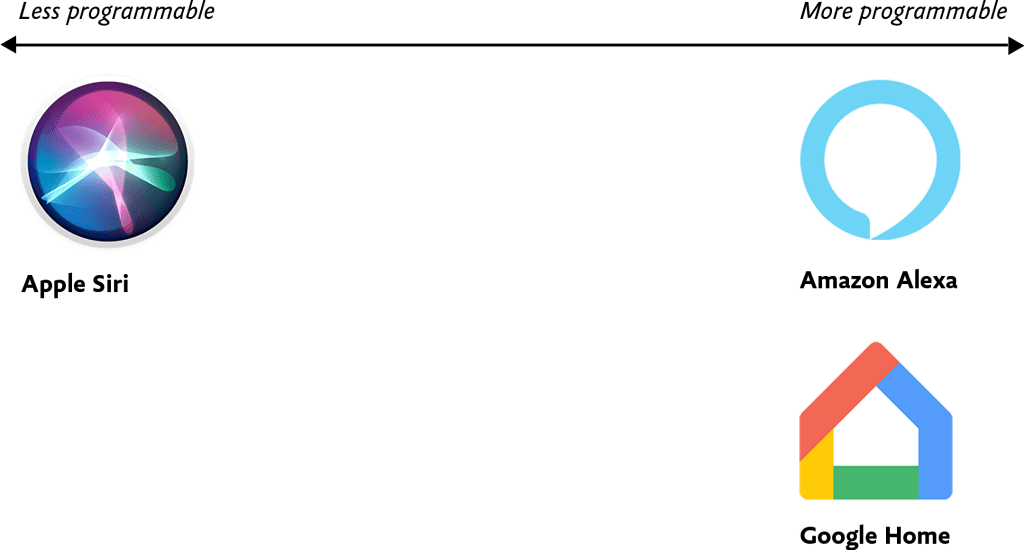
    Thanks to the plethora of voice assistants available today, there is considerable variation in how programmable and customizable certain voice assistants are over others (Fig 1.1). At one extreme, everything except vendor-provided features is locked down; for example, at the time of their release, the core functionality of Apple’s Siri and Microsoft’s Cortana couldn’t be extended beyond their existing capabilities. Even today, it isn’t possible to program Siri to perform arbitrary functions, because there’s no means by which developers can interact with Siri at a low level, apart from predefined categories of tasks like sending messages, hailing rideshares, making restaurant reservations, and certain others.

    At the opposite end of the spectrum, voice assistants like Amazon Alexa and Google Home offer a core foundation on which developers can build custom voice interfaces. For this reason, programmable voice assistants that lend themselves to customization and extensibility are becoming increasingly popular for developers who feel stifled by the limitations of Siri and Cortana. Amazon offers the Alexa Skills Kit, a developer framework for building custom voice interfaces for Amazon Alexa, while Google Home offers the ability to program arbitrary Google Assistant skills. Today, users can choose from among thousands of custom-built skills within both the Amazon Alexa and Google Assistant ecosystems.

    As corporations like Amazon, Apple, Microsoft, and Google continue to stake their territory, they’re also selling and open-sourcing an unprecedented array of tools and frameworks for designers and developers that aim to make building voice interfaces as easy as possible, even without code.

    Often by necessity, voice assistants like Amazon Alexa tend to be monochannel—they’re tightly coupled to a device and can’t be accessed on a computer or smartphone instead. By contrast, many development platforms like Google’s Dialogflow have introduced omnichannel capabilities so users can build a single conversational interface that then manifests as a voice interface, textual chatbot, and IVR system upon deployment. I don’t prescribe any specific implementation approaches in this design-focused book, but in Chapter 4 we’ll get into some of the implications these variables might have on the way you build out your design artifacts.

    Voice Content

    Simply put, voice content is content delivered through voice. To preserve what makes human conversation so compelling in the first place, voice content needs to be free-flowing and organic, contextless and concise—everything written content isn’t.

    Our world is replete with voice content in various forms: screen readers reciting website content, voice assistants rattling off a weather forecast, and automated phone hotline responses governed by IVR systems. In this book, we’re most concerned with content delivered auditorily—not as an option, but as a necessity.

    For many of us, our first foray into informational voice interfaces will be to deliver content to users. There’s only one problem: any content we already have isn’t in any way ready for this new habitat. So how do we make the content trapped on our websites more conversational? And how do we write new copy that lends itself to voice interactions?

    Lately, we’ve begun slicing and dicing our content in unprecedented ways. Websites are, in many respects, colossal vaults of what I call macrocontent: lengthy prose that can extend for infinitely scrollable miles in a browser window, like microfilm viewers of newspaper archives. Back in 2002, well before the present-day ubiquity of voice assistants, technologist Anil Dash defined microcontent as permalinked pieces of content that stay legible regardless of environment, such as email or text messages:

    A day’s weather forcast [sic], the arrival and departure times for an airplane flight, an abstract from a long publication, or a single instant message can all be examples of microcontent. ()

    I’d update Dash’s definition of microcontent to include all examples of bite-sized content that go well beyond written communiqués. After all, today we encounter microcontent in interfaces where a small snippet of copy is displayed alone, unmoored from the browser, like a textbot confirmation of a restaurant reservation. Microcontent offers the best opportunity to gauge how your content can be stretched to the very edges of its capabilities, informing delivery channels both established and novel.

    As microcontent, voice content is unique because it’s an example of how content is experienced in time rather than in space. We can glance at a digital sign underground for an instant and know when the next train is arriving, but voice interfaces hold our attention captive for periods of time that we can’t easily escape or skip, something screen reader users are all too familiar with.

    Because microcontent is fundamentally made up of isolated blobs with no relation to the channels where they’ll eventually end up, we need to ensure that our microcontent truly performs well as voice content—and that means focusing on the two most important traits of robust voice content: voice content legibility and voice content discoverability.

    Fundamentally, the legibility and discoverability of our voice content both have to do with how voice content manifests in perceived time and space.