Category: Blog

Your blog category

  • Personalization Pyramid: A Framework for Designing with User Data

    Personalization Pyramid: A Framework for Designing with User Data

    As a UX professional in today’s data-driven landscape, it’s increasingly likely that you’ve been asked to design a personalized digital experience, whether it’s a public website, user portal, or native application. Yet while there continues to be no shortage of marketing hype around personalization platforms, we still have very few standardized approaches for implementing personalized UX.

    That’s where we come in. After completing dozens of personalization projects over the past few years, we gave ourselves a goal: could you create a holistic personalization framework specifically for UX practitioners? The Personalization Pyramid is a designer-centric model for standing up human-centered personalization programs, spanning data, segmentation, content delivery, and overall goals. By using this approach, you will be able to understand the core components of a contemporary, UX-driven personalization program (or at the very least know enough to get started). 

    Getting Started

    For the sake of this article, we’ll assume you’re already familiar with the basics of digital personalization. A good overview can be found here: Website Personalization Planning. While UX projects in this area can take on many different forms, they often stem from similar starting points.      

    Common scenarios for starting a personalization project:

    • Your organization or client purchased a content management system (CMS) or marketing automation platform (MAP) or related technology that supports personalization
    • The CMO, CDO, or CIO has identified personalization as a goal
    • Customer data is disjointed or ambiguous
    • You are running some isolated targeting campaigns or A/B testing
    • Stakeholders disagree on personalization approach
    • Mandate of customer privacy rules (e.g. GDPR) requires revisiting existing user targeting practices

    Regardless of where you begin, a successful personalization program will require the same core building blocks. We’ve captured these as the “levels” on the pyramid. Whether you are a UX designer, researcher, or strategist, understanding the core components can help make your contribution successful.  

    From top to bottom, the levels include:

    1. North Star: What larger strategic objective is driving the personalization program? 
    2. Goals: What are the specific, measurable outcomes of the program? 
    3. Touchpoints: Where will the personalized experience be served?
    4. Contexts and Campaigns: What personalization content will the user see?
    5. User Segments: What constitutes a unique, usable audience? 
    6. Actionable Data: What reliable and authoritative data is captured by our technical platform to drive personalization?  
    7. Raw Data: What wider set of data is conceivably available (already in our setting) allowing you to personalize?

    We’ll go through each of these levels in turn. To help make this actionable, we created an accompanying deck of cards to illustrate specific examples from each level. We’ve found them helpful in personalization brainstorming sessions, and will include examples for you here.

    Starting at the Top

    The components of the pyramid are as follows:

    North Star

    A north star is what you are aiming for overall with your personalization program (big or small). The North Star defines the (one) overall mission of the personalization program. What do you wish to accomplish? North Stars cast a shadow. The bigger the star, the bigger the shadow. Example of North Starts might include: 

    1. Function: Personalize based on basic user inputs. Examples: “Raw” notifications, basic search results, system user settings and configuration options, general customization, basic optimizations
    2. Feature: Self-contained personalization componentry. Examples: “Cooked” notifications, advanced optimizations (geolocation), basic dynamic messaging, customized modules, automations, recommenders
    3. Experience: Personalized user experiences across multiple interactions and user flows. Examples: Email campaigns, landing pages, advanced messaging (i.e. C2C chat) or conversational interfaces, larger user flows and content-intensive optimizations (localization).
    4. Product: Highly differentiating personalized product experiences. Examples: Standalone, branded experiences with personalization at their core, like the “algotorial” playlists by Spotify such as Discover Weekly.

    Goals

    As in any good UX design, personalization can help accelerate designing with customer intentions. Goals are the tactical and measurable metrics that will prove the overall program is successful. A good place to start is with your current analytics and measurement program and metrics you can benchmark against. In some cases, new goals may be appropriate. The key thing to remember is that personalization itself is not a goal, rather it is a means to an end. Common goals include:

    • Conversion
    • Time on task
    • Net promoter score (NPS)
    • Customer satisfaction 

    Touchpoints

    Touchpoints are where the personalization happens. As a UX designer, this will be one of your largest areas of responsibility. The touchpoints available to you will depend on how your personalization and associated technology capabilities are instrumented, and should be rooted in improving a user’s experience at a particular point in the journey. Touchpoints can be multi-device (mobile, in-store, website) but also more granular (web banner, web pop-up etc.). Here are some examples:

    Channel-level Touchpoints

    • Email: Role
    • Email: Time of open
    • In-store display (JSON endpoint)
    • Native app
    • Search

    Wireframe-level Touchpoints

    • Web overlay
    • Web alert bar
    • Web banner
    • Web content block
    • Web menu

    If you’re designing for web interfaces, for example, you will likely need to include personalized “zones” in your wireframes. The content for these can be presented programmatically in touchpoints based on our next step, contexts and campaigns.

    Contexts and Campaigns

    Once you’ve outlined some touchpoints, you can consider the actual personalized content a user will receive. Many personalization tools will refer to these as “campaigns” (so, for example, a campaign on a web banner for new visitors to the website). These will programmatically be shown at certain touchpoints to certain user segments, as defined by user data. At this stage, we find it helpful to consider two separate models: a context model and a content model. The context helps you consider the level of engagement of the user at the personalization moment, for example a user casually browsing information vs. doing a deep-dive. Think of it in terms of information retrieval behaviors. The content model can then help you determine what type of personalization to serve based on the context (for example, an “Enrich” campaign that shows related articles may be a suitable supplement to extant content).

    Personalization Context Model:

    1. Browse
    2. Skim
    3. Nudge
    4. Feast

    Personalization Content Model:

    1. Alert
    2. Make Easier
    3. Cross-Sell
    4. Enrich

    We’ve written extensively about each of these models elsewhere, so if you’d like to read more you can check out Colin’s Personalization Content Model and Jeff’s Personalization Context Model

    User Segments

    User segments can be created prescriptively or adaptively, based on user research (e.g. via rules and logic tied to set user behaviors or via A/B testing). At a minimum you will likely need to consider how to treat the unknown or first-time visitor, the guest or returning visitor for whom you may have a stateful cookie (or equivalent post-cookie identifier), or the authenticated visitor who is logged in. Here are some examples from the personalization pyramid:

    • Unknown
    • Guest
    • Authenticated
    • Default
    • Referred
    • Role
    • Cohort
    • Unique ID

    Actionable Data

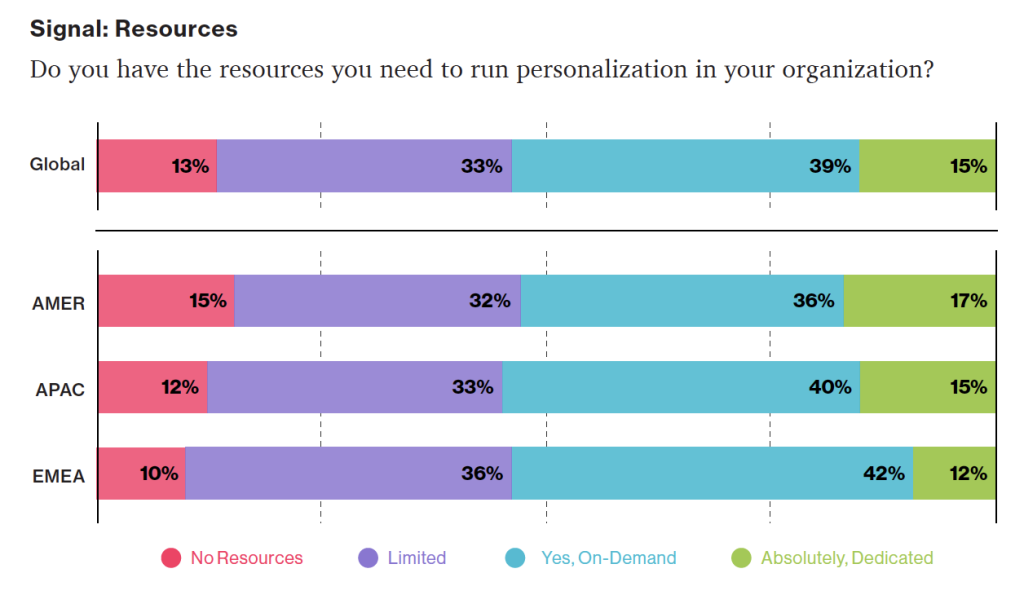
    Every organization with any digital presence has data. It’s a matter of asking what data you can ethically collect on users, its inherent reliability and value, as to how can you use it (sometimes known as “data activation.”) Fortunately, the tide is turning to first-party data: a recent study by Twilio estimates some 80% of businesses are using at least some type of first-party data to personalize the customer experience. 

    First-party data represents multiple advantages on the UX front, including being relatively simple to collect, more likely to be accurate, and less susceptible to the “creep factor” of third-party data. So a key part of your UX strategy should be to determine what the best form of data collection is on your audiences. Here are some examples:

    There is a progression of profiling when it comes to recognizing and making decisioning about different audiences and their signals. It tends to move towards more granular constructs about smaller and smaller cohorts of users as time and confidence and data volume grow.

    While some combination of implicit / explicit data is generally a prerequisite for any implementation (more commonly referred to as first party and third-party data) ML efforts are typically not cost-effective directly out of the box. This is because a strong data backbone and content repository is a prerequisite for optimization. But these approaches should be considered as part of the larger roadmap and may indeed help accelerate the organization’s overall progress. Typically at this point you will partner with key stakeholders and product owners to design a profiling model. The profiling model includes defining approach to configuring profiles, profile keys, profile cards and pattern cards. A multi-faceted approach to profiling which makes it scalable.

    Pulling it Together

    While the cards comprise the starting point to an inventory of sorts (we provide blanks for you to tailor your own), a set of potential levers and motivations for the style of personalization activities you aspire to deliver, they are more valuable when thought of in a grouping. 

    In assembling a card “hand”, one can begin to trace the entire trajectory from leadership focus down through a strategic and tactical execution. It is also at the heart of the way both co-authors have conducted workshops in assembling a program backlog—which is a fine subject for another article.

    In the meantime, what is important to note is that each colored class of card is helpful to survey in understanding the range of choices potentially at your disposal, it is threading through and making concrete decisions about for whom this decisioning will be made: where, when, and how.

    Lay Down Your Cards

    Any sustainable personalization strategy must consider near, mid and long-term goals. Even with the leading CMS platforms like Sitecore and Adobe or the most exciting composable CMS DXP out there, there is simply no “easy button” wherein a personalization program can be stood up and immediately view meaningful results. That said, there is a common grammar to all personalization activities, just like every sentence has nouns and verbs. These cards attempt to map that territory.

  • Anora and The Brutalist Win Big at an Oscars Where Indies Reign

    Anora and The Brutalist Win Big at an Oscars Where Indies Reign

    It began with a song that didn’t come out last year. It began with a song that didn’t come out in this century. But what a song to open the 97th annual Academy Awards: Ariana Grande threading a wilting rendition of “Somewhere Over the Rainbow.” The moment obviously was a nod to the other Oz-centric […]

    The post Anora and The Brutalist Win Big at an Oscars Where Indies Reign appeared first on Den of Geek.

    A science fiction spaceship is a lot like a house party. When I see one, the first thing I want to know is what’s going on in the kitchen. Interior designers are the unsung heroes of sci-fi worldbuilding, and a bit of carefully dressed set can do the work of a dozen dramatic exposition-filled voiceovers or lengthy opening text crawls. And this is nowhere more evident than the kitchen.

    Take a look at your own kitchen. What appliances have you got? A kitchen-bound time traveler could quickly determine when they are with a look at your microwave and fridge. A look at how much the dirty dishes have stacked up tells you about the routines and temperaments of the people who live here. A glance at the fridge will tell you how many kids are here, or show you the nearby takeout favorites.

    cnx.cmd.push(function() {
    cnx({
    playerId: “106e33c0-3911-473c-b599-b1426db57530”,

    }).render(“0270c398a82f44f49c23c16122516796”);
    });

    But more than that, the kind of food available will tell you about the world at large—how far the supply chains reach and how quickly produce can be moved along them, and what kind of cross-cultural pollination this setting is subject to. You can learn about water, power, and heating infrastructure, how much room the people who live here have access to in the rest of the home. The kitchen is a microcosm of everything else that is happening in a place or time.

    When I was writing the Fermi’s Progress series—four novellas about an FTL ship that vaporizes every planet it encounters—the spaceship’s kitchen became a key setting for the story due to all of these reasons mentioned above. And in mapping it out in my head, I thought a lot about how kitchens have worked on other well-known spacecraft.

    Nostromo (Alien)

    We have talked before about the enormous influence the Nostromo’s kitchen and otherwise has had on spaceship set design in general. Alien’s impact on sci-fi aesthetics as a whole is incalculable, sometimes to the detriment of the genre, but that influence is felt strongest where movie spaceship crews eat.

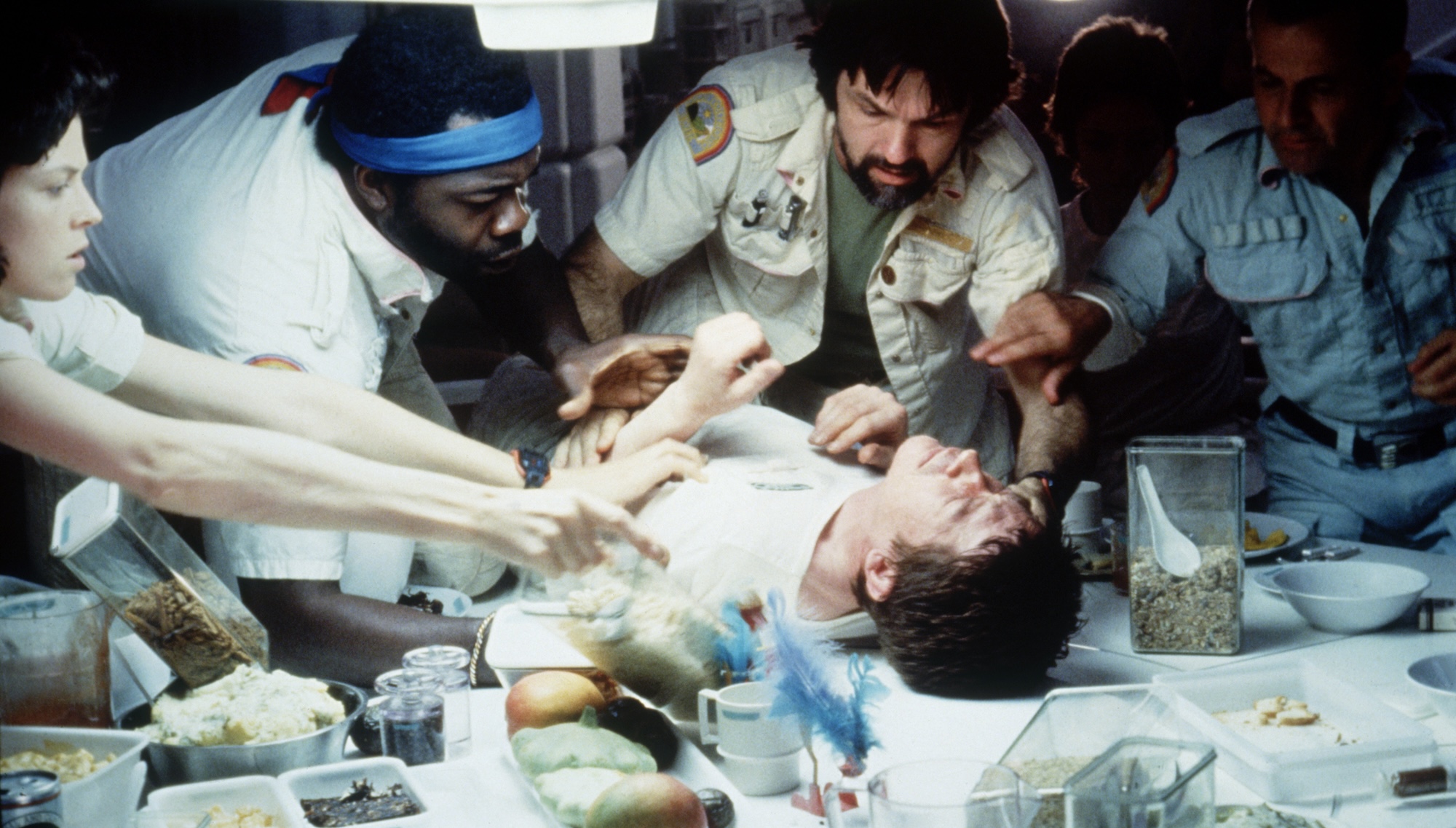
    And with good cause. The meat of the action in Alien does not take place on some bridge or control room, or in a laboratory or Star Trek-style space conference room. It doesn’t even take place in its many spacious air shafts. It all happens in the kitchen. This is where we meet the Nostromo crew for the first time arguing about percentages. This is also, of course, where John Hurt has the worst case of indigestion in film history. It is where plans are suggested, argued over and agreed on. It is where Ash attempts his brutal and terrifying murder of Ripley and the crew overpowers, interrogates and ultimately, cooks him.

    The set for the Nostromo’s kitchen might also just be one of the most intricately designed film sets in movie history. It still places the bar for environmental storytelling, from Ron Cobb’s now legendary “Semiotic Standard” to the cereal station, the wall of cups neatly ensconced in their little cupholders. Everything has its place, its premade slot. 

    But the gap between its intended and actual use is also clear—the stark white is everywhere covered in grime; the walls plastered with pin-ups, stickers, and notes. It is not just the room where the story action takes place, it is the room where the characters live, often despite the wishes of the employer that put them there, and that is visible in every detail.

    One of the most illustrative elements is the food itself. There are no ovens or hobs visible, and certainly no fresh meat or vegetables. This is a place for out-of-the-packet living. The Nostromo crew drinks canned beer and scoop food out of Tupperware containers, eating big bowls of what looks like cheap noodles, although the crew “don’t know what it’s made of.” Frankly, the food tells you how much the crew’s well-being is valued by their employer, foreshadowing what will become of them.

    Serenity (Serenity)

    The kitchen aboard the workhorse spaceship of the series Firefly and its movie spinoff Serenity is probably the second best known spaceship kitchen out there. Before we go any further it is important to also acknowledge we’re not here to celebrate Joss Whedon (who by many accounts is a shit), but Firefly’s impact on the sci-fi genre is undeniable (even if arguably that impact is recycling a bunch of stuff from the Millennium Falcon and throwing in some ideas from Cowboy Bebop and Southern Revisionism of the American Civil War).

    The Serenity has a lot in common with the Nostromo. It is a blue-collar spaceship in a setting so retrofuturistic that it borders on being just plain retro. The kitchen of that spaceship is in many ways its hero set. But Serenity’s kitchen is not your workplace cafeteria; it is the dining room in the homestead. As much as Nathan Fillion’s Mal Reynolds might seem like a salt of the earth working man, he is a salt of the earth working man who can afford an entire working spaceship.

    Comparing the two, the differences are immediate. Instead of pin-up posters, the walls have flowers painted on. There are warmer colors, wooden furniture, a hob for cooking on, and a sink for doing the dishes in. This is a domestic space as much as a workplace. People here tell stories and celebrate birthdays as much as they argue percentages on the latest job.

    When it comes to food, every meal is “protein,” reflecting a universe where food has to travel for longer than fresh produce can be expected to last. But that protein is prepared with care, with spices used to improve the flavor—and when they come by fruit, it is a delicacy.

    But what Serenity most illustrates about the role of the kitchen is that it says a lot about who a space belongs to. The Nostromo’s kitchen belongs to the Company, its crew just eats there. The Serenity’s kitchen is ostensibly the property of its captain, but it is maintained and occupied by its crew, and their personalities shine through in this space.

    Icarus II (Sunshine)

    The kitchen and dining area in Sunshine will not pass the “Definitely Not the Nostromo” smell test. Alien’s design aesthetic is felt strongly here. Yet once you start looking for differences they start to mount up. The lighting is softer, and the crew’s well-being is more of a concern. There is room for personalization in the form of bookshelves and personal storage spaces, but unlike the expansive Nostromo set, here everything is packed in closely, bringing to mind the weight and space restrictions that are a concern on any real-life space mission.

    But the really revealing bit of worldbuilding here is the food. The crew of the Icarus II gets to dine on things that the Nostromo and Serenity crews could only dream about. This is not because their spaceship is any more luxurious, but because the crew are eating the vegetables grown in their own hydroponic garden—the same garden that recycles their oxygen supply.

    It shows us how a spaceship can be many different things. The Serenity is hopping job to job, resupply to resupply. The Nostromo is a cog in a vast machine, equipped with the cheapest mass-produced components necessary for it to complete its job. Icarus II, however, is on a true mission into the unknown. It is designed to be a self-contained world because its crew is not sailing to the next port, they are sailing into a place hostile to life, and so need to take everything they need with them.

    Rocinante (The Expanse)

    Like the Icarus II, the Rocinante is a ship designed with the practicalities of space travel in mind. Where most sci-fi spaceships are laid out like a maritime vessel with decks running horizontally from the fore to the aft of the ship, the Rocinante is more like a tower, with its control room at the top and the engines at the bottom. In this way, acceleration draws everything toward the engine-end of the ship, creating a simulation of gravity.

    That is reflected in the way the Rocinante’s dining and kitchen area is laid out—everything is functional and compact. The kitchen fittings and implements can tell you a lot about technology as well. Are the kitchen crowded with cups and jars, plates and sharp implements? Then this is a spaceship that has real faith in its artificial gravity and inertial dampeners. Alternatively, is everything locked down and strapped into place?

    That hob we mentioned earlier, is it electric or is this crew willing to light a naked flame in a highly pressurised environment in the cold depths of deep space?

    Everything on the Rocinante has a place to be put away—nobody leaves knives lying around that might become projectiles if the ship has to perform a tricky manoeuvre. Fresh herbs for long voyages are grown in small centrifuges that will keep them growing properly even during periods of Zero G.

    But beyond the fittings, spaceship kitchens also tell us a lot because of the kinds of interactions they facilitate. Is this ship’s kitchen a space where a family all eat together at predetermined times of the day, or is it like a student dorm, where people rotate through one or two at a time to feed themselves?

    The kitchen is the room on a spaceship where we are most likely to see the crew when they are not working or asleep. It is the room where characters get downtime, showing us how they relate to each other out of crisis mode. It shows us if people are eating three square meals, or are just grabbing snacks on the fly. The Expanse’s Rocinante was also home to one of the all-time great space kitchen scenes where we see the Rocinante crew get to sit down and share a meal. 

    Unreliable (The Outer Worlds)

    For fans of wandering around spaceship kitchens, poking into all the cupboards and nosing through the fridge, there are quite a few video games that scratch the itch. One of the best examples is the kitchen of the Unreliable in the video game The Outer Worlds. Clearly inspired heavily by Serenity’s kitchen, the Unreliable’s dining area tells stories through the detritus that gradually builds up over time, including scattered game pieces and cards, used dishes, and off-duty crew shooting the shit between missions.

    The Millennium Falcon never showed us much of a kitchen (although expanded universe reference materials tell us Han Solo installed one as a wedding gift for Leia which is… a choice), but Star Wars games have proven an excellent hunting ground for space kitchen fans with the Jedi games’ Stinger Mantis and Outlaw’s Trailblazer both giving you a little kitchenette to sniff around. Mass Effect: Andromeda’s kitchen is pretty small and tucked away, but does give us the ability to watch the crew bickering through notes on the fridge.

    USS Enterprise NCC-1701 (Star Trek: Strange New Worlds)

    All of the kitchens we have looked at so far vary from the spartan yet homey to the grimy yet utilitarian. But all-out luxury can be just as revealing of a setting and its characters. Let’s thus take a look at the kitchen in Captain Pike’s quarters aboard Star Trek: Strange New WorldsEnterprise.

    This is a matter of opinion, but as a big fan of both spaceship kitchens and Star Trek, I think I am qualified to say that Trek does not normally do it for me on the kitchen front. Its ships are, first and foremost, a living room-centred environment. The ship’s dining areas are usually sterile and gray, the only appliance they need is a replicator, and even Neelix’s kitchen feels like an afterthought rather than a facility capable of serving approximately 150 people.

    But Captain Pike’s kitchen in the newest series shows the culmination of what cooking can become in Star Trek’s space communist future, even before the invention of the replicator. It is a leisure activity and a luxury.

    The kitchen is spacious enough to contain three sets of crew quarters from Kirk’s Enterprise (and I still harbor a theory that Uhura assigned Kirk one of the crappier upper deck cabins before repurposing Pike’s room as a Lower Deckers clubhouse). But as well as being a social location, it also serves a work function. This is not the “family table” we see aboard Serenity. Here people are expected to stand, and more importantly, to mingle. For all the friendly bonhomie it evokes, it is a networking space, and Pike is assuming as much authority as he stands over the grill as he does sitting in the bridge’s Big Chair.

    And of course, on Pike’s Enterprise people eat whatever they damn well please, because we might be in deep space, but Star Trek is the definition of luxury space communism. Once, during a talk, someone asked the beloved fantasy writer Terry Pratchett what he first thought about when designing a fantasy city. Pratchett reportedly answered that you should think about how the clean water gets in and the sewage gets out.

    When you are designing your spaceship there are similar concerns—thinking about when, what, and how your crew take in food and water is a good place to start.

    Except of course as a genre, space fiction is usually a good deal more reticent about where the sewage goes…

    The post Why the Kitchen Is the Most Important Room in a Sci-Fi Spaceship appeared first on Den of Geek.

  • User Research Is Storytelling

    User Research Is Storytelling

    I’ve been fascinated by shows since I was a child. I loved the figures and the excitement—but most of all the reports. I aspired to be an artist. And I believed that I’d get to do the things that Indiana Jones did and go on interesting activities. I also came up with concept films that my friends and I could create and sun in. But they never went any farther. However, I did end up in the user experience ( UX) field. Today, I realize that there’s an element of drama to UX— I hadn’t actually considered it before, but consumer research is story. And to get the most out of customer studies, you must tell a compelling story that involves stakeholders, including the product team and decision-makers, and piques their interest in learning more.

    Think of your favourite film. It more than likely follows a three-act construction that’s frequently seen in movies: the layout, the conflict, and the resolution. The second act shows what exists now, and it helps you get to know the figures and the challenges and problems that they face. Act two sets the scene for the issue and the action begins. Here, difficulties grow or get worse. The solution is the third and final work. This is where the issues are resolved and the figures learn and change. This architecture, in my opinion, is also a fantastic way to think about consumer research, and it might be particularly useful for introducing user research to others.

    Use story as a framework for conducting research

    It’s sad to say, but many have come to see studies as being inconsequential. Research is typically one of the first things to go when finances or deadlines are tight. Instead of investing in study, some goods professionals rely on manufacturers or—worse—their personal judgment to make the “right” options for users based on their experience or accepted best practices. That may lead some groups, but that approach can so easily miss the chance to solve people ‘ real issues. To be user-centered, this is something we really avoid. Design is enhanced by customer research. It keeps it on trail, pointing to problems and opportunities. Being aware of problems with your goods and taking corrective actions can help you keep ahead of your competition.

    In the three-act structure, each action corresponds to a part of the process, and each part is important to telling the whole story. Let’s take a look at the various functions and how they relate to customer research.

    Act one: layout

    Fundamental analysis comes in handy because the setup is all about comprehending the background. Basic research ( also called conceptual, discovery, or preliminary research ) helps you understand people and identify their problems. You’re learning about the problems people face now, what options are available, and how those challenges impact them, just like in the films. To do basic research, you may conduct situational inquiries or journal studies ( or both! ), which may assist you in identifying both prospects and problems. It doesn’t need to get a great investment in time or money.

    Erika Hall writes about the most effective anthropology, which can be as straightforward as spending 15 hours with a customer and asking them to” Walk me through your morning yesterday.” That’s it. Current that one ask. Opened up and listen to them for 15 days. Do everything in your power to keep yourself and your pursuits out of it. Bam, you’re doing ethnography”. According to Hall, “[This ] will definitely prove quite fascinating. In the very unlikely event that you didn’t learn anything new or helpful, carry on with increased confidence in your way”.

    I think this makes sense. And I love that this makes consumer studies so visible. You can simply attract participants and carry out the recruitment process without having to make a lot of paperwork! This can offer a wealth of knowledge about your customers, and it’ll help you better understand them and what’s going on in their life. Understanding where people are coming from is what action one is really all about.

    Maybe Spool talks about the importance of basic research and how it may type the bulk of your research. If you can supplement what you’ve heard in the basic studies by using any more user data that you can obtain, such as surveys or analytics, to make recommendations that may need to be investigated further, you might as well use those that can be drawn from those that you can obtain. Together, all this information creates a clearer picture of the state of things and all its deficiencies. And that’s the start of a gripping tale. It’s the place in the story where you realize that the principal characters—or the people in this case—are facing issues that they need to conquer. This is where you begin to develop compassion for the characters and support their success, much like in films. And maybe partners are now doing the same. Their business may lose money because users didn’t finish particular tasks, which may be their love. Or probably they do connect with people ‘ problems. In any case, work one serves as your main strategy to pique the interest and interest of the participants.

    When partners begin to understand the value of basic research, that is open doors to more opportunities that involve users in the decision-making approach. And that can help item team become more user-centric. This gains everyone—users, the goods, and partners. It’s similar to winning an Oscar for a film; it frequently results in a favorable reception and success for your item. And this can be an opportunity for participants to repeat this process with different items. Knowing how to show a good story is the only way to convince partners to worry about doing more research, and story is the key to this method.

    This brings us to work two, where you incrementally examine a design or idea to see whether it addresses the problems.

    Act two: fight

    Act two is all about digging deeper into the issues that you identified in action one. In order to evaluate a potential alternative ( such as a design ), you typically conduct vertical research, such as usability tests, to see if it addresses the problems you identified. The issues may include unfulfilled needs or problems with a circulation or procedure that’s tripping users off. More issues may come up in the process, much like in action two of a movie. It’s ok that you learn more about the characters as they grow and develop through this work.

    Usability tests should generally consist of five participants, according to Jakob Nielsen, who found that that number of users can usually identify the majority of the issues:” As you add more and more users, you learn less and less because you will keep seeing the same things again and again… After the second user, you are wasting your time by observing the same findings regularly but hardly learning much new.”

    There are parallels with storytelling here too, if you try to tell a story with too many characters, the plot may get lost. With fewer participants, each user’s struggles will be more memorable and accessible to other parties when presenting the research. This can help convey the issues that need to be addressed while also highlighting the value of doing the research in the first place.

    Usability tests have been conducted in person for decades, but you can also conduct them remotely using software like Microsoft Teams, Zoom, or other teleconferencing software. This approach has become increasingly popular since the beginning of the pandemic, and it works well. You might consider in-person usability tests like watching a movie as opposed to remote testing like attending a play. There are advantages and disadvantages to each. Usability research in person is a much more extensive experience. Stakeholders can experience the sessions with other stakeholders. You also get real-time feedback on what they’re seeing, including surprises, disagreements, and discussions about them. Much like going to a play, where audiences get to take in the stage, the costumes, the lighting, and the actors ‘ interactions, in-person research lets you see users up close, including their body language, how they interact with the moderator, and how the scene is set up.

    If conducting usability testing in the field is like watching a play that is staged and controlled, where any two sessions may be very different from one another. You can take usability testing into the field by creating a replica of the space where users interact with the product and then conduct your research there. Or you can meet users at their location to conduct your research. With either option, you get to see how things work in context, things come up that wouldn’t have in a lab environment—and conversion can shift in entirely different directions. You have less control over how these sessions end as researchers, but this can occasionally help you understand users even better. Meeting users where they are can provide clues to the external forces that could be affecting how they use your product. In-person usability tests add a level of detail that is frequently absent from remote usability tests.

    That’s not to say that the “movies” —remote sessions—aren’t a good option. A wider audience can be obtained from remote sessions. They allow a lot more stakeholders to be involved in the research and to see what’s going on. Additionally, they make access to a much wider user base geographically. But with any remote session there is the potential of time wasted if participants can’t log in or get their microphone working.

    You can ask real users questions to understand their thoughts and understanding of the solution as a result of usability testing, whether it is conducted remotely or in person. This can help you not only identify problems but also glean why they’re problems in the first place. Additionally, you can test your own hypotheses and determine whether your reasoning is correct. By the end of the sessions, you’ll have a much clearer picture of how usable the designs are and whether they work for their intended purposes. Act two is where the excitement is at the heart of the narrative, but there are also potential surprises. This is equally true of usability tests. Unexpected things that participants say frequently alter the way you look at things, and these unexpected revelations can lead to unexpected turns in the narrative.

    Unfortunately, user research is sometimes seen as expendable. Usability testing is also frequently the only research technique that some stakeholders believe they ever need, and too frequently. In fact, if the designs that you’re evaluating in the usability test aren’t grounded in a solid understanding of your users ( foundational research ), there’s not much to be gained by doing usability testing in the first place. Because you’re narrowing the scope of what you’re receiving feedback on without understanding the needs of the users. As a result, there’s no way of knowing whether the designs might solve a problem that users have. In the context of a usability test, it’s only feedback on a particular design.

    On the other hand, if you only do foundational research, while you might have set out to solve the right problem, you won’t know whether the thing that you’re building will actually solve that. This demonstrates the value of conducting both directional and foundational research.

    In act two, stakeholders will—hopefully—get to watch the story unfold in the user sessions, which creates the conflict and tension in the current design by surfacing their highs and lows. And in turn, this can encourage stakeholders to take action on the issues raised.

    Act three: resolution

    The third act is about resolving the issues from the first two acts, whereas the first two acts are about understanding the context and the tensions that can compel stakeholders to act. While it’s important to have an audience for the first two acts, it’s crucial that they stick around for the final act. That includes the entire product team, including developers, UX experts, business analysts, delivery managers, product managers, and any other interested parties who have a say in the coming development. It allows the whole team to hear users ‘ feedback together, ask questions, and discuss what’s possible within the project’s constraints. Additionally, it enables the UX design and research teams to clarify, suggest alternatives, or provide more context for their decisions. So you can get everyone on the same page and get agreement on the way forward.

    This act is primarily told through voiceover with some audience participation. The researcher is the narrator, who paints a picture of the issues and what the future of the product could look like given the things that the team has learned. They provide the stakeholders with their suggestions and suggestions for how to create this vision.

    Nancy Duarte in the Harvard Business Review offers an approach to structuring presentations that follow a persuasive story. The most effective presenters employ the same methods as great storytellers: By reaffirming the status quo and then revealing a better way, they create a conflict that needs to be resolved, writes Duarte. ” That tension helps them persuade the audience to adopt a new mindset or behave differently”.

    This type of structure aligns well with research results, and particularly results from usability tests. It provides proof for “what is “—the issues you’ve identified. And “what could be “—your recommendations on how to address them. And so forth and forth.

    You can reinforce your recommendations with examples of things that competitors are doing that could address these issues or with examples where competitors are gaining an edge. Or they can be as visual as quick sketches of a potential solution to a problem. These can help generate conversation and momentum. And this continues until the session is over when you’ve concluded everything by summarizing the key points and offering suggestions for a solution. This is the part where you reiterate the main themes or problems and what they mean for the product—the denouement of the story. This stage provides stakeholders with the next steps, and hopefully, the motivation to take those steps as well!

    While we are nearly at the end of this story, let’s reflect on the idea that user research is storytelling. The three-act structure of user research contains all the components for a good story:

      Act one: You meet the protagonists ( the users ) and the antagonists ( the problems affecting users ). This is the plot’s beginning. In act one, researchers might use methods including contextual inquiry, ethnography, diary studies, surveys, and analytics. These techniques can produce personas, empathy maps, user journeys, and analytics dashboards as output.
      Act two: Next, there’s character development. The protagonists encounter problems and challenges, which they must overcome, and there is conflict and tension. In act two, researchers might use methods including usability testing, competitive benchmarking, and heuristics evaluation. Usability findings reports, UX strategy documents, usability guidelines, and best practices can be included in the output of these.
      Act three: The protagonists triumph and you see what a better future looks like. Researchers may use techniques like presentation decks, storytelling, and digital media in act three. The output of these can be: presentation decks, video clips, audio clips, and pictures.

    The researcher plays a variety of roles, including producer, director, and storyteller. The participants have a small role, but they are significant characters ( in the research ). And the audience is the audience, as well. But the most important thing is to get the story right and to use storytelling to tell users ‘ stories through research. By the end, the parties should have a goal and a desire to solve the product’s flaws.

    So the next time that you’re planning research with clients or you’re speaking to stakeholders about research that you’ve done, think about how you can weave in some storytelling. In the end, user research is beneficial to everyone, and all parties must be interested in the conclusion.

  • Doctor Who Series 15 Trailer Breakdown

    Doctor Who Series 15 Trailer Breakdown

    Mundy Flynn will be acknowledged. In the first full trailer for Doctor Who’s next series (number 15 or season two, depending on how you’re counting), we see Varada Sethu’s new companion Belinda Chandra looking puzzled at a picture of herself on the TARDIS scanner. She’s right to look puzzled, because the picture is of Mundy […]

    The post Doctor Who Series 15 Trailer Breakdown appeared first on Den of Geek.

    A science fiction spaceship is a lot like a house party. When I see one, the first thing I want to know is what’s going on in the kitchen. Interior designers are the unsung heroes of sci-fi worldbuilding, and a bit of carefully dressed set can do the work of a dozen dramatic exposition-filled voiceovers or lengthy opening text crawls. And this is nowhere more evident than the kitchen.

    Take a look at your own kitchen. What appliances have you got? A kitchen-bound time traveler could quickly determine when they are with a look at your microwave and fridge. A look at how much the dirty dishes have stacked up tells you about the routines and temperaments of the people who live here. A glance at the fridge will tell you how many kids are here, or show you the nearby takeout favorites.

    cnx.cmd.push(function() {
    cnx({
    playerId: “106e33c0-3911-473c-b599-b1426db57530”,

    }).render(“0270c398a82f44f49c23c16122516796”);
    });

    But more than that, the kind of food available will tell you about the world at large—how far the supply chains reach and how quickly produce can be moved along them, and what kind of cross-cultural pollination this setting is subject to. You can learn about water, power, and heating infrastructure, how much room the people who live here have access to in the rest of the home. The kitchen is a microcosm of everything else that is happening in a place or time.

    When I was writing the Fermi’s Progress series—four novellas about an FTL ship that vaporizes every planet it encounters—the spaceship’s kitchen became a key setting for the story due to all of these reasons mentioned above. And in mapping it out in my head, I thought a lot about how kitchens have worked on other well-known spacecraft.

    Nostromo (Alien)

    We have talked before about the enormous influence the Nostromo’s kitchen and otherwise has had on spaceship set design in general. Alien’s impact on sci-fi aesthetics as a whole is incalculable, sometimes to the detriment of the genre, but that influence is felt strongest where movie spaceship crews eat.

    And with good cause. The meat of the action in Alien does not take place on some bridge or control room, or in a laboratory or Star Trek-style space conference room. It doesn’t even take place in its many spacious air shafts. It all happens in the kitchen. This is where we meet the Nostromo crew for the first time arguing about percentages. This is also, of course, where John Hurt has the worst case of indigestion in film history. It is where plans are suggested, argued over and agreed on. It is where Ash attempts his brutal and terrifying murder of Ripley and the crew overpowers, interrogates and ultimately, cooks him.

    The set for the Nostromo’s kitchen might also just be one of the most intricately designed film sets in movie history. It still places the bar for environmental storytelling, from Ron Cobb’s now legendary “Semiotic Standard” to the cereal station, the wall of cups neatly ensconced in their little cupholders. Everything has its place, its premade slot. 

    But the gap between its intended and actual use is also clear—the stark white is everywhere covered in grime; the walls plastered with pin-ups, stickers, and notes. It is not just the room where the story action takes place, it is the room where the characters live, often despite the wishes of the employer that put them there, and that is visible in every detail.

    One of the most illustrative elements is the food itself. There are no ovens or hobs visible, and certainly no fresh meat or vegetables. This is a place for out-of-the-packet living. The Nostromo crew drinks canned beer and scoop food out of Tupperware containers, eating big bowls of what looks like cheap noodles, although the crew “don’t know what it’s made of.” Frankly, the food tells you how much the crew’s well-being is valued by their employer, foreshadowing what will become of them.

    Serenity (Serenity)

    The kitchen aboard the workhorse spaceship of the series Firefly and its movie spinoff Serenity is probably the second best known spaceship kitchen out there. Before we go any further it is important to also acknowledge we’re not here to celebrate Joss Whedon (who by many accounts is a shit), but Firefly’s impact on the sci-fi genre is undeniable (even if arguably that impact is recycling a bunch of stuff from the Millennium Falcon and throwing in some ideas from Cowboy Bebop and Southern Revisionism of the American Civil War).

    The Serenity has a lot in common with the Nostromo. It is a blue-collar spaceship in a setting so retrofuturistic that it borders on being just plain retro. The kitchen of that spaceship is in many ways its hero set. But Serenity’s kitchen is not your workplace cafeteria; it is the dining room in the homestead. As much as Nathan Fillion’s Mal Reynolds might seem like a salt of the earth working man, he is a salt of the earth working man who can afford an entire working spaceship.

    Comparing the two, the differences are immediate. Instead of pin-up posters, the walls have flowers painted on. There are warmer colors, wooden furniture, a hob for cooking on, and a sink for doing the dishes in. This is a domestic space as much as a workplace. People here tell stories and celebrate birthdays as much as they argue percentages on the latest job.

    When it comes to food, every meal is “protein,” reflecting a universe where food has to travel for longer than fresh produce can be expected to last. But that protein is prepared with care, with spices used to improve the flavor—and when they come by fruit, it is a delicacy.

    But what Serenity most illustrates about the role of the kitchen is that it says a lot about who a space belongs to. The Nostromo’s kitchen belongs to the Company, its crew just eats there. The Serenity’s kitchen is ostensibly the property of its captain, but it is maintained and occupied by its crew, and their personalities shine through in this space.

    Icarus II (Sunshine)

    The kitchen and dining area in Sunshine will not pass the “Definitely Not the Nostromo” smell test. Alien’s design aesthetic is felt strongly here. Yet once you start looking for differences they start to mount up. The lighting is softer, and the crew’s well-being is more of a concern. There is room for personalization in the form of bookshelves and personal storage spaces, but unlike the expansive Nostromo set, here everything is packed in closely, bringing to mind the weight and space restrictions that are a concern on any real-life space mission.

    But the really revealing bit of worldbuilding here is the food. The crew of the Icarus II gets to dine on things that the Nostromo and Serenity crews could only dream about. This is not because their spaceship is any more luxurious, but because the crew are eating the vegetables grown in their own hydroponic garden—the same garden that recycles their oxygen supply.

    It shows us how a spaceship can be many different things. The Serenity is hopping job to job, resupply to resupply. The Nostromo is a cog in a vast machine, equipped with the cheapest mass-produced components necessary for it to complete its job. Icarus II, however, is on a true mission into the unknown. It is designed to be a self-contained world because its crew is not sailing to the next port, they are sailing into a place hostile to life, and so need to take everything they need with them.

    Rocinante (The Expanse)

    Like the Icarus II, the Rocinante is a ship designed with the practicalities of space travel in mind. Where most sci-fi spaceships are laid out like a maritime vessel with decks running horizontally from the fore to the aft of the ship, the Rocinante is more like a tower, with its control room at the top and the engines at the bottom. In this way, acceleration draws everything toward the engine-end of the ship, creating a simulation of gravity.

    That is reflected in the way the Rocinante’s dining and kitchen area is laid out—everything is functional and compact. The kitchen fittings and implements can tell you a lot about technology as well. Are the kitchen crowded with cups and jars, plates and sharp implements? Then this is a spaceship that has real faith in its artificial gravity and inertial dampeners. Alternatively, is everything locked down and strapped into place?

    That hob we mentioned earlier, is it electric or is this crew willing to light a naked flame in a highly pressurised environment in the cold depths of deep space?

    Everything on the Rocinante has a place to be put away—nobody leaves knives lying around that might become projectiles if the ship has to perform a tricky manoeuvre. Fresh herbs for long voyages are grown in small centrifuges that will keep them growing properly even during periods of Zero G.

    But beyond the fittings, spaceship kitchens also tell us a lot because of the kinds of interactions they facilitate. Is this ship’s kitchen a space where a family all eat together at predetermined times of the day, or is it like a student dorm, where people rotate through one or two at a time to feed themselves?

    The kitchen is the room on a spaceship where we are most likely to see the crew when they are not working or asleep. It is the room where characters get downtime, showing us how they relate to each other out of crisis mode. It shows us if people are eating three square meals, or are just grabbing snacks on the fly. The Expanse’s Rocinante was also home to one of the all-time great space kitchen scenes where we see the Rocinante crew get to sit down and share a meal. 

    Unreliable (The Outer Worlds)

    For fans of wandering around spaceship kitchens, poking into all the cupboards and nosing through the fridge, there are quite a few video games that scratch the itch. One of the best examples is the kitchen of the Unreliable in the video game The Outer Worlds. Clearly inspired heavily by Serenity’s kitchen, the Unreliable’s dining area tells stories through the detritus that gradually builds up over time, including scattered game pieces and cards, used dishes, and off-duty crew shooting the shit between missions.

    The Millennium Falcon never showed us much of a kitchen (although expanded universe reference materials tell us Han Solo installed one as a wedding gift for Leia which is… a choice), but Star Wars games have proven an excellent hunting ground for space kitchen fans with the Jedi games’ Stinger Mantis and Outlaw’s Trailblazer both giving you a little kitchenette to sniff around. Mass Effect: Andromeda’s kitchen is pretty small and tucked away, but does give us the ability to watch the crew bickering through notes on the fridge.

    USS Enterprise NCC-1701 (Star Trek: Strange New Worlds)

    All of the kitchens we have looked at so far vary from the spartan yet homey to the grimy yet utilitarian. But all-out luxury can be just as revealing of a setting and its characters. Let’s thus take a look at the kitchen in Captain Pike’s quarters aboard Star Trek: Strange New WorldsEnterprise.

    This is a matter of opinion, but as a big fan of both spaceship kitchens and Star Trek, I think I am qualified to say that Trek does not normally do it for me on the kitchen front. Its ships are, first and foremost, a living room-centred environment. The ship’s dining areas are usually sterile and gray, the only appliance they need is a replicator, and even Neelix’s kitchen feels like an afterthought rather than a facility capable of serving approximately 150 people.

    But Captain Pike’s kitchen in the newest series shows the culmination of what cooking can become in Star Trek’s space communist future, even before the invention of the replicator. It is a leisure activity and a luxury.

    The kitchen is spacious enough to contain three sets of crew quarters from Kirk’s Enterprise (and I still harbor a theory that Uhura assigned Kirk one of the crappier upper deck cabins before repurposing Pike’s room as a Lower Deckers clubhouse). But as well as being a social location, it also serves a work function. This is not the “family table” we see aboard Serenity. Here people are expected to stand, and more importantly, to mingle. For all the friendly bonhomie it evokes, it is a networking space, and Pike is assuming as much authority as he stands over the grill as he does sitting in the bridge’s Big Chair.

    And of course, on Pike’s Enterprise people eat whatever they damn well please, because we might be in deep space, but Star Trek is the definition of luxury space communism. Once, during a talk, someone asked the beloved fantasy writer Terry Pratchett what he first thought about when designing a fantasy city. Pratchett reportedly answered that you should think about how the clean water gets in and the sewage gets out.

    When you are designing your spaceship there are similar concerns—thinking about when, what, and how your crew take in food and water is a good place to start.

    Except of course as a genre, space fiction is usually a good deal more reticent about where the sewage goes…

    The post Why the Kitchen Is the Most Important Room in a Sci-Fi Spaceship appeared first on Den of Geek.

  • Sherlock Holmes Actors Ranked From Passable to Perfect

    Sherlock Holmes Actors Ranked From Passable to Perfect

    Picking a favourite Sherlock Holmes might seem elementary, but, when you consider just how many fantastic actors have donned the deerstalker over the years, you’re faced with a conundrum fiendish enough to daunt the master detective himself. Rathbone, Cumberbatch, Brett, Plummer…it was never going to be straightforward, was it? So, in the spirit of the […]

    The post Sherlock Holmes Actors Ranked From Passable to Perfect appeared first on Den of Geek.

    A science fiction spaceship is a lot like a house party. When I see one, the first thing I want to know is what’s going on in the kitchen. Interior designers are the unsung heroes of sci-fi worldbuilding, and a bit of carefully dressed set can do the work of a dozen dramatic exposition-filled voiceovers or lengthy opening text crawls. And this is nowhere more evident than the kitchen.

    Take a look at your own kitchen. What appliances have you got? A kitchen-bound time traveler could quickly determine when they are with a look at your microwave and fridge. A look at how much the dirty dishes have stacked up tells you about the routines and temperaments of the people who live here. A glance at the fridge will tell you how many kids are here, or show you the nearby takeout favorites.

    cnx.cmd.push(function() {
    cnx({
    playerId: “106e33c0-3911-473c-b599-b1426db57530”,

    }).render(“0270c398a82f44f49c23c16122516796”);
    });

    But more than that, the kind of food available will tell you about the world at large—how far the supply chains reach and how quickly produce can be moved along them, and what kind of cross-cultural pollination this setting is subject to. You can learn about water, power, and heating infrastructure, how much room the people who live here have access to in the rest of the home. The kitchen is a microcosm of everything else that is happening in a place or time.

    When I was writing the Fermi’s Progress series—four novellas about an FTL ship that vaporizes every planet it encounters—the spaceship’s kitchen became a key setting for the story due to all of these reasons mentioned above. And in mapping it out in my head, I thought a lot about how kitchens have worked on other well-known spacecraft.

    Nostromo (Alien)

    We have talked before about the enormous influence the Nostromo’s kitchen and otherwise has had on spaceship set design in general. Alien’s impact on sci-fi aesthetics as a whole is incalculable, sometimes to the detriment of the genre, but that influence is felt strongest where movie spaceship crews eat.

    And with good cause. The meat of the action in Alien does not take place on some bridge or control room, or in a laboratory or Star Trek-style space conference room. It doesn’t even take place in its many spacious air shafts. It all happens in the kitchen. This is where we meet the Nostromo crew for the first time arguing about percentages. This is also, of course, where John Hurt has the worst case of indigestion in film history. It is where plans are suggested, argued over and agreed on. It is where Ash attempts his brutal and terrifying murder of Ripley and the crew overpowers, interrogates and ultimately, cooks him.

    The set for the Nostromo’s kitchen might also just be one of the most intricately designed film sets in movie history. It still places the bar for environmental storytelling, from Ron Cobb’s now legendary “Semiotic Standard” to the cereal station, the wall of cups neatly ensconced in their little cupholders. Everything has its place, its premade slot. 

    But the gap between its intended and actual use is also clear—the stark white is everywhere covered in grime; the walls plastered with pin-ups, stickers, and notes. It is not just the room where the story action takes place, it is the room where the characters live, often despite the wishes of the employer that put them there, and that is visible in every detail.

    One of the most illustrative elements is the food itself. There are no ovens or hobs visible, and certainly no fresh meat or vegetables. This is a place for out-of-the-packet living. The Nostromo crew drinks canned beer and scoop food out of Tupperware containers, eating big bowls of what looks like cheap noodles, although the crew “don’t know what it’s made of.” Frankly, the food tells you how much the crew’s well-being is valued by their employer, foreshadowing what will become of them.

    Serenity (Serenity)

    The kitchen aboard the workhorse spaceship of the series Firefly and its movie spinoff Serenity is probably the second best known spaceship kitchen out there. Before we go any further it is important to also acknowledge we’re not here to celebrate Joss Whedon (who by many accounts is a shit), but Firefly’s impact on the sci-fi genre is undeniable (even if arguably that impact is recycling a bunch of stuff from the Millennium Falcon and throwing in some ideas from Cowboy Bebop and Southern Revisionism of the American Civil War).

    The Serenity has a lot in common with the Nostromo. It is a blue-collar spaceship in a setting so retrofuturistic that it borders on being just plain retro. The kitchen of that spaceship is in many ways its hero set. But Serenity’s kitchen is not your workplace cafeteria; it is the dining room in the homestead. As much as Nathan Fillion’s Mal Reynolds might seem like a salt of the earth working man, he is a salt of the earth working man who can afford an entire working spaceship.

    Comparing the two, the differences are immediate. Instead of pin-up posters, the walls have flowers painted on. There are warmer colors, wooden furniture, a hob for cooking on, and a sink for doing the dishes in. This is a domestic space as much as a workplace. People here tell stories and celebrate birthdays as much as they argue percentages on the latest job.

    When it comes to food, every meal is “protein,” reflecting a universe where food has to travel for longer than fresh produce can be expected to last. But that protein is prepared with care, with spices used to improve the flavor—and when they come by fruit, it is a delicacy.

    But what Serenity most illustrates about the role of the kitchen is that it says a lot about who a space belongs to. The Nostromo’s kitchen belongs to the Company, its crew just eats there. The Serenity’s kitchen is ostensibly the property of its captain, but it is maintained and occupied by its crew, and their personalities shine through in this space.

    Icarus II (Sunshine)

    The kitchen and dining area in Sunshine will not pass the “Definitely Not the Nostromo” smell test. Alien’s design aesthetic is felt strongly here. Yet once you start looking for differences they start to mount up. The lighting is softer, and the crew’s well-being is more of a concern. There is room for personalization in the form of bookshelves and personal storage spaces, but unlike the expansive Nostromo set, here everything is packed in closely, bringing to mind the weight and space restrictions that are a concern on any real-life space mission.

    But the really revealing bit of worldbuilding here is the food. The crew of the Icarus II gets to dine on things that the Nostromo and Serenity crews could only dream about. This is not because their spaceship is any more luxurious, but because the crew are eating the vegetables grown in their own hydroponic garden—the same garden that recycles their oxygen supply.

    It shows us how a spaceship can be many different things. The Serenity is hopping job to job, resupply to resupply. The Nostromo is a cog in a vast machine, equipped with the cheapest mass-produced components necessary for it to complete its job. Icarus II, however, is on a true mission into the unknown. It is designed to be a self-contained world because its crew is not sailing to the next port, they are sailing into a place hostile to life, and so need to take everything they need with them.

    Rocinante (The Expanse)

    Like the Icarus II, the Rocinante is a ship designed with the practicalities of space travel in mind. Where most sci-fi spaceships are laid out like a maritime vessel with decks running horizontally from the fore to the aft of the ship, the Rocinante is more like a tower, with its control room at the top and the engines at the bottom. In this way, acceleration draws everything toward the engine-end of the ship, creating a simulation of gravity.

    That is reflected in the way the Rocinante’s dining and kitchen area is laid out—everything is functional and compact. The kitchen fittings and implements can tell you a lot about technology as well. Are the kitchen crowded with cups and jars, plates and sharp implements? Then this is a spaceship that has real faith in its artificial gravity and inertial dampeners. Alternatively, is everything locked down and strapped into place?

    That hob we mentioned earlier, is it electric or is this crew willing to light a naked flame in a highly pressurised environment in the cold depths of deep space?

    Everything on the Rocinante has a place to be put away—nobody leaves knives lying around that might become projectiles if the ship has to perform a tricky manoeuvre. Fresh herbs for long voyages are grown in small centrifuges that will keep them growing properly even during periods of Zero G.

    But beyond the fittings, spaceship kitchens also tell us a lot because of the kinds of interactions they facilitate. Is this ship’s kitchen a space where a family all eat together at predetermined times of the day, or is it like a student dorm, where people rotate through one or two at a time to feed themselves?

    The kitchen is the room on a spaceship where we are most likely to see the crew when they are not working or asleep. It is the room where characters get downtime, showing us how they relate to each other out of crisis mode. It shows us if people are eating three square meals, or are just grabbing snacks on the fly. The Expanse’s Rocinante was also home to one of the all-time great space kitchen scenes where we see the Rocinante crew get to sit down and share a meal. 

    Unreliable (The Outer Worlds)

    For fans of wandering around spaceship kitchens, poking into all the cupboards and nosing through the fridge, there are quite a few video games that scratch the itch. One of the best examples is the kitchen of the Unreliable in the video game The Outer Worlds. Clearly inspired heavily by Serenity’s kitchen, the Unreliable’s dining area tells stories through the detritus that gradually builds up over time, including scattered game pieces and cards, used dishes, and off-duty crew shooting the shit between missions.

    The Millennium Falcon never showed us much of a kitchen (although expanded universe reference materials tell us Han Solo installed one as a wedding gift for Leia which is… a choice), but Star Wars games have proven an excellent hunting ground for space kitchen fans with the Jedi games’ Stinger Mantis and Outlaw’s Trailblazer both giving you a little kitchenette to sniff around. Mass Effect: Andromeda’s kitchen is pretty small and tucked away, but does give us the ability to watch the crew bickering through notes on the fridge.

    USS Enterprise NCC-1701 (Star Trek: Strange New Worlds)

    All of the kitchens we have looked at so far vary from the spartan yet homey to the grimy yet utilitarian. But all-out luxury can be just as revealing of a setting and its characters. Let’s thus take a look at the kitchen in Captain Pike’s quarters aboard Star Trek: Strange New WorldsEnterprise.

    This is a matter of opinion, but as a big fan of both spaceship kitchens and Star Trek, I think I am qualified to say that Trek does not normally do it for me on the kitchen front. Its ships are, first and foremost, a living room-centred environment. The ship’s dining areas are usually sterile and gray, the only appliance they need is a replicator, and even Neelix’s kitchen feels like an afterthought rather than a facility capable of serving approximately 150 people.

    But Captain Pike’s kitchen in the newest series shows the culmination of what cooking can become in Star Trek’s space communist future, even before the invention of the replicator. It is a leisure activity and a luxury.

    The kitchen is spacious enough to contain three sets of crew quarters from Kirk’s Enterprise (and I still harbor a theory that Uhura assigned Kirk one of the crappier upper deck cabins before repurposing Pike’s room as a Lower Deckers clubhouse). But as well as being a social location, it also serves a work function. This is not the “family table” we see aboard Serenity. Here people are expected to stand, and more importantly, to mingle. For all the friendly bonhomie it evokes, it is a networking space, and Pike is assuming as much authority as he stands over the grill as he does sitting in the bridge’s Big Chair.

    And of course, on Pike’s Enterprise people eat whatever they damn well please, because we might be in deep space, but Star Trek is the definition of luxury space communism. Once, during a talk, someone asked the beloved fantasy writer Terry Pratchett what he first thought about when designing a fantasy city. Pratchett reportedly answered that you should think about how the clean water gets in and the sewage gets out.

    When you are designing your spaceship there are similar concerns—thinking about when, what, and how your crew take in food and water is a good place to start.

    Except of course as a genre, space fiction is usually a good deal more reticent about where the sewage goes…

    The post Why the Kitchen Is the Most Important Room in a Sci-Fi Spaceship appeared first on Den of Geek.

  • Why the Kitchen Is the Most Important Room in a Sci-Fi Spaceship

    Why the Kitchen Is the Most Important Room in a Sci-Fi Spaceship

    A science fiction spaceship is a lot like a house party. When I see one, the first thing I want to know is what’s going on in the kitchen. Interior designers are the unsung heroes of sci-fi worldbuilding, and a bit of carefully dressed set can do the work of a dozen dramatic exposition-filled voiceovers […]

    The post Why the Kitchen Is the Most Important Room in a Sci-Fi Spaceship appeared first on Den of Geek.

    A science fiction spaceship is a lot like a house party. When I see one, the first thing I want to know is what’s going on in the kitchen. Interior designers are the unsung heroes of sci-fi worldbuilding, and a bit of carefully dressed set can do the work of a dozen dramatic exposition-filled voiceovers or lengthy opening text crawls. And this is nowhere more evident than the kitchen.

    Take a look at your own kitchen. What appliances have you got? A kitchen-bound time traveler could quickly determine when they are with a look at your microwave and fridge. A look at how much the dirty dishes have stacked up tells you about the routines and temperaments of the people who live here. A glance at the fridge will tell you how many kids are here, or show you the nearby takeout favorites.

    cnx.cmd.push(function() {
    cnx({
    playerId: “106e33c0-3911-473c-b599-b1426db57530”,

    }).render(“0270c398a82f44f49c23c16122516796”);
    });

    But more than that, the kind of food available will tell you about the world at large—how far the supply chains reach and how quickly produce can be moved along them, and what kind of cross-cultural pollination this setting is subject to. You can learn about water, power, and heating infrastructure, how much room the people who live here have access to in the rest of the home. The kitchen is a microcosm of everything else that is happening in a place or time.

    When I was writing the Fermi’s Progress series—four novellas about an FTL ship that vaporizes every planet it encounters—the spaceship’s kitchen became a key setting for the story due to all of these reasons mentioned above. And in mapping it out in my head, I thought a lot about how kitchens have worked on other well-known spacecraft.

    Nostromo (Alien)

    We have talked before about the enormous influence the Nostromo’s kitchen and otherwise has had on spaceship set design in general. Alien’s impact on sci-fi aesthetics as a whole is incalculable, sometimes to the detriment of the genre, but that influence is felt strongest where movie spaceship crews eat.

    And with good cause. The meat of the action in Alien does not take place on some bridge or control room, or in a laboratory or Star Trek-style space conference room. It doesn’t even take place in its many spacious air shafts. It all happens in the kitchen. This is where we meet the Nostromo crew for the first time arguing about percentages. This is also, of course, where John Hurt has the worst case of indigestion in film history. It is where plans are suggested, argued over and agreed on. It is where Ash attempts his brutal and terrifying murder of Ripley and the crew overpowers, interrogates and ultimately, cooks him.

    The set for the Nostromo’s kitchen might also just be one of the most intricately designed film sets in movie history. It still places the bar for environmental storytelling, from Ron Cobb’s now legendary “Semiotic Standard” to the cereal station, the wall of cups neatly ensconced in their little cupholders. Everything has its place, its premade slot. 

    But the gap between its intended and actual use is also clear—the stark white is everywhere covered in grime; the walls plastered with pin-ups, stickers, and notes. It is not just the room where the story action takes place, it is the room where the characters live, often despite the wishes of the employer that put them there, and that is visible in every detail.

    One of the most illustrative elements is the food itself. There are no ovens or hobs visible, and certainly no fresh meat or vegetables. This is a place for out-of-the-packet living. The Nostromo crew drinks canned beer and scoop food out of Tupperware containers, eating big bowls of what looks like cheap noodles, although the crew “don’t know what it’s made of.” Frankly, the food tells you how much the crew’s well-being is valued by their employer, foreshadowing what will become of them.

    Serenity (Serenity)

    The kitchen aboard the workhorse spaceship of the series Firefly and its movie spinoff Serenity is probably the second best known spaceship kitchen out there. Before we go any further it is important to also acknowledge we’re not here to celebrate Joss Whedon (who by many accounts is a shit), but Firefly’s impact on the sci-fi genre is undeniable (even if arguably that impact is recycling a bunch of stuff from the Millennium Falcon and throwing in some ideas from Cowboy Bebop and Southern Revisionism of the American Civil War).

    The Serenity has a lot in common with the Nostromo. It is a blue-collar spaceship in a setting so retrofuturistic that it borders on being just plain retro. The kitchen of that spaceship is in many ways its hero set. But Serenity’s kitchen is not your workplace cafeteria; it is the dining room in the homestead. As much as Nathan Fillion’s Mal Reynolds might seem like a salt of the earth working man, he is a salt of the earth working man who can afford an entire working spaceship.

    Comparing the two, the differences are immediate. Instead of pin-up posters, the walls have flowers painted on. There are warmer colors, wooden furniture, a hob for cooking on, and a sink for doing the dishes in. This is a domestic space as much as a workplace. People here tell stories and celebrate birthdays as much as they argue percentages on the latest job.

    When it comes to food, every meal is “protein,” reflecting a universe where food has to travel for longer than fresh produce can be expected to last. But that protein is prepared with care, with spices used to improve the flavor—and when they come by fruit, it is a delicacy.

    But what Serenity most illustrates about the role of the kitchen is that it says a lot about who a space belongs to. The Nostromo’s kitchen belongs to the Company, its crew just eats there. The Serenity’s kitchen is ostensibly the property of its captain, but it is maintained and occupied by its crew, and their personalities shine through in this space.

    Icarus II (Sunshine)

    The kitchen and dining area in Sunshine will not pass the “Definitely Not the Nostromo” smell test. Alien’s design aesthetic is felt strongly here. Yet once you start looking for differences they start to mount up. The lighting is softer, and the crew’s well-being is more of a concern. There is room for personalization in the form of bookshelves and personal storage spaces, but unlike the expansive Nostromo set, here everything is packed in closely, bringing to mind the weight and space restrictions that are a concern on any real-life space mission.

    But the really revealing bit of worldbuilding here is the food. The crew of the Icarus II gets to dine on things that the Nostromo and Serenity crews could only dream about. This is not because their spaceship is any more luxurious, but because the crew are eating the vegetables grown in their own hydroponic garden—the same garden that recycles their oxygen supply.

    It shows us how a spaceship can be many different things. The Serenity is hopping job to job, resupply to resupply. The Nostromo is a cog in a vast machine, equipped with the cheapest mass-produced components necessary for it to complete its job. Icarus II, however, is on a true mission into the unknown. It is designed to be a self-contained world because its crew is not sailing to the next port, they are sailing into a place hostile to life, and so need to take everything they need with them.

    Rocinante (The Expanse)

    Like the Icarus II, the Rocinante is a ship designed with the practicalities of space travel in mind. Where most sci-fi spaceships are laid out like a maritime vessel with decks running horizontally from the fore to the aft of the ship, the Rocinante is more like a tower, with its control room at the top and the engines at the bottom. In this way, acceleration draws everything toward the engine-end of the ship, creating a simulation of gravity.

    That is reflected in the way the Rocinante’s dining and kitchen area is laid out—everything is functional and compact. The kitchen fittings and implements can tell you a lot about technology as well. Are the kitchen crowded with cups and jars, plates and sharp implements? Then this is a spaceship that has real faith in its artificial gravity and inertial dampeners. Alternatively, is everything locked down and strapped into place?

    That hob we mentioned earlier, is it electric or is this crew willing to light a naked flame in a highly pressurised environment in the cold depths of deep space?

    Everything on the Rocinante has a place to be put away—nobody leaves knives lying around that might become projectiles if the ship has to perform a tricky manoeuvre. Fresh herbs for long voyages are grown in small centrifuges that will keep them growing properly even during periods of Zero G.

    But beyond the fittings, spaceship kitchens also tell us a lot because of the kinds of interactions they facilitate. Is this ship’s kitchen a space where a family all eat together at predetermined times of the day, or is it like a student dorm, where people rotate through one or two at a time to feed themselves?

    The kitchen is the room on a spaceship where we are most likely to see the crew when they are not working or asleep. It is the room where characters get downtime, showing us how they relate to each other out of crisis mode. It shows us if people are eating three square meals, or are just grabbing snacks on the fly. The Expanse’s Rocinante was also home to one of the all-time great space kitchen scenes where we see the Rocinante crew get to sit down and share a meal. 

    Unreliable (The Outer Worlds)

    For fans of wandering around spaceship kitchens, poking into all the cupboards and nosing through the fridge, there are quite a few video games that scratch the itch. One of the best examples is the kitchen of the Unreliable in the video game The Outer Worlds. Clearly inspired heavily by Serenity’s kitchen, the Unreliable’s dining area tells stories through the detritus that gradually builds up over time, including scattered game pieces and cards, used dishes, and off-duty crew shooting the shit between missions.

    The Millennium Falcon never showed us much of a kitchen (although expanded universe reference materials tell us Han Solo installed one as a wedding gift for Leia which is… a choice), but Star Wars games have proven an excellent hunting ground for space kitchen fans with the Jedi games’ Stinger Mantis and Outlaw’s Trailblazer both giving you a little kitchenette to sniff around. Mass Effect: Andromeda’s kitchen is pretty small and tucked away, but does give us the ability to watch the crew bickering through notes on the fridge.

    USS Enterprise NCC-1701 (Star Trek: Strange New Worlds)

    All of the kitchens we have looked at so far vary from the spartan yet homey to the grimy yet utilitarian. But all-out luxury can be just as revealing of a setting and its characters. Let’s thus take a look at the kitchen in Captain Pike’s quarters aboard Star Trek: Strange New WorldsEnterprise.

    This is a matter of opinion, but as a big fan of both spaceship kitchens and Star Trek, I think I am qualified to say that Trek does not normally do it for me on the kitchen front. Its ships are, first and foremost, a living room-centred environment. The ship’s dining areas are usually sterile and gray, the only appliance they need is a replicator, and even Neelix’s kitchen feels like an afterthought rather than a facility capable of serving approximately 150 people.

    But Captain Pike’s kitchen in the newest series shows the culmination of what cooking can become in Star Trek’s space communist future, even before the invention of the replicator. It is a leisure activity and a luxury.

    The kitchen is spacious enough to contain three sets of crew quarters from Kirk’s Enterprise (and I still harbor a theory that Uhura assigned Kirk one of the crappier upper deck cabins before repurposing Pike’s room as a Lower Deckers clubhouse). But as well as being a social location, it also serves a work function. This is not the “family table” we see aboard Serenity. Here people are expected to stand, and more importantly, to mingle. For all the friendly bonhomie it evokes, it is a networking space, and Pike is assuming as much authority as he stands over the grill as he does sitting in the bridge’s Big Chair.

    And of course, on Pike’s Enterprise people eat whatever they damn well please, because we might be in deep space, but Star Trek is the definition of luxury space communism. Once, during a talk, someone asked the beloved fantasy writer Terry Pratchett what he first thought about when designing a fantasy city. Pratchett reportedly answered that you should think about how the clean water gets in and the sewage gets out.

    When you are designing your spaceship there are similar concerns—thinking about when, what, and how your crew take in food and water is a good place to start.

    Except of course as a genre, space fiction is usually a good deal more reticent about where the sewage goes…

    The post Why the Kitchen Is the Most Important Room in a Sci-Fi Spaceship appeared first on Den of Geek.

  • The White Lotus Just Teased a Closer Connection to Season 1

    The White Lotus Just Teased a Closer Connection to Season 1

    This article contains spoilers for episode 3 of The White Lotus. The White Lotus season 3 keeps revealing more and more connections to the first season. From the beginning, we’ve known that Belinda (Natasha Rothwell) was set to return just as Tanya (Jennifer Coolidge) did in season 2. However, the first episode of season 3 […]

    The post The White Lotus Just Teased a Closer Connection to Season 1 appeared first on Den of Geek.

    A science fiction spaceship is a lot like a house party. When I see one, the first thing I want to know is what’s going on in the kitchen. Interior designers are the unsung heroes of sci-fi worldbuilding, and a bit of carefully dressed set can do the work of a dozen dramatic exposition-filled voiceovers or lengthy opening text crawls. And this is nowhere more evident than the kitchen.

    Take a look at your own kitchen. What appliances have you got? A kitchen-bound time traveler could quickly determine when they are with a look at your microwave and fridge. A look at how much the dirty dishes have stacked up tells you about the routines and temperaments of the people who live here. A glance at the fridge will tell you how many kids are here, or show you the nearby takeout favorites.

    cnx.cmd.push(function() {
    cnx({
    playerId: “106e33c0-3911-473c-b599-b1426db57530”,

    }).render(“0270c398a82f44f49c23c16122516796”);
    });

    But more than that, the kind of food available will tell you about the world at large—how far the supply chains reach and how quickly produce can be moved along them, and what kind of cross-cultural pollination this setting is subject to. You can learn about water, power, and heating infrastructure, how much room the people who live here have access to in the rest of the home. The kitchen is a microcosm of everything else that is happening in a place or time.

    When I was writing the Fermi’s Progress series—four novellas about an FTL ship that vaporizes every planet it encounters—the spaceship’s kitchen became a key setting for the story due to all of these reasons mentioned above. And in mapping it out in my head, I thought a lot about how kitchens have worked on other well-known spacecraft.

    Nostromo (Alien)

    We have talked before about the enormous influence the Nostromo’s kitchen and otherwise has had on spaceship set design in general. Alien’s impact on sci-fi aesthetics as a whole is incalculable, sometimes to the detriment of the genre, but that influence is felt strongest where movie spaceship crews eat.

    And with good cause. The meat of the action in Alien does not take place on some bridge or control room, or in a laboratory or Star Trek-style space conference room. It doesn’t even take place in its many spacious air shafts. It all happens in the kitchen. This is where we meet the Nostromo crew for the first time arguing about percentages. This is also, of course, where John Hurt has the worst case of indigestion in film history. It is where plans are suggested, argued over and agreed on. It is where Ash attempts his brutal and terrifying murder of Ripley and the crew overpowers, interrogates and ultimately, cooks him.

    The set for the Nostromo’s kitchen might also just be one of the most intricately designed film sets in movie history. It still places the bar for environmental storytelling, from Ron Cobb’s now legendary “Semiotic Standard” to the cereal station, the wall of cups neatly ensconced in their little cupholders. Everything has its place, its premade slot. 

    But the gap between its intended and actual use is also clear—the stark white is everywhere covered in grime; the walls plastered with pin-ups, stickers, and notes. It is not just the room where the story action takes place, it is the room where the characters live, often despite the wishes of the employer that put them there, and that is visible in every detail.

    One of the most illustrative elements is the food itself. There are no ovens or hobs visible, and certainly no fresh meat or vegetables. This is a place for out-of-the-packet living. The Nostromo crew drinks canned beer and scoop food out of Tupperware containers, eating big bowls of what looks like cheap noodles, although the crew “don’t know what it’s made of.” Frankly, the food tells you how much the crew’s well-being is valued by their employer, foreshadowing what will become of them.

    Serenity (Serenity)

    The kitchen aboard the workhorse spaceship of the series Firefly and its movie spinoff Serenity is probably the second best known spaceship kitchen out there. Before we go any further it is important to also acknowledge we’re not here to celebrate Joss Whedon (who by many accounts is a shit), but Firefly’s impact on the sci-fi genre is undeniable (even if arguably that impact is recycling a bunch of stuff from the Millennium Falcon and throwing in some ideas from Cowboy Bebop and Southern Revisionism of the American Civil War).

    The Serenity has a lot in common with the Nostromo. It is a blue-collar spaceship in a setting so retrofuturistic that it borders on being just plain retro. The kitchen of that spaceship is in many ways its hero set. But Serenity’s kitchen is not your workplace cafeteria; it is the dining room in the homestead. As much as Nathan Fillion’s Mal Reynolds might seem like a salt of the earth working man, he is a salt of the earth working man who can afford an entire working spaceship.

    Comparing the two, the differences are immediate. Instead of pin-up posters, the walls have flowers painted on. There are warmer colors, wooden furniture, a hob for cooking on, and a sink for doing the dishes in. This is a domestic space as much as a workplace. People here tell stories and celebrate birthdays as much as they argue percentages on the latest job.

    When it comes to food, every meal is “protein,” reflecting a universe where food has to travel for longer than fresh produce can be expected to last. But that protein is prepared with care, with spices used to improve the flavor—and when they come by fruit, it is a delicacy.

    But what Serenity most illustrates about the role of the kitchen is that it says a lot about who a space belongs to. The Nostromo’s kitchen belongs to the Company, its crew just eats there. The Serenity’s kitchen is ostensibly the property of its captain, but it is maintained and occupied by its crew, and their personalities shine through in this space.

    Icarus II (Sunshine)

    The kitchen and dining area in Sunshine will not pass the “Definitely Not the Nostromo” smell test. Alien’s design aesthetic is felt strongly here. Yet once you start looking for differences they start to mount up. The lighting is softer, and the crew’s well-being is more of a concern. There is room for personalization in the form of bookshelves and personal storage spaces, but unlike the expansive Nostromo set, here everything is packed in closely, bringing to mind the weight and space restrictions that are a concern on any real-life space mission.

    But the really revealing bit of worldbuilding here is the food. The crew of the Icarus II gets to dine on things that the Nostromo and Serenity crews could only dream about. This is not because their spaceship is any more luxurious, but because the crew are eating the vegetables grown in their own hydroponic garden—the same garden that recycles their oxygen supply.

    It shows us how a spaceship can be many different things. The Serenity is hopping job to job, resupply to resupply. The Nostromo is a cog in a vast machine, equipped with the cheapest mass-produced components necessary for it to complete its job. Icarus II, however, is on a true mission into the unknown. It is designed to be a self-contained world because its crew is not sailing to the next port, they are sailing into a place hostile to life, and so need to take everything they need with them.

    Rocinante (The Expanse)

    Like the Icarus II, the Rocinante is a ship designed with the practicalities of space travel in mind. Where most sci-fi spaceships are laid out like a maritime vessel with decks running horizontally from the fore to the aft of the ship, the Rocinante is more like a tower, with its control room at the top and the engines at the bottom. In this way, acceleration draws everything toward the engine-end of the ship, creating a simulation of gravity.

    That is reflected in the way the Rocinante’s dining and kitchen area is laid out—everything is functional and compact. The kitchen fittings and implements can tell you a lot about technology as well. Are the kitchen crowded with cups and jars, plates and sharp implements? Then this is a spaceship that has real faith in its artificial gravity and inertial dampeners. Alternatively, is everything locked down and strapped into place?

    That hob we mentioned earlier, is it electric or is this crew willing to light a naked flame in a highly pressurised environment in the cold depths of deep space?

    Everything on the Rocinante has a place to be put away—nobody leaves knives lying around that might become projectiles if the ship has to perform a tricky manoeuvre. Fresh herbs for long voyages are grown in small centrifuges that will keep them growing properly even during periods of Zero G.

    But beyond the fittings, spaceship kitchens also tell us a lot because of the kinds of interactions they facilitate. Is this ship’s kitchen a space where a family all eat together at predetermined times of the day, or is it like a student dorm, where people rotate through one or two at a time to feed themselves?

    The kitchen is the room on a spaceship where we are most likely to see the crew when they are not working or asleep. It is the room where characters get downtime, showing us how they relate to each other out of crisis mode. It shows us if people are eating three square meals, or are just grabbing snacks on the fly. The Expanse’s Rocinante was also home to one of the all-time great space kitchen scenes where we see the Rocinante crew get to sit down and share a meal. 

    Unreliable (The Outer Worlds)

    For fans of wandering around spaceship kitchens, poking into all the cupboards and nosing through the fridge, there are quite a few video games that scratch the itch. One of the best examples is the kitchen of the Unreliable in the video game The Outer Worlds. Clearly inspired heavily by Serenity’s kitchen, the Unreliable’s dining area tells stories through the detritus that gradually builds up over time, including scattered game pieces and cards, used dishes, and off-duty crew shooting the shit between missions.

    The Millennium Falcon never showed us much of a kitchen (although expanded universe reference materials tell us Han Solo installed one as a wedding gift for Leia which is… a choice), but Star Wars games have proven an excellent hunting ground for space kitchen fans with the Jedi games’ Stinger Mantis and Outlaw’s Trailblazer both giving you a little kitchenette to sniff around. Mass Effect: Andromeda’s kitchen is pretty small and tucked away, but does give us the ability to watch the crew bickering through notes on the fridge.

    USS Enterprise NCC-1701 (Star Trek: Strange New Worlds)

    All of the kitchens we have looked at so far vary from the spartan yet homey to the grimy yet utilitarian. But all-out luxury can be just as revealing of a setting and its characters. Let’s thus take a look at the kitchen in Captain Pike’s quarters aboard Star Trek: Strange New WorldsEnterprise.

    This is a matter of opinion, but as a big fan of both spaceship kitchens and Star Trek, I think I am qualified to say that Trek does not normally do it for me on the kitchen front. Its ships are, first and foremost, a living room-centred environment. The ship’s dining areas are usually sterile and gray, the only appliance they need is a replicator, and even Neelix’s kitchen feels like an afterthought rather than a facility capable of serving approximately 150 people.

    But Captain Pike’s kitchen in the newest series shows the culmination of what cooking can become in Star Trek’s space communist future, even before the invention of the replicator. It is a leisure activity and a luxury.

    The kitchen is spacious enough to contain three sets of crew quarters from Kirk’s Enterprise (and I still harbor a theory that Uhura assigned Kirk one of the crappier upper deck cabins before repurposing Pike’s room as a Lower Deckers clubhouse). But as well as being a social location, it also serves a work function. This is not the “family table” we see aboard Serenity. Here people are expected to stand, and more importantly, to mingle. For all the friendly bonhomie it evokes, it is a networking space, and Pike is assuming as much authority as he stands over the grill as he does sitting in the bridge’s Big Chair.

    And of course, on Pike’s Enterprise people eat whatever they damn well please, because we might be in deep space, but Star Trek is the definition of luxury space communism. Once, during a talk, someone asked the beloved fantasy writer Terry Pratchett what he first thought about when designing a fantasy city. Pratchett reportedly answered that you should think about how the clean water gets in and the sewage gets out.

    When you are designing your spaceship there are similar concerns—thinking about when, what, and how your crew take in food and water is a good place to start.

    Except of course as a genre, space fiction is usually a good deal more reticent about where the sewage goes…

    The post Why the Kitchen Is the Most Important Room in a Sci-Fi Spaceship appeared first on Den of Geek.

  • Daredevil: Born Again Release Time and Daredevil Season 3 Recap

    Daredevil: Born Again Release Time and Daredevil Season 3 Recap

    After almost six years and a few cameos in the MCU, Matt Murdock (Charlie Cox) is finally returning in his own solo series once again. Daredevil: Born Again will be the character’s first formal foray into the MCU proper, with the first three seasons of the Netflix series essentially being grandfathered into the canon. Along […]

    The post Daredevil: Born Again Release Time and Daredevil Season 3 Recap appeared first on Den of Geek.

    A science fiction spaceship is a lot like a house party. When I see one, the first thing I want to know is what’s going on in the kitchen. Interior designers are the unsung heroes of sci-fi worldbuilding, and a bit of carefully dressed set can do the work of a dozen dramatic exposition-filled voiceovers or lengthy opening text crawls. And this is nowhere more evident than the kitchen.

    Take a look at your own kitchen. What appliances have you got? A kitchen-bound time traveler could quickly determine when they are with a look at your microwave and fridge. A look at how much the dirty dishes have stacked up tells you about the routines and temperaments of the people who live here. A glance at the fridge will tell you how many kids are here, or show you the nearby takeout favorites.

    cnx.cmd.push(function() {
    cnx({
    playerId: “106e33c0-3911-473c-b599-b1426db57530”,

    }).render(“0270c398a82f44f49c23c16122516796”);
    });

    But more than that, the kind of food available will tell you about the world at large—how far the supply chains reach and how quickly produce can be moved along them, and what kind of cross-cultural pollination this setting is subject to. You can learn about water, power, and heating infrastructure, how much room the people who live here have access to in the rest of the home. The kitchen is a microcosm of everything else that is happening in a place or time.

    When I was writing the Fermi’s Progress series—four novellas about an FTL ship that vaporizes every planet it encounters—the spaceship’s kitchen became a key setting for the story due to all of these reasons mentioned above. And in mapping it out in my head, I thought a lot about how kitchens have worked on other well-known spacecraft.

    Nostromo (Alien)

    We have talked before about the enormous influence the Nostromo’s kitchen and otherwise has had on spaceship set design in general. Alien’s impact on sci-fi aesthetics as a whole is incalculable, sometimes to the detriment of the genre, but that influence is felt strongest where movie spaceship crews eat.

    And with good cause. The meat of the action in Alien does not take place on some bridge or control room, or in a laboratory or Star Trek-style space conference room. It doesn’t even take place in its many spacious air shafts. It all happens in the kitchen. This is where we meet the Nostromo crew for the first time arguing about percentages. This is also, of course, where John Hurt has the worst case of indigestion in film history. It is where plans are suggested, argued over and agreed on. It is where Ash attempts his brutal and terrifying murder of Ripley and the crew overpowers, interrogates and ultimately, cooks him.

    The set for the Nostromo’s kitchen might also just be one of the most intricately designed film sets in movie history. It still places the bar for environmental storytelling, from Ron Cobb’s now legendary “Semiotic Standard” to the cereal station, the wall of cups neatly ensconced in their little cupholders. Everything has its place, its premade slot. 

    But the gap between its intended and actual use is also clear—the stark white is everywhere covered in grime; the walls plastered with pin-ups, stickers, and notes. It is not just the room where the story action takes place, it is the room where the characters live, often despite the wishes of the employer that put them there, and that is visible in every detail.

    One of the most illustrative elements is the food itself. There are no ovens or hobs visible, and certainly no fresh meat or vegetables. This is a place for out-of-the-packet living. The Nostromo crew drinks canned beer and scoop food out of Tupperware containers, eating big bowls of what looks like cheap noodles, although the crew “don’t know what it’s made of.” Frankly, the food tells you how much the crew’s well-being is valued by their employer, foreshadowing what will become of them.

    Serenity (Serenity)

    The kitchen aboard the workhorse spaceship of the series Firefly and its movie spinoff Serenity is probably the second best known spaceship kitchen out there. Before we go any further it is important to also acknowledge we’re not here to celebrate Joss Whedon (who by many accounts is a shit), but Firefly’s impact on the sci-fi genre is undeniable (even if arguably that impact is recycling a bunch of stuff from the Millennium Falcon and throwing in some ideas from Cowboy Bebop and Southern Revisionism of the American Civil War).

    The Serenity has a lot in common with the Nostromo. It is a blue-collar spaceship in a setting so retrofuturistic that it borders on being just plain retro. The kitchen of that spaceship is in many ways its hero set. But Serenity’s kitchen is not your workplace cafeteria; it is the dining room in the homestead. As much as Nathan Fillion’s Mal Reynolds might seem like a salt of the earth working man, he is a salt of the earth working man who can afford an entire working spaceship.

    Comparing the two, the differences are immediate. Instead of pin-up posters, the walls have flowers painted on. There are warmer colors, wooden furniture, a hob for cooking on, and a sink for doing the dishes in. This is a domestic space as much as a workplace. People here tell stories and celebrate birthdays as much as they argue percentages on the latest job.

    When it comes to food, every meal is “protein,” reflecting a universe where food has to travel for longer than fresh produce can be expected to last. But that protein is prepared with care, with spices used to improve the flavor—and when they come by fruit, it is a delicacy.

    But what Serenity most illustrates about the role of the kitchen is that it says a lot about who a space belongs to. The Nostromo’s kitchen belongs to the Company, its crew just eats there. The Serenity’s kitchen is ostensibly the property of its captain, but it is maintained and occupied by its crew, and their personalities shine through in this space.

    Icarus II (Sunshine)

    The kitchen and dining area in Sunshine will not pass the “Definitely Not the Nostromo” smell test. Alien’s design aesthetic is felt strongly here. Yet once you start looking for differences they start to mount up. The lighting is softer, and the crew’s well-being is more of a concern. There is room for personalization in the form of bookshelves and personal storage spaces, but unlike the expansive Nostromo set, here everything is packed in closely, bringing to mind the weight and space restrictions that are a concern on any real-life space mission.

    But the really revealing bit of worldbuilding here is the food. The crew of the Icarus II gets to dine on things that the Nostromo and Serenity crews could only dream about. This is not because their spaceship is any more luxurious, but because the crew are eating the vegetables grown in their own hydroponic garden—the same garden that recycles their oxygen supply.

    It shows us how a spaceship can be many different things. The Serenity is hopping job to job, resupply to resupply. The Nostromo is a cog in a vast machine, equipped with the cheapest mass-produced components necessary for it to complete its job. Icarus II, however, is on a true mission into the unknown. It is designed to be a self-contained world because its crew is not sailing to the next port, they are sailing into a place hostile to life, and so need to take everything they need with them.

    Rocinante (The Expanse)

    Like the Icarus II, the Rocinante is a ship designed with the practicalities of space travel in mind. Where most sci-fi spaceships are laid out like a maritime vessel with decks running horizontally from the fore to the aft of the ship, the Rocinante is more like a tower, with its control room at the top and the engines at the bottom. In this way, acceleration draws everything toward the engine-end of the ship, creating a simulation of gravity.

    That is reflected in the way the Rocinante’s dining and kitchen area is laid out—everything is functional and compact. The kitchen fittings and implements can tell you a lot about technology as well. Are the kitchen crowded with cups and jars, plates and sharp implements? Then this is a spaceship that has real faith in its artificial gravity and inertial dampeners. Alternatively, is everything locked down and strapped into place?

    That hob we mentioned earlier, is it electric or is this crew willing to light a naked flame in a highly pressurised environment in the cold depths of deep space?

    Everything on the Rocinante has a place to be put away—nobody leaves knives lying around that might become projectiles if the ship has to perform a tricky manoeuvre. Fresh herbs for long voyages are grown in small centrifuges that will keep them growing properly even during periods of Zero G.

    But beyond the fittings, spaceship kitchens also tell us a lot because of the kinds of interactions they facilitate. Is this ship’s kitchen a space where a family all eat together at predetermined times of the day, or is it like a student dorm, where people rotate through one or two at a time to feed themselves?

    The kitchen is the room on a spaceship where we are most likely to see the crew when they are not working or asleep. It is the room where characters get downtime, showing us how they relate to each other out of crisis mode. It shows us if people are eating three square meals, or are just grabbing snacks on the fly. The Expanse’s Rocinante was also home to one of the all-time great space kitchen scenes where we see the Rocinante crew get to sit down and share a meal. 

    Unreliable (The Outer Worlds)

    For fans of wandering around spaceship kitchens, poking into all the cupboards and nosing through the fridge, there are quite a few video games that scratch the itch. One of the best examples is the kitchen of the Unreliable in the video game The Outer Worlds. Clearly inspired heavily by Serenity’s kitchen, the Unreliable’s dining area tells stories through the detritus that gradually builds up over time, including scattered game pieces and cards, used dishes, and off-duty crew shooting the shit between missions.

    The Millennium Falcon never showed us much of a kitchen (although expanded universe reference materials tell us Han Solo installed one as a wedding gift for Leia which is… a choice), but Star Wars games have proven an excellent hunting ground for space kitchen fans with the Jedi games’ Stinger Mantis and Outlaw’s Trailblazer both giving you a little kitchenette to sniff around. Mass Effect: Andromeda’s kitchen is pretty small and tucked away, but does give us the ability to watch the crew bickering through notes on the fridge.

    USS Enterprise NCC-1701 (Star Trek: Strange New Worlds)

    All of the kitchens we have looked at so far vary from the spartan yet homey to the grimy yet utilitarian. But all-out luxury can be just as revealing of a setting and its characters. Let’s thus take a look at the kitchen in Captain Pike’s quarters aboard Star Trek: Strange New WorldsEnterprise.

    This is a matter of opinion, but as a big fan of both spaceship kitchens and Star Trek, I think I am qualified to say that Trek does not normally do it for me on the kitchen front. Its ships are, first and foremost, a living room-centred environment. The ship’s dining areas are usually sterile and gray, the only appliance they need is a replicator, and even Neelix’s kitchen feels like an afterthought rather than a facility capable of serving approximately 150 people.

    But Captain Pike’s kitchen in the newest series shows the culmination of what cooking can become in Star Trek’s space communist future, even before the invention of the replicator. It is a leisure activity and a luxury.

    The kitchen is spacious enough to contain three sets of crew quarters from Kirk’s Enterprise (and I still harbor a theory that Uhura assigned Kirk one of the crappier upper deck cabins before repurposing Pike’s room as a Lower Deckers clubhouse). But as well as being a social location, it also serves a work function. This is not the “family table” we see aboard Serenity. Here people are expected to stand, and more importantly, to mingle. For all the friendly bonhomie it evokes, it is a networking space, and Pike is assuming as much authority as he stands over the grill as he does sitting in the bridge’s Big Chair.

    And of course, on Pike’s Enterprise people eat whatever they damn well please, because we might be in deep space, but Star Trek is the definition of luxury space communism. Once, during a talk, someone asked the beloved fantasy writer Terry Pratchett what he first thought about when designing a fantasy city. Pratchett reportedly answered that you should think about how the clean water gets in and the sewage gets out.

    When you are designing your spaceship there are similar concerns—thinking about when, what, and how your crew take in food and water is a good place to start.

    Except of course as a genre, space fiction is usually a good deal more reticent about where the sewage goes…

    The post Why the Kitchen Is the Most Important Room in a Sci-Fi Spaceship appeared first on Den of Geek.

  • Towards Zero Ending Explained and How It Changes the Agatha Christie Book

    Towards Zero Ending Explained and How It Changes the Agatha Christie Book

    Warning: contains finale spoilers for Towards Zero.  “Why have a husband when you can have a lawyer?” asks Lady Tressilian in episode one of Towards Zero. It’s a maxim that Audrey Strange would have done well to follow, considering how this twisted story unfurled. The name “Nevile Strange” with its idiosyncratic one-l spelling was a clue hiding […]

    The post Towards Zero Ending Explained and How It Changes the Agatha Christie Book appeared first on Den of Geek.

    A science fiction spaceship is a lot like a house party. When I see one, the first thing I want to know is what’s going on in the kitchen. Interior designers are the unsung heroes of sci-fi worldbuilding, and a bit of carefully dressed set can do the work of a dozen dramatic exposition-filled voiceovers or lengthy opening text crawls. And this is nowhere more evident than the kitchen.

    Take a look at your own kitchen. What appliances have you got? A kitchen-bound time traveler could quickly determine when they are with a look at your microwave and fridge. A look at how much the dirty dishes have stacked up tells you about the routines and temperaments of the people who live here. A glance at the fridge will tell you how many kids are here, or show you the nearby takeout favorites.

    cnx.cmd.push(function() {
    cnx({
    playerId: “106e33c0-3911-473c-b599-b1426db57530”,

    }).render(“0270c398a82f44f49c23c16122516796”);
    });

    But more than that, the kind of food available will tell you about the world at large—how far the supply chains reach and how quickly produce can be moved along them, and what kind of cross-cultural pollination this setting is subject to. You can learn about water, power, and heating infrastructure, how much room the people who live here have access to in the rest of the home. The kitchen is a microcosm of everything else that is happening in a place or time.

    When I was writing the Fermi’s Progress series—four novellas about an FTL ship that vaporizes every planet it encounters—the spaceship’s kitchen became a key setting for the story due to all of these reasons mentioned above. And in mapping it out in my head, I thought a lot about how kitchens have worked on other well-known spacecraft.

    Nostromo (Alien)

    We have talked before about the enormous influence the Nostromo’s kitchen and otherwise has had on spaceship set design in general. Alien’s impact on sci-fi aesthetics as a whole is incalculable, sometimes to the detriment of the genre, but that influence is felt strongest where movie spaceship crews eat.

    And with good cause. The meat of the action in Alien does not take place on some bridge or control room, or in a laboratory or Star Trek-style space conference room. It doesn’t even take place in its many spacious air shafts. It all happens in the kitchen. This is where we meet the Nostromo crew for the first time arguing about percentages. This is also, of course, where John Hurt has the worst case of indigestion in film history. It is where plans are suggested, argued over and agreed on. It is where Ash attempts his brutal and terrifying murder of Ripley and the crew overpowers, interrogates and ultimately, cooks him.

    The set for the Nostromo’s kitchen might also just be one of the most intricately designed film sets in movie history. It still places the bar for environmental storytelling, from Ron Cobb’s now legendary “Semiotic Standard” to the cereal station, the wall of cups neatly ensconced in their little cupholders. Everything has its place, its premade slot. 

    But the gap between its intended and actual use is also clear—the stark white is everywhere covered in grime; the walls plastered with pin-ups, stickers, and notes. It is not just the room where the story action takes place, it is the room where the characters live, often despite the wishes of the employer that put them there, and that is visible in every detail.

    One of the most illustrative elements is the food itself. There are no ovens or hobs visible, and certainly no fresh meat or vegetables. This is a place for out-of-the-packet living. The Nostromo crew drinks canned beer and scoop food out of Tupperware containers, eating big bowls of what looks like cheap noodles, although the crew “don’t know what it’s made of.” Frankly, the food tells you how much the crew’s well-being is valued by their employer, foreshadowing what will become of them.

    Serenity (Serenity)

    The kitchen aboard the workhorse spaceship of the series Firefly and its movie spinoff Serenity is probably the second best known spaceship kitchen out there. Before we go any further it is important to also acknowledge we’re not here to celebrate Joss Whedon (who by many accounts is a shit), but Firefly’s impact on the sci-fi genre is undeniable (even if arguably that impact is recycling a bunch of stuff from the Millennium Falcon and throwing in some ideas from Cowboy Bebop and Southern Revisionism of the American Civil War).

    The Serenity has a lot in common with the Nostromo. It is a blue-collar spaceship in a setting so retrofuturistic that it borders on being just plain retro. The kitchen of that spaceship is in many ways its hero set. But Serenity’s kitchen is not your workplace cafeteria; it is the dining room in the homestead. As much as Nathan Fillion’s Mal Reynolds might seem like a salt of the earth working man, he is a salt of the earth working man who can afford an entire working spaceship.

    Comparing the two, the differences are immediate. Instead of pin-up posters, the walls have flowers painted on. There are warmer colors, wooden furniture, a hob for cooking on, and a sink for doing the dishes in. This is a domestic space as much as a workplace. People here tell stories and celebrate birthdays as much as they argue percentages on the latest job.

    When it comes to food, every meal is “protein,” reflecting a universe where food has to travel for longer than fresh produce can be expected to last. But that protein is prepared with care, with spices used to improve the flavor—and when they come by fruit, it is a delicacy.

    But what Serenity most illustrates about the role of the kitchen is that it says a lot about who a space belongs to. The Nostromo’s kitchen belongs to the Company, its crew just eats there. The Serenity’s kitchen is ostensibly the property of its captain, but it is maintained and occupied by its crew, and their personalities shine through in this space.

    Icarus II (Sunshine)

    The kitchen and dining area in Sunshine will not pass the “Definitely Not the Nostromo” smell test. Alien’s design aesthetic is felt strongly here. Yet once you start looking for differences they start to mount up. The lighting is softer, and the crew’s well-being is more of a concern. There is room for personalization in the form of bookshelves and personal storage spaces, but unlike the expansive Nostromo set, here everything is packed in closely, bringing to mind the weight and space restrictions that are a concern on any real-life space mission.

    But the really revealing bit of worldbuilding here is the food. The crew of the Icarus II gets to dine on things that the Nostromo and Serenity crews could only dream about. This is not because their spaceship is any more luxurious, but because the crew are eating the vegetables grown in their own hydroponic garden—the same garden that recycles their oxygen supply.

    It shows us how a spaceship can be many different things. The Serenity is hopping job to job, resupply to resupply. The Nostromo is a cog in a vast machine, equipped with the cheapest mass-produced components necessary for it to complete its job. Icarus II, however, is on a true mission into the unknown. It is designed to be a self-contained world because its crew is not sailing to the next port, they are sailing into a place hostile to life, and so need to take everything they need with them.

    Rocinante (The Expanse)

    Like the Icarus II, the Rocinante is a ship designed with the practicalities of space travel in mind. Where most sci-fi spaceships are laid out like a maritime vessel with decks running horizontally from the fore to the aft of the ship, the Rocinante is more like a tower, with its control room at the top and the engines at the bottom. In this way, acceleration draws everything toward the engine-end of the ship, creating a simulation of gravity.

    That is reflected in the way the Rocinante’s dining and kitchen area is laid out—everything is functional and compact. The kitchen fittings and implements can tell you a lot about technology as well. Are the kitchen crowded with cups and jars, plates and sharp implements? Then this is a spaceship that has real faith in its artificial gravity and inertial dampeners. Alternatively, is everything locked down and strapped into place?

    That hob we mentioned earlier, is it electric or is this crew willing to light a naked flame in a highly pressurised environment in the cold depths of deep space?

    Everything on the Rocinante has a place to be put away—nobody leaves knives lying around that might become projectiles if the ship has to perform a tricky manoeuvre. Fresh herbs for long voyages are grown in small centrifuges that will keep them growing properly even during periods of Zero G.

    But beyond the fittings, spaceship kitchens also tell us a lot because of the kinds of interactions they facilitate. Is this ship’s kitchen a space where a family all eat together at predetermined times of the day, or is it like a student dorm, where people rotate through one or two at a time to feed themselves?

    The kitchen is the room on a spaceship where we are most likely to see the crew when they are not working or asleep. It is the room where characters get downtime, showing us how they relate to each other out of crisis mode. It shows us if people are eating three square meals, or are just grabbing snacks on the fly. The Expanse’s Rocinante was also home to one of the all-time great space kitchen scenes where we see the Rocinante crew get to sit down and share a meal. 

    Unreliable (The Outer Worlds)

    For fans of wandering around spaceship kitchens, poking into all the cupboards and nosing through the fridge, there are quite a few video games that scratch the itch. One of the best examples is the kitchen of the Unreliable in the video game The Outer Worlds. Clearly inspired heavily by Serenity’s kitchen, the Unreliable’s dining area tells stories through the detritus that gradually builds up over time, including scattered game pieces and cards, used dishes, and off-duty crew shooting the shit between missions.

    The Millennium Falcon never showed us much of a kitchen (although expanded universe reference materials tell us Han Solo installed one as a wedding gift for Leia which is… a choice), but Star Wars games have proven an excellent hunting ground for space kitchen fans with the Jedi games’ Stinger Mantis and Outlaw’s Trailblazer both giving you a little kitchenette to sniff around. Mass Effect: Andromeda’s kitchen is pretty small and tucked away, but does give us the ability to watch the crew bickering through notes on the fridge.

    USS Enterprise NCC-1701 (Star Trek: Strange New Worlds)

    All of the kitchens we have looked at so far vary from the spartan yet homey to the grimy yet utilitarian. But all-out luxury can be just as revealing of a setting and its characters. Let’s thus take a look at the kitchen in Captain Pike’s quarters aboard Star Trek: Strange New WorldsEnterprise.

    This is a matter of opinion, but as a big fan of both spaceship kitchens and Star Trek, I think I am qualified to say that Trek does not normally do it for me on the kitchen front. Its ships are, first and foremost, a living room-centred environment. The ship’s dining areas are usually sterile and gray, the only appliance they need is a replicator, and even Neelix’s kitchen feels like an afterthought rather than a facility capable of serving approximately 150 people.

    But Captain Pike’s kitchen in the newest series shows the culmination of what cooking can become in Star Trek’s space communist future, even before the invention of the replicator. It is a leisure activity and a luxury.

    The kitchen is spacious enough to contain three sets of crew quarters from Kirk’s Enterprise (and I still harbor a theory that Uhura assigned Kirk one of the crappier upper deck cabins before repurposing Pike’s room as a Lower Deckers clubhouse). But as well as being a social location, it also serves a work function. This is not the “family table” we see aboard Serenity. Here people are expected to stand, and more importantly, to mingle. For all the friendly bonhomie it evokes, it is a networking space, and Pike is assuming as much authority as he stands over the grill as he does sitting in the bridge’s Big Chair.

    And of course, on Pike’s Enterprise people eat whatever they damn well please, because we might be in deep space, but Star Trek is the definition of luxury space communism. Once, during a talk, someone asked the beloved fantasy writer Terry Pratchett what he first thought about when designing a fantasy city. Pratchett reportedly answered that you should think about how the clean water gets in and the sewage gets out.

    When you are designing your spaceship there are similar concerns—thinking about when, what, and how your crew take in food and water is a good place to start.

    Except of course as a genre, space fiction is usually a good deal more reticent about where the sewage goes…

    The post Why the Kitchen Is the Most Important Room in a Sci-Fi Spaceship appeared first on Den of Geek.

  • Beware the Cut ‘n’ Paste Persona

    Beware the Cut ‘n’ Paste Persona

    This Person Does Not Exist is a website that generates human faces with a machine learning algorithm. It takes real portraits and recombines them into fake human faces. We recently scrolled past a LinkedIn post stating that this website could be useful “if you are developing a persona and looking for a photo.” 

    We agree: the computer-generated faces could be a great match for personas—but not for the reason you might think. Ironically, the website highlights the core issue of this very common design method: the person(a) does not exist. Like the pictures, personas are artificially made. Information is taken out of natural context and recombined into an isolated snapshot that’s detached from reality. 

    But strangely enough, designers use personas to inspire their design for the real world. 

    Personas: A step back

    Most designers have created, used, or come across personas at least once in their career. In their article “Personas – A Simple Introduction,” the Interaction Design Foundation defines personas as “fictional characters, which you create based upon your research in order to represent the different user types that might use your service, product, site, or brand.” In their most complete expression, personas typically consist of a name, profile picture, quotes, demographics, goals, needs, behavior in relation to a certain service/product, emotions, and motivations (for example, see Creative Companion’s Persona Core Poster). The purpose of personas, as stated by design agency Designit, is “to make the research relatable, [and] easy to communicate, digest, reference, and apply to product and service development.”

    The decontextualization of personas

    Personas are popular because they make “dry” research data more relatable, more human. However, this method constrains the researcher’s data analysis in such a way that the investigated users are removed from their unique contexts. As a result, personas don’t portray key factors that make you understand their decision-making process or allow you to relate to users’ thoughts and behavior; they lack stories. You understand what the persona did, but you don’t have the background to understand why. You end up with representations of users that are actually less human.

    This “decontextualization” we see in personas happens in four ways, which we’ll explain below. 

    Personas assume people are static 

    Although many companies still try to box in their employees and customers with outdated personality tests (referring to you, Myers-Briggs), here’s a painfully obvious truth: people are not a fixed set of features. You act, think, and feel differently according to the situations you experience. You appear different to different people; you might act friendly to some, rough to others. And you change your mind all the time about decisions you’ve taken. 

    Modern psychologists agree that while people generally behave according to certain patterns, it’s actually a combination of background and environment that determines how people act and take decisions. The context—the environment, the influence of other people, your mood, the entire history that led up to a situation—determines the kind of person you are in each specific moment. 

    In their attempt to simplify reality, personas do not take this variability into account; they present a user as a fixed set of features. Like personality tests, personas snatch people away from real life. Even worse, people are reduced to a label and categorized as “that kind of person” with no means to exercise their innate flexibility. This practice reinforces stereotypes, lowers diversity, and doesn’t reflect reality. 

    Personas focus on individuals, not the environment

    In the real world, you’re designing for a context, not for an individual. Each person lives in a family, a community, an ecosystem, where there are environmental, political, and social factors you need to consider. A design is never meant for a single user. Rather, you design for one or more particular contexts in which many people might use that product. Personas, however, show the user alone rather than describe how the user relates to the environment. 

    Would you always make the same decision over and over again? Maybe you’re a committed vegan but still decide to buy some meat when your relatives are coming over. As they depend on different situations and variables, your decisions—and behavior, opinions, and statements—are not absolute but highly contextual. The persona that “represents” you wouldn’t take into account this dependency, because it doesn’t specify the premises of your decisions. It doesn’t provide a justification of why you act the way you do. Personas enact the well-known bias called fundamental attribution error: explaining others’ behavior too much by their personality and too little by the situation.

    As mentioned by the Interaction Design Foundation, personas are usually placed in a scenario that’s a “specific context with a problem they want to or have to solve”—does that mean context actually is considered? Unfortunately, what often happens is that you take a fictional character and based on that fiction determine how this character might deal with a certain situation. This is made worse by the fact that you haven’t even fully investigated and understood the current context of the people your persona seeks to represent; so how could you possibly understand how they would act in new situations? 

    Personas are meaningless averages

    As mentioned in Shlomo Goltz’s introductory article on Smashing Magazine, “a persona is depicted as a specific person but is not a real individual; rather, it is synthesized from observations of many people.” A well-known critique to this aspect of personas is that the average person does not exist, as per the famous example of the USA Air Force designing planes based on the average of 140 of their pilots’ physical dimensions and not a single pilot actually fitting within that average seat. 

    The same limitation applies to mental aspects of people. Have you ever heard a famous person say, “They took what I said out of context! They used my words, but I didn’t mean it like that.” The celebrity’s statement was reported literally, but the reporter failed to explain the context around the statement and didn’t describe the non-verbal expressions. As a result, the intended meaning was lost. You do the same when you create personas: you collect somebody’s statement (or goal, or need, or emotion), of which the meaning can only be understood if you provide its own specific context, yet report it as an isolated finding. 

    But personas go a step further, extracting a decontextualized finding and joining it with another decontextualized finding from somebody else. The resulting set of findings often does not make sense: it’s unclear, or even contrasting, because it lacks the underlying reasons on why and how that finding has arisen. It lacks meaning. And the persona doesn’t give you the full background of the person(s) to uncover this meaning: you would need to dive into the raw data for each single persona item to find it. What, then, is the usefulness of the persona?

    The relatability of personas is deceiving

    To a certain extent, designers realize that a persona is a lifeless average. To overcome this, designers invent and add “relatable” details to personas to make them resemble real individuals. Nothing captures the absurdity of this better than a sentence by the Interaction Design Foundation: “Add a few fictional personal details to make the persona a realistic character.” In other words, you add non-realism in an attempt to create more realism. You deliberately obscure the fact that “John Doe” is an abstract representation of research findings; but wouldn’t it be much more responsible to emphasize that John is only an abstraction? If something is artificial, let’s present it as such.

    It’s the finishing touch of a persona’s decontextualization: after having assumed that people’s personalities are fixed, dismissed the importance of their environment, and hidden meaning by joining isolated, non-generalizable findings, designers invent new context to create (their own) meaning. In doing so, as with everything they create, they introduce a host of biases. As phrased by Designit, as designers we can “contextualize [the persona] based on our reality and experience. We create connections that are familiar to us.” This practice reinforces stereotypes, doesn’t reflect real-world diversity, and gets further away from people’s actual reality with every detail added. 

    To do good design research, we should report the reality “as-is” and make it relatable for our audience, so everyone can use their own empathy and develop their own interpretation and emotional response.

    Dynamic Selves: The alternative to personas

    If we shouldn’t use personas, what should we do instead? 

    Designit has proposed using Mindsets instead of personas. Each Mindset is a “spectrum of attitudes and emotional responses that different people have within the same context or life experience.” It challenges designers to not get fixated on a single user’s way of being. Unfortunately, while being a step in the right direction, this proposal doesn’t take into account that people are part of an environment that determines their personality, their behavior, and, yes, their mindset. Therefore, Mindsets are also not absolute but change in regard to the situation. The question remains, what determines a certain Mindset?

    Another alternative comes from Margaret P., author of the article “Kill Your Personas,” who has argued for replacing personas with persona spectrums that consist of a range of user abilities. For example, a visual impairment could be permanent (blindness), temporary (recovery from eye surgery), or situational (screen glare). Persona spectrums are highly useful for more inclusive and context-based design, as they’re based on the understanding that the context is the pattern, not the personality. Their limitation, however, is that they have a very functional take on users that misses the relatability of a real person taken from within a spectrum. 

    In developing an alternative to personas, we aim to transform the standard design process to be context-based. Contexts are generalizable and have patterns that we can identify, just like we tried to do previously with people. So how do we identify these patterns? How do we ensure truly context-based design? 

    Understand real individuals in multiple contexts

    Nothing is more relatable and inspiring than reality. Therefore, we have to understand real individuals in their multi-faceted contexts, and use this understanding to fuel our design. We refer to this approach as Dynamic Selves.

    Let’s take a look at what the approach looks like, based on an example of how one of us applied it in a recent project that researched habits of Italians around energy consumption. We drafted a design research plan aimed at investigating people’s attitudes toward energy consumption and sustainable behavior, with a focus on smart thermostats. 

    1. Choose the right sample

    When we argue against personas, we’re often challenged with quotes such as “Where are you going to find a single person that encapsulates all the information from one of these advanced personas[?]” The answer is simple: you don’t have to. You don’t need to have information about many people for your insights to be deep and meaningful. 

    In qualitative research, validity does not derive from quantity but from accurate sampling. You select the people that best represent the “population” you’re designing for. If this sample is chosen well, and you have understood the sampled people in sufficient depth, you’re able to infer how the rest of the population thinks and behaves. There’s no need to study seven Susans and five Yuriys; one of each will do. 

    Similarly, you don’t need to understand Susan in fifteen different contexts. Once you’ve seen her in a couple of diverse situations, you’ve understood the scheme of Susan’s response to different contexts. Not Susan as an atomic being but Susan in relation to the surrounding environment: how she might act, feel, and think in different situations. 

    Given that each person is representative of a part of the total population you’re researching, it becomes clear why each should be represented as an individual, as each already is an abstraction of a larger group of individuals in similar contexts. You don’t want abstractions of abstractions! These selected people need to be understood and shown in their full expression, remaining in their microcosmos—and if you want to identify patterns you can focus on identifying patterns in contexts.

    Yet the question remains: how do you select a representative sample? First of all, you have to consider what’s the target audience of the product or service you are designing: it might be useful to look at the company’s goals and strategy, the current customer base, and/or a possible future target audience. 

    In our example project, we were designing an application for those who own a smart thermostat. In the future, everyone could have a smart thermostat in their house. Right now, though, only early adopters own one. To build a significant sample, we needed to understand the reason why these early adopters became such. We therefore recruited by asking people why they had a smart thermostat and how they got it. There were those who had chosen to buy it, those who had been influenced by others to buy it, and those who had found it in their house. So we selected representatives of these three situations, from different age groups and geographical locations, with an equal balance of tech savvy and non-tech savvy participants. 

    2. Conduct your research

    After having chosen and recruited your sample, conduct your research using ethnographic methodologies. This will make your qualitative data rich with anecdotes and examples. In our example project, given COVID-19 restrictions, we converted an in-house ethnographic research effort into remote family interviews, conducted from home and accompanied by diary studies.

    To gain an in-depth understanding of attitudes and decision-making trade-offs, the research focus was not limited to the interviewee alone but deliberately included the whole family. Each interviewee would tell a story that would then become much more lively and precise with the corrections or additional details coming from wives, husbands, children, or sometimes even pets. We also focused on the relationships with other meaningful people (such as colleagues or distant family) and all the behaviors that resulted from those relationships. This wide research focus allowed us to shape a vivid mental image of dynamic situations with multiple actors. 

    It’s essential that the scope of the research remains broad enough to be able to include all possible actors. Therefore, it normally works best to define broad research areas with macro questions. Interviews are best set up in a semi-structured way, where follow-up questions will dive into topics mentioned spontaneously by the interviewee. This open-minded “plan to be surprised” will yield the most insightful findings. When we asked one of our participants how his family regulated the house temperature, he replied, “My wife has not installed the thermostat’s app—she uses WhatsApp instead. If she wants to turn on the heater and she is not home, she will text me. I am her thermostat.”

    3. Analysis: Create the Dynamic Selves

    During the research analysis, you start representing each individual with multiple Dynamic Selves, each “Self” representing one of the contexts you have investigated. The core of each Dynamic Self is a quote, which comes supported by a photo and a few relevant demographics that illustrate the wider context. The research findings themselves will show which demographics are relevant to show. In our case, as our research focused on families and their lifestyle to understand their needs for thermal regulation, the important demographics were family type, number and nature of houses owned, economic status, and technological maturity. (We also included the individual’s name and age, but they’re optional—we included them to ease the stakeholders’ transition from personas and be able to connect multiple actions and contexts to the same person).

    To capture exact quotes, interviews need to be video-recorded and notes need to be taken verbatim as much as possible. This is essential to the truthfulness of the several Selves of each participant. In the case of real-life ethnographic research, photos of the context and anonymized actors are essential to build realistic Selves. Ideally, these photos should come directly from field research, but an evocative and representative image will work, too, as long as it’s realistic and depicts meaningful actions that you associate with your participants. For example, one of our interviewees told us about his mountain home where he used to spend every weekend with his family. Therefore, we portrayed him hiking with his little daughter. 

    At the end of the research analysis, we displayed all of the Selves’ “cards” on a single canvas, categorized by activities. Each card displayed a situation, represented by a quote and a unique photo. All participants had multiple cards about themselves.

    4. Identify design opportunities

    Once you have collected all main quotes from the interview transcripts and diaries, and laid them all down as Self cards, you will see patterns emerge. These patterns will highlight the opportunity areas for new product creation, new functionalities, and new services—for new design. 

    In our example project, there was a particularly interesting insight around the concept of humidity. We realized that people don’t know what humidity is and why it is important to monitor it for health: an environment that’s too dry or too wet can cause respiratory problems or worsen existing ones. This highlighted a big opportunity for our client to educate users on this concept and become a health advisor.

    Benefits of Dynamic Selves

    When you use the Dynamic Selves approach in your research, you start to notice unique social relations, peculiar situations real people face and the actions that follow, and that people are surrounded by changing environments. In our thermostat project, we have come to know one of the participants, Davide, as a boyfriend, dog-lover, and tech enthusiast. 

    Davide is an individual we might have once reduced to a persona called “tech enthusiast.” But we can have tech enthusiasts who have families or are single, who are rich or poor. Their motivations and priorities when deciding to purchase a new thermostat can be opposite according to these different frames. 

    Once you have understood Davide in multiple situations, and for each situation have understood in sufficient depth the underlying reasons for his behavior, you’re able to generalize how he would act in another situation. You can use your understanding of him to infer what he would think and do in the contexts (or scenarios) that you design for.

    The Dynamic Selves approach aims to dismiss the conflicted dual purpose of personas—to summarize and empathize at the same time—by separating your research summary from the people you’re seeking to empathize with. This is important because our empathy for people is affected by scale: the bigger the group, the harder it is to feel empathy for others. We feel the strongest empathy for individuals we can personally relate to.  

    If you take a real person as inspiration for your design, you no longer need to create an artificial character. No more inventing details to make the character more “realistic,” no more unnecessary additional bias. It’s simply how this person is in real life. In fact, in our experience, personas quickly become nothing more than a name in our priority guides and prototype screens, as we all know that these characters don’t really exist. 

    Another powerful benefit of the Dynamic Selves approach is that it raises the stakes of your work: if you mess up your design, someone real, a person you and the team know and have met, is going to feel the consequences. It might stop you from taking shortcuts and will remind you to conduct daily checks on your designs.

    And finally, real people in their specific contexts are a better basis for anecdotal storytelling and therefore are more effective in persuasion. Documentation of real research is essential in achieving this result. It adds weight and urgency behind your design arguments: “When I met Alessandra, the conditions of her workplace struck me. Noise, bad ergonomics, lack of light, you name it. If we go for this functionality, I’m afraid we’re going to add complexity to her life.”

    Conclusion

    Designit mentioned in their article on Mindsets that “design thinking tools offer a shortcut to deal with reality’s complexities, but this process of simplification can sometimes flatten out people’s lives into a few general characteristics.” Unfortunately, personas have been culprits in a crime of oversimplification. They are unsuited to represent the complex nature of our users’ decision-making processes and don’t account for the fact that humans are immersed in contexts. 

    Design needs simplification but not generalization. You have to look at the research elements that stand out: the sentences that captured your attention, the images that struck you, the sounds that linger. Portray those, use them to describe the person in their multiple contexts. Both insights and people come with a context; they cannot be cut from that context because it would remove meaning. 

    It’s high time for design to move away from fiction, and embrace reality—in its messy, surprising, and unquantifiable beauty—as our guide and inspiration.