Blog

  • Design for Amiability: Lessons from Vienna

    Design for Amiability: Lessons from Vienna

    Today’s web is not always an amiable place. Sites greet you with a popover that demands assent to their cookie policy, and leave you with Taboola ads promising “One Weird Trick!” to cure your ailments. Social media sites are tuned for engagement, and few things are more engaging than a fight. Today it seems that people want to quarrel; I have seen flame wars among birders.  

    These tensions are often at odds with a site’s goals. If we are providing support and advice to customers, we don’t want those customers to wrangle with each other. If we offer news about the latest research, we want readers to feel at ease; if we promote upcoming marches, we want our core supporters to feel comfortable and we want curious newcomers to feel welcome. 

    In a study for a conference on the History of the Web, I looked to the origins of Computer Science in Vienna (1928-1934)  for a case study of the importance of amiability in a research community and the disastrous consequences of its loss. That story has interesting implications for web environments that promote amiable interaction among disparate, difficult (and sometimes disagreeable) people.

    The Vienna Circle

    Though people had been thinking about calculating engines and thinking machines from antiquity, Computing really got going in Depression-era Vienna.  The people who worked out the theory had no interest in building machines; they wanted to puzzle out the limits of reason in the absence of divine authority. If we could not rely on God or Aristotle to tell us how to think, could we instead build arguments that were self-contained and demonstrably correct? Can we be sure that mathematics is consistent? Are there things that are true but that cannot be expressed in language? 

    The core ideas were worked out in the weekly meetings (Thursdays at 6) of a group remembered as the Vienna Circle. They got together in the office of Professor Moritz Schlick at the University of Vienna to discuss problems in philosophy, math, and language. The intersection of physics and philosophy had long been a specialty of this Vienna department, and this work had placed them among the world leaders.  Schlick’s colleague Hans Hahn was a central participant, and by 1928 Hahn brought along his graduate students Karl Menger and Kurt Gödel. Other frequent participants included philosopher Rudolf Carnap, psychologist Karl Popper, economist Ludwig von Mises (brought by his brother Frederick, a physicist),  graphic designer Otto Neurath (inventor of infographics), and architect Josef Frank (brought by his physicist brother, Phillip).  Out-of-town visitors often joined, including the young Johnny von Neumann, Alfred Tarski, and the irascible Ludwig Wittgenstein. 

    When Schlick’s office grew too dim, participants adjourned to a nearby café for additional discussion with an even larger circle of participants.  This convivial circle was far from unique.  An intersecting circle–Neurath, von Mises, Oskar Morgenstern–established the Austrian School of free-market economics. There were theatrical circles (Peter Lorre, Hedy Lamarr, Max Reinhardt), and literary circles. The café was where things happened.

    The interdisciplinarity of the group posed real challenges of temperament and understanding. Personalities were often a challenge. Gödel was convinced people were trying to poison him. Architect Josef Frank depended on contracts for public housing, which Mises opposed as wasteful. Wittgenstein’s temper had lost him his job as a secondary school teacher, and for some of these years he maintained a detailed list of whom he was willing to meet. Neurath was eager to detect muddled thinking and would interrupt a speaker with a shouted “Metaphysics!” The continuing amity of these meetings was facilitated by the personality of their leader, Moritz Schlick, who would be remembered as notably adept in keeping disagreements from becoming quarrels.

    In the Café

    The Viennese café of this era was long remembered as a particularly good place to argue with your friends, to read, and to write. Built to serve an imperial capital, the cafés found themselves with too much space and too few customers now that the Empire was gone. There was no need to turn tables: a café could only survive by coaxing customers to linger. Perhaps they would order another coffee, or one of their friends might drop by. One could play chess, or billiards, or read newspapers from abroad. Coffee was invariably served with a glass of purified spring water, still a novelty in an era in which most water was still unsafe to drink. That water glass would be refilled indefinitely. 

    In the basement of one café, the poet Jura Soyfer staged “The End Of The World,” a musical comedy in which Professor Peep has discovered a comet heading for earth.

    Prof. Peep: The comet is going to destroy everybody!

    Hitler:  Destroying everybody is my business.

    Of course, coffee can be prepared in many ways, and the Viennese café developed a broad vocabulary to represent precisely how one preferred to drink it: melange, Einspänner, Brauner, Schwarzer, Kapuziner. This extensive customization, with correspondingly esoteric conventions of service, established the café as a comfortable and personal third space, a neutral ground in which anyone who could afford a coffee would be welcome. Viennese of this era were fastidious in their use of personal titles, of which an abundance were in common use. Café waiters greeted regular customers with titles too, but were careful to address their patrons with titles a notch or two greater than they deserved. A graduate student would be Doktor, an unpaid postdoc Professor.  This assurance mattered all the more because so many members of the Circle (and so many other Viennese) came from elsewhere: Carnap from Wuppertal, Gödel from Brno, von Neumann from Budapest. No one was going to make fun of your clothes, mannerisms, or accent. Your friends wouldn’t be bothered by the pram in the hall. Everyone shared a Germanic Austrian literary and philosophical culture, not least those whose ancestors had been Eastern European Jews who knew that culture well, having read all about it in books.

    The amiability of the café circle was enhanced by its openness. Because the circle sometimes extended to architects and actors, people could feel less constrained to admit shortfalls in their understanding. It was soon discovered that marble tabletops made a useful surface for pencil sketches, serving all as an improvised and accessible blackboard.

    Comedies like “The End Of The World” and fictional newspaper sketches or feuilletons of writers like Joseph Roth and Stefan Zweig served as a second defense against disagreeable or churlish behavior. The knowledge that, if one got carried away, a parody of one’s remarks might shortly appear in Neue Freie Presse surely helped Professor Schlick keep matters in hand.

    The End Of Red Vienna

    Though Austria’s government drifted to the right after the War, Vienna’s city council had been Socialist, dedicated to public housing based on user-centered design, and embracing  ambitious programs of public outreach and adult education. In 1934 the Socialists lost a local election, and this era soon came to its end as the new administration focused on the imagined threat of the International Jewish Conspiracy. Most members of the Circle fled within months: von Neumann to Princeton, Neurath to Holland and Oxford, Popper to New Zealand, Carnap to Chicago. Prof. Schlick was murdered on the steps of the University by a student outraged by his former association with Jews.  Jura Soyfer, who wrote “The End Of The World,” died in Buchenwald.

    In 1939, von Neumann finally convinced Gödel to accept a job in Princeton. Gödel was required to pay large fines to emigrate. The officer in charge of these fees would look back on this as the best posting of his career; his name was Eichmann.

    Design for Amiability

    An impressive literature recounts those discussions and the environment that facilitated the development of computing. How can we design for amiability?  This is not just a matter of choosing rounded typefaces and a cheerful pastel palette. I believe we may identify eight distinct issues that exert design forces in usefully amiable directions.

    Seriousness: The Vienna Circle was wrestling with a notoriously difficult book—Wittgenstein’s Tractus Logico-Philosophicus—and a catalog of outstanding open questions in mathematics. They were concerned with consequential problems, not merely scoring points for debating. Constant reminders that the questions you are considering matter—not only that they are consequential or that those opposing you are scoundrels—help promote amity.

    Empiricism: The characteristic approach of the Vienna Circle demanded that knowledge be grounded either in direct observation or in rigorous reasoning. Disagreement, when it arose, could be settled by observation or by proof. If neither seemed ready to hand, the matter could not be settled. On these terms, one can seldom if ever demolish an opposing argument, and trolling is pointless.

    Abstraction: Disputes grow worse when losing the argument entails lost face or lost jobs. The Vienna Circle’s focus on theory—the limits of mathematics, the capability of language—promoted amity. Without seriousness, abstraction could have been merely academic, but the limits of reason and the consistency of mathematics were clearly serious.

    Formality: The punctilious demeanor of waiters and the elaborated rituals of coffee service helped to establish orderly attitudes amongst the argumentative participants. This stands in contrast to the contemptuous sneer that now dominates social media.  

    Schlamperei: Members of the Vienna Circle maintained a global correspondence, and they knew their work was at the frontier of research. Still, this was Vienna, at the margins of Europe: old-fashioned, frumpy, and dingy. Many participants came from even more obscure backwaters. Most or all harbored the suspicion that they were really schleppers, and a tinge of the ridiculous helped to moderate tempers. The director of “The End Of The World” had to pass the hat for money to purchase a moon for the set, and thought it was funny enough to write up for publication.

    Openness: All sorts of people were involved in discussion, anyone might join in. Each week would bring different participants. Fluid borders reduce tension, and provide opportunities to broaden the range of discussion and the terms of engagement. Low entrance friction was characteristic of the café: anyone could come, and if you came twice you were virtually a regular. Permeable boundaries and café culture made it easier for moderating influences to draw in raconteurs and storytellers to defuse awkward moments, and Vienna’s cafés had no shortage of humorists. Openness counteracts the suspicion that promoters of amiability are exerting censorship.

    Parody: The environs of the Circle—the university office and the café—were unmistakably public. There were writers about, some of them renowned humorists. The prospect that one’s bad taste or bad behavior might be ridiculed in print kept discussion within bounds. The sanction of public humiliation, however, was itself made mild by the veneer of fiction; even if you got a little carried away and a character based on you made a splash in some newspaper fiction, it wasn’t the end of the world.

    Engagement: The subject matter was important to the participants, but it was esoteric: it did not matter very much to their mothers or their siblings. A small stumble or a minor humiliation could be shrugged off in ways that major media confrontations cannot.

    I believe it is notable that this environment was designed to promote amiability through several different voices.  The café waiter flattered each newcomer and served everyone, and also kept out local pickpockets and drunks who would be mere disruptions. Schlick and other regulars kept discussion moving and on track. The fiction writers and raconteurs—perhaps the most peripheral of the participants—kept people in a good mood and reminded them that bad behavior could make anyone ridiculous.  Crucially, each of these voices were human: you could reason with them. Algorithmic or AI moderators, however clever, are seldom perceived as reasonable. The café circles had no central authority or Moderator against whom everyone’s resentments might be focused. Even after the disaster of 1934, what people remembered were those cheerful arguments.

  • Good designers, bad websites: a proposal

    Good designers, bad websites: a proposal

    I want to discuss accessibility because it is the most important thing for making websites. Other A List Apart articles give you innovation and insight. This article will give you homework. These are just my personal views, but they’re pretty good.

    I want to start off with a couple of statements, and you will agree:

    1. Designers are good people. I have never heard a designer say, “I don’t care if somebody can’t read this text”, “Not my fault if somebody can’t use this device”, or “Who cares if this is confusing?”
    2. Some designs exclude people. You have seen people unable to read the text on a website or app that somebody designed. You’ve seen people unable to use a physical device that somebody has designed. You’ve seen people utterly bamboozled while trying to use a service that somebody designed.

    So what?

    The first question is, “Is this life-or-death stuff?” The answer is, “Yes.” In my favorite essay, This Is All There Is, Aral Balkan makes the point that pretty much everything that we design can affect life events and death events. Aral gives the example of how even a straightforward bus timetable app can affect life and death events, if we design it badly:

    • somebody might miss a life event, such as their daughter’s fifth birthday party; or
    • somebody might miss a death event, such as the chance to say goodbye to a dying grandmother.

    The next—and frustrating—question is, “Why do some designs still exclude people?” After all, we know that:

    • not everybody can see perfectly;
    • not everybody can hear perfectly;
    • not everybody thinks the same way; and
    • not everybody moves the same way.

    I think the answer is that there’s too much to recall. Consider, if you will, the wide variety of topics that A List Apart articles cover. Designers are expected to remember all of that guidance, plus all of the accessibility guidance, plus so much more. It is too much.

    Recognizing accessibility issues while designing

    I’d like to point toward one possible solution, starting from Jakob Nielsen’s 10 Usability Heuristics for User Interface Design. These are from the mid-1990s, and—although there’s a good chance that you, gentle reader, are a lot younger than that—please bear with me. 

    Seeing as the problem is that there’s too much to recall, I want to look at heuristic № 6, “Recognition rather than Recall.” Jakob Nielsen said that for users, information required to use the design should be visible or easily retrievable when needed. I suggest we tweak that to make life easier for designers. Let’s say that the information required to produce the design should be visible or easily retrievable when needed. In other words, let’s make it easier to recognise accessibility issues while we’re designing.

    How are we going to do that? I really like the book A Web for Everyone—Designing Accessible User Experiences by Sarah Horton and Whitney Quesenbery. I really like this book not only because it includes a quote from me—actually two quotes, but I don’t like to boast—but because it includes personas that are perfect for helping us to recognise accessibility issues. That’s the good news. The even better news is that these personas are available now for free on the companion website to the book What Every Engineer Should Know About Digital Accessibility, again by Sarah Horton, with David Sloan this time.

    Meet your users

    I’m going to introduce you to these personas now:

    I want to throw one more persona at you now, because, well, A List Apart readers are overachievers. One of my favorite authors, Cennydd Bowles—who literally wrote the book on Future Ethics—says to create Personas Non Grata. In other words, every time we design something, we have to think about what a bad guy could do with that thing, and whom that might affect.

    To actually use these personas while designing, I like what Eric Meyer and Sara Wachter-Boettcher in Design for Real Life call the Designated Dissenter: for each project that you work on, one of your teams should be responsible for asking, “Will this work for Vishnu?”, “How’s Trevor going to get on with this?”, and so on. 

    Then, once you’ve used the personas to recognise the accessibility issues, you can look up the guidelines for whichever platforms you’re designing for: 

    Your mission, should you choose to accept it

    I told you in the introduction of this article that I would give you homework. You thought I was joking. So, here’s your homework: I want you to grab the personas from the Know About Accessibility website, and use them throughout every design project to help you recognise accessibility issues while you work—and reclaim design for everyone.


    NOTE: This article is based on “Recognise,” my five-minute presentation from Interaction Design Association (IxDA) Dublin’s Defuse (Design for Use) event in 2025.

  • Designed for a Dead Language

    Designed for a Dead Language

    Every language app in your pocket inherited a teaching method built for Latin. Understanding why that happened is a more useful design lesson than anything the apps themselves will teach you.

    In 1788, Prussia introduced the Abitur, a standardized national examination required for entry into universities and the civil service. To pass it, students needed to demonstrate measurable, gradable knowledge. The system needed to teach language to large classrooms, produce consistent outcomes, and do it with one teacher and thirty students. The educators responsible for designing this system reached for the only teaching template they had, one that had been used in European schools for two centuries: the method developed to teach Latin.

    Latin, by 1788, was a dead language. Nobody needed to speak it. The scholars who studied it were reading Cicero and Virgil, not conducting conversations. The method built around it, memorizing grammar rules, constructing translations, analyzing written texts, reflected that reality exactly. Oral skills were irrelevant. Comprehension of written form was everything. The method was not designed to produce speakers. It was designed to produce readers of texts in a language nobody spoke.

    When Prussia applied this template to French and German, living languages spoken by living people, the premise did not change. Johann Valentin Meidinger’s textbook Praktische Französische Grammatik, published in 1804, ran to 37 editions across Europe by 1857. Karl Plotz formalized the approach into what became the dominant model for teaching modern languages across Europe and eventually the United States, where it became known simply as the Prussian Method [1]. Each institution that adopted it trained teachers in it, who trained students who became teachers. The constraint that created the method, how do you grade language at scale with limited resources, became invisible inside the method itself. What remained was the assumption: language is a body of rules to be learned consciously and measured. It was a design decision dressed up, over time, as a pedagogical truth.

    The observation that should have ended it

    There are people in the world who cannot read or write a language and speak it fluently. There are children who hold full conversations years before they can read a single word. There are immigrants who arrive in a country knowing nothing of its language and come out, years later, speaking it naturally, not because they studied it, but because they lived inside it. Literacy and fluency are separate things produced by entirely separate mechanisms. The Grammar-Translation method, as it became known, assumed they were the same thing. That assumption was inherited from a method designed for a language nobody needed to speak, and it was wrong the moment it was applied to a language people actually used.

    The evidence against it accumulated slowly. In the mid to late nineteenth century, reformers including François Gouin in France and Maximilian Berlitz in the United States argued independently that language should be taught the way it is actually acquired, through immersive exposure to real communication in the target language, not through analysis of its rules. Berlitz built an entire school network around this principle. The reformers were correct. They were also largely ignored by mainstream education systems, because the Grammar-Translation method had one decisive advantage that direct immersion did not: it could be graded.

    In 1982, the linguist Stephen Krashen gave the argument its most formal articulation in what he called the Monitor Model of second language acquisition. His distinction was precise: language acquisition, the unconscious process through which children absorb their native language and through which adults succeed in immersive environments, is categorically different from language learning, the conscious study of grammar rules and vocabulary that classrooms deliver [2]. Acquisition produces fluency. Learning, at best, produces the ability to pass a test. The evidence supporting this distinction, and the observation that immersive exposure to real native-speaker communication is the mechanism that produces genuine fluency, has only grown since.

    I went to Brazil without a word of Portuguese and came out speaking it. I studied French in a classroom for years and cannot hold a conversation in French today. This is not an unusual experience. It is the expected outcome, and it has been the expected outcome for as long as we have had formal language education.

    The same decision, made again in a different medium

    Prussian educators faced the question: How do you deliver language learning at scale, measure progress, and retain users over time? The answer it arrived at was structurally identical to the one arrived at in 1788. Duolingo gamified the grammar drill into a streak. Anki formalized the translation exercise into a spaced-repetition flashcard. Babbel organized grammar lessons into structured modules. The interfaces were new. The underlying assumption, that language is a thing you study rather than an environment you inhabit, was not.

    This was not a failure of design skill. The products that emerged from these decisions are, in many respects, genuinely well-crafted. Duolingo’s retention mechanics are sophisticated. Anki’s spaced repetition is grounded in real cognitive science. They are excellent at what they actually do. The problem is what they actually do: produce measurable engagement with a proxy for language rather than the conditions that produce language itself. A streak is measurable. A vocabulary score is measurable. The moment a user walks out of an app and holds a real conversation in another language, that happens in the world, outside the product, and cannot be instrumented.

    When the outcome a user needs is difficult to measure directly, the design process tends to reach for something that can be measured. The proxy becomes the goal. The interface optimizes for it. The gap between what the product delivers and what the user actually needed grows. This is not a pattern unique to language learning. It is a pattern that repeats across product categories whenever a design constraint—the need to measure, the need to scale, the need to produce a grade—gets built into a system so deeply that it stops being visible as a constraint and starts being mistaken for a truth about the problem itself.

    What happens when the constraint changes

    The constraint that made the Grammar-Translation method necessary in 1788 was real and rational. One teacher. Thirty students. A standardized exam. You cannot grade a conversation at scale. You can grade a translation exercise. The method was not chosen because it produced fluency. It was chosen because it produced a score.

    That constraint no longer exists in the same form. Technology has made it possible to deliver immersive, real-time conversation practice to anyone with a smartphone, at a cost that continues to fall. The design problem is no longer how to make language learning gradable at scale. It is how to make the conditions of genuine language acquisition accessible to people who cannot move to another country or afford a native-speaker tutor.

    The products that are now closest to solving the actual problem are not the ones that invented a new pedagogy. They are the ones that removed the access barrier to an old one. Praktika builds AI conversation partners with distinct personalities, regional dialects, and cultural context, replicating the specificity of a real native speaker rather than a generic language-learning voice. Langua clones native speaker voices so that the interaction feels like a real conversation rather than a lesson. Rosetta Stone’s foundational methodology, image association in the target language with no translation, was built on the same insight Berlitz arrived at in the nineteenth century: language is acquired through immersive exposure, not through analysis of its rules [3]. A 2025 meta-analysis of 31 studies found that AI conversation tools produced a statistically significant improvement in language learning outcomes, a result that no amount of flashcard optimization has consistently matched [4].

    None of these products invented a new theory of language acquisition. They translated an existing one into something more people could reach.

    The design question this leaves

    The Grammar-Translation method persisted not because educators were wrong about design, but because a design decision made under a specific constraint became, over two centuries, indistinguishable from the thing itself. The constraint, how do you grade language at scale, was forgotten. The method it produced was inherited as if it were a description of how language works, passed from Prussia to Europe to America to the App Store, from the grammar drill to the streak.

    Every time a design team optimizes for a metric because the actual outcome is hard to measure, they are making a version of the same decision. It is often the right decision given real constraints. The question worth asking is whether the constraint that made it necessary still exists, or whether it has simply become invisible inside the system it originally produced.

    Before reaching for what can be measured, it is worth asking what the user actually needs to do, and what stopped them from doing it before. Sometimes the answer is a new solution. More often it is an old one that was always out of reach.

  • 15 Celebrities Who Had Strange First Encounters With Fame

    15 Celebrities Who Had Strange First Encounters With Fame

    Fame rarely arrives in a neat, predictable way. For some celebrities, the first taste of public attention came through an awkward audition, a bizarre coincidence, a childhood appearance, or a job they never expected to turn into a career. A few were discovered in places that had nothing to do with entertainment, while others suddenly found themselves recognized for something they had done almost by accident. Those early moments can feel especially strange when you know what these people eventually became. Before the awards, blockbuster movies, sold out concerts, and enormous fan bases, there was usually one unusual moment when everything started changing. Here are fifteen celebrities whose first encounters with fame happened in surprisingly unexpected ways.

    The post 15 Celebrities Who Had Strange First Encounters With Fame appeared first on Den of Geek.

    Martin Scorsese has been making movies since 1967. His filmography currently sits at 26 features, 16 documentaries, and numerous short films. He’s a tireless advocate for film, supporting numerous preservation efforts and sponsoring the world cinema project, which brings attention to filmmakers across the globe. And lately he’s become something of a social media darling, thanks to the efforts of his granddaughter, plus pop star Charli XCX.

    Yet if you ask the average moviegoer about Martin Scorsese, they’re likely to identify him as just that guy who makes gangster pictures. To a certain degree, it’s a fair assessment. Scorsese did, after all, make Goodfellas, Casino, and The Irishman, some of the greatest mob movies of all time. Heck, we can include The Wolf of Wall Street and Killers of the Flower Moon in that same category since they are flicks about groups of people doing crime. (Which for the purposes of this list, we are!) Still, Scorsese is so much more than just a chronicler of the mob life. One need not look far into his filmography to find movies in every genre, some of them masterpieces like these nine greats.

    cnx.cmd.push(function() {
    cnx({
    playerId: “106e33c0-3911-473c-b599-b1426db57530”,

    }).render(“0270c398a82f44f49c23c16122516796”);
    });

    Alice Doesn’t Live Here Anymore (1974)

    Even after making three pictures, Scorsese was worried that he was focusing too much on the wiseguys. So when Ellen Burstyn, hot off her Best Actress nomination for The Exorcist, brought to him a Robert Getchell script about a single mom starting out on a new life, Scorsese jumped at the chance to direct. Some of the hallmarks of Scorsese’s style appear in Alice Doesn’t Live Here Anymore, including a bad man played by frequent collaborator Harvey Keitel. But much of Alice shows off the director’s keen eye for desperate people finding themselves, even if they do so through entirely legal means.

    Burstyn plays Alice Hyatt, whose unhappy marriage comes to an end when her husband (Billy Green Bush) dies in a car accident. Together with her son Tommy (Alfred Lutter), Alice moves to her California hometown hoping to ignite a singing career. But when that fails to take off, she takes a job as a lounge singer where she falls for Ben (Keitel), a violent man hiding his marriage from Alice. To escape Ben, Alice goes to Tuscon, Arizona, where she gets a job at a diner filled with colorful characters, and embarks on a romance with David (Kris Kristofferson). Despite the movie’s more warm-hearted ending, Alice Doesn’t Live Here Anymore has the same clear-eyed seriousness that Scorsese brings to all of his movies, making Alice just as complicated as any made man he’d later bring to the screen.

    Taxi Driver (1976)

    Between its iconic lines (“You talkin’ to me?”) and its gratuitously violent climax, which famously almost earned the film an X-rating, Taxi Driver is unquestionably a Martin Scorsese movie. Yet for as much as Robert De Niro‘s Travis Bickle, with his mohawk and dark glasses, has implanted himself in popular culture, the depth and loneliness of Taxi Driver has been too often overlooked.

    Taxi Driver is decidedly not a gangster movie, because Travis Bickle has no gang. Heck, he doesn’t even have friends or co-workers. Instead he spends his nights driving a cab throughout the city, a job he takes as a response to his insomnia. He makes no connections with the people who come in and out of his car, but rather turns them into objects of his fantasies, whether they be a young sex worker (Jodie Foster), a potential date (Cybill Shepherd), or a deeply bigoted man played by Scorsese himself. Lost in his own head, Bickle sees himself as a brutal avenger, one who may or may not mete out his own form of justice.

    The Last Waltz (1978)

    Pop music has always been a big part of Scorsese’s filmography, right from the rambunctious opening of his debut feature Who’s That Knocking at My Door?. So it’s no surprise that he would eventually skip the needle drops and go straight to shooting the band themselves. Which is literally what he does with his first concert documentary The Last Waltz, which captures the final performances of legendary rock group The Band.

    Music aficionados will be quick to point out that The Last Waltz does a poor job of representing the actual group, as it pushes most members to the side to focus on frontman Robbie Robertson. But for those willing to set aside accuracy and take the movie as it comes, The Last Waltz is as riveting as any of Scorsese’s works. The songs, of course, are incredible, especially when the Staples Singers join the group to deliver their classic “The Weight.” But just as impressive is the way Scorsese and his crew capture the artists, most notably Muddy Waters’ thundering “Mannish Boy,” a number they almost neglected to shoot, captured on a single camera that rocks to the rhythm of the blues master’s beat.

    Raging Bull (1980)

    Martin Scorsese has remarked more than once that he was pleasantly surprised when he came out on the other side of Raging Bull to discover that he was still breathing. The experience (and the cocaine) had given him reasons to doubt. We’re of course glad he made it through and also relieed he achieved this uncompromising and brutal triumph of cinema. Jake LaMotta is indeed a tough man to love, with the real-life middleweight boxing champion being essayed in all his violence, hostility, and downright cruelty to his wife and a brother who was (at least according to this film) the only person he could trust.

    A biopic about a hard man, Raging Bull turns blood and despair into poetry, reinventing the boxing movie for the first time in decades into a one-man ringside ballet defused in rich black and white cinematography (compliments of Michael Chapman) and a towering performance by Robert De Niro as man unable and uninterested in articulating the source of his rage, but who lets it consume him total even when it makes him a champ. The brilliance of the movie is that it then stays with him past those heady and kinetic days in the ring, finding him decades later alone and miserable in a tragedy that the director and star covet like a lover.

    The King of Comedy (1982)

    It takes most viewers several rewatches of Taxi Driver before they realize that Travis Bickle is, above all, pathetic. Not so with Rupert Pupkin! Here is the lonely antihero that De Niro plays in The King of Comedy. Written by Paul D. Zimmerman, The King of Comedy follows ambitious comedian Pupkin as he embarks on a desperate plot to get attention by kidnapping Jerry Langford, a talk show host played by Jerry Lewis.

    Pupkin is no less frightening than Travis Bickle, even if he presents himself as affable and funny. De Niro injects a sense of menace into his character’s smile, whether he’s making appeals to Langford or addressing the studio audience. Yet where Bickle’s exploits largely take place in his head, Pupkin has a studio audience and viewers on television—perhaps several, depending on how one reads the movie’s depiction of reality and fantasy. However, the audiences don’t make Pupkin any more accepted and loved, putting a new spin on the loneliness that affected his predecessor, Travis.

    The Last Temptation of Christ (1988)

    Scorsese’s movies have been as much about Christianity as they have been about crime and rock and roll. From Mean Streets onward, his characters have sought salvation and wrestled with the fear of damnation, often calling out to God for direction. In that way, the Jesus of The Last Temptation of Christ, played by Willem Dafoe, isn’t that different than any of Scorsese’s other protagonists, even if he’s called to be the son of God.

    Written by Taxi Driver scribe Paul Schrader and adapted from the novel by Nikos Kazantzakis, The Last Temptation of Christ depicts a fully human Jesus, someone who wants nothing more than to marry Mary Madgeline (Barbara Hershey) and spend his days working, but who cannot escape the call of God. To some, The Last Temptation of Christ feels blasphemous, as this Jesus can be read as giving into the final temptation, the one that allows him to avoid sacrifice. But those watching closely will see that the devout Scorsese has given us a faithful Jesus, faithful even to death on a cross.

    The Age of Innocence (1993)

    Scorsese famously called The Age of Innocence, which he and co-screenwriter Jay Cocks adapted from the Edith Wharton novel, his most violent film. At first that claim sounds hyperbolic. After all, no one in this story of romance among the monied elite of 1870s New York pulls a gun or sticks someone’s head in a vice. Yet when one pays attention to the emotional vulnerability on display, and the great risks assumed by those who seek love, only to have it flatly denied, then Scorsese’s assessment rings true.

    Daniel Day Lewis plays Newland Archer, a lawyer who hopes to marry May Welland (Winona Ryder). But when Welland’s cousin, the Countess Ellen Olenska (Michelle Pfeiffer), returns to New York after her failed marriage to a Polish nobleman, Archer’s feelings start to shift. The trio must navigate not just their complicated emotions, but also the demands of high society, a veritable tribe, which already have punished Ellen for the crime of her failed marriage. In the end, The Age of Innocence captures a desire that can never be fulfilled and a longing that can’t be articulated, putting its characters through pain greater than any mobster could ever inflict.

    The Aviator (2004)

    A movie that Leonardo DiCaprio holds in particularly high regard for what it represented in his career, The Aviator was the second of the then young star’s collaborations with the Raging Bull director. We also would maintain it is one of their more underappreciated despite numerous Oscar nominations, and five wins, including Cate Blanchett for playing Hollywood legend Katharine Hepburn. It’s a movie obviously meant to wow the Academy (at least in the eyes of its studio backers at Miramax). But for Scorsese it epitomized one of his great fixations: the obsessive, passionate artist who will annihilate himself and everyone around him to achieve his dreams.

    Admittedly, the real Howard Hughes—the eccentric and, eventually, OCD-raddled mogul played by DiCaprio—likely would not have called himself an artist. He was an aviator, a businessman, a movie producer, a self-described patriot, and plenty of other unsavory things too. But in Scorsese’s hands his near ruinous obsession with directing Hell’s Angels, the half-talkie and half-silent World War I aviation epic that almost bankrupted Hughes twice over before the age of 25 (and then turned out to be Hollywood’s first epic of the sound era) encapsulates a life lived like Icarus: an ancient hero who flies too close to the sun. His literal fall and crash above the rooftops of Beverly Hills is likewise pretty spectacular in Scorsese’s hands. More important than the set pieces, however, is a cinephile’s awe at the Golden Age Hollywood through which Hughes in his prime drifted, and his tragic empathy for a guy who basically had it all but through his own neuroses did great things, terrible things, defied authority, and made for himself a prison worthy of Charles Foster Kane.

    Silence (2016)

    Although undisputedly the auteur of his films, Scorsese has few writing credits to his name. So the fact that he is listed as a screenwriter, once again alongside Cocks, for adapting the 1966 novel by Japanese author Shūsaku Endō means that Silence has particular importance for Scorsese. Silence brings Scorsese once again back to his Christian faith, and once again deals with questions of skepticism. But unlike his previous religious pictures, Silence brings in a level of suffering and violence usually reserved for movies about gangsters and criminals.

    Set in 1640, Silence has a Heart of Darkness-style premise in which young Jesuit priests Sebastião Rodrigues (Andrew Garfield) and Francisco Garupe (Adam Driver) are dispatched to Japan to find their mentor Cristóvão Ferreira (Liam Neeson), who has reportedly abandoned the faith in a land now shut off from the West. There they discover the Tokugawa shogunate now ruling Japan has not only cast out the priests but are murdering Catholic Japanese peasants who refuse to renounce their faith by the thousands. Meanwhile our priests find themselves forced to renounce their beliefs on pain of torture. What follows is one of Scorsese’s most unpleasant but breathtaking movies, proving that he understands the capacity for violence, and sacrifice, in anyone, saint and sinner alike.

    The post The Best Martin Scorsese Movies Not About Gangsters appeared first on Den of Geek.

  • Star Trek: Strange New Worlds Season 4 Episode 7 Review — Like Chronitons Through the Hourglass

    Star Trek: Strange New Worlds Season 4 Episode 7 Review — Like Chronitons Through the Hourglass

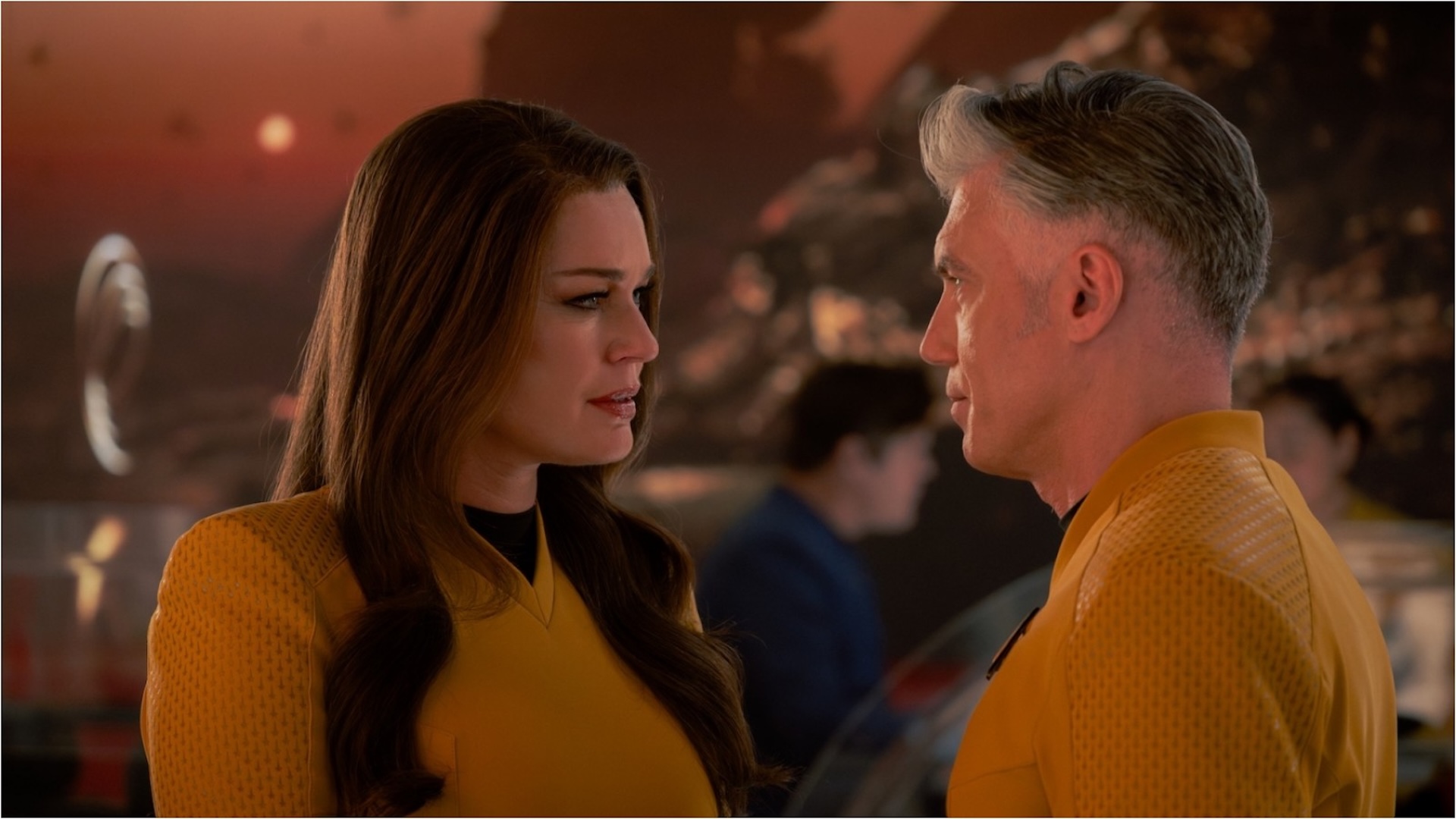
    The following contains spoilers for Star Trek: Strange New Worlds season 4 episode 7. Star Trek: Strange New Worlds has gleefully played around in lots of different genres and movements. This season alone it’s tackled film noir, horror, and whatever you call it when the bulk of the main cast turns into puppets. (Do The […]

    The post Star Trek: Strange New Worlds Season 4 Episode 7 Review — Like Chronitons Through the Hourglass appeared first on Den of Geek.

    Martin Scorsese has been making movies since 1967. His filmography currently sits at 26 features, 16 documentaries, and numerous short films. He’s a tireless advocate for film, supporting numerous preservation efforts and sponsoring the world cinema project, which brings attention to filmmakers across the globe. And lately he’s become something of a social media darling, thanks to the efforts of his granddaughter, plus pop star Charli XCX.

    Yet if you ask the average moviegoer about Martin Scorsese, they’re likely to identify him as just that guy who makes gangster pictures. To a certain degree, it’s a fair assessment. Scorsese did, after all, make Goodfellas, Casino, and The Irishman, some of the greatest mob movies of all time. Heck, we can include The Wolf of Wall Street and Killers of the Flower Moon in that same category since they are flicks about groups of people doing crime. (Which for the purposes of this list, we are!) Still, Scorsese is so much more than just a chronicler of the mob life. One need not look far into his filmography to find movies in every genre, some of them masterpieces like these nine greats.

    cnx.cmd.push(function() {
    cnx({
    playerId: “106e33c0-3911-473c-b599-b1426db57530”,

    }).render(“0270c398a82f44f49c23c16122516796”);
    });

    Alice Doesn’t Live Here Anymore (1974)

    Even after making three pictures, Scorsese was worried that he was focusing too much on the wiseguys. So when Ellen Burstyn, hot off her Best Actress nomination for The Exorcist, brought to him a Robert Getchell script about a single mom starting out on a new life, Scorsese jumped at the chance to direct. Some of the hallmarks of Scorsese’s style appear in Alice Doesn’t Live Here Anymore, including a bad man played by frequent collaborator Harvey Keitel. But much of Alice shows off the director’s keen eye for desperate people finding themselves, even if they do so through entirely legal means.

    Burstyn plays Alice Hyatt, whose unhappy marriage comes to an end when her husband (Billy Green Bush) dies in a car accident. Together with her son Tommy (Alfred Lutter), Alice moves to her California hometown hoping to ignite a singing career. But when that fails to take off, she takes a job as a lounge singer where she falls for Ben (Keitel), a violent man hiding his marriage from Alice. To escape Ben, Alice goes to Tuscon, Arizona, where she gets a job at a diner filled with colorful characters, and embarks on a romance with David (Kris Kristofferson). Despite the movie’s more warm-hearted ending, Alice Doesn’t Live Here Anymore has the same clear-eyed seriousness that Scorsese brings to all of his movies, making Alice just as complicated as any made man he’d later bring to the screen.

    Taxi Driver (1976)

    Between its iconic lines (“You talkin’ to me?”) and its gratuitously violent climax, which famously almost earned the film an X-rating, Taxi Driver is unquestionably a Martin Scorsese movie. Yet for as much as Robert De Niro‘s Travis Bickle, with his mohawk and dark glasses, has implanted himself in popular culture, the depth and loneliness of Taxi Driver has been too often overlooked.

    Taxi Driver is decidedly not a gangster movie, because Travis Bickle has no gang. Heck, he doesn’t even have friends or co-workers. Instead he spends his nights driving a cab throughout the city, a job he takes as a response to his insomnia. He makes no connections with the people who come in and out of his car, but rather turns them into objects of his fantasies, whether they be a young sex worker (Jodie Foster), a potential date (Cybill Shepherd), or a deeply bigoted man played by Scorsese himself. Lost in his own head, Bickle sees himself as a brutal avenger, one who may or may not mete out his own form of justice.

    The Last Waltz (1978)

    Pop music has always been a big part of Scorsese’s filmography, right from the rambunctious opening of his debut feature Who’s That Knocking at My Door?. So it’s no surprise that he would eventually skip the needle drops and go straight to shooting the band themselves. Which is literally what he does with his first concert documentary The Last Waltz, which captures the final performances of legendary rock group The Band.

    Music aficionados will be quick to point out that The Last Waltz does a poor job of representing the actual group, as it pushes most members to the side to focus on frontman Robbie Robertson. But for those willing to set aside accuracy and take the movie as it comes, The Last Waltz is as riveting as any of Scorsese’s works. The songs, of course, are incredible, especially when the Staples Singers join the group to deliver their classic “The Weight.” But just as impressive is the way Scorsese and his crew capture the artists, most notably Muddy Waters’ thundering “Mannish Boy,” a number they almost neglected to shoot, captured on a single camera that rocks to the rhythm of the blues master’s beat.

    Raging Bull (1980)

    Martin Scorsese has remarked more than once that he was pleasantly surprised when he came out on the other side of Raging Bull to discover that he was still breathing. The experience (and the cocaine) had given him reasons to doubt. We’re of course glad he made it through and also relieed he achieved this uncompromising and brutal triumph of cinema. Jake LaMotta is indeed a tough man to love, with the real-life middleweight boxing champion being essayed in all his violence, hostility, and downright cruelty to his wife and a brother who was (at least according to this film) the only person he could trust.

    A biopic about a hard man, Raging Bull turns blood and despair into poetry, reinventing the boxing movie for the first time in decades into a one-man ringside ballet defused in rich black and white cinematography (compliments of Michael Chapman) and a towering performance by Robert De Niro as man unable and uninterested in articulating the source of his rage, but who lets it consume him total even when it makes him a champ. The brilliance of the movie is that it then stays with him past those heady and kinetic days in the ring, finding him decades later alone and miserable in a tragedy that the director and star covet like a lover.

    The King of Comedy (1982)

    It takes most viewers several rewatches of Taxi Driver before they realize that Travis Bickle is, above all, pathetic. Not so with Rupert Pupkin! Here is the lonely antihero that De Niro plays in The King of Comedy. Written by Paul D. Zimmerman, The King of Comedy follows ambitious comedian Pupkin as he embarks on a desperate plot to get attention by kidnapping Jerry Langford, a talk show host played by Jerry Lewis.

    Pupkin is no less frightening than Travis Bickle, even if he presents himself as affable and funny. De Niro injects a sense of menace into his character’s smile, whether he’s making appeals to Langford or addressing the studio audience. Yet where Bickle’s exploits largely take place in his head, Pupkin has a studio audience and viewers on television—perhaps several, depending on how one reads the movie’s depiction of reality and fantasy. However, the audiences don’t make Pupkin any more accepted and loved, putting a new spin on the loneliness that affected his predecessor, Travis.

    The Last Temptation of Christ (1988)

    Scorsese’s movies have been as much about Christianity as they have been about crime and rock and roll. From Mean Streets onward, his characters have sought salvation and wrestled with the fear of damnation, often calling out to God for direction. In that way, the Jesus of The Last Temptation of Christ, played by Willem Dafoe, isn’t that different than any of Scorsese’s other protagonists, even if he’s called to be the son of God.

    Written by Taxi Driver scribe Paul Schrader and adapted from the novel by Nikos Kazantzakis, The Last Temptation of Christ depicts a fully human Jesus, someone who wants nothing more than to marry Mary Madgeline (Barbara Hershey) and spend his days working, but who cannot escape the call of God. To some, The Last Temptation of Christ feels blasphemous, as this Jesus can be read as giving into the final temptation, the one that allows him to avoid sacrifice. But those watching closely will see that the devout Scorsese has given us a faithful Jesus, faithful even to death on a cross.

    The Age of Innocence (1993)

    Scorsese famously called The Age of Innocence, which he and co-screenwriter Jay Cocks adapted from the Edith Wharton novel, his most violent film. At first that claim sounds hyperbolic. After all, no one in this story of romance among the monied elite of 1870s New York pulls a gun or sticks someone’s head in a vice. Yet when one pays attention to the emotional vulnerability on display, and the great risks assumed by those who seek love, only to have it flatly denied, then Scorsese’s assessment rings true.

    Daniel Day Lewis plays Newland Archer, a lawyer who hopes to marry May Welland (Winona Ryder). But when Welland’s cousin, the Countess Ellen Olenska (Michelle Pfeiffer), returns to New York after her failed marriage to a Polish nobleman, Archer’s feelings start to shift. The trio must navigate not just their complicated emotions, but also the demands of high society, a veritable tribe, which already have punished Ellen for the crime of her failed marriage. In the end, The Age of Innocence captures a desire that can never be fulfilled and a longing that can’t be articulated, putting its characters through pain greater than any mobster could ever inflict.

    The Aviator (2004)

    A movie that Leonardo DiCaprio holds in particularly high regard for what it represented in his career, The Aviator was the second of the then young star’s collaborations with the Raging Bull director. We also would maintain it is one of their more underappreciated despite numerous Oscar nominations, and five wins, including Cate Blanchett for playing Hollywood legend Katharine Hepburn. It’s a movie obviously meant to wow the Academy (at least in the eyes of its studio backers at Miramax). But for Scorsese it epitomized one of his great fixations: the obsessive, passionate artist who will annihilate himself and everyone around him to achieve his dreams.

    Admittedly, the real Howard Hughes—the eccentric and, eventually, OCD-raddled mogul played by DiCaprio—likely would not have called himself an artist. He was an aviator, a businessman, a movie producer, a self-described patriot, and plenty of other unsavory things too. But in Scorsese’s hands his near ruinous obsession with directing Hell’s Angels, the half-talkie and half-silent World War I aviation epic that almost bankrupted Hughes twice over before the age of 25 (and then turned out to be Hollywood’s first epic of the sound era) encapsulates a life lived like Icarus: an ancient hero who flies too close to the sun. His literal fall and crash above the rooftops of Beverly Hills is likewise pretty spectacular in Scorsese’s hands. More important than the set pieces, however, is a cinephile’s awe at the Golden Age Hollywood through which Hughes in his prime drifted, and his tragic empathy for a guy who basically had it all but through his own neuroses did great things, terrible things, defied authority, and made for himself a prison worthy of Charles Foster Kane.

    Silence (2016)

    Although undisputedly the auteur of his films, Scorsese has few writing credits to his name. So the fact that he is listed as a screenwriter, once again alongside Cocks, for adapting the 1966 novel by Japanese author Shūsaku Endō means that Silence has particular importance for Scorsese. Silence brings Scorsese once again back to his Christian faith, and once again deals with questions of skepticism. But unlike his previous religious pictures, Silence brings in a level of suffering and violence usually reserved for movies about gangsters and criminals.

    Set in 1640, Silence has a Heart of Darkness-style premise in which young Jesuit priests Sebastião Rodrigues (Andrew Garfield) and Francisco Garupe (Adam Driver) are dispatched to Japan to find their mentor Cristóvão Ferreira (Liam Neeson), who has reportedly abandoned the faith in a land now shut off from the West. There they discover the Tokugawa shogunate now ruling Japan has not only cast out the priests but are murdering Catholic Japanese peasants who refuse to renounce their faith by the thousands. Meanwhile our priests find themselves forced to renounce their beliefs on pain of torture. What follows is one of Scorsese’s most unpleasant but breathtaking movies, proving that he understands the capacity for violence, and sacrifice, in anyone, saint and sinner alike.

    The post The Best Martin Scorsese Movies Not About Gangsters appeared first on Den of Geek.

  • 15 Comedians You May Have Never Heard of, But We Can’t Stop Laughing At

    15 Comedians You May Have Never Heard of, But We Can’t Stop Laughing At

    Comedy is full of people who never become household names despite being incredibly funny. Some built loyal audiences through stand up, podcasts, sketch shows, or small movie roles, while others became favorites in comedy circles without ever reaching the level of the biggest stars. That can make discovering them feel like finding a secret everyone else somehow missed. They may not have the biggest credits or millions of followers, but their timing, delivery, observations, and completely strange sense of humor can make them impossible to stop watching once you find them. Here are fifteen comedians who deserve far more attention, especially if you are tired of hearing about the same famous comedy stars.

    The post 15 Comedians You May Have Never Heard of, But We Can’t Stop Laughing At appeared first on Den of Geek.

    Martin Scorsese has been making movies since 1967. His filmography currently sits at 26 features, 16 documentaries, and numerous short films. He’s a tireless advocate for film, supporting numerous preservation efforts and sponsoring the world cinema project, which brings attention to filmmakers across the globe. And lately he’s become something of a social media darling, thanks to the efforts of his granddaughter, plus pop star Charli XCX.

    Yet if you ask the average moviegoer about Martin Scorsese, they’re likely to identify him as just that guy who makes gangster pictures. To a certain degree, it’s a fair assessment. Scorsese did, after all, make Goodfellas, Casino, and The Irishman, some of the greatest mob movies of all time. Heck, we can include The Wolf of Wall Street and Killers of the Flower Moon in that same category since they are flicks about groups of people doing crime. (Which for the purposes of this list, we are!) Still, Scorsese is so much more than just a chronicler of the mob life. One need not look far into his filmography to find movies in every genre, some of them masterpieces like these nine greats.

    cnx.cmd.push(function() {
    cnx({
    playerId: “106e33c0-3911-473c-b599-b1426db57530”,

    }).render(“0270c398a82f44f49c23c16122516796”);
    });

    Alice Doesn’t Live Here Anymore (1974)

    Even after making three pictures, Scorsese was worried that he was focusing too much on the wiseguys. So when Ellen Burstyn, hot off her Best Actress nomination for The Exorcist, brought to him a Robert Getchell script about a single mom starting out on a new life, Scorsese jumped at the chance to direct. Some of the hallmarks of Scorsese’s style appear in Alice Doesn’t Live Here Anymore, including a bad man played by frequent collaborator Harvey Keitel. But much of Alice shows off the director’s keen eye for desperate people finding themselves, even if they do so through entirely legal means.

    Burstyn plays Alice Hyatt, whose unhappy marriage comes to an end when her husband (Billy Green Bush) dies in a car accident. Together with her son Tommy (Alfred Lutter), Alice moves to her California hometown hoping to ignite a singing career. But when that fails to take off, she takes a job as a lounge singer where she falls for Ben (Keitel), a violent man hiding his marriage from Alice. To escape Ben, Alice goes to Tuscon, Arizona, where she gets a job at a diner filled with colorful characters, and embarks on a romance with David (Kris Kristofferson). Despite the movie’s more warm-hearted ending, Alice Doesn’t Live Here Anymore has the same clear-eyed seriousness that Scorsese brings to all of his movies, making Alice just as complicated as any made man he’d later bring to the screen.

    Taxi Driver (1976)

    Between its iconic lines (“You talkin’ to me?”) and its gratuitously violent climax, which famously almost earned the film an X-rating, Taxi Driver is unquestionably a Martin Scorsese movie. Yet for as much as Robert De Niro‘s Travis Bickle, with his mohawk and dark glasses, has implanted himself in popular culture, the depth and loneliness of Taxi Driver has been too often overlooked.

    Taxi Driver is decidedly not a gangster movie, because Travis Bickle has no gang. Heck, he doesn’t even have friends or co-workers. Instead he spends his nights driving a cab throughout the city, a job he takes as a response to his insomnia. He makes no connections with the people who come in and out of his car, but rather turns them into objects of his fantasies, whether they be a young sex worker (Jodie Foster), a potential date (Cybill Shepherd), or a deeply bigoted man played by Scorsese himself. Lost in his own head, Bickle sees himself as a brutal avenger, one who may or may not mete out his own form of justice.

    The Last Waltz (1978)

    Pop music has always been a big part of Scorsese’s filmography, right from the rambunctious opening of his debut feature Who’s That Knocking at My Door?. So it’s no surprise that he would eventually skip the needle drops and go straight to shooting the band themselves. Which is literally what he does with his first concert documentary The Last Waltz, which captures the final performances of legendary rock group The Band.

    Music aficionados will be quick to point out that The Last Waltz does a poor job of representing the actual group, as it pushes most members to the side to focus on frontman Robbie Robertson. But for those willing to set aside accuracy and take the movie as it comes, The Last Waltz is as riveting as any of Scorsese’s works. The songs, of course, are incredible, especially when the Staples Singers join the group to deliver their classic “The Weight.” But just as impressive is the way Scorsese and his crew capture the artists, most notably Muddy Waters’ thundering “Mannish Boy,” a number they almost neglected to shoot, captured on a single camera that rocks to the rhythm of the blues master’s beat.

    Raging Bull (1980)

    Martin Scorsese has remarked more than once that he was pleasantly surprised when he came out on the other side of Raging Bull to discover that he was still breathing. The experience (and the cocaine) had given him reasons to doubt. We’re of course glad he made it through and also relieed he achieved this uncompromising and brutal triumph of cinema. Jake LaMotta is indeed a tough man to love, with the real-life middleweight boxing champion being essayed in all his violence, hostility, and downright cruelty to his wife and a brother who was (at least according to this film) the only person he could trust.

    A biopic about a hard man, Raging Bull turns blood and despair into poetry, reinventing the boxing movie for the first time in decades into a one-man ringside ballet defused in rich black and white cinematography (compliments of Michael Chapman) and a towering performance by Robert De Niro as man unable and uninterested in articulating the source of his rage, but who lets it consume him total even when it makes him a champ. The brilliance of the movie is that it then stays with him past those heady and kinetic days in the ring, finding him decades later alone and miserable in a tragedy that the director and star covet like a lover.

    The King of Comedy (1982)

    It takes most viewers several rewatches of Taxi Driver before they realize that Travis Bickle is, above all, pathetic. Not so with Rupert Pupkin! Here is the lonely antihero that De Niro plays in The King of Comedy. Written by Paul D. Zimmerman, The King of Comedy follows ambitious comedian Pupkin as he embarks on a desperate plot to get attention by kidnapping Jerry Langford, a talk show host played by Jerry Lewis.

    Pupkin is no less frightening than Travis Bickle, even if he presents himself as affable and funny. De Niro injects a sense of menace into his character’s smile, whether he’s making appeals to Langford or addressing the studio audience. Yet where Bickle’s exploits largely take place in his head, Pupkin has a studio audience and viewers on television—perhaps several, depending on how one reads the movie’s depiction of reality and fantasy. However, the audiences don’t make Pupkin any more accepted and loved, putting a new spin on the loneliness that affected his predecessor, Travis.

    The Last Temptation of Christ (1988)

    Scorsese’s movies have been as much about Christianity as they have been about crime and rock and roll. From Mean Streets onward, his characters have sought salvation and wrestled with the fear of damnation, often calling out to God for direction. In that way, the Jesus of The Last Temptation of Christ, played by Willem Dafoe, isn’t that different than any of Scorsese’s other protagonists, even if he’s called to be the son of God.

    Written by Taxi Driver scribe Paul Schrader and adapted from the novel by Nikos Kazantzakis, The Last Temptation of Christ depicts a fully human Jesus, someone who wants nothing more than to marry Mary Madgeline (Barbara Hershey) and spend his days working, but who cannot escape the call of God. To some, The Last Temptation of Christ feels blasphemous, as this Jesus can be read as giving into the final temptation, the one that allows him to avoid sacrifice. But those watching closely will see that the devout Scorsese has given us a faithful Jesus, faithful even to death on a cross.

    The Age of Innocence (1993)

    Scorsese famously called The Age of Innocence, which he and co-screenwriter Jay Cocks adapted from the Edith Wharton novel, his most violent film. At first that claim sounds hyperbolic. After all, no one in this story of romance among the monied elite of 1870s New York pulls a gun or sticks someone’s head in a vice. Yet when one pays attention to the emotional vulnerability on display, and the great risks assumed by those who seek love, only to have it flatly denied, then Scorsese’s assessment rings true.

    Daniel Day Lewis plays Newland Archer, a lawyer who hopes to marry May Welland (Winona Ryder). But when Welland’s cousin, the Countess Ellen Olenska (Michelle Pfeiffer), returns to New York after her failed marriage to a Polish nobleman, Archer’s feelings start to shift. The trio must navigate not just their complicated emotions, but also the demands of high society, a veritable tribe, which already have punished Ellen for the crime of her failed marriage. In the end, The Age of Innocence captures a desire that can never be fulfilled and a longing that can’t be articulated, putting its characters through pain greater than any mobster could ever inflict.

    The Aviator (2004)

    A movie that Leonardo DiCaprio holds in particularly high regard for what it represented in his career, The Aviator was the second of the then young star’s collaborations with the Raging Bull director. We also would maintain it is one of their more underappreciated despite numerous Oscar nominations, and five wins, including Cate Blanchett for playing Hollywood legend Katharine Hepburn. It’s a movie obviously meant to wow the Academy (at least in the eyes of its studio backers at Miramax). But for Scorsese it epitomized one of his great fixations: the obsessive, passionate artist who will annihilate himself and everyone around him to achieve his dreams.

    Admittedly, the real Howard Hughes—the eccentric and, eventually, OCD-raddled mogul played by DiCaprio—likely would not have called himself an artist. He was an aviator, a businessman, a movie producer, a self-described patriot, and plenty of other unsavory things too. But in Scorsese’s hands his near ruinous obsession with directing Hell’s Angels, the half-talkie and half-silent World War I aviation epic that almost bankrupted Hughes twice over before the age of 25 (and then turned out to be Hollywood’s first epic of the sound era) encapsulates a life lived like Icarus: an ancient hero who flies too close to the sun. His literal fall and crash above the rooftops of Beverly Hills is likewise pretty spectacular in Scorsese’s hands. More important than the set pieces, however, is a cinephile’s awe at the Golden Age Hollywood through which Hughes in his prime drifted, and his tragic empathy for a guy who basically had it all but through his own neuroses did great things, terrible things, defied authority, and made for himself a prison worthy of Charles Foster Kane.

    Silence (2016)

    Although undisputedly the auteur of his films, Scorsese has few writing credits to his name. So the fact that he is listed as a screenwriter, once again alongside Cocks, for adapting the 1966 novel by Japanese author Shūsaku Endō means that Silence has particular importance for Scorsese. Silence brings Scorsese once again back to his Christian faith, and once again deals with questions of skepticism. But unlike his previous religious pictures, Silence brings in a level of suffering and violence usually reserved for movies about gangsters and criminals.

    Set in 1640, Silence has a Heart of Darkness-style premise in which young Jesuit priests Sebastião Rodrigues (Andrew Garfield) and Francisco Garupe (Adam Driver) are dispatched to Japan to find their mentor Cristóvão Ferreira (Liam Neeson), who has reportedly abandoned the faith in a land now shut off from the West. There they discover the Tokugawa shogunate now ruling Japan has not only cast out the priests but are murdering Catholic Japanese peasants who refuse to renounce their faith by the thousands. Meanwhile our priests find themselves forced to renounce their beliefs on pain of torture. What follows is one of Scorsese’s most unpleasant but breathtaking movies, proving that he understands the capacity for violence, and sacrifice, in anyone, saint and sinner alike.

    The post The Best Martin Scorsese Movies Not About Gangsters appeared first on Den of Geek.

  • Uncanny Movie Facts That Might Change Your Perspective

    Uncanny Movie Facts That Might Change Your Perspective

    Movies can feel completely different once you know what was happening behind the scenes. A harmless looking scene may have been created under bizarre circumstances, a familiar performance may have a surprisingly uncomfortable story behind it, or a tiny production decision may completely change the way you interpret what appears on screen. Some facts are simply strange, while others make familiar movies feel almost eerie when you revisit them. The best ones are not obscure trivia for the sake of it. They give you a reason to look at a movie differently the next time you watch it. Here are fifteen uncanny movie facts that might make some very familiar films feel surprisingly different.

    The post Uncanny Movie Facts That Might Change Your Perspective appeared first on Den of Geek.

    Martin Scorsese has been making movies since 1967. His filmography currently sits at 26 features, 16 documentaries, and numerous short films. He’s a tireless advocate for film, supporting numerous preservation efforts and sponsoring the world cinema project, which brings attention to filmmakers across the globe. And lately he’s become something of a social media darling, thanks to the efforts of his granddaughter, plus pop star Charli XCX.

    Yet if you ask the average moviegoer about Martin Scorsese, they’re likely to identify him as just that guy who makes gangster pictures. To a certain degree, it’s a fair assessment. Scorsese did, after all, make Goodfellas, Casino, and The Irishman, some of the greatest mob movies of all time. Heck, we can include The Wolf of Wall Street and Killers of the Flower Moon in that same category since they are flicks about groups of people doing crime. (Which for the purposes of this list, we are!) Still, Scorsese is so much more than just a chronicler of the mob life. One need not look far into his filmography to find movies in every genre, some of them masterpieces like these nine greats.

    cnx.cmd.push(function() {
    cnx({
    playerId: “106e33c0-3911-473c-b599-b1426db57530”,

    }).render(“0270c398a82f44f49c23c16122516796”);
    });

    Alice Doesn’t Live Here Anymore (1974)

    Even after making three pictures, Scorsese was worried that he was focusing too much on the wiseguys. So when Ellen Burstyn, hot off her Best Actress nomination for The Exorcist, brought to him a Robert Getchell script about a single mom starting out on a new life, Scorsese jumped at the chance to direct. Some of the hallmarks of Scorsese’s style appear in Alice Doesn’t Live Here Anymore, including a bad man played by frequent collaborator Harvey Keitel. But much of Alice shows off the director’s keen eye for desperate people finding themselves, even if they do so through entirely legal means.

    Burstyn plays Alice Hyatt, whose unhappy marriage comes to an end when her husband (Billy Green Bush) dies in a car accident. Together with her son Tommy (Alfred Lutter), Alice moves to her California hometown hoping to ignite a singing career. But when that fails to take off, she takes a job as a lounge singer where she falls for Ben (Keitel), a violent man hiding his marriage from Alice. To escape Ben, Alice goes to Tuscon, Arizona, where she gets a job at a diner filled with colorful characters, and embarks on a romance with David (Kris Kristofferson). Despite the movie’s more warm-hearted ending, Alice Doesn’t Live Here Anymore has the same clear-eyed seriousness that Scorsese brings to all of his movies, making Alice just as complicated as any made man he’d later bring to the screen.

    Taxi Driver (1976)

    Between its iconic lines (“You talkin’ to me?”) and its gratuitously violent climax, which famously almost earned the film an X-rating, Taxi Driver is unquestionably a Martin Scorsese movie. Yet for as much as Robert De Niro‘s Travis Bickle, with his mohawk and dark glasses, has implanted himself in popular culture, the depth and loneliness of Taxi Driver has been too often overlooked.

    Taxi Driver is decidedly not a gangster movie, because Travis Bickle has no gang. Heck, he doesn’t even have friends or co-workers. Instead he spends his nights driving a cab throughout the city, a job he takes as a response to his insomnia. He makes no connections with the people who come in and out of his car, but rather turns them into objects of his fantasies, whether they be a young sex worker (Jodie Foster), a potential date (Cybill Shepherd), or a deeply bigoted man played by Scorsese himself. Lost in his own head, Bickle sees himself as a brutal avenger, one who may or may not mete out his own form of justice.

    The Last Waltz (1978)

    Pop music has always been a big part of Scorsese’s filmography, right from the rambunctious opening of his debut feature Who’s That Knocking at My Door?. So it’s no surprise that he would eventually skip the needle drops and go straight to shooting the band themselves. Which is literally what he does with his first concert documentary The Last Waltz, which captures the final performances of legendary rock group The Band.

    Music aficionados will be quick to point out that The Last Waltz does a poor job of representing the actual group, as it pushes most members to the side to focus on frontman Robbie Robertson. But for those willing to set aside accuracy and take the movie as it comes, The Last Waltz is as riveting as any of Scorsese’s works. The songs, of course, are incredible, especially when the Staples Singers join the group to deliver their classic “The Weight.” But just as impressive is the way Scorsese and his crew capture the artists, most notably Muddy Waters’ thundering “Mannish Boy,” a number they almost neglected to shoot, captured on a single camera that rocks to the rhythm of the blues master’s beat.

    Raging Bull (1980)

    Martin Scorsese has remarked more than once that he was pleasantly surprised when he came out on the other side of Raging Bull to discover that he was still breathing. The experience (and the cocaine) had given him reasons to doubt. We’re of course glad he made it through and also relieed he achieved this uncompromising and brutal triumph of cinema. Jake LaMotta is indeed a tough man to love, with the real-life middleweight boxing champion being essayed in all his violence, hostility, and downright cruelty to his wife and a brother who was (at least according to this film) the only person he could trust.

    A biopic about a hard man, Raging Bull turns blood and despair into poetry, reinventing the boxing movie for the first time in decades into a one-man ringside ballet defused in rich black and white cinematography (compliments of Michael Chapman) and a towering performance by Robert De Niro as man unable and uninterested in articulating the source of his rage, but who lets it consume him total even when it makes him a champ. The brilliance of the movie is that it then stays with him past those heady and kinetic days in the ring, finding him decades later alone and miserable in a tragedy that the director and star covet like a lover.

    The King of Comedy (1982)

    It takes most viewers several rewatches of Taxi Driver before they realize that Travis Bickle is, above all, pathetic. Not so with Rupert Pupkin! Here is the lonely antihero that De Niro plays in The King of Comedy. Written by Paul D. Zimmerman, The King of Comedy follows ambitious comedian Pupkin as he embarks on a desperate plot to get attention by kidnapping Jerry Langford, a talk show host played by Jerry Lewis.

    Pupkin is no less frightening than Travis Bickle, even if he presents himself as affable and funny. De Niro injects a sense of menace into his character’s smile, whether he’s making appeals to Langford or addressing the studio audience. Yet where Bickle’s exploits largely take place in his head, Pupkin has a studio audience and viewers on television—perhaps several, depending on how one reads the movie’s depiction of reality and fantasy. However, the audiences don’t make Pupkin any more accepted and loved, putting a new spin on the loneliness that affected his predecessor, Travis.

    The Last Temptation of Christ (1988)

    Scorsese’s movies have been as much about Christianity as they have been about crime and rock and roll. From Mean Streets onward, his characters have sought salvation and wrestled with the fear of damnation, often calling out to God for direction. In that way, the Jesus of The Last Temptation of Christ, played by Willem Dafoe, isn’t that different than any of Scorsese’s other protagonists, even if he’s called to be the son of God.

    Written by Taxi Driver scribe Paul Schrader and adapted from the novel by Nikos Kazantzakis, The Last Temptation of Christ depicts a fully human Jesus, someone who wants nothing more than to marry Mary Madgeline (Barbara Hershey) and spend his days working, but who cannot escape the call of God. To some, The Last Temptation of Christ feels blasphemous, as this Jesus can be read as giving into the final temptation, the one that allows him to avoid sacrifice. But those watching closely will see that the devout Scorsese has given us a faithful Jesus, faithful even to death on a cross.

    The Age of Innocence (1993)

    Scorsese famously called The Age of Innocence, which he and co-screenwriter Jay Cocks adapted from the Edith Wharton novel, his most violent film. At first that claim sounds hyperbolic. After all, no one in this story of romance among the monied elite of 1870s New York pulls a gun or sticks someone’s head in a vice. Yet when one pays attention to the emotional vulnerability on display, and the great risks assumed by those who seek love, only to have it flatly denied, then Scorsese’s assessment rings true.

    Daniel Day Lewis plays Newland Archer, a lawyer who hopes to marry May Welland (Winona Ryder). But when Welland’s cousin, the Countess Ellen Olenska (Michelle Pfeiffer), returns to New York after her failed marriage to a Polish nobleman, Archer’s feelings start to shift. The trio must navigate not just their complicated emotions, but also the demands of high society, a veritable tribe, which already have punished Ellen for the crime of her failed marriage. In the end, The Age of Innocence captures a desire that can never be fulfilled and a longing that can’t be articulated, putting its characters through pain greater than any mobster could ever inflict.

    The Aviator (2004)

    A movie that Leonardo DiCaprio holds in particularly high regard for what it represented in his career, The Aviator was the second of the then young star’s collaborations with the Raging Bull director. We also would maintain it is one of their more underappreciated despite numerous Oscar nominations, and five wins, including Cate Blanchett for playing Hollywood legend Katharine Hepburn. It’s a movie obviously meant to wow the Academy (at least in the eyes of its studio backers at Miramax). But for Scorsese it epitomized one of his great fixations: the obsessive, passionate artist who will annihilate himself and everyone around him to achieve his dreams.

    Admittedly, the real Howard Hughes—the eccentric and, eventually, OCD-raddled mogul played by DiCaprio—likely would not have called himself an artist. He was an aviator, a businessman, a movie producer, a self-described patriot, and plenty of other unsavory things too. But in Scorsese’s hands his near ruinous obsession with directing Hell’s Angels, the half-talkie and half-silent World War I aviation epic that almost bankrupted Hughes twice over before the age of 25 (and then turned out to be Hollywood’s first epic of the sound era) encapsulates a life lived like Icarus: an ancient hero who flies too close to the sun. His literal fall and crash above the rooftops of Beverly Hills is likewise pretty spectacular in Scorsese’s hands. More important than the set pieces, however, is a cinephile’s awe at the Golden Age Hollywood through which Hughes in his prime drifted, and his tragic empathy for a guy who basically had it all but through his own neuroses did great things, terrible things, defied authority, and made for himself a prison worthy of Charles Foster Kane.

    Silence (2016)

    Although undisputedly the auteur of his films, Scorsese has few writing credits to his name. So the fact that he is listed as a screenwriter, once again alongside Cocks, for adapting the 1966 novel by Japanese author Shūsaku Endō means that Silence has particular importance for Scorsese. Silence brings Scorsese once again back to his Christian faith, and once again deals with questions of skepticism. But unlike his previous religious pictures, Silence brings in a level of suffering and violence usually reserved for movies about gangsters and criminals.

    Set in 1640, Silence has a Heart of Darkness-style premise in which young Jesuit priests Sebastião Rodrigues (Andrew Garfield) and Francisco Garupe (Adam Driver) are dispatched to Japan to find their mentor Cristóvão Ferreira (Liam Neeson), who has reportedly abandoned the faith in a land now shut off from the West. There they discover the Tokugawa shogunate now ruling Japan has not only cast out the priests but are murdering Catholic Japanese peasants who refuse to renounce their faith by the thousands. Meanwhile our priests find themselves forced to renounce their beliefs on pain of torture. What follows is one of Scorsese’s most unpleasant but breathtaking movies, proving that he understands the capacity for violence, and sacrifice, in anyone, saint and sinner alike.

    The post The Best Martin Scorsese Movies Not About Gangsters appeared first on Den of Geek.

  • 15 TV Episodes That Were Considered Too Weird to Air

    15 TV Episodes That Were Considered Too Weird to Air

    Television has always had moments when a network executive looked at an episode and wondered what on earth the writers were thinking. Sometimes the problem was the subject matter, while other episodes pushed animation, storytelling, violence, surreal humor, or social commentary far beyond what audiences expected from the show. A few were delayed, edited, pulled from schedules, or only aired after serious arguments behind the scenes. Others technically made it to television but left viewers wondering how anyone managed to get them approved. These fifteen episodes earned unusual reputations for being too strange, uncomfortable, controversial, or simply bizarre for their time, proving that television has occasionally gone much further than anyone expected.

    The post 15 TV Episodes That Were Considered Too Weird to Air appeared first on Den of Geek.

    Martin Scorsese has been making movies since 1967. His filmography currently sits at 26 features, 16 documentaries, and numerous short films. He’s a tireless advocate for film, supporting numerous preservation efforts and sponsoring the world cinema project, which brings attention to filmmakers across the globe. And lately he’s become something of a social media darling, thanks to the efforts of his granddaughter, plus pop star Charli XCX.

    Yet if you ask the average moviegoer about Martin Scorsese, they’re likely to identify him as just that guy who makes gangster pictures. To a certain degree, it’s a fair assessment. Scorsese did, after all, make Goodfellas, Casino, and The Irishman, some of the greatest mob movies of all time. Heck, we can include The Wolf of Wall Street and Killers of the Flower Moon in that same category since they are flicks about groups of people doing crime. (Which for the purposes of this list, we are!) Still, Scorsese is so much more than just a chronicler of the mob life. One need not look far into his filmography to find movies in every genre, some of them masterpieces like these nine greats.

    cnx.cmd.push(function() {
    cnx({
    playerId: “106e33c0-3911-473c-b599-b1426db57530”,

    }).render(“0270c398a82f44f49c23c16122516796”);
    });

    Alice Doesn’t Live Here Anymore (1974)

    Even after making three pictures, Scorsese was worried that he was focusing too much on the wiseguys. So when Ellen Burstyn, hot off her Best Actress nomination for The Exorcist, brought to him a Robert Getchell script about a single mom starting out on a new life, Scorsese jumped at the chance to direct. Some of the hallmarks of Scorsese’s style appear in Alice Doesn’t Live Here Anymore, including a bad man played by frequent collaborator Harvey Keitel. But much of Alice shows off the director’s keen eye for desperate people finding themselves, even if they do so through entirely legal means.

    Burstyn plays Alice Hyatt, whose unhappy marriage comes to an end when her husband (Billy Green Bush) dies in a car accident. Together with her son Tommy (Alfred Lutter), Alice moves to her California hometown hoping to ignite a singing career. But when that fails to take off, she takes a job as a lounge singer where she falls for Ben (Keitel), a violent man hiding his marriage from Alice. To escape Ben, Alice goes to Tuscon, Arizona, where she gets a job at a diner filled with colorful characters, and embarks on a romance with David (Kris Kristofferson). Despite the movie’s more warm-hearted ending, Alice Doesn’t Live Here Anymore has the same clear-eyed seriousness that Scorsese brings to all of his movies, making Alice just as complicated as any made man he’d later bring to the screen.

    Taxi Driver (1976)

    Between its iconic lines (“You talkin’ to me?”) and its gratuitously violent climax, which famously almost earned the film an X-rating, Taxi Driver is unquestionably a Martin Scorsese movie. Yet for as much as Robert De Niro‘s Travis Bickle, with his mohawk and dark glasses, has implanted himself in popular culture, the depth and loneliness of Taxi Driver has been too often overlooked.

    Taxi Driver is decidedly not a gangster movie, because Travis Bickle has no gang. Heck, he doesn’t even have friends or co-workers. Instead he spends his nights driving a cab throughout the city, a job he takes as a response to his insomnia. He makes no connections with the people who come in and out of his car, but rather turns them into objects of his fantasies, whether they be a young sex worker (Jodie Foster), a potential date (Cybill Shepherd), or a deeply bigoted man played by Scorsese himself. Lost in his own head, Bickle sees himself as a brutal avenger, one who may or may not mete out his own form of justice.

    The Last Waltz (1978)

    Pop music has always been a big part of Scorsese’s filmography, right from the rambunctious opening of his debut feature Who’s That Knocking at My Door?. So it’s no surprise that he would eventually skip the needle drops and go straight to shooting the band themselves. Which is literally what he does with his first concert documentary The Last Waltz, which captures the final performances of legendary rock group The Band.

    Music aficionados will be quick to point out that The Last Waltz does a poor job of representing the actual group, as it pushes most members to the side to focus on frontman Robbie Robertson. But for those willing to set aside accuracy and take the movie as it comes, The Last Waltz is as riveting as any of Scorsese’s works. The songs, of course, are incredible, especially when the Staples Singers join the group to deliver their classic “The Weight.” But just as impressive is the way Scorsese and his crew capture the artists, most notably Muddy Waters’ thundering “Mannish Boy,” a number they almost neglected to shoot, captured on a single camera that rocks to the rhythm of the blues master’s beat.

    Raging Bull (1980)

    Martin Scorsese has remarked more than once that he was pleasantly surprised when he came out on the other side of Raging Bull to discover that he was still breathing. The experience (and the cocaine) had given him reasons to doubt. We’re of course glad he made it through and also relieed he achieved this uncompromising and brutal triumph of cinema. Jake LaMotta is indeed a tough man to love, with the real-life middleweight boxing champion being essayed in all his violence, hostility, and downright cruelty to his wife and a brother who was (at least according to this film) the only person he could trust.

    A biopic about a hard man, Raging Bull turns blood and despair into poetry, reinventing the boxing movie for the first time in decades into a one-man ringside ballet defused in rich black and white cinematography (compliments of Michael Chapman) and a towering performance by Robert De Niro as man unable and uninterested in articulating the source of his rage, but who lets it consume him total even when it makes him a champ. The brilliance of the movie is that it then stays with him past those heady and kinetic days in the ring, finding him decades later alone and miserable in a tragedy that the director and star covet like a lover.

    The King of Comedy (1982)

    It takes most viewers several rewatches of Taxi Driver before they realize that Travis Bickle is, above all, pathetic. Not so with Rupert Pupkin! Here is the lonely antihero that De Niro plays in The King of Comedy. Written by Paul D. Zimmerman, The King of Comedy follows ambitious comedian Pupkin as he embarks on a desperate plot to get attention by kidnapping Jerry Langford, a talk show host played by Jerry Lewis.

    Pupkin is no less frightening than Travis Bickle, even if he presents himself as affable and funny. De Niro injects a sense of menace into his character’s smile, whether he’s making appeals to Langford or addressing the studio audience. Yet where Bickle’s exploits largely take place in his head, Pupkin has a studio audience and viewers on television—perhaps several, depending on how one reads the movie’s depiction of reality and fantasy. However, the audiences don’t make Pupkin any more accepted and loved, putting a new spin on the loneliness that affected his predecessor, Travis.

    The Last Temptation of Christ (1988)

    Scorsese’s movies have been as much about Christianity as they have been about crime and rock and roll. From Mean Streets onward, his characters have sought salvation and wrestled with the fear of damnation, often calling out to God for direction. In that way, the Jesus of The Last Temptation of Christ, played by Willem Dafoe, isn’t that different than any of Scorsese’s other protagonists, even if he’s called to be the son of God.

    Written by Taxi Driver scribe Paul Schrader and adapted from the novel by Nikos Kazantzakis, The Last Temptation of Christ depicts a fully human Jesus, someone who wants nothing more than to marry Mary Madgeline (Barbara Hershey) and spend his days working, but who cannot escape the call of God. To some, The Last Temptation of Christ feels blasphemous, as this Jesus can be read as giving into the final temptation, the one that allows him to avoid sacrifice. But those watching closely will see that the devout Scorsese has given us a faithful Jesus, faithful even to death on a cross.

    The Age of Innocence (1993)

    Scorsese famously called The Age of Innocence, which he and co-screenwriter Jay Cocks adapted from the Edith Wharton novel, his most violent film. At first that claim sounds hyperbolic. After all, no one in this story of romance among the monied elite of 1870s New York pulls a gun or sticks someone’s head in a vice. Yet when one pays attention to the emotional vulnerability on display, and the great risks assumed by those who seek love, only to have it flatly denied, then Scorsese’s assessment rings true.

    Daniel Day Lewis plays Newland Archer, a lawyer who hopes to marry May Welland (Winona Ryder). But when Welland’s cousin, the Countess Ellen Olenska (Michelle Pfeiffer), returns to New York after her failed marriage to a Polish nobleman, Archer’s feelings start to shift. The trio must navigate not just their complicated emotions, but also the demands of high society, a veritable tribe, which already have punished Ellen for the crime of her failed marriage. In the end, The Age of Innocence captures a desire that can never be fulfilled and a longing that can’t be articulated, putting its characters through pain greater than any mobster could ever inflict.

    The Aviator (2004)

    A movie that Leonardo DiCaprio holds in particularly high regard for what it represented in his career, The Aviator was the second of the then young star’s collaborations with the Raging Bull director. We also would maintain it is one of their more underappreciated despite numerous Oscar nominations, and five wins, including Cate Blanchett for playing Hollywood legend Katharine Hepburn. It’s a movie obviously meant to wow the Academy (at least in the eyes of its studio backers at Miramax). But for Scorsese it epitomized one of his great fixations: the obsessive, passionate artist who will annihilate himself and everyone around him to achieve his dreams.

    Admittedly, the real Howard Hughes—the eccentric and, eventually, OCD-raddled mogul played by DiCaprio—likely would not have called himself an artist. He was an aviator, a businessman, a movie producer, a self-described patriot, and plenty of other unsavory things too. But in Scorsese’s hands his near ruinous obsession with directing Hell’s Angels, the half-talkie and half-silent World War I aviation epic that almost bankrupted Hughes twice over before the age of 25 (and then turned out to be Hollywood’s first epic of the sound era) encapsulates a life lived like Icarus: an ancient hero who flies too close to the sun. His literal fall and crash above the rooftops of Beverly Hills is likewise pretty spectacular in Scorsese’s hands. More important than the set pieces, however, is a cinephile’s awe at the Golden Age Hollywood through which Hughes in his prime drifted, and his tragic empathy for a guy who basically had it all but through his own neuroses did great things, terrible things, defied authority, and made for himself a prison worthy of Charles Foster Kane.

    Silence (2016)

    Although undisputedly the auteur of his films, Scorsese has few writing credits to his name. So the fact that he is listed as a screenwriter, once again alongside Cocks, for adapting the 1966 novel by Japanese author Shūsaku Endō means that Silence has particular importance for Scorsese. Silence brings Scorsese once again back to his Christian faith, and once again deals with questions of skepticism. But unlike his previous religious pictures, Silence brings in a level of suffering and violence usually reserved for movies about gangsters and criminals.

    Set in 1640, Silence has a Heart of Darkness-style premise in which young Jesuit priests Sebastião Rodrigues (Andrew Garfield) and Francisco Garupe (Adam Driver) are dispatched to Japan to find their mentor Cristóvão Ferreira (Liam Neeson), who has reportedly abandoned the faith in a land now shut off from the West. There they discover the Tokugawa shogunate now ruling Japan has not only cast out the priests but are murdering Catholic Japanese peasants who refuse to renounce their faith by the thousands. Meanwhile our priests find themselves forced to renounce their beliefs on pain of torture. What follows is one of Scorsese’s most unpleasant but breathtaking movies, proving that he understands the capacity for violence, and sacrifice, in anyone, saint and sinner alike.

    The post The Best Martin Scorsese Movies Not About Gangsters appeared first on Den of Geek.

  • 14 Movies That Decided History Was Just a Suggestion

    14 Movies That Decided History Was Just a Suggestion

    Historical movies have never been required to behave like history textbooks, but some take that freedom to impressive extremes. A real person can become an entirely different character, major events can happen years apart, and fictional stories can be dropped into moments that barely resemble what actually happened. Sometimes filmmakers simplify complicated events for dramatic reasons, while other movies seem to treat historical accuracy as an optional extra. The result can be entertaining, memorable, and occasionally completely ridiculous. These fifteen films all borrowed real people, places, or events and then took some serious creative liberties with the facts. If you are watching them for history lessons, you may want to keep a textbook nearby.

    The post 14 Movies That Decided History Was Just a Suggestion appeared first on Den of Geek.

    Martin Scorsese has been making movies since 1967. His filmography currently sits at 26 features, 16 documentaries, and numerous short films. He’s a tireless advocate for film, supporting numerous preservation efforts and sponsoring the world cinema project, which brings attention to filmmakers across the globe. And lately he’s become something of a social media darling, thanks to the efforts of his granddaughter, plus pop star Charli XCX.

    Yet if you ask the average moviegoer about Martin Scorsese, they’re likely to identify him as just that guy who makes gangster pictures. To a certain degree, it’s a fair assessment. Scorsese did, after all, make Goodfellas, Casino, and The Irishman, some of the greatest mob movies of all time. Heck, we can include The Wolf of Wall Street and Killers of the Flower Moon in that same category since they are flicks about groups of people doing crime. (Which for the purposes of this list, we are!) Still, Scorsese is so much more than just a chronicler of the mob life. One need not look far into his filmography to find movies in every genre, some of them masterpieces like these nine greats.

    cnx.cmd.push(function() {
    cnx({
    playerId: “106e33c0-3911-473c-b599-b1426db57530”,

    }).render(“0270c398a82f44f49c23c16122516796”);
    });

    Alice Doesn’t Live Here Anymore (1974)

    Even after making three pictures, Scorsese was worried that he was focusing too much on the wiseguys. So when Ellen Burstyn, hot off her Best Actress nomination for The Exorcist, brought to him a Robert Getchell script about a single mom starting out on a new life, Scorsese jumped at the chance to direct. Some of the hallmarks of Scorsese’s style appear in Alice Doesn’t Live Here Anymore, including a bad man played by frequent collaborator Harvey Keitel. But much of Alice shows off the director’s keen eye for desperate people finding themselves, even if they do so through entirely legal means.

    Burstyn plays Alice Hyatt, whose unhappy marriage comes to an end when her husband (Billy Green Bush) dies in a car accident. Together with her son Tommy (Alfred Lutter), Alice moves to her California hometown hoping to ignite a singing career. But when that fails to take off, she takes a job as a lounge singer where she falls for Ben (Keitel), a violent man hiding his marriage from Alice. To escape Ben, Alice goes to Tuscon, Arizona, where she gets a job at a diner filled with colorful characters, and embarks on a romance with David (Kris Kristofferson). Despite the movie’s more warm-hearted ending, Alice Doesn’t Live Here Anymore has the same clear-eyed seriousness that Scorsese brings to all of his movies, making Alice just as complicated as any made man he’d later bring to the screen.

    Taxi Driver (1976)

    Between its iconic lines (“You talkin’ to me?”) and its gratuitously violent climax, which famously almost earned the film an X-rating, Taxi Driver is unquestionably a Martin Scorsese movie. Yet for as much as Robert De Niro‘s Travis Bickle, with his mohawk and dark glasses, has implanted himself in popular culture, the depth and loneliness of Taxi Driver has been too often overlooked.

    Taxi Driver is decidedly not a gangster movie, because Travis Bickle has no gang. Heck, he doesn’t even have friends or co-workers. Instead he spends his nights driving a cab throughout the city, a job he takes as a response to his insomnia. He makes no connections with the people who come in and out of his car, but rather turns them into objects of his fantasies, whether they be a young sex worker (Jodie Foster), a potential date (Cybill Shepherd), or a deeply bigoted man played by Scorsese himself. Lost in his own head, Bickle sees himself as a brutal avenger, one who may or may not mete out his own form of justice.

    The Last Waltz (1978)

    Pop music has always been a big part of Scorsese’s filmography, right from the rambunctious opening of his debut feature Who’s That Knocking at My Door?. So it’s no surprise that he would eventually skip the needle drops and go straight to shooting the band themselves. Which is literally what he does with his first concert documentary The Last Waltz, which captures the final performances of legendary rock group The Band.

    Music aficionados will be quick to point out that The Last Waltz does a poor job of representing the actual group, as it pushes most members to the side to focus on frontman Robbie Robertson. But for those willing to set aside accuracy and take the movie as it comes, The Last Waltz is as riveting as any of Scorsese’s works. The songs, of course, are incredible, especially when the Staples Singers join the group to deliver their classic “The Weight.” But just as impressive is the way Scorsese and his crew capture the artists, most notably Muddy Waters’ thundering “Mannish Boy,” a number they almost neglected to shoot, captured on a single camera that rocks to the rhythm of the blues master’s beat.

    Raging Bull (1980)

    Martin Scorsese has remarked more than once that he was pleasantly surprised when he came out on the other side of Raging Bull to discover that he was still breathing. The experience (and the cocaine) had given him reasons to doubt. We’re of course glad he made it through and also relieed he achieved this uncompromising and brutal triumph of cinema. Jake LaMotta is indeed a tough man to love, with the real-life middleweight boxing champion being essayed in all his violence, hostility, and downright cruelty to his wife and a brother who was (at least according to this film) the only person he could trust.

    A biopic about a hard man, Raging Bull turns blood and despair into poetry, reinventing the boxing movie for the first time in decades into a one-man ringside ballet defused in rich black and white cinematography (compliments of Michael Chapman) and a towering performance by Robert De Niro as man unable and uninterested in articulating the source of his rage, but who lets it consume him total even when it makes him a champ. The brilliance of the movie is that it then stays with him past those heady and kinetic days in the ring, finding him decades later alone and miserable in a tragedy that the director and star covet like a lover.

    The King of Comedy (1982)

    It takes most viewers several rewatches of Taxi Driver before they realize that Travis Bickle is, above all, pathetic. Not so with Rupert Pupkin! Here is the lonely antihero that De Niro plays in The King of Comedy. Written by Paul D. Zimmerman, The King of Comedy follows ambitious comedian Pupkin as he embarks on a desperate plot to get attention by kidnapping Jerry Langford, a talk show host played by Jerry Lewis.

    Pupkin is no less frightening than Travis Bickle, even if he presents himself as affable and funny. De Niro injects a sense of menace into his character’s smile, whether he’s making appeals to Langford or addressing the studio audience. Yet where Bickle’s exploits largely take place in his head, Pupkin has a studio audience and viewers on television—perhaps several, depending on how one reads the movie’s depiction of reality and fantasy. However, the audiences don’t make Pupkin any more accepted and loved, putting a new spin on the loneliness that affected his predecessor, Travis.

    The Last Temptation of Christ (1988)

    Scorsese’s movies have been as much about Christianity as they have been about crime and rock and roll. From Mean Streets onward, his characters have sought salvation and wrestled with the fear of damnation, often calling out to God for direction. In that way, the Jesus of The Last Temptation of Christ, played by Willem Dafoe, isn’t that different than any of Scorsese’s other protagonists, even if he’s called to be the son of God.

    Written by Taxi Driver scribe Paul Schrader and adapted from the novel by Nikos Kazantzakis, The Last Temptation of Christ depicts a fully human Jesus, someone who wants nothing more than to marry Mary Madgeline (Barbara Hershey) and spend his days working, but who cannot escape the call of God. To some, The Last Temptation of Christ feels blasphemous, as this Jesus can be read as giving into the final temptation, the one that allows him to avoid sacrifice. But those watching closely will see that the devout Scorsese has given us a faithful Jesus, faithful even to death on a cross.

    The Age of Innocence (1993)

    Scorsese famously called The Age of Innocence, which he and co-screenwriter Jay Cocks adapted from the Edith Wharton novel, his most violent film. At first that claim sounds hyperbolic. After all, no one in this story of romance among the monied elite of 1870s New York pulls a gun or sticks someone’s head in a vice. Yet when one pays attention to the emotional vulnerability on display, and the great risks assumed by those who seek love, only to have it flatly denied, then Scorsese’s assessment rings true.

    Daniel Day Lewis plays Newland Archer, a lawyer who hopes to marry May Welland (Winona Ryder). But when Welland’s cousin, the Countess Ellen Olenska (Michelle Pfeiffer), returns to New York after her failed marriage to a Polish nobleman, Archer’s feelings start to shift. The trio must navigate not just their complicated emotions, but also the demands of high society, a veritable tribe, which already have punished Ellen for the crime of her failed marriage. In the end, The Age of Innocence captures a desire that can never be fulfilled and a longing that can’t be articulated, putting its characters through pain greater than any mobster could ever inflict.

    The Aviator (2004)

    A movie that Leonardo DiCaprio holds in particularly high regard for what it represented in his career, The Aviator was the second of the then young star’s collaborations with the Raging Bull director. We also would maintain it is one of their more underappreciated despite numerous Oscar nominations, and five wins, including Cate Blanchett for playing Hollywood legend Katharine Hepburn. It’s a movie obviously meant to wow the Academy (at least in the eyes of its studio backers at Miramax). But for Scorsese it epitomized one of his great fixations: the obsessive, passionate artist who will annihilate himself and everyone around him to achieve his dreams.

    Admittedly, the real Howard Hughes—the eccentric and, eventually, OCD-raddled mogul played by DiCaprio—likely would not have called himself an artist. He was an aviator, a businessman, a movie producer, a self-described patriot, and plenty of other unsavory things too. But in Scorsese’s hands his near ruinous obsession with directing Hell’s Angels, the half-talkie and half-silent World War I aviation epic that almost bankrupted Hughes twice over before the age of 25 (and then turned out to be Hollywood’s first epic of the sound era) encapsulates a life lived like Icarus: an ancient hero who flies too close to the sun. His literal fall and crash above the rooftops of Beverly Hills is likewise pretty spectacular in Scorsese’s hands. More important than the set pieces, however, is a cinephile’s awe at the Golden Age Hollywood through which Hughes in his prime drifted, and his tragic empathy for a guy who basically had it all but through his own neuroses did great things, terrible things, defied authority, and made for himself a prison worthy of Charles Foster Kane.

    Silence (2016)

    Although undisputedly the auteur of his films, Scorsese has few writing credits to his name. So the fact that he is listed as a screenwriter, once again alongside Cocks, for adapting the 1966 novel by Japanese author Shūsaku Endō means that Silence has particular importance for Scorsese. Silence brings Scorsese once again back to his Christian faith, and once again deals with questions of skepticism. But unlike his previous religious pictures, Silence brings in a level of suffering and violence usually reserved for movies about gangsters and criminals.

    Set in 1640, Silence has a Heart of Darkness-style premise in which young Jesuit priests Sebastião Rodrigues (Andrew Garfield) and Francisco Garupe (Adam Driver) are dispatched to Japan to find their mentor Cristóvão Ferreira (Liam Neeson), who has reportedly abandoned the faith in a land now shut off from the West. There they discover the Tokugawa shogunate now ruling Japan has not only cast out the priests but are murdering Catholic Japanese peasants who refuse to renounce their faith by the thousands. Meanwhile our priests find themselves forced to renounce their beliefs on pain of torture. What follows is one of Scorsese’s most unpleasant but breathtaking movies, proving that he understands the capacity for violence, and sacrifice, in anyone, saint and sinner alike.

    The post The Best Martin Scorsese Movies Not About Gangsters appeared first on Den of Geek.

  • Has The Walking Dead Franchise Successfully Redeemed Negan?

    Has The Walking Dead Franchise Successfully Redeemed Negan?

    After a third-season episode of The Walking Dead: Dead City suggested that Maggie and Negan were always fated to form a connection with each other in any universe, a portion of the fandom reacted badly to the notion. Though the show’s creators seem to have no intention of making their relationship romantic, the idea that […]

    The post Has The Walking Dead Franchise Successfully Redeemed Negan? appeared first on Den of Geek.

    Martin Scorsese has been making movies since 1967. His filmography currently sits at 26 features, 16 documentaries, and numerous short films. He’s a tireless advocate for film, supporting numerous preservation efforts and sponsoring the world cinema project, which brings attention to filmmakers across the globe. And lately he’s become something of a social media darling, thanks to the efforts of his granddaughter, plus pop star Charli XCX.

    Yet if you ask the average moviegoer about Martin Scorsese, they’re likely to identify him as just that guy who makes gangster pictures. To a certain degree, it’s a fair assessment. Scorsese did, after all, make Goodfellas, Casino, and The Irishman, some of the greatest mob movies of all time. Heck, we can include The Wolf of Wall Street and Killers of the Flower Moon in that same category since they are flicks about groups of people doing crime. (Which for the purposes of this list, we are!) Still, Scorsese is so much more than just a chronicler of the mob life. One need not look far into his filmography to find movies in every genre, some of them masterpieces like these nine greats.

    cnx.cmd.push(function() {
    cnx({
    playerId: “106e33c0-3911-473c-b599-b1426db57530”,

    }).render(“0270c398a82f44f49c23c16122516796”);
    });

    Alice Doesn’t Live Here Anymore (1974)

    Even after making three pictures, Scorsese was worried that he was focusing too much on the wiseguys. So when Ellen Burstyn, hot off her Best Actress nomination for The Exorcist, brought to him a Robert Getchell script about a single mom starting out on a new life, Scorsese jumped at the chance to direct. Some of the hallmarks of Scorsese’s style appear in Alice Doesn’t Live Here Anymore, including a bad man played by frequent collaborator Harvey Keitel. But much of Alice shows off the director’s keen eye for desperate people finding themselves, even if they do so through entirely legal means.

    Burstyn plays Alice Hyatt, whose unhappy marriage comes to an end when her husband (Billy Green Bush) dies in a car accident. Together with her son Tommy (Alfred Lutter), Alice moves to her California hometown hoping to ignite a singing career. But when that fails to take off, she takes a job as a lounge singer where she falls for Ben (Keitel), a violent man hiding his marriage from Alice. To escape Ben, Alice goes to Tuscon, Arizona, where she gets a job at a diner filled with colorful characters, and embarks on a romance with David (Kris Kristofferson). Despite the movie’s more warm-hearted ending, Alice Doesn’t Live Here Anymore has the same clear-eyed seriousness that Scorsese brings to all of his movies, making Alice just as complicated as any made man he’d later bring to the screen.

    Taxi Driver (1976)

    Between its iconic lines (“You talkin’ to me?”) and its gratuitously violent climax, which famously almost earned the film an X-rating, Taxi Driver is unquestionably a Martin Scorsese movie. Yet for as much as Robert De Niro‘s Travis Bickle, with his mohawk and dark glasses, has implanted himself in popular culture, the depth and loneliness of Taxi Driver has been too often overlooked.

    Taxi Driver is decidedly not a gangster movie, because Travis Bickle has no gang. Heck, he doesn’t even have friends or co-workers. Instead he spends his nights driving a cab throughout the city, a job he takes as a response to his insomnia. He makes no connections with the people who come in and out of his car, but rather turns them into objects of his fantasies, whether they be a young sex worker (Jodie Foster), a potential date (Cybill Shepherd), or a deeply bigoted man played by Scorsese himself. Lost in his own head, Bickle sees himself as a brutal avenger, one who may or may not mete out his own form of justice.

    The Last Waltz (1978)

    Pop music has always been a big part of Scorsese’s filmography, right from the rambunctious opening of his debut feature Who’s That Knocking at My Door?. So it’s no surprise that he would eventually skip the needle drops and go straight to shooting the band themselves. Which is literally what he does with his first concert documentary The Last Waltz, which captures the final performances of legendary rock group The Band.

    Music aficionados will be quick to point out that The Last Waltz does a poor job of representing the actual group, as it pushes most members to the side to focus on frontman Robbie Robertson. But for those willing to set aside accuracy and take the movie as it comes, The Last Waltz is as riveting as any of Scorsese’s works. The songs, of course, are incredible, especially when the Staples Singers join the group to deliver their classic “The Weight.” But just as impressive is the way Scorsese and his crew capture the artists, most notably Muddy Waters’ thundering “Mannish Boy,” a number they almost neglected to shoot, captured on a single camera that rocks to the rhythm of the blues master’s beat.

    Raging Bull (1980)

    Martin Scorsese has remarked more than once that he was pleasantly surprised when he came out on the other side of Raging Bull to discover that he was still breathing. The experience (and the cocaine) had given him reasons to doubt. We’re of course glad he made it through and also relieed he achieved this uncompromising and brutal triumph of cinema. Jake LaMotta is indeed a tough man to love, with the real-life middleweight boxing champion being essayed in all his violence, hostility, and downright cruelty to his wife and a brother who was (at least according to this film) the only person he could trust.

    A biopic about a hard man, Raging Bull turns blood and despair into poetry, reinventing the boxing movie for the first time in decades into a one-man ringside ballet defused in rich black and white cinematography (compliments of Michael Chapman) and a towering performance by Robert De Niro as man unable and uninterested in articulating the source of his rage, but who lets it consume him total even when it makes him a champ. The brilliance of the movie is that it then stays with him past those heady and kinetic days in the ring, finding him decades later alone and miserable in a tragedy that the director and star covet like a lover.

    The King of Comedy (1982)

    It takes most viewers several rewatches of Taxi Driver before they realize that Travis Bickle is, above all, pathetic. Not so with Rupert Pupkin! Here is the lonely antihero that De Niro plays in The King of Comedy. Written by Paul D. Zimmerman, The King of Comedy follows ambitious comedian Pupkin as he embarks on a desperate plot to get attention by kidnapping Jerry Langford, a talk show host played by Jerry Lewis.

    Pupkin is no less frightening than Travis Bickle, even if he presents himself as affable and funny. De Niro injects a sense of menace into his character’s smile, whether he’s making appeals to Langford or addressing the studio audience. Yet where Bickle’s exploits largely take place in his head, Pupkin has a studio audience and viewers on television—perhaps several, depending on how one reads the movie’s depiction of reality and fantasy. However, the audiences don’t make Pupkin any more accepted and loved, putting a new spin on the loneliness that affected his predecessor, Travis.

    The Last Temptation of Christ (1988)

    Scorsese’s movies have been as much about Christianity as they have been about crime and rock and roll. From Mean Streets onward, his characters have sought salvation and wrestled with the fear of damnation, often calling out to God for direction. In that way, the Jesus of The Last Temptation of Christ, played by Willem Dafoe, isn’t that different than any of Scorsese’s other protagonists, even if he’s called to be the son of God.

    Written by Taxi Driver scribe Paul Schrader and adapted from the novel by Nikos Kazantzakis, The Last Temptation of Christ depicts a fully human Jesus, someone who wants nothing more than to marry Mary Madgeline (Barbara Hershey) and spend his days working, but who cannot escape the call of God. To some, The Last Temptation of Christ feels blasphemous, as this Jesus can be read as giving into the final temptation, the one that allows him to avoid sacrifice. But those watching closely will see that the devout Scorsese has given us a faithful Jesus, faithful even to death on a cross.

    The Age of Innocence (1993)

    Scorsese famously called The Age of Innocence, which he and co-screenwriter Jay Cocks adapted from the Edith Wharton novel, his most violent film. At first that claim sounds hyperbolic. After all, no one in this story of romance among the monied elite of 1870s New York pulls a gun or sticks someone’s head in a vice. Yet when one pays attention to the emotional vulnerability on display, and the great risks assumed by those who seek love, only to have it flatly denied, then Scorsese’s assessment rings true.

    Daniel Day Lewis plays Newland Archer, a lawyer who hopes to marry May Welland (Winona Ryder). But when Welland’s cousin, the Countess Ellen Olenska (Michelle Pfeiffer), returns to New York after her failed marriage to a Polish nobleman, Archer’s feelings start to shift. The trio must navigate not just their complicated emotions, but also the demands of high society, a veritable tribe, which already have punished Ellen for the crime of her failed marriage. In the end, The Age of Innocence captures a desire that can never be fulfilled and a longing that can’t be articulated, putting its characters through pain greater than any mobster could ever inflict.

    The Aviator (2004)

    A movie that Leonardo DiCaprio holds in particularly high regard for what it represented in his career, The Aviator was the second of the then young star’s collaborations with the Raging Bull director. We also would maintain it is one of their more underappreciated despite numerous Oscar nominations, and five wins, including Cate Blanchett for playing Hollywood legend Katharine Hepburn. It’s a movie obviously meant to wow the Academy (at least in the eyes of its studio backers at Miramax). But for Scorsese it epitomized one of his great fixations: the obsessive, passionate artist who will annihilate himself and everyone around him to achieve his dreams.

    Admittedly, the real Howard Hughes—the eccentric and, eventually, OCD-raddled mogul played by DiCaprio—likely would not have called himself an artist. He was an aviator, a businessman, a movie producer, a self-described patriot, and plenty of other unsavory things too. But in Scorsese’s hands his near ruinous obsession with directing Hell’s Angels, the half-talkie and half-silent World War I aviation epic that almost bankrupted Hughes twice over before the age of 25 (and then turned out to be Hollywood’s first epic of the sound era) encapsulates a life lived like Icarus: an ancient hero who flies too close to the sun. His literal fall and crash above the rooftops of Beverly Hills is likewise pretty spectacular in Scorsese’s hands. More important than the set pieces, however, is a cinephile’s awe at the Golden Age Hollywood through which Hughes in his prime drifted, and his tragic empathy for a guy who basically had it all but through his own neuroses did great things, terrible things, defied authority, and made for himself a prison worthy of Charles Foster Kane.

    Silence (2016)

    Although undisputedly the auteur of his films, Scorsese has few writing credits to his name. So the fact that he is listed as a screenwriter, once again alongside Cocks, for adapting the 1966 novel by Japanese author Shūsaku Endō means that Silence has particular importance for Scorsese. Silence brings Scorsese once again back to his Christian faith, and once again deals with questions of skepticism. But unlike his previous religious pictures, Silence brings in a level of suffering and violence usually reserved for movies about gangsters and criminals.

    Set in 1640, Silence has a Heart of Darkness-style premise in which young Jesuit priests Sebastião Rodrigues (Andrew Garfield) and Francisco Garupe (Adam Driver) are dispatched to Japan to find their mentor Cristóvão Ferreira (Liam Neeson), who has reportedly abandoned the faith in a land now shut off from the West. There they discover the Tokugawa shogunate now ruling Japan has not only cast out the priests but are murdering Catholic Japanese peasants who refuse to renounce their faith by the thousands. Meanwhile our priests find themselves forced to renounce their beliefs on pain of torture. What follows is one of Scorsese’s most unpleasant but breathtaking movies, proving that he understands the capacity for violence, and sacrifice, in anyone, saint and sinner alike.

    The post The Best Martin Scorsese Movies Not About Gangsters appeared first on Den of Geek.