I want to discuss accessibility because it is the most important thing for making websites. Other A List Apart articles give you innovation and insight. This article will give you homework. These are just my personal views, but they’re pretty good.
I want to start off with a couple of statements, and you will agree:
Designers are good people. I have never heard a designer say, “I don’t care if somebody can’t read this text”, “Not my fault if somebody can’t use this device”, or “Who cares if this is confusing?”
Some designs exclude people. You have seen people unable to read the text on a website or app that somebody designed. You’ve seen people unable to use a physical device that somebody has designed. You’ve seen people utterly bamboozled while trying to use a service that somebody designed.
So what?
The first question is, “Is this life-or-death stuff?” The answer is, “Yes.” In my favorite essay, This Is All There Is, Aral Balkan makes the point that pretty much everything that we design can affect life events and death events. Aral gives the example of how even a straightforward bus timetable app can affect life and death events, if we design it badly:
somebody might miss a life event, such as their daughter’s fifth birthday party; or
somebody might miss a death event, such as the chance to say goodbye to a dying grandmother.
The next—and frustrating—question is, “Why do some designs still exclude people?” After all, we know that:
not everybody can see perfectly;
not everybody can hear perfectly;
not everybody thinks the same way; and
not everybody moves the same way.
I think the answer is that there’s too much to recall. Consider, if you will, the wide variety of topics that A List Apart articles cover. Designers are expected to remember all of that guidance, plus all of the accessibility guidance, plus so much more. It is too much.
Recognizing accessibility issues while designing
I’d like to point toward one possible solution, starting from Jakob Nielsen’s 10 Usability Heuristics for User Interface Design. These are from the mid-1990s, and—although there’s a good chance that you, gentle reader, are a lot younger than that—please bear with me.
Seeing as the problem is that there’s too much to recall, I want to look at heuristic № 6, “Recognition rather than Recall.” Jakob Nielsen said that for users, information required to use the design should be visible or easily retrievable when needed. I suggest we tweak that to make life easier for designers. Let’s say that the information required to produce the design should be visible or easily retrievable when needed. In other words, let’s make it easier to recognise accessibility issues while we’re designing.
Vishnu, an engineer and global citizen with low vision says, “I want to be on the same level as everyone else”, “If I can adjust my screen, I can read comfortably”, and, “Translating in my head is easier with simpler sentences.”
Trevor, a high school student with autism, says, “I like consistent, familiar places on the web”, “When I can learn the pattern, I can find my way”, and, “Reading is hard for me”.
Maria, a bilingual community health worker, says, “I love this. It’s all here … when I can find it”, “When a site is confusing, I just leave”—fair enough, Maria!—and, “When I hear and see it, health information makes more sense”.
Lea, an editor living with fatigue and pain, says, “No one gets that this really is a disability”, “Don’t make me work so hard”—please do not bombard this lady with drop-down lists—and, “Links at the top of the page make navigation easier for me”.
Carol, a grandmother with macular degeneration which affects her sight, says, “My grandkids are dragging me into the world of technology”, “I don’t understand what the screen is saying”, and, “Why can’t the text be just a little bit larger?”
I want to throw one more persona at you now, because, well, A List Apart readers are overachievers. One of my favorite authors, Cennydd Bowles—who literally wrote the book on Future Ethics—says to create Personas Non Grata. In other words, every time we design something, we have to think about what a bad guy could do with that thing, and whom that might affect.
To actually use these personas while designing, I like what Eric Meyer and Sara Wachter-Boettcher in Design for Real Life call the Designated Dissenter: for each project that you work on, one of your teams should be responsible for asking, “Will this work for Vishnu?”, “How’s Trevor going to get on with this?”, and so on.
Then, once you’ve used the personas to recognise the accessibility issues, you can look up the guidelines for whichever platforms you’re designing for:
I told you in the introduction of this article that I would give you homework. You thought I was joking. So, here’s your homework: I want you to grab the personas from the Know About Accessibility website, and use them throughout every design project to help you recognise accessibility issues while you work—and reclaim design for everyone.
Every language app in your pocket inherited a teaching method built for Latin. Understanding why that happened is a more useful design lesson than anything the apps themselves will teach you.
In 1788, Prussia introduced the Abitur, a standardized national examination required for entry into universities and the civil service. To pass it, students needed to demonstrate measurable, gradable knowledge. The system needed to teach language to large classrooms, produce consistent outcomes, and do it with one teacher and thirty students. The educators responsible for designing this system reached for the only teaching template they had, one that had been used in European schools for two centuries: the method developed to teach Latin.
Latin, by 1788, was a dead language. Nobody needed to speak it. The scholars who studied it were reading Cicero and Virgil, not conducting conversations. The method built around it, memorizing grammar rules, constructing translations, analyzing written texts, reflected that reality exactly. Oral skills were irrelevant. Comprehension of written form was everything. The method was not designed to produce speakers. It was designed to produce readers of texts in a language nobody spoke.
When Prussia applied this template to French and German, living languages spoken by living people, the premise did not change. Johann Valentin Meidinger’s textbook Praktische Französische Grammatik, published in 1804, ran to 37 editions across Europe by 1857. Karl Plotz formalized the approach into what became the dominant model for teaching modern languages across Europe and eventually the United States, where it became known simply as the Prussian Method [1]. Each institution that adopted it trained teachers in it, who trained students who became teachers. The constraint that created the method, how do you grade language at scale with limited resources, became invisible inside the method itself. What remained was the assumption: language is a body of rules to be learned consciously and measured. It was a design decision dressed up, over time, as a pedagogical truth.
The observation that should have ended it
There are people in the world who cannot read or write a language and speak it fluently. There are children who hold full conversations years before they can read a single word. There are immigrants who arrive in a country knowing nothing of its language and come out, years later, speaking it naturally, not because they studied it, but because they lived inside it. Literacy and fluency are separate things produced by entirely separate mechanisms. The Grammar-Translation method, as it became known, assumed they were the same thing. That assumption was inherited from a method designed for a language nobody needed to speak, and it was wrong the moment it was applied to a language people actually used.
The evidence against it accumulated slowly. In the mid to late nineteenth century, reformers including François Gouin in France and Maximilian Berlitz in the United States argued independently that language should be taught the way it is actually acquired, through immersive exposure to real communication in the target language, not through analysis of its rules. Berlitz built an entire school network around this principle. The reformers were correct. They were also largely ignored by mainstream education systems, because the Grammar-Translation method had one decisive advantage that direct immersion did not: it could be graded.
In 1982, the linguist Stephen Krashen gave the argument its most formal articulation in what he called the Monitor Model of second language acquisition. His distinction was precise: language acquisition, the unconscious process through which children absorb their native language and through which adults succeed in immersive environments, is categorically different from language learning, the conscious study of grammar rules and vocabulary that classrooms deliver [2]. Acquisition produces fluency. Learning, at best, produces the ability to pass a test. The evidence supporting this distinction, and the observation that immersive exposure to real native-speaker communication is the mechanism that produces genuine fluency, has only grown since.
I went to Brazil without a word of Portuguese and came out speaking it. I studied French in a classroom for years and cannot hold a conversation in French today. This is not an unusual experience. It is the expected outcome, and it has been the expected outcome for as long as we have had formal language education.
The same decision, made again in a different medium
Prussian educators faced the question: How do you deliver language learning at scale, measure progress, and retain users over time? The answer it arrived at was structurally identical to the one arrived at in 1788. Duolingo gamified the grammar drill into a streak. Anki formalized the translation exercise into a spaced-repetition flashcard. Babbel organized grammar lessons into structured modules. The interfaces were new. The underlying assumption, that language is a thing you study rather than an environment you inhabit, was not.
This was not a failure of design skill. The products that emerged from these decisions are, in many respects, genuinely well-crafted. Duolingo’s retention mechanics are sophisticated. Anki’s spaced repetition is grounded in real cognitive science. They are excellent at what they actually do. The problem is what they actually do: produce measurable engagement with a proxy for language rather than the conditions that produce language itself. A streak is measurable. A vocabulary score is measurable. The moment a user walks out of an app and holds a real conversation in another language, that happens in the world, outside the product, and cannot be instrumented.
When the outcome a user needs is difficult to measure directly, the design process tends to reach for something that can be measured. The proxy becomes the goal. The interface optimizes for it. The gap between what the product delivers and what the user actually needed grows. This is not a pattern unique to language learning. It is a pattern that repeats across product categories whenever a design constraint—the need to measure, the need to scale, the need to produce a grade—gets built into a system so deeply that it stops being visible as a constraint and starts being mistaken for a truth about the problem itself.
What happens when the constraint changes
The constraint that made the Grammar-Translation method necessary in 1788 was real and rational. One teacher. Thirty students. A standardized exam. You cannot grade a conversation at scale. You can grade a translation exercise. The method was not chosen because it produced fluency. It was chosen because it produced a score.
That constraint no longer exists in the same form. Technology has made it possible to deliver immersive, real-time conversation practice to anyone with a smartphone, at a cost that continues to fall. The design problem is no longer how to make language learning gradable at scale. It is how to make the conditions of genuine language acquisition accessible to people who cannot move to another country or afford a native-speaker tutor.
The products that are now closest to solving the actual problem are not the ones that invented a new pedagogy. They are the ones that removed the access barrier to an old one. Praktika builds AI conversation partners with distinct personalities, regional dialects, and cultural context, replicating the specificity of a real native speaker rather than a generic language-learning voice. Langua clones native speaker voices so that the interaction feels like a real conversation rather than a lesson. Rosetta Stone’s foundational methodology, image association in the target language with no translation, was built on the same insight Berlitz arrived at in the nineteenth century: language is acquired through immersive exposure, not through analysis of its rules [3]. A 2025 meta-analysis of 31 studies found that AI conversation tools produced a statistically significant improvement in language learning outcomes, a result that no amount of flashcard optimization has consistently matched [4].
None of these products invented a new theory of language acquisition. They translated an existing one into something more people could reach.
The design question this leaves
The Grammar-Translation method persisted not because educators were wrong about design, but because a design decision made under a specific constraint became, over two centuries, indistinguishable from the thing itself. The constraint, how do you grade language at scale, was forgotten. The method it produced was inherited as if it were a description of how language works, passed from Prussia to Europe to America to the App Store, from the grammar drill to the streak.
Every time a design team optimizes for a metric because the actual outcome is hard to measure, they are making a version of the same decision. It is often the right decision given real constraints. The question worth asking is whether the constraint that made it necessary still exists, or whether it has simply become invisible inside the system it originally produced.
Before reaching for what can be measured, it is worth asking what the user actually needs to do, and what stopped them from doing it before. Sometimes the answer is a new solution. More often it is an old one that was always out of reach.
For some celebrities, one role, one album, or one defining public moment can change everything. Before that breakthrough, they may have looked, acted, or carried themselves in a completely different way, often blending into the background of the industry. Then something clicks, and suddenly their image becomes fixed in the public imagination. That shift can affect style, career choices, public perception, and even the types of roles they are offered afterward. In many cases, the transformation is so complete that it becomes difficult to remember how they looked before it happened. These stars experienced exactly that kind of change.
This article contains some Minions & Monsters spoilers.
Minions & Monsters is the third Illumination film to bear the title of the devious, banana-shaped critters who were first dreamed up by filmmaker Pierre Coffin and collaborators Chris Renaud and Eric Guillon. It is also the seventh film to showcase these animated hybrids between Oompa-Loompas and the Keystone Cops. Yet while devising a new film about the little guys, writer-director Coffin wasn’t so much thinking about their future as he was their past. Plus his own. It’s a fact that becomes obvious before the finished film even starts.
When families and fans enter the cinema for Minions & Monsters this holiday weekend, the first thing they’ll see is Eadweard Muybridge’s 1878 motion picture of a horse running (albeit Minions style). The second is a literal walk back through time via every Universal Pictures title card since the studio’s 1912 founding.
“I had the idea from the start,” Coffin confides to us with a wry smile over Zoom. “I even went on YouTube and got all the Universal logos.” With the exception of the earliest version from the salad days of studio founder Carl Laemmle, they were all online and easy to mash up and reverse. “I didn’t know if it was going to work, so I stole those off of YouTube, edited them, put it backwards, edited that little effect, and it’s in the movie.” It serves as a cute easter egg but also a statement of intent.
For Coffin, the whole appeal of Minions & Monsters has been this walk down memory lane, both as a cinephile who loves the building blocks of the moving image, as well as someone who was once a kid growing up on Universal’s catalog of monsters from nearly a century ago. Minions & Monsters represented a chance to explore the past, even while creating something new for the next generation.
“The goal of the movie is that it’s a Minions movie but it feels different,” Coffin admits. “[It needs to be] funny… but I didn’t want it to be more of the same. So the era, and everything that we put in there, was stuff that felt relevant and also that motivated me into wanting to do it.” Below are a handful of those biggest motivators and inspirations, for Minions, Monsters, and more…
Hollywood History, Gods and (Universal) Monsters
The new Illumination film’s framing deviceis designed to get moviegoers of every generation feeling nostalgic. Inside an apparent Hollywood History museum, a snappy tour guide voiced by Allison Janney walks families and school children by familiar—and often Universal copyrighted—sights. The hoverboard fromBack to the Future Part II(1989); E.T. and the fateful bicycle from the Steven Spielberg movie of 1982; there’s even a deeper cut of Alfred Hitchcock’s The Birds(1963). Oh, also, no less than George Lucas himself.
But in the corner that sets the plot in motion is an area dedicated solely to the memory of Henry and James, the Minions from a different tribe who broke into Hollywood in a big way during the 1920s and ‘30s. And as a testament to their legacy are three specific movie posters: one for the Fritz Lang German silent film classic Metropolis(1927), and two that directly riff on iconic Universal Monsters The Mummy(1932) and Creature from the Black Lagoon (1954), albeit with a certain Minions styling. The latter two specifically represented monumental moments in Coffin’s childhood introduction to American culture.
“I didn’t know those movies existed before moving to the States in ’77,” Coffin reveals. “I moved to the States for three years, and there were so many horror movies that I didn’t know existed. So when I discovered them on TV—[movies like] The Fly and Frankenstein—at the time I was just in awe of these movies. They weren’t aired on French TV at the time, so I was just like, ‘Whoa, how come I can’t see them in my local theater?’ I had to chase them on those TV channels they were on at the time.”
Indeed, while The Mummy appears to be a personal favorite with a versionof the Boris Karloff undead sorcerer showing up before quickly unraveling later in Minions & Monsters, one non-Universal beastie that had special significance on the film and young Coffin is Paramount’s original The Blob from 1958.
“I remember going to the movies in France to see The Blob… in the ‘70s,” says Coffin, “and I was terrified by it, really terrified. And just because of that I had the idea [on Minions & Monsters] for Irene.” The writer-director is referring to the ultimate monster that a Cthulu-like creature summons in the third act of the film (and which is on all the posters).
Says Coffin, “I was like, ‘Let’s make Irene this blobby thing with eyes.’ I then said we should all go look at that movie again.” The filmmaker pauses and a grin spreads across his face. “And horrible, just horrible. The Blob doesn’t even move in that movie! It’s just like standing there with everybody yelling and that was it! So the perception of it as a kid and knowing what it is as an adult, it’s a different thing.”
Charlie Chaplin, Harold Lloyd, Buster Keaton, and the Building Blocks of Comedy
Yet while the monsters of the title are one of the selling points of the movie, the real centerpiece of its muses comes during the grandest animated set piece. It’s the scene where the Minions Henry, Ed, and James quite literally break into Hollywood by way of a runaway locomotive that explodes into the film like a prop from The Great Train Robbery (1903). Meanwhile in hot pursuit is no less than the Keystone Cops, the titular slapstick law enforcement buffoons who appeared in a series of comedies produced by the Keystone Film Company between 1912 and 1917.
According to Coffin, all of the mayhem that ensued, including the Minions meeting their veritable ancestors in comedy stars like Charlie Chaplin, Buster Keaton, and Harold Lloyd, originally sprang from Coffin and his team trying to imagine a humorous way to introduce the Minions crossing over from ancient history to the relatively recent backstory of cinema.
“I go by visual cues,” Coffin admits. So when he and his team drew up what it would look like if there were so many Minions climbing atop a stagecoach in the Old West, Coffin knew they were on the right track by how humorously jarring it was when they started forming into giant balls of yellow. After that, it became about escalation.
“I knew that I needed to create a little bit of surprise,” Coffin explains, “so we added the train, and then we referenced The Great Train Robbery. And then the whole moment was for me to say, ‘How do I get from the audience thinking we’re in the Western era to the moment where we’re discovering that, no, that’s totally wrong, we’re in 1920s Hollywood. So we [decided] we need to trickle out the clues. And so from the train, we go to the Keystone Cops, which is ‘whoa, what are the cops doing here?’”
Eventually, though, it became specifically about recreating—and perhaps affectionately desecrating with Minions mayhem—three iconic moments in physical comedy: Harold Lloyd hanging from a clocktower in the vertigo-inducing silent rom-com classic, Safety Last! (1923), Buster Keaton surviving a literal house falling down around him in a shot that would make insurance men sweat bullets during Steamboat Bill Jr. (1928), and most especially the bit where Charlie Chaplin gets gummed up in the bowels of industrial America during Modern Times (1936).
“When I was thinking about a factory [setting], I said, ‘Maybe we should do that Modern Times quick reference and have our take at it?’” Coffin recalls. “And the conceit of those three little moments—Chaplin in Modern Times, Harold Lloyd in Safety Last!, and Buster Keaton in [Steamboat Bill Jr.]… is just not to give a reference. It was just to say maybe what we know of history is wrong? Maybe it’s the Minions that actually provoked those accidents?!”
Kidding aside, for Coffin it was about paying homage to his forebears.
“I think the Minions come down from every one of those geniuses that did slapstick at the time,” says Coffin. “Like before doing this movie, we were already referencing those guys just because in animation we go for slapstick, which is a form of physical comedy. So cartoons, in terms of an animated genre, is only referencing those guys who have invented slapstick: non-talking characters, physical violence, you name it. It’s Tom and Jerry, it’s all the Tex Avery movies.”
Babylon, Singin’ in the Rain, and All That Jazz
While Minions & Monsters isn’t (quite) another parable about the cataclysmic culture shock of sound being introduced to silent pictures in the 1920s, the movie nonetheless moves and bustles through quite a bit of Hollywood history, showing the Minions rising to the top of silent comedy cinema in the Jazz Age and getting completely decked out how we might expect.
Indeed, there’s a scene where James and Henry win an Oscar and a line of sequined flappers in pink dresses come bounding on the stage behind them. Coffin freely admits they’re modeled after Debbie Reynolds’ iconic cake-girl outfit and routine in the definitive Hollywood musical-comedy about Hollywood itself, Singin’ in the Rain (1952).
“Yeah, totally,” Coffin laughs. “She has the same hairstyle and stuff.” But then he admits he is playing in the same sandbox as every film, recent and old, that has revisited this monumental moment in Hollywood history. “I mean it’s the same subject matter, right?” Coffin considers. “Babylon, Singin’ in the Rain, and The Artist, they all speak about that era and the arrival of sound, obviously.” By his own admission, the party sequences in Minions & Monsters were more specifically modeled after the epic shindigs written down by F. Scott Fitzgerald in the seminal 1925 novel The Great Gatsby. Yet even by almost accident, he found himself echoing the immense bacchanal of Damien Chazelle’s Babylon, which imagined Hollywood debauchery culminating in an elephant running through Los Angeles house parties.
“The Babylon thing came after the fact, but my initial thing was Blake Edwards more than Babylon,” says Coffin. “It was just a general collectivist thing where let’s have crazy animals in there to show these guys are so rich they can get anything they want.” The filmmaker is specifically referring to the Blake Edwards and Peter Sellers comedy The Party (1968), wherein ‘60s go-go swingers and flower children throw down at a party that also includes an Asian elephant running wild. Still, when the connection to Babylon became apparent, Coffin and his team happily brought it into the merrymaking.
Casablanca, Citizen Kane, and the Brothers Warner
Of course no exploration of the Golden Age of Hollywood, especially when sound is introduced, can occur without a nod to two poles that frequently wind up at the top of all rankings of the greatest American movies: Michael Curtiz and Warner Brothers’ gold standard example of the Hollywood system of yore being able to produce masterpieces, Casablanca(1942), and the iconoclastic film that broke that mold and bucked industry trends and cinema vernacular, Orson Wells’ Citizen Kane(1941).
One of the latter’s severaleaster egg nods in the film has been partially released online, in which one of the Minion performers continuously flubs a pivotal moment for his director (Christoph Waltz) by being unable to say the fateful word “rosebud” on his deathbed. Once you see the finished film though… it ain’t “rosebud” that comes out of James’ mouth!
“Citizen Kane is obviously the ultimate thing,” Coffin admits, and it was one of the movies from the earliest concept art and meetings that was always going to be referenced in a montage of the Minions struggling with sound.
“That survived the test of time, but we tweaked it slightly, because we used to end it on just one word, a nonsense word. It used to be ‘bikini,’ which I think now is second. But in the end, it’s just, ‘Oh poop!’ And then ‘bikini.’ Then all of them.” It’s the culmination of a gag that was always supposed to show, like for the characters of Singin’ in the Rain, that the talking pictures were hard, man.
“We tried, I think, a dozen ideas,” Coffin explains. “I know that I wanted a moment where the Minions would screw up with sound. I didn’t know how yet. I didn’t know if it was going to be because they’re saying the English words wrong or if they just can’t speak. I didn’t know. So we did a lot of stuff.” At one point, the Minions were going to mess up on the set of a Western, at another they were going to fumble on the set of James Whale’s Frankenstein (1931), and also a Ten Commandments-esque biblical epic. What survived this process though was Citizen Kane being the ultimate punchline, a nondescript World War I epic that Coffin claims he picked just because he liked the aesthetics—albeit I see quite a bit of The Big Parade (1925) in it—and of course Casablanca, with maybe a little bit of The Maltese Falcon (1941) sprinkled in.
Both of those last two star Humphrey Bogart, which is the name that James’ miscast Minion goes by while chatting up a dame in an office that looks suspiciously like a film noir private eye’s humble abode.
Says Coffin, “Casablanca was really the thing that felt like it started slowly. Like ‘Okay, it established the principal and cue cards, and all that stuff.’ We needed something that slowly grew.”
Yet it wouldn’t be the only Casablanca nod in the film which also seems to be taking special aim at Jack Warner and Harry Warner, two of the Warner brothers who gave WB its name. Theirs was the studio that produced Casablanca with its iconic use of the song “As Time Goes By.” In Minions & Monsters, we meet the Bright Brothers of slightly diverging sensibilities on a studio lot that looks like a cross between WB and the iconic Paramount Pictures gate. Coffin freely admits he modeled both Bright Brothers on Jack and company.
“If I was a cartoonist at the time, that’s how I would draw them,” Coffin says of the Warners. “That image of the director stuck between those two big guys is actually a drawing for me where, when I started doing the beat boards and for this movie, that was one of the images I wanted to see in the movie. So it’s there. If I could have done like cigars and stuff, I would have done it, but I was not allowed.”
With that said, he wanted to at least nod to the legacy of what they could create as well.
“I wanted to have the cliché of those mean, scary guys, and then ultimately, we made them slightly different. One really ruthless, like mean, and the other one is just as ruthless but in a nice way. And adding that little Casablanca moment made them very human, which was very important to me. I didn’t want them to be all the way through caricature. I still wanted them to have this soul, this sensitivity, and them asking that Sam, the piano player, to play that music felt like a good way to humanize those guys.”
The Power of Movies
There is a line of thinking that might question why any of these sometimes hundred-year-old films are being homaged and revered in a Minions movie. The target audience will undoubtedly be children who likely never have heard of Citizen Kane, much less the infamous revelation that “rosebud” is the name of Charles Foster Kane’s sled.
“I get asked that question,” Coffin concedes. “‘But kids don’t know Citizen Kane’ and dah dah dah. I don’t think you need to know. You just need to know that it’s a guy, or Minion, that looks like he’s dying and his last words are, ‘Oh poop.’”
That’s the gag, but truthfully, Coffin hopes Minions & Monsters will be the start of some kids discovering more.
“So whether it’s Citizen Kane or all these moments of ‘who are those guys? Why is everybody laughing, hopefully, at the Modern Times moment, at the Harold Lloyd moment?,’” Coffins begins, “I don’t think kids know that, or maybe they do. But then it’s sort of a TikTok thing where it’s ‘poof,’ and ‘Harold Lloyd was a genius,’ and then moving on. So I’m hoping that if they don’t know, they’ll ask and then they’ll find an answer, and then they’ll realize that, yeah, Buster Keaton, when you see his stunts, they’re incredible. And then you fall on a video where you see a collection of all his stunts, and then all of a sudden you’re interested in his film career, and then you plunge into it, and you find The General, The Cameraman, and then you find all these movies that are still working to this day.”
By the Minions maestro’s accounting, these are the kind of classics that will always hold up.
“When you look at them, they’re just brilliant,” he says. “And when I showed it to my kids, they were reacting to the black and white, and saying, ‘Oh, what is this?’ But then 10 seconds in, they were totally forgetting that it was in black and white, and they were struck by the storytelling, which is still working these days, particularly Chaplin, by the way.”
Some celebrities seem to dominate culture so intensely that it feels like they were everywhere for decades, even when their actual peak was surprisingly brief. A hit film, a viral moment, or a short burst of music success can create the impression of long term stardom, but in reality their time at the top can be quite limited. Public memory often stretches their relevance far beyond the period where they were truly everywhere. These cases highlight how fast fame can rise, how quickly it can saturate media, and how easily it can fade while still leaving a lasting cultural footprint.
This article contains some Minions & Monsters spoilers.
Minions & Monsters is the third Illumination film to bear the title of the devious, banana-shaped critters who were first dreamed up by filmmaker Pierre Coffin and collaborators Chris Renaud and Eric Guillon. It is also the seventh film to showcase these animated hybrids between Oompa-Loompas and the Keystone Cops. Yet while devising a new film about the little guys, writer-director Coffin wasn’t so much thinking about their future as he was their past. Plus his own. It’s a fact that becomes obvious before the finished film even starts.
When families and fans enter the cinema for Minions & Monsters this holiday weekend, the first thing they’ll see is Eadweard Muybridge’s 1878 motion picture of a horse running (albeit Minions style). The second is a literal walk back through time via every Universal Pictures title card since the studio’s 1912 founding.
“I had the idea from the start,” Coffin confides to us with a wry smile over Zoom. “I even went on YouTube and got all the Universal logos.” With the exception of the earliest version from the salad days of studio founder Carl Laemmle, they were all online and easy to mash up and reverse. “I didn’t know if it was going to work, so I stole those off of YouTube, edited them, put it backwards, edited that little effect, and it’s in the movie.” It serves as a cute easter egg but also a statement of intent.
For Coffin, the whole appeal of Minions & Monsters has been this walk down memory lane, both as a cinephile who loves the building blocks of the moving image, as well as someone who was once a kid growing up on Universal’s catalog of monsters from nearly a century ago. Minions & Monsters represented a chance to explore the past, even while creating something new for the next generation.
“The goal of the movie is that it’s a Minions movie but it feels different,” Coffin admits. “[It needs to be] funny… but I didn’t want it to be more of the same. So the era, and everything that we put in there, was stuff that felt relevant and also that motivated me into wanting to do it.” Below are a handful of those biggest motivators and inspirations, for Minions, Monsters, and more…
Hollywood History, Gods and (Universal) Monsters
The new Illumination film’s framing deviceis designed to get moviegoers of every generation feeling nostalgic. Inside an apparent Hollywood History museum, a snappy tour guide voiced by Allison Janney walks families and school children by familiar—and often Universal copyrighted—sights. The hoverboard fromBack to the Future Part II(1989); E.T. and the fateful bicycle from the Steven Spielberg movie of 1982; there’s even a deeper cut of Alfred Hitchcock’s The Birds(1963). Oh, also, no less than George Lucas himself.
But in the corner that sets the plot in motion is an area dedicated solely to the memory of Henry and James, the Minions from a different tribe who broke into Hollywood in a big way during the 1920s and ‘30s. And as a testament to their legacy are three specific movie posters: one for the Fritz Lang German silent film classic Metropolis(1927), and two that directly riff on iconic Universal Monsters The Mummy(1932) and Creature from the Black Lagoon (1954), albeit with a certain Minions styling. The latter two specifically represented monumental moments in Coffin’s childhood introduction to American culture.
“I didn’t know those movies existed before moving to the States in ’77,” Coffin reveals. “I moved to the States for three years, and there were so many horror movies that I didn’t know existed. So when I discovered them on TV—[movies like] The Fly and Frankenstein—at the time I was just in awe of these movies. They weren’t aired on French TV at the time, so I was just like, ‘Whoa, how come I can’t see them in my local theater?’ I had to chase them on those TV channels they were on at the time.”
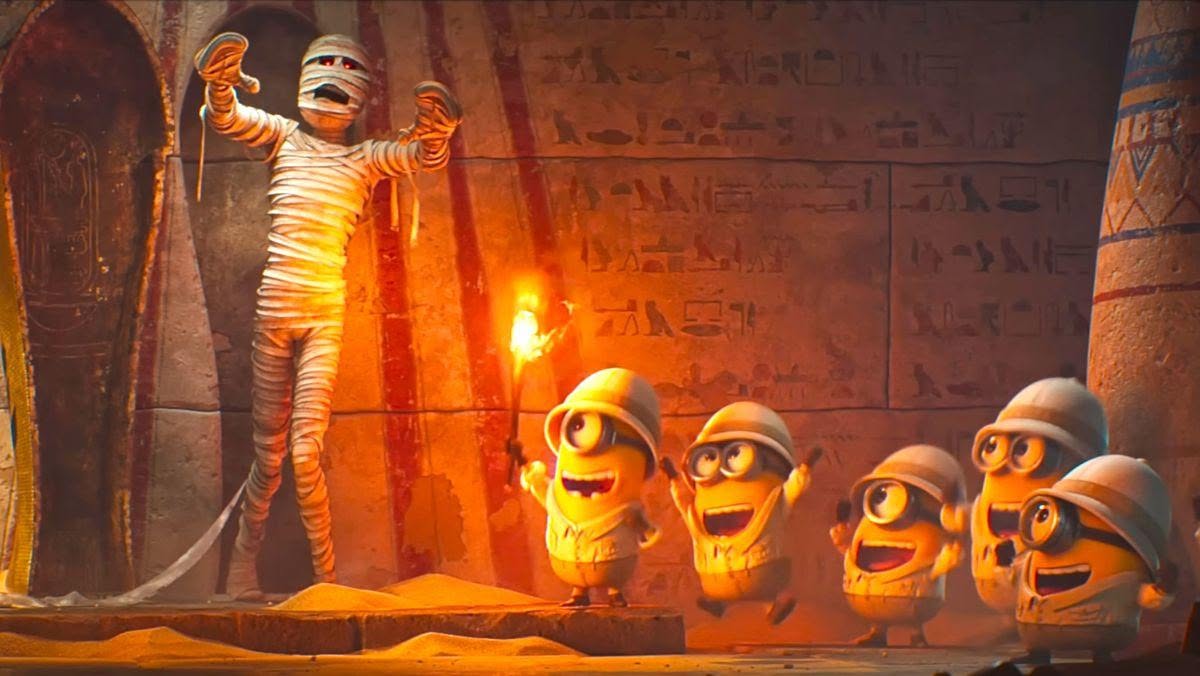
Indeed, while The Mummy appears to be a personal favorite with a versionof the Boris Karloff undead sorcerer showing up before quickly unraveling later in Minions & Monsters, one non-Universal beastie that had special significance on the film and young Coffin is Paramount’s original The Blob from 1958.
“I remember going to the movies in France to see The Blob… in the ‘70s,” says Coffin, “and I was terrified by it, really terrified. And just because of that I had the idea [on Minions & Monsters] for Irene.” The writer-director is referring to the ultimate monster that a Cthulu-like creature summons in the third act of the film (and which is on all the posters).
Says Coffin, “I was like, ‘Let’s make Irene this blobby thing with eyes.’ I then said we should all go look at that movie again.” The filmmaker pauses and a grin spreads across his face. “And horrible, just horrible. The Blob doesn’t even move in that movie! It’s just like standing there with everybody yelling and that was it! So the perception of it as a kid and knowing what it is as an adult, it’s a different thing.”
Charlie Chaplin, Harold Lloyd, Buster Keaton, and the Building Blocks of Comedy
Yet while the monsters of the title are one of the selling points of the movie, the real centerpiece of its muses comes during the grandest animated set piece. It’s the scene where the Minions Henry, Ed, and James quite literally break into Hollywood by way of a runaway locomotive that explodes into the film like a prop from The Great Train Robbery (1903). Meanwhile in hot pursuit is no less than the Keystone Cops, the titular slapstick law enforcement buffoons who appeared in a series of comedies produced by the Keystone Film Company between 1912 and 1917.
According to Coffin, all of the mayhem that ensued, including the Minions meeting their veritable ancestors in comedy stars like Charlie Chaplin, Buster Keaton, and Harold Lloyd, originally sprang from Coffin and his team trying to imagine a humorous way to introduce the Minions crossing over from ancient history to the relatively recent backstory of cinema.
“I go by visual cues,” Coffin admits. So when he and his team drew up what it would look like if there were so many Minions climbing atop a stagecoach in the Old West, Coffin knew they were on the right track by how humorously jarring it was when they started forming into giant balls of yellow. After that, it became about escalation.
“I knew that I needed to create a little bit of surprise,” Coffin explains, “so we added the train, and then we referenced The Great Train Robbery. And then the whole moment was for me to say, ‘How do I get from the audience thinking we’re in the Western era to the moment where we’re discovering that, no, that’s totally wrong, we’re in 1920s Hollywood. So we [decided] we need to trickle out the clues. And so from the train, we go to the Keystone Cops, which is ‘whoa, what are the cops doing here?’”
Eventually, though, it became specifically about recreating—and perhaps affectionately desecrating with Minions mayhem—three iconic moments in physical comedy: Harold Lloyd hanging from a clocktower in the vertigo-inducing silent rom-com classic, Safety Last! (1923), Buster Keaton surviving a literal house falling down around him in a shot that would make insurance men sweat bullets during Steamboat Bill Jr. (1928), and most especially the bit where Charlie Chaplin gets gummed up in the bowels of industrial America during Modern Times (1936).
“When I was thinking about a factory [setting], I said, ‘Maybe we should do that Modern Times quick reference and have our take at it?’” Coffin recalls. “And the conceit of those three little moments—Chaplin in Modern Times, Harold Lloyd in Safety Last!, and Buster Keaton in [Steamboat Bill Jr.]… is just not to give a reference. It was just to say maybe what we know of history is wrong? Maybe it’s the Minions that actually provoked those accidents?!”
Kidding aside, for Coffin it was about paying homage to his forebears.
“I think the Minions come down from every one of those geniuses that did slapstick at the time,” says Coffin. “Like before doing this movie, we were already referencing those guys just because in animation we go for slapstick, which is a form of physical comedy. So cartoons, in terms of an animated genre, is only referencing those guys who have invented slapstick: non-talking characters, physical violence, you name it. It’s Tom and Jerry, it’s all the Tex Avery movies.”
Babylon, Singin’ in the Rain, and All That Jazz
While Minions & Monsters isn’t (quite) another parable about the cataclysmic culture shock of sound being introduced to silent pictures in the 1920s, the movie nonetheless moves and bustles through quite a bit of Hollywood history, showing the Minions rising to the top of silent comedy cinema in the Jazz Age and getting completely decked out how we might expect.
Indeed, there’s a scene where James and Henry win an Oscar and a line of sequined flappers in pink dresses come bounding on the stage behind them. Coffin freely admits they’re modeled after Debbie Reynolds’ iconic cake-girl outfit and routine in the definitive Hollywood musical-comedy about Hollywood itself, Singin’ in the Rain (1952).
“Yeah, totally,” Coffin laughs. “She has the same hairstyle and stuff.” But then he admits he is playing in the same sandbox as every film, recent and old, that has revisited this monumental moment in Hollywood history. “I mean it’s the same subject matter, right?” Coffin considers. “Babylon, Singin’ in the Rain, and The Artist, they all speak about that era and the arrival of sound, obviously.” By his own admission, the party sequences in Minions & Monsters were more specifically modeled after the epic shindigs written down by F. Scott Fitzgerald in the seminal 1925 novel The Great Gatsby. Yet even by almost accident, he found himself echoing the immense bacchanal of Damien Chazelle’s Babylon, which imagined Hollywood debauchery culminating in an elephant running through Los Angeles house parties.
“The Babylon thing came after the fact, but my initial thing was Blake Edwards more than Babylon,” says Coffin. “It was just a general collectivist thing where let’s have crazy animals in there to show these guys are so rich they can get anything they want.” The filmmaker is specifically referring to the Blake Edwards and Peter Sellers comedy The Party (1968), wherein ‘60s go-go swingers and flower children throw down at a party that also includes an Asian elephant running wild. Still, when the connection to Babylon became apparent, Coffin and his team happily brought it into the merrymaking.
Casablanca, Citizen Kane, and the Brothers Warner
Of course no exploration of the Golden Age of Hollywood, especially when sound is introduced, can occur without a nod to two poles that frequently wind up at the top of all rankings of the greatest American movies: Michael Curtiz and Warner Brothers’ gold standard example of the Hollywood system of yore being able to produce masterpieces, Casablanca(1942), and the iconoclastic film that broke that mold and bucked industry trends and cinema vernacular, Orson Wells’ Citizen Kane(1941).
One of the latter’s severaleaster egg nods in the film has been partially released online, in which one of the Minion performers continuously flubs a pivotal moment for his director (Christoph Waltz) by being unable to say the fateful word “rosebud” on his deathbed. Once you see the finished film though… it ain’t “rosebud” that comes out of James’ mouth!
“Citizen Kane is obviously the ultimate thing,” Coffin admits, and it was one of the movies from the earliest concept art and meetings that was always going to be referenced in a montage of the Minions struggling with sound.
“That survived the test of time, but we tweaked it slightly, because we used to end it on just one word, a nonsense word. It used to be ‘bikini,’ which I think now is second. But in the end, it’s just, ‘Oh poop!’ And then ‘bikini.’ Then all of them.” It’s the culmination of a gag that was always supposed to show, like for the characters of Singin’ in the Rain, that the talking pictures were hard, man.
“We tried, I think, a dozen ideas,” Coffin explains. “I know that I wanted a moment where the Minions would screw up with sound. I didn’t know how yet. I didn’t know if it was going to be because they’re saying the English words wrong or if they just can’t speak. I didn’t know. So we did a lot of stuff.” At one point, the Minions were going to mess up on the set of a Western, at another they were going to fumble on the set of James Whale’s Frankenstein (1931), and also a Ten Commandments-esque biblical epic. What survived this process though was Citizen Kane being the ultimate punchline, a nondescript World War I epic that Coffin claims he picked just because he liked the aesthetics—albeit I see quite a bit of The Big Parade (1925) in it—and of course Casablanca, with maybe a little bit of The Maltese Falcon (1941) sprinkled in.
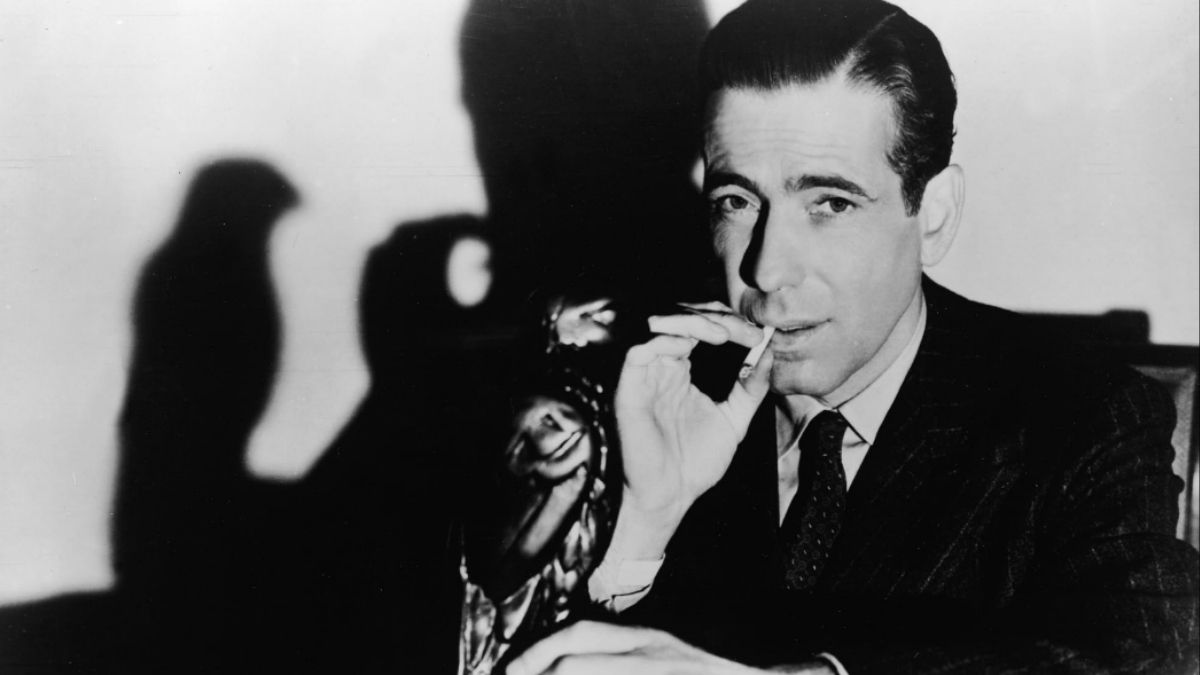
Both of those last two star Humphrey Bogart, which is the name that James’ miscast Minion goes by while chatting up a dame in an office that looks suspiciously like a film noir private eye’s humble abode.
Says Coffin, “Casablanca was really the thing that felt like it started slowly. Like ‘Okay, it established the principal and cue cards, and all that stuff.’ We needed something that slowly grew.”
Yet it wouldn’t be the only Casablanca nod in the film which also seems to be taking special aim at Jack Warner and Harry Warner, two of the Warner brothers who gave WB its name. Theirs was the studio that produced Casablanca with its iconic use of the song “As Time Goes By.” In Minions & Monsters, we meet the Bright Brothers of slightly diverging sensibilities on a studio lot that looks like a cross between WB and the iconic Paramount Pictures gate. Coffin freely admits he modeled both Bright Brothers on Jack and company.
“If I was a cartoonist at the time, that’s how I would draw them,” Coffin says of the Warners. “That image of the director stuck between those two big guys is actually a drawing for me where, when I started doing the beat boards and for this movie, that was one of the images I wanted to see in the movie. So it’s there. If I could have done like cigars and stuff, I would have done it, but I was not allowed.”
With that said, he wanted to at least nod to the legacy of what they could create as well.
“I wanted to have the cliché of those mean, scary guys, and then ultimately, we made them slightly different. One really ruthless, like mean, and the other one is just as ruthless but in a nice way. And adding that little Casablanca moment made them very human, which was very important to me. I didn’t want them to be all the way through caricature. I still wanted them to have this soul, this sensitivity, and them asking that Sam, the piano player, to play that music felt like a good way to humanize those guys.”
The Power of Movies
There is a line of thinking that might question why any of these sometimes hundred-year-old films are being homaged and revered in a Minions movie. The target audience will undoubtedly be children who likely never have heard of Citizen Kane, much less the infamous revelation that “rosebud” is the name of Charles Foster Kane’s sled.
“I get asked that question,” Coffin concedes. “‘But kids don’t know Citizen Kane’ and dah dah dah. I don’t think you need to know. You just need to know that it’s a guy, or Minion, that looks like he’s dying and his last words are, ‘Oh poop.’”
That’s the gag, but truthfully, Coffin hopes Minions & Monsters will be the start of some kids discovering more.
“So whether it’s Citizen Kane or all these moments of ‘who are those guys? Why is everybody laughing, hopefully, at the Modern Times moment, at the Harold Lloyd moment?,’” Coffins begins, “I don’t think kids know that, or maybe they do. But then it’s sort of a TikTok thing where it’s ‘poof,’ and ‘Harold Lloyd was a genius,’ and then moving on. So I’m hoping that if they don’t know, they’ll ask and then they’ll find an answer, and then they’ll realize that, yeah, Buster Keaton, when you see his stunts, they’re incredible. And then you fall on a video where you see a collection of all his stunts, and then all of a sudden you’re interested in his film career, and then you plunge into it, and you find The General, The Cameraman, and then you find all these movies that are still working to this day.”
By the Minions maestro’s accounting, these are the kind of classics that will always hold up.
“When you look at them, they’re just brilliant,” he says. “And when I showed it to my kids, they were reacting to the black and white, and saying, ‘Oh, what is this?’ But then 10 seconds in, they were totally forgetting that it was in black and white, and they were struck by the storytelling, which is still working these days, particularly Chaplin, by the way.”
Some television shows manage to grab attention immediately, setting a tone, mystery, or emotional hook that makes stopping after the first episode almost impossible. The pilot episode becomes more than an introduction, it acts as a promise that the story will continue to escalate in intensity, character depth, or narrative intrigue. These shows often rely on strong openings, sharp pacing, or unforgettable premises that pull viewers in instantly. Whether through mystery, drama, or high concept storytelling, they establish momentum from the very first minutes and make it clear that the next episode is not optional but inevitable.
This article contains some Minions & Monsters spoilers.
Minions & Monsters is the third Illumination film to bear the title of the devious, banana-shaped critters who were first dreamed up by filmmaker Pierre Coffin and collaborators Chris Renaud and Eric Guillon. It is also the seventh film to showcase these animated hybrids between Oompa-Loompas and the Keystone Cops. Yet while devising a new film about the little guys, writer-director Coffin wasn’t so much thinking about their future as he was their past. Plus his own. It’s a fact that becomes obvious before the finished film even starts.
When families and fans enter the cinema for Minions & Monsters this holiday weekend, the first thing they’ll see is Eadweard Muybridge’s 1878 motion picture of a horse running (albeit Minions style). The second is a literal walk back through time via every Universal Pictures title card since the studio’s 1912 founding.
“I had the idea from the start,” Coffin confides to us with a wry smile over Zoom. “I even went on YouTube and got all the Universal logos.” With the exception of the earliest version from the salad days of studio founder Carl Laemmle, they were all online and easy to mash up and reverse. “I didn’t know if it was going to work, so I stole those off of YouTube, edited them, put it backwards, edited that little effect, and it’s in the movie.” It serves as a cute easter egg but also a statement of intent.
For Coffin, the whole appeal of Minions & Monsters has been this walk down memory lane, both as a cinephile who loves the building blocks of the moving image, as well as someone who was once a kid growing up on Universal’s catalog of monsters from nearly a century ago. Minions & Monsters represented a chance to explore the past, even while creating something new for the next generation.
“The goal of the movie is that it’s a Minions movie but it feels different,” Coffin admits. “[It needs to be] funny… but I didn’t want it to be more of the same. So the era, and everything that we put in there, was stuff that felt relevant and also that motivated me into wanting to do it.” Below are a handful of those biggest motivators and inspirations, for Minions, Monsters, and more…
Hollywood History, Gods and (Universal) Monsters
The new Illumination film’s framing deviceis designed to get moviegoers of every generation feeling nostalgic. Inside an apparent Hollywood History museum, a snappy tour guide voiced by Allison Janney walks families and school children by familiar—and often Universal copyrighted—sights. The hoverboard fromBack to the Future Part II(1989); E.T. and the fateful bicycle from the Steven Spielberg movie of 1982; there’s even a deeper cut of Alfred Hitchcock’s The Birds(1963). Oh, also, no less than George Lucas himself.
But in the corner that sets the plot in motion is an area dedicated solely to the memory of Henry and James, the Minions from a different tribe who broke into Hollywood in a big way during the 1920s and ‘30s. And as a testament to their legacy are three specific movie posters: one for the Fritz Lang German silent film classic Metropolis(1927), and two that directly riff on iconic Universal Monsters The Mummy(1932) and Creature from the Black Lagoon (1954), albeit with a certain Minions styling. The latter two specifically represented monumental moments in Coffin’s childhood introduction to American culture.
“I didn’t know those movies existed before moving to the States in ’77,” Coffin reveals. “I moved to the States for three years, and there were so many horror movies that I didn’t know existed. So when I discovered them on TV—[movies like] The Fly and Frankenstein—at the time I was just in awe of these movies. They weren’t aired on French TV at the time, so I was just like, ‘Whoa, how come I can’t see them in my local theater?’ I had to chase them on those TV channels they were on at the time.”
Indeed, while The Mummy appears to be a personal favorite with a versionof the Boris Karloff undead sorcerer showing up before quickly unraveling later in Minions & Monsters, one non-Universal beastie that had special significance on the film and young Coffin is Paramount’s original The Blob from 1958.
“I remember going to the movies in France to see The Blob… in the ‘70s,” says Coffin, “and I was terrified by it, really terrified. And just because of that I had the idea [on Minions & Monsters] for Irene.” The writer-director is referring to the ultimate monster that a Cthulu-like creature summons in the third act of the film (and which is on all the posters).
Says Coffin, “I was like, ‘Let’s make Irene this blobby thing with eyes.’ I then said we should all go look at that movie again.” The filmmaker pauses and a grin spreads across his face. “And horrible, just horrible. The Blob doesn’t even move in that movie! It’s just like standing there with everybody yelling and that was it! So the perception of it as a kid and knowing what it is as an adult, it’s a different thing.”
Charlie Chaplin, Harold Lloyd, Buster Keaton, and the Building Blocks of Comedy
Yet while the monsters of the title are one of the selling points of the movie, the real centerpiece of its muses comes during the grandest animated set piece. It’s the scene where the Minions Henry, Ed, and James quite literally break into Hollywood by way of a runaway locomotive that explodes into the film like a prop from The Great Train Robbery (1903). Meanwhile in hot pursuit is no less than the Keystone Cops, the titular slapstick law enforcement buffoons who appeared in a series of comedies produced by the Keystone Film Company between 1912 and 1917.
According to Coffin, all of the mayhem that ensued, including the Minions meeting their veritable ancestors in comedy stars like Charlie Chaplin, Buster Keaton, and Harold Lloyd, originally sprang from Coffin and his team trying to imagine a humorous way to introduce the Minions crossing over from ancient history to the relatively recent backstory of cinema.
“I go by visual cues,” Coffin admits. So when he and his team drew up what it would look like if there were so many Minions climbing atop a stagecoach in the Old West, Coffin knew they were on the right track by how humorously jarring it was when they started forming into giant balls of yellow. After that, it became about escalation.
“I knew that I needed to create a little bit of surprise,” Coffin explains, “so we added the train, and then we referenced The Great Train Robbery. And then the whole moment was for me to say, ‘How do I get from the audience thinking we’re in the Western era to the moment where we’re discovering that, no, that’s totally wrong, we’re in 1920s Hollywood. So we [decided] we need to trickle out the clues. And so from the train, we go to the Keystone Cops, which is ‘whoa, what are the cops doing here?’”
Eventually, though, it became specifically about recreating—and perhaps affectionately desecrating with Minions mayhem—three iconic moments in physical comedy: Harold Lloyd hanging from a clocktower in the vertigo-inducing silent rom-com classic, Safety Last! (1923), Buster Keaton surviving a literal house falling down around him in a shot that would make insurance men sweat bullets during Steamboat Bill Jr. (1928), and most especially the bit where Charlie Chaplin gets gummed up in the bowels of industrial America during Modern Times (1936).
“When I was thinking about a factory [setting], I said, ‘Maybe we should do that Modern Times quick reference and have our take at it?’” Coffin recalls. “And the conceit of those three little moments—Chaplin in Modern Times, Harold Lloyd in Safety Last!, and Buster Keaton in [Steamboat Bill Jr.]… is just not to give a reference. It was just to say maybe what we know of history is wrong? Maybe it’s the Minions that actually provoked those accidents?!”
Kidding aside, for Coffin it was about paying homage to his forebears.
“I think the Minions come down from every one of those geniuses that did slapstick at the time,” says Coffin. “Like before doing this movie, we were already referencing those guys just because in animation we go for slapstick, which is a form of physical comedy. So cartoons, in terms of an animated genre, is only referencing those guys who have invented slapstick: non-talking characters, physical violence, you name it. It’s Tom and Jerry, it’s all the Tex Avery movies.”
Babylon, Singin’ in the Rain, and All That Jazz
While Minions & Monsters isn’t (quite) another parable about the cataclysmic culture shock of sound being introduced to silent pictures in the 1920s, the movie nonetheless moves and bustles through quite a bit of Hollywood history, showing the Minions rising to the top of silent comedy cinema in the Jazz Age and getting completely decked out how we might expect.
Indeed, there’s a scene where James and Henry win an Oscar and a line of sequined flappers in pink dresses come bounding on the stage behind them. Coffin freely admits they’re modeled after Debbie Reynolds’ iconic cake-girl outfit and routine in the definitive Hollywood musical-comedy about Hollywood itself, Singin’ in the Rain (1952).
“Yeah, totally,” Coffin laughs. “She has the same hairstyle and stuff.” But then he admits he is playing in the same sandbox as every film, recent and old, that has revisited this monumental moment in Hollywood history. “I mean it’s the same subject matter, right?” Coffin considers. “Babylon, Singin’ in the Rain, and The Artist, they all speak about that era and the arrival of sound, obviously.” By his own admission, the party sequences in Minions & Monsters were more specifically modeled after the epic shindigs written down by F. Scott Fitzgerald in the seminal 1925 novel The Great Gatsby. Yet even by almost accident, he found himself echoing the immense bacchanal of Damien Chazelle’s Babylon, which imagined Hollywood debauchery culminating in an elephant running through Los Angeles house parties.
“The Babylon thing came after the fact, but my initial thing was Blake Edwards more than Babylon,” says Coffin. “It was just a general collectivist thing where let’s have crazy animals in there to show these guys are so rich they can get anything they want.” The filmmaker is specifically referring to the Blake Edwards and Peter Sellers comedy The Party (1968), wherein ‘60s go-go swingers and flower children throw down at a party that also includes an Asian elephant running wild. Still, when the connection to Babylon became apparent, Coffin and his team happily brought it into the merrymaking.
Casablanca, Citizen Kane, and the Brothers Warner
Of course no exploration of the Golden Age of Hollywood, especially when sound is introduced, can occur without a nod to two poles that frequently wind up at the top of all rankings of the greatest American movies: Michael Curtiz and Warner Brothers’ gold standard example of the Hollywood system of yore being able to produce masterpieces, Casablanca(1942), and the iconoclastic film that broke that mold and bucked industry trends and cinema vernacular, Orson Wells’ Citizen Kane(1941).
One of the latter’s severaleaster egg nods in the film has been partially released online, in which one of the Minion performers continuously flubs a pivotal moment for his director (Christoph Waltz) by being unable to say the fateful word “rosebud” on his deathbed. Once you see the finished film though… it ain’t “rosebud” that comes out of James’ mouth!
“Citizen Kane is obviously the ultimate thing,” Coffin admits, and it was one of the movies from the earliest concept art and meetings that was always going to be referenced in a montage of the Minions struggling with sound.
“That survived the test of time, but we tweaked it slightly, because we used to end it on just one word, a nonsense word. It used to be ‘bikini,’ which I think now is second. But in the end, it’s just, ‘Oh poop!’ And then ‘bikini.’ Then all of them.” It’s the culmination of a gag that was always supposed to show, like for the characters of Singin’ in the Rain, that the talking pictures were hard, man.
“We tried, I think, a dozen ideas,” Coffin explains. “I know that I wanted a moment where the Minions would screw up with sound. I didn’t know how yet. I didn’t know if it was going to be because they’re saying the English words wrong or if they just can’t speak. I didn’t know. So we did a lot of stuff.” At one point, the Minions were going to mess up on the set of a Western, at another they were going to fumble on the set of James Whale’s Frankenstein (1931), and also a Ten Commandments-esque biblical epic. What survived this process though was Citizen Kane being the ultimate punchline, a nondescript World War I epic that Coffin claims he picked just because he liked the aesthetics—albeit I see quite a bit of The Big Parade (1925) in it—and of course Casablanca, with maybe a little bit of The Maltese Falcon (1941) sprinkled in.
Both of those last two star Humphrey Bogart, which is the name that James’ miscast Minion goes by while chatting up a dame in an office that looks suspiciously like a film noir private eye’s humble abode.
Says Coffin, “Casablanca was really the thing that felt like it started slowly. Like ‘Okay, it established the principal and cue cards, and all that stuff.’ We needed something that slowly grew.”
Yet it wouldn’t be the only Casablanca nod in the film which also seems to be taking special aim at Jack Warner and Harry Warner, two of the Warner brothers who gave WB its name. Theirs was the studio that produced Casablanca with its iconic use of the song “As Time Goes By.” In Minions & Monsters, we meet the Bright Brothers of slightly diverging sensibilities on a studio lot that looks like a cross between WB and the iconic Paramount Pictures gate. Coffin freely admits he modeled both Bright Brothers on Jack and company.
“If I was a cartoonist at the time, that’s how I would draw them,” Coffin says of the Warners. “That image of the director stuck between those two big guys is actually a drawing for me where, when I started doing the beat boards and for this movie, that was one of the images I wanted to see in the movie. So it’s there. If I could have done like cigars and stuff, I would have done it, but I was not allowed.”
With that said, he wanted to at least nod to the legacy of what they could create as well.
“I wanted to have the cliché of those mean, scary guys, and then ultimately, we made them slightly different. One really ruthless, like mean, and the other one is just as ruthless but in a nice way. And adding that little Casablanca moment made them very human, which was very important to me. I didn’t want them to be all the way through caricature. I still wanted them to have this soul, this sensitivity, and them asking that Sam, the piano player, to play that music felt like a good way to humanize those guys.”
The Power of Movies
There is a line of thinking that might question why any of these sometimes hundred-year-old films are being homaged and revered in a Minions movie. The target audience will undoubtedly be children who likely never have heard of Citizen Kane, much less the infamous revelation that “rosebud” is the name of Charles Foster Kane’s sled.
“I get asked that question,” Coffin concedes. “‘But kids don’t know Citizen Kane’ and dah dah dah. I don’t think you need to know. You just need to know that it’s a guy, or Minion, that looks like he’s dying and his last words are, ‘Oh poop.’”
That’s the gag, but truthfully, Coffin hopes Minions & Monsters will be the start of some kids discovering more.
“So whether it’s Citizen Kane or all these moments of ‘who are those guys? Why is everybody laughing, hopefully, at the Modern Times moment, at the Harold Lloyd moment?,’” Coffins begins, “I don’t think kids know that, or maybe they do. But then it’s sort of a TikTok thing where it’s ‘poof,’ and ‘Harold Lloyd was a genius,’ and then moving on. So I’m hoping that if they don’t know, they’ll ask and then they’ll find an answer, and then they’ll realize that, yeah, Buster Keaton, when you see his stunts, they’re incredible. And then you fall on a video where you see a collection of all his stunts, and then all of a sudden you’re interested in his film career, and then you plunge into it, and you find The General, The Cameraman, and then you find all these movies that are still working to this day.”
By the Minions maestro’s accounting, these are the kind of classics that will always hold up.
“When you look at them, they’re just brilliant,” he says. “And when I showed it to my kids, they were reacting to the black and white, and saying, ‘Oh, what is this?’ But then 10 seconds in, they were totally forgetting that it was in black and white, and they were struck by the storytelling, which is still working these days, particularly Chaplin, by the way.”
A ‘MacGuffin’ is a storytelling device that keeps characters moving, even if the object itself barely matters in the end. Alfred Hitchcock popularized the term to describe the mysterious briefcases, artifacts, and secret documents that motivate entire plots without being the real point of the story.
It is understandable that they aren’t a focus, rather an excuse, but as audiences we do feel they need to be able to do something. If the movie is going to revolve around a single item, we should at least understand its purpose. These are some of the most memorable movie MacGuffins that, in hindsight, were surprisingly pointless.
This article contains some Minions & Monsters spoilers.
Minions & Monsters is the third Illumination film to bear the title of the devious, banana-shaped critters who were first dreamed up by filmmaker Pierre Coffin and collaborators Chris Renaud and Eric Guillon. It is also the seventh film to showcase these animated hybrids between Oompa-Loompas and the Keystone Cops. Yet while devising a new film about the little guys, writer-director Coffin wasn’t so much thinking about their future as he was their past. Plus his own. It’s a fact that becomes obvious before the finished film even starts.
When families and fans enter the cinema for Minions & Monsters this holiday weekend, the first thing they’ll see is Eadweard Muybridge’s 1878 motion picture of a horse running (albeit Minions style). The second is a literal walk back through time via every Universal Pictures title card since the studio’s 1912 founding.
“I had the idea from the start,” Coffin confides to us with a wry smile over Zoom. “I even went on YouTube and got all the Universal logos.” With the exception of the earliest version from the salad days of studio founder Carl Laemmle, they were all online and easy to mash up and reverse. “I didn’t know if it was going to work, so I stole those off of YouTube, edited them, put it backwards, edited that little effect, and it’s in the movie.” It serves as a cute easter egg but also a statement of intent.
For Coffin, the whole appeal of Minions & Monsters has been this walk down memory lane, both as a cinephile who loves the building blocks of the moving image, as well as someone who was once a kid growing up on Universal’s catalog of monsters from nearly a century ago. Minions & Monsters represented a chance to explore the past, even while creating something new for the next generation.
“The goal of the movie is that it’s a Minions movie but it feels different,” Coffin admits. “[It needs to be] funny… but I didn’t want it to be more of the same. So the era, and everything that we put in there, was stuff that felt relevant and also that motivated me into wanting to do it.” Below are a handful of those biggest motivators and inspirations, for Minions, Monsters, and more…
Hollywood History, Gods and (Universal) Monsters
The new Illumination film’s framing deviceis designed to get moviegoers of every generation feeling nostalgic. Inside an apparent Hollywood History museum, a snappy tour guide voiced by Allison Janney walks families and school children by familiar—and often Universal copyrighted—sights. The hoverboard fromBack to the Future Part II(1989); E.T. and the fateful bicycle from the Steven Spielberg movie of 1982; there’s even a deeper cut of Alfred Hitchcock’s The Birds(1963). Oh, also, no less than George Lucas himself.
But in the corner that sets the plot in motion is an area dedicated solely to the memory of Henry and James, the Minions from a different tribe who broke into Hollywood in a big way during the 1920s and ‘30s. And as a testament to their legacy are three specific movie posters: one for the Fritz Lang German silent film classic Metropolis(1927), and two that directly riff on iconic Universal Monsters The Mummy(1932) and Creature from the Black Lagoon (1954), albeit with a certain Minions styling. The latter two specifically represented monumental moments in Coffin’s childhood introduction to American culture.
“I didn’t know those movies existed before moving to the States in ’77,” Coffin reveals. “I moved to the States for three years, and there were so many horror movies that I didn’t know existed. So when I discovered them on TV—[movies like] The Fly and Frankenstein—at the time I was just in awe of these movies. They weren’t aired on French TV at the time, so I was just like, ‘Whoa, how come I can’t see them in my local theater?’ I had to chase them on those TV channels they were on at the time.”
Indeed, while The Mummy appears to be a personal favorite with a versionof the Boris Karloff undead sorcerer showing up before quickly unraveling later in Minions & Monsters, one non-Universal beastie that had special significance on the film and young Coffin is Paramount’s original The Blob from 1958.
“I remember going to the movies in France to see The Blob… in the ‘70s,” says Coffin, “and I was terrified by it, really terrified. And just because of that I had the idea [on Minions & Monsters] for Irene.” The writer-director is referring to the ultimate monster that a Cthulu-like creature summons in the third act of the film (and which is on all the posters).
Says Coffin, “I was like, ‘Let’s make Irene this blobby thing with eyes.’ I then said we should all go look at that movie again.” The filmmaker pauses and a grin spreads across his face. “And horrible, just horrible. The Blob doesn’t even move in that movie! It’s just like standing there with everybody yelling and that was it! So the perception of it as a kid and knowing what it is as an adult, it’s a different thing.”
Charlie Chaplin, Harold Lloyd, Buster Keaton, and the Building Blocks of Comedy
Yet while the monsters of the title are one of the selling points of the movie, the real centerpiece of its muses comes during the grandest animated set piece. It’s the scene where the Minions Henry, Ed, and James quite literally break into Hollywood by way of a runaway locomotive that explodes into the film like a prop from The Great Train Robbery (1903). Meanwhile in hot pursuit is no less than the Keystone Cops, the titular slapstick law enforcement buffoons who appeared in a series of comedies produced by the Keystone Film Company between 1912 and 1917.
According to Coffin, all of the mayhem that ensued, including the Minions meeting their veritable ancestors in comedy stars like Charlie Chaplin, Buster Keaton, and Harold Lloyd, originally sprang from Coffin and his team trying to imagine a humorous way to introduce the Minions crossing over from ancient history to the relatively recent backstory of cinema.
“I go by visual cues,” Coffin admits. So when he and his team drew up what it would look like if there were so many Minions climbing atop a stagecoach in the Old West, Coffin knew they were on the right track by how humorously jarring it was when they started forming into giant balls of yellow. After that, it became about escalation.
“I knew that I needed to create a little bit of surprise,” Coffin explains, “so we added the train, and then we referenced The Great Train Robbery. And then the whole moment was for me to say, ‘How do I get from the audience thinking we’re in the Western era to the moment where we’re discovering that, no, that’s totally wrong, we’re in 1920s Hollywood. So we [decided] we need to trickle out the clues. And so from the train, we go to the Keystone Cops, which is ‘whoa, what are the cops doing here?’”
Eventually, though, it became specifically about recreating—and perhaps affectionately desecrating with Minions mayhem—three iconic moments in physical comedy: Harold Lloyd hanging from a clocktower in the vertigo-inducing silent rom-com classic, Safety Last! (1923), Buster Keaton surviving a literal house falling down around him in a shot that would make insurance men sweat bullets during Steamboat Bill Jr. (1928), and most especially the bit where Charlie Chaplin gets gummed up in the bowels of industrial America during Modern Times (1936).
“When I was thinking about a factory [setting], I said, ‘Maybe we should do that Modern Times quick reference and have our take at it?’” Coffin recalls. “And the conceit of those three little moments—Chaplin in Modern Times, Harold Lloyd in Safety Last!, and Buster Keaton in [Steamboat Bill Jr.]… is just not to give a reference. It was just to say maybe what we know of history is wrong? Maybe it’s the Minions that actually provoked those accidents?!”
Kidding aside, for Coffin it was about paying homage to his forebears.
“I think the Minions come down from every one of those geniuses that did slapstick at the time,” says Coffin. “Like before doing this movie, we were already referencing those guys just because in animation we go for slapstick, which is a form of physical comedy. So cartoons, in terms of an animated genre, is only referencing those guys who have invented slapstick: non-talking characters, physical violence, you name it. It’s Tom and Jerry, it’s all the Tex Avery movies.”
Babylon, Singin’ in the Rain, and All That Jazz
While Minions & Monsters isn’t (quite) another parable about the cataclysmic culture shock of sound being introduced to silent pictures in the 1920s, the movie nonetheless moves and bustles through quite a bit of Hollywood history, showing the Minions rising to the top of silent comedy cinema in the Jazz Age and getting completely decked out how we might expect.
Indeed, there’s a scene where James and Henry win an Oscar and a line of sequined flappers in pink dresses come bounding on the stage behind them. Coffin freely admits they’re modeled after Debbie Reynolds’ iconic cake-girl outfit and routine in the definitive Hollywood musical-comedy about Hollywood itself, Singin’ in the Rain (1952).
“Yeah, totally,” Coffin laughs. “She has the same hairstyle and stuff.” But then he admits he is playing in the same sandbox as every film, recent and old, that has revisited this monumental moment in Hollywood history. “I mean it’s the same subject matter, right?” Coffin considers. “Babylon, Singin’ in the Rain, and The Artist, they all speak about that era and the arrival of sound, obviously.” By his own admission, the party sequences in Minions & Monsters were more specifically modeled after the epic shindigs written down by F. Scott Fitzgerald in the seminal 1925 novel The Great Gatsby. Yet even by almost accident, he found himself echoing the immense bacchanal of Damien Chazelle’s Babylon, which imagined Hollywood debauchery culminating in an elephant running through Los Angeles house parties.
“The Babylon thing came after the fact, but my initial thing was Blake Edwards more than Babylon,” says Coffin. “It was just a general collectivist thing where let’s have crazy animals in there to show these guys are so rich they can get anything they want.” The filmmaker is specifically referring to the Blake Edwards and Peter Sellers comedy The Party (1968), wherein ‘60s go-go swingers and flower children throw down at a party that also includes an Asian elephant running wild. Still, when the connection to Babylon became apparent, Coffin and his team happily brought it into the merrymaking.
Casablanca, Citizen Kane, and the Brothers Warner
Of course no exploration of the Golden Age of Hollywood, especially when sound is introduced, can occur without a nod to two poles that frequently wind up at the top of all rankings of the greatest American movies: Michael Curtiz and Warner Brothers’ gold standard example of the Hollywood system of yore being able to produce masterpieces, Casablanca(1942), and the iconoclastic film that broke that mold and bucked industry trends and cinema vernacular, Orson Wells’ Citizen Kane(1941).
One of the latter’s severaleaster egg nods in the film has been partially released online, in which one of the Minion performers continuously flubs a pivotal moment for his director (Christoph Waltz) by being unable to say the fateful word “rosebud” on his deathbed. Once you see the finished film though… it ain’t “rosebud” that comes out of James’ mouth!
“Citizen Kane is obviously the ultimate thing,” Coffin admits, and it was one of the movies from the earliest concept art and meetings that was always going to be referenced in a montage of the Minions struggling with sound.
“That survived the test of time, but we tweaked it slightly, because we used to end it on just one word, a nonsense word. It used to be ‘bikini,’ which I think now is second. But in the end, it’s just, ‘Oh poop!’ And then ‘bikini.’ Then all of them.” It’s the culmination of a gag that was always supposed to show, like for the characters of Singin’ in the Rain, that the talking pictures were hard, man.
“We tried, I think, a dozen ideas,” Coffin explains. “I know that I wanted a moment where the Minions would screw up with sound. I didn’t know how yet. I didn’t know if it was going to be because they’re saying the English words wrong or if they just can’t speak. I didn’t know. So we did a lot of stuff.” At one point, the Minions were going to mess up on the set of a Western, at another they were going to fumble on the set of James Whale’s Frankenstein (1931), and also a Ten Commandments-esque biblical epic. What survived this process though was Citizen Kane being the ultimate punchline, a nondescript World War I epic that Coffin claims he picked just because he liked the aesthetics—albeit I see quite a bit of The Big Parade (1925) in it—and of course Casablanca, with maybe a little bit of The Maltese Falcon (1941) sprinkled in.
Both of those last two star Humphrey Bogart, which is the name that James’ miscast Minion goes by while chatting up a dame in an office that looks suspiciously like a film noir private eye’s humble abode.
Says Coffin, “Casablanca was really the thing that felt like it started slowly. Like ‘Okay, it established the principal and cue cards, and all that stuff.’ We needed something that slowly grew.”
Yet it wouldn’t be the only Casablanca nod in the film which also seems to be taking special aim at Jack Warner and Harry Warner, two of the Warner brothers who gave WB its name. Theirs was the studio that produced Casablanca with its iconic use of the song “As Time Goes By.” In Minions & Monsters, we meet the Bright Brothers of slightly diverging sensibilities on a studio lot that looks like a cross between WB and the iconic Paramount Pictures gate. Coffin freely admits he modeled both Bright Brothers on Jack and company.
“If I was a cartoonist at the time, that’s how I would draw them,” Coffin says of the Warners. “That image of the director stuck between those two big guys is actually a drawing for me where, when I started doing the beat boards and for this movie, that was one of the images I wanted to see in the movie. So it’s there. If I could have done like cigars and stuff, I would have done it, but I was not allowed.”
With that said, he wanted to at least nod to the legacy of what they could create as well.
“I wanted to have the cliché of those mean, scary guys, and then ultimately, we made them slightly different. One really ruthless, like mean, and the other one is just as ruthless but in a nice way. And adding that little Casablanca moment made them very human, which was very important to me. I didn’t want them to be all the way through caricature. I still wanted them to have this soul, this sensitivity, and them asking that Sam, the piano player, to play that music felt like a good way to humanize those guys.”
The Power of Movies
There is a line of thinking that might question why any of these sometimes hundred-year-old films are being homaged and revered in a Minions movie. The target audience will undoubtedly be children who likely never have heard of Citizen Kane, much less the infamous revelation that “rosebud” is the name of Charles Foster Kane’s sled.
“I get asked that question,” Coffin concedes. “‘But kids don’t know Citizen Kane’ and dah dah dah. I don’t think you need to know. You just need to know that it’s a guy, or Minion, that looks like he’s dying and his last words are, ‘Oh poop.’”
That’s the gag, but truthfully, Coffin hopes Minions & Monsters will be the start of some kids discovering more.
“So whether it’s Citizen Kane or all these moments of ‘who are those guys? Why is everybody laughing, hopefully, at the Modern Times moment, at the Harold Lloyd moment?,’” Coffins begins, “I don’t think kids know that, or maybe they do. But then it’s sort of a TikTok thing where it’s ‘poof,’ and ‘Harold Lloyd was a genius,’ and then moving on. So I’m hoping that if they don’t know, they’ll ask and then they’ll find an answer, and then they’ll realize that, yeah, Buster Keaton, when you see his stunts, they’re incredible. And then you fall on a video where you see a collection of all his stunts, and then all of a sudden you’re interested in his film career, and then you plunge into it, and you find The General, The Cameraman, and then you find all these movies that are still working to this day.”
By the Minions maestro’s accounting, these are the kind of classics that will always hold up.
“When you look at them, they’re just brilliant,” he says. “And when I showed it to my kids, they were reacting to the black and white, and saying, ‘Oh, what is this?’ But then 10 seconds in, they were totally forgetting that it was in black and white, and they were struck by the storytelling, which is still working these days, particularly Chaplin, by the way.”
Sitcom characters aren’t meant to be realistic, they are a constant source of conflicts that make us laugh through their antics. They don’t solve problems the obvious way, have communication problems and are, in a general sense, not great to be around.
But what if you don’t live with them, but next door to them? Well, with such vocal personalities, what makes audiences laugh would make neighbors want to kick them out of the hood. These are just a few sitcom characters whose neighbors would likely spend more time complaining than borrowing a cup of sugar.
This article contains some Minions & Monsters spoilers.
Minions & Monsters is the third Illumination film to bear the title of the devious, banana-shaped critters who were first dreamed up by filmmaker Pierre Coffin and collaborators Chris Renaud and Eric Guillon. It is also the seventh film to showcase these animated hybrids between Oompa-Loompas and the Keystone Cops. Yet while devising a new film about the little guys, writer-director Coffin wasn’t so much thinking about their future as he was their past. Plus his own. It’s a fact that becomes obvious before the finished film even starts.
When families and fans enter the cinema for Minions & Monsters this holiday weekend, the first thing they’ll see is Eadweard Muybridge’s 1878 motion picture of a horse running (albeit Minions style). The second is a literal walk back through time via every Universal Pictures title card since the studio’s 1912 founding.
“I had the idea from the start,” Coffin confides to us with a wry smile over Zoom. “I even went on YouTube and got all the Universal logos.” With the exception of the earliest version from the salad days of studio founder Carl Laemmle, they were all online and easy to mash up and reverse. “I didn’t know if it was going to work, so I stole those off of YouTube, edited them, put it backwards, edited that little effect, and it’s in the movie.” It serves as a cute easter egg but also a statement of intent.
For Coffin, the whole appeal of Minions & Monsters has been this walk down memory lane, both as a cinephile who loves the building blocks of the moving image, as well as someone who was once a kid growing up on Universal’s catalog of monsters from nearly a century ago. Minions & Monsters represented a chance to explore the past, even while creating something new for the next generation.
“The goal of the movie is that it’s a Minions movie but it feels different,” Coffin admits. “[It needs to be] funny… but I didn’t want it to be more of the same. So the era, and everything that we put in there, was stuff that felt relevant and also that motivated me into wanting to do it.” Below are a handful of those biggest motivators and inspirations, for Minions, Monsters, and more…
Hollywood History, Gods and (Universal) Monsters
The new Illumination film’s framing deviceis designed to get moviegoers of every generation feeling nostalgic. Inside an apparent Hollywood History museum, a snappy tour guide voiced by Allison Janney walks families and school children by familiar—and often Universal copyrighted—sights. The hoverboard fromBack to the Future Part II(1989); E.T. and the fateful bicycle from the Steven Spielberg movie of 1982; there’s even a deeper cut of Alfred Hitchcock’s The Birds(1963). Oh, also, no less than George Lucas himself.
But in the corner that sets the plot in motion is an area dedicated solely to the memory of Henry and James, the Minions from a different tribe who broke into Hollywood in a big way during the 1920s and ‘30s. And as a testament to their legacy are three specific movie posters: one for the Fritz Lang German silent film classic Metropolis(1927), and two that directly riff on iconic Universal Monsters The Mummy(1932) and Creature from the Black Lagoon (1954), albeit with a certain Minions styling. The latter two specifically represented monumental moments in Coffin’s childhood introduction to American culture.
“I didn’t know those movies existed before moving to the States in ’77,” Coffin reveals. “I moved to the States for three years, and there were so many horror movies that I didn’t know existed. So when I discovered them on TV—[movies like] The Fly and Frankenstein—at the time I was just in awe of these movies. They weren’t aired on French TV at the time, so I was just like, ‘Whoa, how come I can’t see them in my local theater?’ I had to chase them on those TV channels they were on at the time.”
Indeed, while The Mummy appears to be a personal favorite with a versionof the Boris Karloff undead sorcerer showing up before quickly unraveling later in Minions & Monsters, one non-Universal beastie that had special significance on the film and young Coffin is Paramount’s original The Blob from 1958.
“I remember going to the movies in France to see The Blob… in the ‘70s,” says Coffin, “and I was terrified by it, really terrified. And just because of that I had the idea [on Minions & Monsters] for Irene.” The writer-director is referring to the ultimate monster that a Cthulu-like creature summons in the third act of the film (and which is on all the posters).
Says Coffin, “I was like, ‘Let’s make Irene this blobby thing with eyes.’ I then said we should all go look at that movie again.” The filmmaker pauses and a grin spreads across his face. “And horrible, just horrible. The Blob doesn’t even move in that movie! It’s just like standing there with everybody yelling and that was it! So the perception of it as a kid and knowing what it is as an adult, it’s a different thing.”
Charlie Chaplin, Harold Lloyd, Buster Keaton, and the Building Blocks of Comedy
Yet while the monsters of the title are one of the selling points of the movie, the real centerpiece of its muses comes during the grandest animated set piece. It’s the scene where the Minions Henry, Ed, and James quite literally break into Hollywood by way of a runaway locomotive that explodes into the film like a prop from The Great Train Robbery (1903). Meanwhile in hot pursuit is no less than the Keystone Cops, the titular slapstick law enforcement buffoons who appeared in a series of comedies produced by the Keystone Film Company between 1912 and 1917.
According to Coffin, all of the mayhem that ensued, including the Minions meeting their veritable ancestors in comedy stars like Charlie Chaplin, Buster Keaton, and Harold Lloyd, originally sprang from Coffin and his team trying to imagine a humorous way to introduce the Minions crossing over from ancient history to the relatively recent backstory of cinema.
“I go by visual cues,” Coffin admits. So when he and his team drew up what it would look like if there were so many Minions climbing atop a stagecoach in the Old West, Coffin knew they were on the right track by how humorously jarring it was when they started forming into giant balls of yellow. After that, it became about escalation.
“I knew that I needed to create a little bit of surprise,” Coffin explains, “so we added the train, and then we referenced The Great Train Robbery. And then the whole moment was for me to say, ‘How do I get from the audience thinking we’re in the Western era to the moment where we’re discovering that, no, that’s totally wrong, we’re in 1920s Hollywood. So we [decided] we need to trickle out the clues. And so from the train, we go to the Keystone Cops, which is ‘whoa, what are the cops doing here?’”
Eventually, though, it became specifically about recreating—and perhaps affectionately desecrating with Minions mayhem—three iconic moments in physical comedy: Harold Lloyd hanging from a clocktower in the vertigo-inducing silent rom-com classic, Safety Last! (1923), Buster Keaton surviving a literal house falling down around him in a shot that would make insurance men sweat bullets during Steamboat Bill Jr. (1928), and most especially the bit where Charlie Chaplin gets gummed up in the bowels of industrial America during Modern Times (1936).
“When I was thinking about a factory [setting], I said, ‘Maybe we should do that Modern Times quick reference and have our take at it?’” Coffin recalls. “And the conceit of those three little moments—Chaplin in Modern Times, Harold Lloyd in Safety Last!, and Buster Keaton in [Steamboat Bill Jr.]… is just not to give a reference. It was just to say maybe what we know of history is wrong? Maybe it’s the Minions that actually provoked those accidents?!”
Kidding aside, for Coffin it was about paying homage to his forebears.
“I think the Minions come down from every one of those geniuses that did slapstick at the time,” says Coffin. “Like before doing this movie, we were already referencing those guys just because in animation we go for slapstick, which is a form of physical comedy. So cartoons, in terms of an animated genre, is only referencing those guys who have invented slapstick: non-talking characters, physical violence, you name it. It’s Tom and Jerry, it’s all the Tex Avery movies.”
Babylon, Singin’ in the Rain, and All That Jazz
While Minions & Monsters isn’t (quite) another parable about the cataclysmic culture shock of sound being introduced to silent pictures in the 1920s, the movie nonetheless moves and bustles through quite a bit of Hollywood history, showing the Minions rising to the top of silent comedy cinema in the Jazz Age and getting completely decked out how we might expect.
Indeed, there’s a scene where James and Henry win an Oscar and a line of sequined flappers in pink dresses come bounding on the stage behind them. Coffin freely admits they’re modeled after Debbie Reynolds’ iconic cake-girl outfit and routine in the definitive Hollywood musical-comedy about Hollywood itself, Singin’ in the Rain (1952).
“Yeah, totally,” Coffin laughs. “She has the same hairstyle and stuff.” But then he admits he is playing in the same sandbox as every film, recent and old, that has revisited this monumental moment in Hollywood history. “I mean it’s the same subject matter, right?” Coffin considers. “Babylon, Singin’ in the Rain, and The Artist, they all speak about that era and the arrival of sound, obviously.” By his own admission, the party sequences in Minions & Monsters were more specifically modeled after the epic shindigs written down by F. Scott Fitzgerald in the seminal 1925 novel The Great Gatsby. Yet even by almost accident, he found himself echoing the immense bacchanal of Damien Chazelle’s Babylon, which imagined Hollywood debauchery culminating in an elephant running through Los Angeles house parties.
“The Babylon thing came after the fact, but my initial thing was Blake Edwards more than Babylon,” says Coffin. “It was just a general collectivist thing where let’s have crazy animals in there to show these guys are so rich they can get anything they want.” The filmmaker is specifically referring to the Blake Edwards and Peter Sellers comedy The Party (1968), wherein ‘60s go-go swingers and flower children throw down at a party that also includes an Asian elephant running wild. Still, when the connection to Babylon became apparent, Coffin and his team happily brought it into the merrymaking.
Casablanca, Citizen Kane, and the Brothers Warner
Of course no exploration of the Golden Age of Hollywood, especially when sound is introduced, can occur without a nod to two poles that frequently wind up at the top of all rankings of the greatest American movies: Michael Curtiz and Warner Brothers’ gold standard example of the Hollywood system of yore being able to produce masterpieces, Casablanca(1942), and the iconoclastic film that broke that mold and bucked industry trends and cinema vernacular, Orson Wells’ Citizen Kane(1941).
One of the latter’s severaleaster egg nods in the film has been partially released online, in which one of the Minion performers continuously flubs a pivotal moment for his director (Christoph Waltz) by being unable to say the fateful word “rosebud” on his deathbed. Once you see the finished film though… it ain’t “rosebud” that comes out of James’ mouth!
“Citizen Kane is obviously the ultimate thing,” Coffin admits, and it was one of the movies from the earliest concept art and meetings that was always going to be referenced in a montage of the Minions struggling with sound.
“That survived the test of time, but we tweaked it slightly, because we used to end it on just one word, a nonsense word. It used to be ‘bikini,’ which I think now is second. But in the end, it’s just, ‘Oh poop!’ And then ‘bikini.’ Then all of them.” It’s the culmination of a gag that was always supposed to show, like for the characters of Singin’ in the Rain, that the talking pictures were hard, man.
“We tried, I think, a dozen ideas,” Coffin explains. “I know that I wanted a moment where the Minions would screw up with sound. I didn’t know how yet. I didn’t know if it was going to be because they’re saying the English words wrong or if they just can’t speak. I didn’t know. So we did a lot of stuff.” At one point, the Minions were going to mess up on the set of a Western, at another they were going to fumble on the set of James Whale’s Frankenstein (1931), and also a Ten Commandments-esque biblical epic. What survived this process though was Citizen Kane being the ultimate punchline, a nondescript World War I epic that Coffin claims he picked just because he liked the aesthetics—albeit I see quite a bit of The Big Parade (1925) in it—and of course Casablanca, with maybe a little bit of The Maltese Falcon (1941) sprinkled in.
Both of those last two star Humphrey Bogart, which is the name that James’ miscast Minion goes by while chatting up a dame in an office that looks suspiciously like a film noir private eye’s humble abode.
Says Coffin, “Casablanca was really the thing that felt like it started slowly. Like ‘Okay, it established the principal and cue cards, and all that stuff.’ We needed something that slowly grew.”
Yet it wouldn’t be the only Casablanca nod in the film which also seems to be taking special aim at Jack Warner and Harry Warner, two of the Warner brothers who gave WB its name. Theirs was the studio that produced Casablanca with its iconic use of the song “As Time Goes By.” In Minions & Monsters, we meet the Bright Brothers of slightly diverging sensibilities on a studio lot that looks like a cross between WB and the iconic Paramount Pictures gate. Coffin freely admits he modeled both Bright Brothers on Jack and company.
“If I was a cartoonist at the time, that’s how I would draw them,” Coffin says of the Warners. “That image of the director stuck between those two big guys is actually a drawing for me where, when I started doing the beat boards and for this movie, that was one of the images I wanted to see in the movie. So it’s there. If I could have done like cigars and stuff, I would have done it, but I was not allowed.”
With that said, he wanted to at least nod to the legacy of what they could create as well.
“I wanted to have the cliché of those mean, scary guys, and then ultimately, we made them slightly different. One really ruthless, like mean, and the other one is just as ruthless but in a nice way. And adding that little Casablanca moment made them very human, which was very important to me. I didn’t want them to be all the way through caricature. I still wanted them to have this soul, this sensitivity, and them asking that Sam, the piano player, to play that music felt like a good way to humanize those guys.”
The Power of Movies
There is a line of thinking that might question why any of these sometimes hundred-year-old films are being homaged and revered in a Minions movie. The target audience will undoubtedly be children who likely never have heard of Citizen Kane, much less the infamous revelation that “rosebud” is the name of Charles Foster Kane’s sled.
“I get asked that question,” Coffin concedes. “‘But kids don’t know Citizen Kane’ and dah dah dah. I don’t think you need to know. You just need to know that it’s a guy, or Minion, that looks like he’s dying and his last words are, ‘Oh poop.’”
That’s the gag, but truthfully, Coffin hopes Minions & Monsters will be the start of some kids discovering more.
“So whether it’s Citizen Kane or all these moments of ‘who are those guys? Why is everybody laughing, hopefully, at the Modern Times moment, at the Harold Lloyd moment?,’” Coffins begins, “I don’t think kids know that, or maybe they do. But then it’s sort of a TikTok thing where it’s ‘poof,’ and ‘Harold Lloyd was a genius,’ and then moving on. So I’m hoping that if they don’t know, they’ll ask and then they’ll find an answer, and then they’ll realize that, yeah, Buster Keaton, when you see his stunts, they’re incredible. And then you fall on a video where you see a collection of all his stunts, and then all of a sudden you’re interested in his film career, and then you plunge into it, and you find The General, The Cameraman, and then you find all these movies that are still working to this day.”
By the Minions maestro’s accounting, these are the kind of classics that will always hold up.
“When you look at them, they’re just brilliant,” he says. “And when I showed it to my kids, they were reacting to the black and white, and saying, ‘Oh, what is this?’ But then 10 seconds in, they were totally forgetting that it was in black and white, and they were struck by the storytelling, which is still working these days, particularly Chaplin, by the way.”
A hero or protagonist of a film is often the one that solves the problems being thrown at them by the plot, and seeing how they can triumph at the end tends to be the point of the story. Some tales, however, involve heroes that, through their very own actions, made their lives so much harder than needed.
The way they act is oftentimes why their tales are so successful, but it doesn’t stop us from feeling frustrated at how their lives could’ve been much easier. An easy life doesn’t make for good content, but we like these characters enough to wish they had a break.
This article contains some Minions & Monsters spoilers.
Minions & Monsters is the third Illumination film to bear the title of the devious, banana-shaped critters who were first dreamed up by filmmaker Pierre Coffin and collaborators Chris Renaud and Eric Guillon. It is also the seventh film to showcase these animated hybrids between Oompa-Loompas and the Keystone Cops. Yet while devising a new film about the little guys, writer-director Coffin wasn’t so much thinking about their future as he was their past. Plus his own. It’s a fact that becomes obvious before the finished film even starts.
When families and fans enter the cinema for Minions & Monsters this holiday weekend, the first thing they’ll see is Eadweard Muybridge’s 1878 motion picture of a horse running (albeit Minions style). The second is a literal walk back through time via every Universal Pictures title card since the studio’s 1912 founding.
“I had the idea from the start,” Coffin confides to us with a wry smile over Zoom. “I even went on YouTube and got all the Universal logos.” With the exception of the earliest version from the salad days of studio founder Carl Laemmle, they were all online and easy to mash up and reverse. “I didn’t know if it was going to work, so I stole those off of YouTube, edited them, put it backwards, edited that little effect, and it’s in the movie.” It serves as a cute easter egg but also a statement of intent.
For Coffin, the whole appeal of Minions & Monsters has been this walk down memory lane, both as a cinephile who loves the building blocks of the moving image, as well as someone who was once a kid growing up on Universal’s catalog of monsters from nearly a century ago. Minions & Monsters represented a chance to explore the past, even while creating something new for the next generation.
“The goal of the movie is that it’s a Minions movie but it feels different,” Coffin admits. “[It needs to be] funny… but I didn’t want it to be more of the same. So the era, and everything that we put in there, was stuff that felt relevant and also that motivated me into wanting to do it.” Below are a handful of those biggest motivators and inspirations, for Minions, Monsters, and more…
Hollywood History, Gods and (Universal) Monsters
The new Illumination film’s framing deviceis designed to get moviegoers of every generation feeling nostalgic. Inside an apparent Hollywood History museum, a snappy tour guide voiced by Allison Janney walks families and school children by familiar—and often Universal copyrighted—sights. The hoverboard fromBack to the Future Part II(1989); E.T. and the fateful bicycle from the Steven Spielberg movie of 1982; there’s even a deeper cut of Alfred Hitchcock’s The Birds(1963). Oh, also, no less than George Lucas himself.
But in the corner that sets the plot in motion is an area dedicated solely to the memory of Henry and James, the Minions from a different tribe who broke into Hollywood in a big way during the 1920s and ‘30s. And as a testament to their legacy are three specific movie posters: one for the Fritz Lang German silent film classic Metropolis(1927), and two that directly riff on iconic Universal Monsters The Mummy(1932) and Creature from the Black Lagoon (1954), albeit with a certain Minions styling. The latter two specifically represented monumental moments in Coffin’s childhood introduction to American culture.
“I didn’t know those movies existed before moving to the States in ’77,” Coffin reveals. “I moved to the States for three years, and there were so many horror movies that I didn’t know existed. So when I discovered them on TV—[movies like] The Fly and Frankenstein—at the time I was just in awe of these movies. They weren’t aired on French TV at the time, so I was just like, ‘Whoa, how come I can’t see them in my local theater?’ I had to chase them on those TV channels they were on at the time.”
Indeed, while The Mummy appears to be a personal favorite with a versionof the Boris Karloff undead sorcerer showing up before quickly unraveling later in Minions & Monsters, one non-Universal beastie that had special significance on the film and young Coffin is Paramount’s original The Blob from 1958.
“I remember going to the movies in France to see The Blob… in the ‘70s,” says Coffin, “and I was terrified by it, really terrified. And just because of that I had the idea [on Minions & Monsters] for Irene.” The writer-director is referring to the ultimate monster that a Cthulu-like creature summons in the third act of the film (and which is on all the posters).
Says Coffin, “I was like, ‘Let’s make Irene this blobby thing with eyes.’ I then said we should all go look at that movie again.” The filmmaker pauses and a grin spreads across his face. “And horrible, just horrible. The Blob doesn’t even move in that movie! It’s just like standing there with everybody yelling and that was it! So the perception of it as a kid and knowing what it is as an adult, it’s a different thing.”
Charlie Chaplin, Harold Lloyd, Buster Keaton, and the Building Blocks of Comedy
Yet while the monsters of the title are one of the selling points of the movie, the real centerpiece of its muses comes during the grandest animated set piece. It’s the scene where the Minions Henry, Ed, and James quite literally break into Hollywood by way of a runaway locomotive that explodes into the film like a prop from The Great Train Robbery (1903). Meanwhile in hot pursuit is no less than the Keystone Cops, the titular slapstick law enforcement buffoons who appeared in a series of comedies produced by the Keystone Film Company between 1912 and 1917.
According to Coffin, all of the mayhem that ensued, including the Minions meeting their veritable ancestors in comedy stars like Charlie Chaplin, Buster Keaton, and Harold Lloyd, originally sprang from Coffin and his team trying to imagine a humorous way to introduce the Minions crossing over from ancient history to the relatively recent backstory of cinema.
“I go by visual cues,” Coffin admits. So when he and his team drew up what it would look like if there were so many Minions climbing atop a stagecoach in the Old West, Coffin knew they were on the right track by how humorously jarring it was when they started forming into giant balls of yellow. After that, it became about escalation.
“I knew that I needed to create a little bit of surprise,” Coffin explains, “so we added the train, and then we referenced The Great Train Robbery. And then the whole moment was for me to say, ‘How do I get from the audience thinking we’re in the Western era to the moment where we’re discovering that, no, that’s totally wrong, we’re in 1920s Hollywood. So we [decided] we need to trickle out the clues. And so from the train, we go to the Keystone Cops, which is ‘whoa, what are the cops doing here?’”
Eventually, though, it became specifically about recreating—and perhaps affectionately desecrating with Minions mayhem—three iconic moments in physical comedy: Harold Lloyd hanging from a clocktower in the vertigo-inducing silent rom-com classic, Safety Last! (1923), Buster Keaton surviving a literal house falling down around him in a shot that would make insurance men sweat bullets during Steamboat Bill Jr. (1928), and most especially the bit where Charlie Chaplin gets gummed up in the bowels of industrial America during Modern Times (1936).
“When I was thinking about a factory [setting], I said, ‘Maybe we should do that Modern Times quick reference and have our take at it?’” Coffin recalls. “And the conceit of those three little moments—Chaplin in Modern Times, Harold Lloyd in Safety Last!, and Buster Keaton in [Steamboat Bill Jr.]… is just not to give a reference. It was just to say maybe what we know of history is wrong? Maybe it’s the Minions that actually provoked those accidents?!”
Kidding aside, for Coffin it was about paying homage to his forebears.
“I think the Minions come down from every one of those geniuses that did slapstick at the time,” says Coffin. “Like before doing this movie, we were already referencing those guys just because in animation we go for slapstick, which is a form of physical comedy. So cartoons, in terms of an animated genre, is only referencing those guys who have invented slapstick: non-talking characters, physical violence, you name it. It’s Tom and Jerry, it’s all the Tex Avery movies.”
Babylon, Singin’ in the Rain, and All That Jazz
While Minions & Monsters isn’t (quite) another parable about the cataclysmic culture shock of sound being introduced to silent pictures in the 1920s, the movie nonetheless moves and bustles through quite a bit of Hollywood history, showing the Minions rising to the top of silent comedy cinema in the Jazz Age and getting completely decked out how we might expect.
Indeed, there’s a scene where James and Henry win an Oscar and a line of sequined flappers in pink dresses come bounding on the stage behind them. Coffin freely admits they’re modeled after Debbie Reynolds’ iconic cake-girl outfit and routine in the definitive Hollywood musical-comedy about Hollywood itself, Singin’ in the Rain (1952).
“Yeah, totally,” Coffin laughs. “She has the same hairstyle and stuff.” But then he admits he is playing in the same sandbox as every film, recent and old, that has revisited this monumental moment in Hollywood history. “I mean it’s the same subject matter, right?” Coffin considers. “Babylon, Singin’ in the Rain, and The Artist, they all speak about that era and the arrival of sound, obviously.” By his own admission, the party sequences in Minions & Monsters were more specifically modeled after the epic shindigs written down by F. Scott Fitzgerald in the seminal 1925 novel The Great Gatsby. Yet even by almost accident, he found himself echoing the immense bacchanal of Damien Chazelle’s Babylon, which imagined Hollywood debauchery culminating in an elephant running through Los Angeles house parties.
“The Babylon thing came after the fact, but my initial thing was Blake Edwards more than Babylon,” says Coffin. “It was just a general collectivist thing where let’s have crazy animals in there to show these guys are so rich they can get anything they want.” The filmmaker is specifically referring to the Blake Edwards and Peter Sellers comedy The Party (1968), wherein ‘60s go-go swingers and flower children throw down at a party that also includes an Asian elephant running wild. Still, when the connection to Babylon became apparent, Coffin and his team happily brought it into the merrymaking.
Casablanca, Citizen Kane, and the Brothers Warner
Of course no exploration of the Golden Age of Hollywood, especially when sound is introduced, can occur without a nod to two poles that frequently wind up at the top of all rankings of the greatest American movies: Michael Curtiz and Warner Brothers’ gold standard example of the Hollywood system of yore being able to produce masterpieces, Casablanca(1942), and the iconoclastic film that broke that mold and bucked industry trends and cinema vernacular, Orson Wells’ Citizen Kane(1941).
One of the latter’s severaleaster egg nods in the film has been partially released online, in which one of the Minion performers continuously flubs a pivotal moment for his director (Christoph Waltz) by being unable to say the fateful word “rosebud” on his deathbed. Once you see the finished film though… it ain’t “rosebud” that comes out of James’ mouth!
“Citizen Kane is obviously the ultimate thing,” Coffin admits, and it was one of the movies from the earliest concept art and meetings that was always going to be referenced in a montage of the Minions struggling with sound.
“That survived the test of time, but we tweaked it slightly, because we used to end it on just one word, a nonsense word. It used to be ‘bikini,’ which I think now is second. But in the end, it’s just, ‘Oh poop!’ And then ‘bikini.’ Then all of them.” It’s the culmination of a gag that was always supposed to show, like for the characters of Singin’ in the Rain, that the talking pictures were hard, man.
“We tried, I think, a dozen ideas,” Coffin explains. “I know that I wanted a moment where the Minions would screw up with sound. I didn’t know how yet. I didn’t know if it was going to be because they’re saying the English words wrong or if they just can’t speak. I didn’t know. So we did a lot of stuff.” At one point, the Minions were going to mess up on the set of a Western, at another they were going to fumble on the set of James Whale’s Frankenstein (1931), and also a Ten Commandments-esque biblical epic. What survived this process though was Citizen Kane being the ultimate punchline, a nondescript World War I epic that Coffin claims he picked just because he liked the aesthetics—albeit I see quite a bit of The Big Parade (1925) in it—and of course Casablanca, with maybe a little bit of The Maltese Falcon (1941) sprinkled in.
Both of those last two star Humphrey Bogart, which is the name that James’ miscast Minion goes by while chatting up a dame in an office that looks suspiciously like a film noir private eye’s humble abode.
Says Coffin, “Casablanca was really the thing that felt like it started slowly. Like ‘Okay, it established the principal and cue cards, and all that stuff.’ We needed something that slowly grew.”
Yet it wouldn’t be the only Casablanca nod in the film which also seems to be taking special aim at Jack Warner and Harry Warner, two of the Warner brothers who gave WB its name. Theirs was the studio that produced Casablanca with its iconic use of the song “As Time Goes By.” In Minions & Monsters, we meet the Bright Brothers of slightly diverging sensibilities on a studio lot that looks like a cross between WB and the iconic Paramount Pictures gate. Coffin freely admits he modeled both Bright Brothers on Jack and company.
“If I was a cartoonist at the time, that’s how I would draw them,” Coffin says of the Warners. “That image of the director stuck between those two big guys is actually a drawing for me where, when I started doing the beat boards and for this movie, that was one of the images I wanted to see in the movie. So it’s there. If I could have done like cigars and stuff, I would have done it, but I was not allowed.”
With that said, he wanted to at least nod to the legacy of what they could create as well.
“I wanted to have the cliché of those mean, scary guys, and then ultimately, we made them slightly different. One really ruthless, like mean, and the other one is just as ruthless but in a nice way. And adding that little Casablanca moment made them very human, which was very important to me. I didn’t want them to be all the way through caricature. I still wanted them to have this soul, this sensitivity, and them asking that Sam, the piano player, to play that music felt like a good way to humanize those guys.”
The Power of Movies
There is a line of thinking that might question why any of these sometimes hundred-year-old films are being homaged and revered in a Minions movie. The target audience will undoubtedly be children who likely never have heard of Citizen Kane, much less the infamous revelation that “rosebud” is the name of Charles Foster Kane’s sled.
“I get asked that question,” Coffin concedes. “‘But kids don’t know Citizen Kane’ and dah dah dah. I don’t think you need to know. You just need to know that it’s a guy, or Minion, that looks like he’s dying and his last words are, ‘Oh poop.’”
That’s the gag, but truthfully, Coffin hopes Minions & Monsters will be the start of some kids discovering more.
“So whether it’s Citizen Kane or all these moments of ‘who are those guys? Why is everybody laughing, hopefully, at the Modern Times moment, at the Harold Lloyd moment?,’” Coffins begins, “I don’t think kids know that, or maybe they do. But then it’s sort of a TikTok thing where it’s ‘poof,’ and ‘Harold Lloyd was a genius,’ and then moving on. So I’m hoping that if they don’t know, they’ll ask and then they’ll find an answer, and then they’ll realize that, yeah, Buster Keaton, when you see his stunts, they’re incredible. And then you fall on a video where you see a collection of all his stunts, and then all of a sudden you’re interested in his film career, and then you plunge into it, and you find The General, The Cameraman, and then you find all these movies that are still working to this day.”
By the Minions maestro’s accounting, these are the kind of classics that will always hold up.
“When you look at them, they’re just brilliant,” he says. “And when I showed it to my kids, they were reacting to the black and white, and saying, ‘Oh, what is this?’ But then 10 seconds in, they were totally forgetting that it was in black and white, and they were struck by the storytelling, which is still working these days, particularly Chaplin, by the way.”
Movies don’t necessarily need to answer every single question they pose, since what we can imagine can often fill the gaps. These mysteries stay with us far longer than any definitive answer can, letting fans discuss the film for decades rather than just having an opinion on the solution.
We do admit that, sometimes, that can be frustrating. Some mystery is fine, but when you don’t have anything to hold on to form a theory, you’re just shooting in the dark. These following movies present questions without clear answers, although if they do it well or not, that’s up to you.
This article contains some Minions & Monsters spoilers.
Minions & Monsters is the third Illumination film to bear the title of the devious, banana-shaped critters who were first dreamed up by filmmaker Pierre Coffin and collaborators Chris Renaud and Eric Guillon. It is also the seventh film to showcase these animated hybrids between Oompa-Loompas and the Keystone Cops. Yet while devising a new film about the little guys, writer-director Coffin wasn’t so much thinking about their future as he was their past. Plus his own. It’s a fact that becomes obvious before the finished film even starts.
When families and fans enter the cinema for Minions & Monsters this holiday weekend, the first thing they’ll see is Eadweard Muybridge’s 1878 motion picture of a horse running (albeit Minions style). The second is a literal walk back through time via every Universal Pictures title card since the studio’s 1912 founding.
“I had the idea from the start,” Coffin confides to us with a wry smile over Zoom. “I even went on YouTube and got all the Universal logos.” With the exception of the earliest version from the salad days of studio founder Carl Laemmle, they were all online and easy to mash up and reverse. “I didn’t know if it was going to work, so I stole those off of YouTube, edited them, put it backwards, edited that little effect, and it’s in the movie.” It serves as a cute easter egg but also a statement of intent.
For Coffin, the whole appeal of Minions & Monsters has been this walk down memory lane, both as a cinephile who loves the building blocks of the moving image, as well as someone who was once a kid growing up on Universal’s catalog of monsters from nearly a century ago. Minions & Monsters represented a chance to explore the past, even while creating something new for the next generation.
“The goal of the movie is that it’s a Minions movie but it feels different,” Coffin admits. “[It needs to be] funny… but I didn’t want it to be more of the same. So the era, and everything that we put in there, was stuff that felt relevant and also that motivated me into wanting to do it.” Below are a handful of those biggest motivators and inspirations, for Minions, Monsters, and more…
Hollywood History, Gods and (Universal) Monsters
The new Illumination film’s framing deviceis designed to get moviegoers of every generation feeling nostalgic. Inside an apparent Hollywood History museum, a snappy tour guide voiced by Allison Janney walks families and school children by familiar—and often Universal copyrighted—sights. The hoverboard fromBack to the Future Part II(1989); E.T. and the fateful bicycle from the Steven Spielberg movie of 1982; there’s even a deeper cut of Alfred Hitchcock’s The Birds(1963). Oh, also, no less than George Lucas himself.
But in the corner that sets the plot in motion is an area dedicated solely to the memory of Henry and James, the Minions from a different tribe who broke into Hollywood in a big way during the 1920s and ‘30s. And as a testament to their legacy are three specific movie posters: one for the Fritz Lang German silent film classic Metropolis(1927), and two that directly riff on iconic Universal Monsters The Mummy(1932) and Creature from the Black Lagoon (1954), albeit with a certain Minions styling. The latter two specifically represented monumental moments in Coffin’s childhood introduction to American culture.
“I didn’t know those movies existed before moving to the States in ’77,” Coffin reveals. “I moved to the States for three years, and there were so many horror movies that I didn’t know existed. So when I discovered them on TV—[movies like] The Fly and Frankenstein—at the time I was just in awe of these movies. They weren’t aired on French TV at the time, so I was just like, ‘Whoa, how come I can’t see them in my local theater?’ I had to chase them on those TV channels they were on at the time.”
Indeed, while The Mummy appears to be a personal favorite with a versionof the Boris Karloff undead sorcerer showing up before quickly unraveling later in Minions & Monsters, one non-Universal beastie that had special significance on the film and young Coffin is Paramount’s original The Blob from 1958.
“I remember going to the movies in France to see The Blob… in the ‘70s,” says Coffin, “and I was terrified by it, really terrified. And just because of that I had the idea [on Minions & Monsters] for Irene.” The writer-director is referring to the ultimate monster that a Cthulu-like creature summons in the third act of the film (and which is on all the posters).
Says Coffin, “I was like, ‘Let’s make Irene this blobby thing with eyes.’ I then said we should all go look at that movie again.” The filmmaker pauses and a grin spreads across his face. “And horrible, just horrible. The Blob doesn’t even move in that movie! It’s just like standing there with everybody yelling and that was it! So the perception of it as a kid and knowing what it is as an adult, it’s a different thing.”
Charlie Chaplin, Harold Lloyd, Buster Keaton, and the Building Blocks of Comedy
Yet while the monsters of the title are one of the selling points of the movie, the real centerpiece of its muses comes during the grandest animated set piece. It’s the scene where the Minions Henry, Ed, and James quite literally break into Hollywood by way of a runaway locomotive that explodes into the film like a prop from The Great Train Robbery (1903). Meanwhile in hot pursuit is no less than the Keystone Cops, the titular slapstick law enforcement buffoons who appeared in a series of comedies produced by the Keystone Film Company between 1912 and 1917.
According to Coffin, all of the mayhem that ensued, including the Minions meeting their veritable ancestors in comedy stars like Charlie Chaplin, Buster Keaton, and Harold Lloyd, originally sprang from Coffin and his team trying to imagine a humorous way to introduce the Minions crossing over from ancient history to the relatively recent backstory of cinema.
“I go by visual cues,” Coffin admits. So when he and his team drew up what it would look like if there were so many Minions climbing atop a stagecoach in the Old West, Coffin knew they were on the right track by how humorously jarring it was when they started forming into giant balls of yellow. After that, it became about escalation.
“I knew that I needed to create a little bit of surprise,” Coffin explains, “so we added the train, and then we referenced The Great Train Robbery. And then the whole moment was for me to say, ‘How do I get from the audience thinking we’re in the Western era to the moment where we’re discovering that, no, that’s totally wrong, we’re in 1920s Hollywood. So we [decided] we need to trickle out the clues. And so from the train, we go to the Keystone Cops, which is ‘whoa, what are the cops doing here?’”
Eventually, though, it became specifically about recreating—and perhaps affectionately desecrating with Minions mayhem—three iconic moments in physical comedy: Harold Lloyd hanging from a clocktower in the vertigo-inducing silent rom-com classic, Safety Last! (1923), Buster Keaton surviving a literal house falling down around him in a shot that would make insurance men sweat bullets during Steamboat Bill Jr. (1928), and most especially the bit where Charlie Chaplin gets gummed up in the bowels of industrial America during Modern Times (1936).
“When I was thinking about a factory [setting], I said, ‘Maybe we should do that Modern Times quick reference and have our take at it?’” Coffin recalls. “And the conceit of those three little moments—Chaplin in Modern Times, Harold Lloyd in Safety Last!, and Buster Keaton in [Steamboat Bill Jr.]… is just not to give a reference. It was just to say maybe what we know of history is wrong? Maybe it’s the Minions that actually provoked those accidents?!”
Kidding aside, for Coffin it was about paying homage to his forebears.
“I think the Minions come down from every one of those geniuses that did slapstick at the time,” says Coffin. “Like before doing this movie, we were already referencing those guys just because in animation we go for slapstick, which is a form of physical comedy. So cartoons, in terms of an animated genre, is only referencing those guys who have invented slapstick: non-talking characters, physical violence, you name it. It’s Tom and Jerry, it’s all the Tex Avery movies.”
Babylon, Singin’ in the Rain, and All That Jazz
While Minions & Monsters isn’t (quite) another parable about the cataclysmic culture shock of sound being introduced to silent pictures in the 1920s, the movie nonetheless moves and bustles through quite a bit of Hollywood history, showing the Minions rising to the top of silent comedy cinema in the Jazz Age and getting completely decked out how we might expect.
Indeed, there’s a scene where James and Henry win an Oscar and a line of sequined flappers in pink dresses come bounding on the stage behind them. Coffin freely admits they’re modeled after Debbie Reynolds’ iconic cake-girl outfit and routine in the definitive Hollywood musical-comedy about Hollywood itself, Singin’ in the Rain (1952).
“Yeah, totally,” Coffin laughs. “She has the same hairstyle and stuff.” But then he admits he is playing in the same sandbox as every film, recent and old, that has revisited this monumental moment in Hollywood history. “I mean it’s the same subject matter, right?” Coffin considers. “Babylon, Singin’ in the Rain, and The Artist, they all speak about that era and the arrival of sound, obviously.” By his own admission, the party sequences in Minions & Monsters were more specifically modeled after the epic shindigs written down by F. Scott Fitzgerald in the seminal 1925 novel The Great Gatsby. Yet even by almost accident, he found himself echoing the immense bacchanal of Damien Chazelle’s Babylon, which imagined Hollywood debauchery culminating in an elephant running through Los Angeles house parties.
“The Babylon thing came after the fact, but my initial thing was Blake Edwards more than Babylon,” says Coffin. “It was just a general collectivist thing where let’s have crazy animals in there to show these guys are so rich they can get anything they want.” The filmmaker is specifically referring to the Blake Edwards and Peter Sellers comedy The Party (1968), wherein ‘60s go-go swingers and flower children throw down at a party that also includes an Asian elephant running wild. Still, when the connection to Babylon became apparent, Coffin and his team happily brought it into the merrymaking.
Casablanca, Citizen Kane, and the Brothers Warner
Of course no exploration of the Golden Age of Hollywood, especially when sound is introduced, can occur without a nod to two poles that frequently wind up at the top of all rankings of the greatest American movies: Michael Curtiz and Warner Brothers’ gold standard example of the Hollywood system of yore being able to produce masterpieces, Casablanca(1942), and the iconoclastic film that broke that mold and bucked industry trends and cinema vernacular, Orson Wells’ Citizen Kane(1941).
One of the latter’s severaleaster egg nods in the film has been partially released online, in which one of the Minion performers continuously flubs a pivotal moment for his director (Christoph Waltz) by being unable to say the fateful word “rosebud” on his deathbed. Once you see the finished film though… it ain’t “rosebud” that comes out of James’ mouth!
“Citizen Kane is obviously the ultimate thing,” Coffin admits, and it was one of the movies from the earliest concept art and meetings that was always going to be referenced in a montage of the Minions struggling with sound.
“That survived the test of time, but we tweaked it slightly, because we used to end it on just one word, a nonsense word. It used to be ‘bikini,’ which I think now is second. But in the end, it’s just, ‘Oh poop!’ And then ‘bikini.’ Then all of them.” It’s the culmination of a gag that was always supposed to show, like for the characters of Singin’ in the Rain, that the talking pictures were hard, man.
“We tried, I think, a dozen ideas,” Coffin explains. “I know that I wanted a moment where the Minions would screw up with sound. I didn’t know how yet. I didn’t know if it was going to be because they’re saying the English words wrong or if they just can’t speak. I didn’t know. So we did a lot of stuff.” At one point, the Minions were going to mess up on the set of a Western, at another they were going to fumble on the set of James Whale’s Frankenstein (1931), and also a Ten Commandments-esque biblical epic. What survived this process though was Citizen Kane being the ultimate punchline, a nondescript World War I epic that Coffin claims he picked just because he liked the aesthetics—albeit I see quite a bit of The Big Parade (1925) in it—and of course Casablanca, with maybe a little bit of The Maltese Falcon (1941) sprinkled in.
Both of those last two star Humphrey Bogart, which is the name that James’ miscast Minion goes by while chatting up a dame in an office that looks suspiciously like a film noir private eye’s humble abode.
Says Coffin, “Casablanca was really the thing that felt like it started slowly. Like ‘Okay, it established the principal and cue cards, and all that stuff.’ We needed something that slowly grew.”
Yet it wouldn’t be the only Casablanca nod in the film which also seems to be taking special aim at Jack Warner and Harry Warner, two of the Warner brothers who gave WB its name. Theirs was the studio that produced Casablanca with its iconic use of the song “As Time Goes By.” In Minions & Monsters, we meet the Bright Brothers of slightly diverging sensibilities on a studio lot that looks like a cross between WB and the iconic Paramount Pictures gate. Coffin freely admits he modeled both Bright Brothers on Jack and company.
“If I was a cartoonist at the time, that’s how I would draw them,” Coffin says of the Warners. “That image of the director stuck between those two big guys is actually a drawing for me where, when I started doing the beat boards and for this movie, that was one of the images I wanted to see in the movie. So it’s there. If I could have done like cigars and stuff, I would have done it, but I was not allowed.”
With that said, he wanted to at least nod to the legacy of what they could create as well.
“I wanted to have the cliché of those mean, scary guys, and then ultimately, we made them slightly different. One really ruthless, like mean, and the other one is just as ruthless but in a nice way. And adding that little Casablanca moment made them very human, which was very important to me. I didn’t want them to be all the way through caricature. I still wanted them to have this soul, this sensitivity, and them asking that Sam, the piano player, to play that music felt like a good way to humanize those guys.”
The Power of Movies
There is a line of thinking that might question why any of these sometimes hundred-year-old films are being homaged and revered in a Minions movie. The target audience will undoubtedly be children who likely never have heard of Citizen Kane, much less the infamous revelation that “rosebud” is the name of Charles Foster Kane’s sled.
“I get asked that question,” Coffin concedes. “‘But kids don’t know Citizen Kane’ and dah dah dah. I don’t think you need to know. You just need to know that it’s a guy, or Minion, that looks like he’s dying and his last words are, ‘Oh poop.’”
That’s the gag, but truthfully, Coffin hopes Minions & Monsters will be the start of some kids discovering more.
“So whether it’s Citizen Kane or all these moments of ‘who are those guys? Why is everybody laughing, hopefully, at the Modern Times moment, at the Harold Lloyd moment?,’” Coffins begins, “I don’t think kids know that, or maybe they do. But then it’s sort of a TikTok thing where it’s ‘poof,’ and ‘Harold Lloyd was a genius,’ and then moving on. So I’m hoping that if they don’t know, they’ll ask and then they’ll find an answer, and then they’ll realize that, yeah, Buster Keaton, when you see his stunts, they’re incredible. And then you fall on a video where you see a collection of all his stunts, and then all of a sudden you’re interested in his film career, and then you plunge into it, and you find The General, The Cameraman, and then you find all these movies that are still working to this day.”
By the Minions maestro’s accounting, these are the kind of classics that will always hold up.
“When you look at them, they’re just brilliant,” he says. “And when I showed it to my kids, they were reacting to the black and white, and saying, ‘Oh, what is this?’ But then 10 seconds in, they were totally forgetting that it was in black and white, and they were struck by the storytelling, which is still working these days, particularly Chaplin, by the way.”
This article contains some Minions & Monsters spoilers. Minions & Monsters is the third Illumination film to bear the title of the devious, banana-shaped critters who were first dreamed up by filmmaker Pierre Coffin and collaborators Chris Renaud and Eric Guillon. It is also the seventh film to showcase these animated hybrids between Oompa-Loompas and […]
This article contains some Minions & Monsters spoilers.
Minions & Monsters is the third Illumination film to bear the title of the devious, banana-shaped critters who were first dreamed up by filmmaker Pierre Coffin and collaborators Chris Renaud and Eric Guillon. It is also the seventh film to showcase these animated hybrids between Oompa-Loompas and the Keystone Cops. Yet while devising a new film about the little guys, writer-director Coffin wasn’t so much thinking about their future as he was their past. Plus his own. It’s a fact that becomes obvious before the finished film even starts.
When families and fans enter the cinema for Minions & Monsters this holiday weekend, the first thing they’ll see is Eadweard Muybridge’s 1878 motion picture of a horse running (albeit Minions style). The second is a literal walk back through time via every Universal Pictures title card since the studio’s 1912 founding.
“I had the idea from the start,” Coffin confides to us with a wry smile over Zoom. “I even went on YouTube and got all the Universal logos.” With the exception of the earliest version from the salad days of studio founder Carl Laemmle, they were all online and easy to mash up and reverse. “I didn’t know if it was going to work, so I stole those off of YouTube, edited them, put it backwards, edited that little effect, and it’s in the movie.” It serves as a cute easter egg but also a statement of intent.
For Coffin, the whole appeal of Minions & Monsters has been this walk down memory lane, both as a cinephile who loves the building blocks of the moving image, as well as someone who was once a kid growing up on Universal’s catalog of monsters from nearly a century ago. Minions & Monsters represented a chance to explore the past, even while creating something new for the next generation.
“The goal of the movie is that it’s a Minions movie but it feels different,” Coffin admits. “[It needs to be] funny… but I didn’t want it to be more of the same. So the era, and everything that we put in there, was stuff that felt relevant and also that motivated me into wanting to do it.” Below are a handful of those biggest motivators and inspirations, for Minions, Monsters, and more…
Hollywood History, Gods and (Universal) Monsters
The new Illumination film’s framing deviceis designed to get moviegoers of every generation feeling nostalgic. Inside an apparent Hollywood History museum, a snappy tour guide voiced by Allison Janney walks families and school children by familiar—and often Universal copyrighted—sights. The hoverboard fromBack to the Future Part II(1989); E.T. and the fateful bicycle from the Steven Spielberg movie of 1982; there’s even a deeper cut of Alfred Hitchcock’s The Birds(1963). Oh, also, no less than George Lucas himself.
But in the corner that sets the plot in motion is an area dedicated solely to the memory of Henry and James, the Minions from a different tribe who broke into Hollywood in a big way during the 1920s and ‘30s. And as a testament to their legacy are three specific movie posters: one for the Fritz Lang German silent film classic Metropolis(1927), and two that directly riff on iconic Universal Monsters The Mummy(1932) and Creature from the Black Lagoon (1954), albeit with a certain Minions styling. The latter two specifically represented monumental moments in Coffin’s childhood introduction to American culture.
“I didn’t know those movies existed before moving to the States in ’77,” Coffin reveals. “I moved to the States for three years, and there were so many horror movies that I didn’t know existed. So when I discovered them on TV—[movies like] The Fly and Frankenstein—at the time I was just in awe of these movies. They weren’t aired on French TV at the time, so I was just like, ‘Whoa, how come I can’t see them in my local theater?’ I had to chase them on those TV channels they were on at the time.”
Indeed, while The Mummy appears to be a personal favorite with a versionof the Boris Karloff undead sorcerer showing up before quickly unraveling later in Minions & Monsters, one non-Universal beastie that had special significance on the film and young Coffin is Paramount’s original The Blob from 1958.
“I remember going to the movies in France to see The Blob… in the ‘70s,” says Coffin, “and I was terrified by it, really terrified. And just because of that I had the idea [on Minions & Monsters] for Irene.” The writer-director is referring to the ultimate monster that a Cthulu-like creature summons in the third act of the film (and which is on all the posters).
Says Coffin, “I was like, ‘Let’s make Irene this blobby thing with eyes.’ I then said we should all go look at that movie again.” The filmmaker pauses and a grin spreads across his face. “And horrible, just horrible. The Blob doesn’t even move in that movie! It’s just like standing there with everybody yelling and that was it! So the perception of it as a kid and knowing what it is as an adult, it’s a different thing.”
Charlie Chaplin, Harold Lloyd, Buster Keaton, and the Building Blocks of Comedy
Yet while the monsters of the title are one of the selling points of the movie, the real centerpiece of its muses comes during the grandest animated set piece. It’s the scene where the Minions Henry, Ed, and James quite literally break into Hollywood by way of a runaway locomotive that explodes into the film like a prop from The Great Train Robbery (1903). Meanwhile in hot pursuit is no less than the Keystone Cops, the titular slapstick law enforcement buffoons who appeared in a series of comedies produced by the Keystone Film Company between 1912 and 1917.
According to Coffin, all of the mayhem that ensued, including the Minions meeting their veritable ancestors in comedy stars like Charlie Chaplin, Buster Keaton, and Harold Lloyd, originally sprang from Coffin and his team trying to imagine a humorous way to introduce the Minions crossing over from ancient history to the relatively recent backstory of cinema.
“I go by visual cues,” Coffin admits. So when he and his team drew up what it would look like if there were so many Minions climbing atop a stagecoach in the Old West, Coffin knew they were on the right track by how humorously jarring it was when they started forming into giant balls of yellow. After that, it became about escalation.
“I knew that I needed to create a little bit of surprise,” Coffin explains, “so we added the train, and then we referenced The Great Train Robbery. And then the whole moment was for me to say, ‘How do I get from the audience thinking we’re in the Western era to the moment where we’re discovering that, no, that’s totally wrong, we’re in 1920s Hollywood. So we [decided] we need to trickle out the clues. And so from the train, we go to the Keystone Cops, which is ‘whoa, what are the cops doing here?’”
Eventually, though, it became specifically about recreating—and perhaps affectionately desecrating with Minions mayhem—three iconic moments in physical comedy: Harold Lloyd hanging from a clocktower in the vertigo-inducing silent rom-com classic, Safety Last! (1923), Buster Keaton surviving a literal house falling down around him in a shot that would make insurance men sweat bullets during Steamboat Bill Jr. (1928), and most especially the bit where Charlie Chaplin gets gummed up in the bowels of industrial America during Modern Times (1936).
“When I was thinking about a factory [setting], I said, ‘Maybe we should do that Modern Times quick reference and have our take at it?’” Coffin recalls. “And the conceit of those three little moments—Chaplin in Modern Times, Harold Lloyd in Safety Last!, and Buster Keaton in [Steamboat Bill Jr.]… is just not to give a reference. It was just to say maybe what we know of history is wrong? Maybe it’s the Minions that actually provoked those accidents?!”
Kidding aside, for Coffin it was about paying homage to his forebears.
“I think the Minions come down from every one of those geniuses that did slapstick at the time,” says Coffin. “Like before doing this movie, we were already referencing those guys just because in animation we go for slapstick, which is a form of physical comedy. So cartoons, in terms of an animated genre, is only referencing those guys who have invented slapstick: non-talking characters, physical violence, you name it. It’s Tom and Jerry, it’s all the Tex Avery movies.”
Babylon, Singin’ in the Rain, and All That Jazz
While Minions & Monsters isn’t (quite) another parable about the cataclysmic culture shock of sound being introduced to silent pictures in the 1920s, the movie nonetheless moves and bustles through quite a bit of Hollywood history, showing the Minions rising to the top of silent comedy cinema in the Jazz Age and getting completely decked out how we might expect.
Indeed, there’s a scene where James and Henry win an Oscar and a line of sequined flappers in pink dresses come bounding on the stage behind them. Coffin freely admits they’re modeled after Debbie Reynolds’ iconic cake-girl outfit and routine in the definitive Hollywood musical-comedy about Hollywood itself, Singin’ in the Rain (1952).
“Yeah, totally,” Coffin laughs. “She has the same hairstyle and stuff.” But then he admits he is playing in the same sandbox as every film, recent and old, that has revisited this monumental moment in Hollywood history. “I mean it’s the same subject matter, right?” Coffin considers. “Babylon, Singin’ in the Rain, and The Artist, they all speak about that era and the arrival of sound, obviously.” By his own admission, the party sequences in Minions & Monsters were more specifically modeled after the epic shindigs written down by F. Scott Fitzgerald in the seminal 1925 novel The Great Gatsby. Yet even by almost accident, he found himself echoing the immense bacchanal of Damien Chazelle’s Babylon, which imagined Hollywood debauchery culminating in an elephant running through Los Angeles house parties.
“The Babylon thing came after the fact, but my initial thing was Blake Edwards more than Babylon,” says Coffin. “It was just a general collectivist thing where let’s have crazy animals in there to show these guys are so rich they can get anything they want.” The filmmaker is specifically referring to the Blake Edwards and Peter Sellers comedy The Party (1968), wherein ‘60s go-go swingers and flower children throw down at a party that also includes an Asian elephant running wild. Still, when the connection to Babylon became apparent, Coffin and his team happily brought it into the merrymaking.
Casablanca, Citizen Kane, and the Brothers Warner
Of course no exploration of the Golden Age of Hollywood, especially when sound is introduced, can occur without a nod to two poles that frequently wind up at the top of all rankings of the greatest American movies: Michael Curtiz and Warner Brothers’ gold standard example of the Hollywood system of yore being able to produce masterpieces, Casablanca(1942), and the iconoclastic film that broke that mold and bucked industry trends and cinema vernacular, Orson Wells’ Citizen Kane(1941).
One of the latter’s severaleaster egg nods in the film has been partially released online, in which one of the Minion performers continuously flubs a pivotal moment for his director (Christoph Waltz) by being unable to say the fateful word “rosebud” on his deathbed. Once you see the finished film though… it ain’t “rosebud” that comes out of James’ mouth!
“Citizen Kane is obviously the ultimate thing,” Coffin admits, and it was one of the movies from the earliest concept art and meetings that was always going to be referenced in a montage of the Minions struggling with sound.
“That survived the test of time, but we tweaked it slightly, because we used to end it on just one word, a nonsense word. It used to be ‘bikini,’ which I think now is second. But in the end, it’s just, ‘Oh poop!’ And then ‘bikini.’ Then all of them.” It’s the culmination of a gag that was always supposed to show, like for the characters of Singin’ in the Rain, that the talking pictures were hard, man.
“We tried, I think, a dozen ideas,” Coffin explains. “I know that I wanted a moment where the Minions would screw up with sound. I didn’t know how yet. I didn’t know if it was going to be because they’re saying the English words wrong or if they just can’t speak. I didn’t know. So we did a lot of stuff.” At one point, the Minions were going to mess up on the set of a Western, at another they were going to fumble on the set of James Whale’s Frankenstein (1931), and also a Ten Commandments-esque biblical epic. What survived this process though was Citizen Kane being the ultimate punchline, a nondescript World War I epic that Coffin claims he picked just because he liked the aesthetics—albeit I see quite a bit of The Big Parade (1925) in it—and of course Casablanca, with maybe a little bit of The Maltese Falcon (1941) sprinkled in.
Both of those last two star Humphrey Bogart, which is the name that James’ miscast Minion goes by while chatting up a dame in an office that looks suspiciously like a film noir private eye’s humble abode.
Says Coffin, “Casablanca was really the thing that felt like it started slowly. Like ‘Okay, it established the principal and cue cards, and all that stuff.’ We needed something that slowly grew.”
Yet it wouldn’t be the only Casablanca nod in the film which also seems to be taking special aim at Jack Warner and Harry Warner, two of the Warner brothers who gave WB its name. Theirs was the studio that produced Casablanca with its iconic use of the song “As Time Goes By.” In Minions & Monsters, we meet the Bright Brothers of slightly diverging sensibilities on a studio lot that looks like a cross between WB and the iconic Paramount Pictures gate. Coffin freely admits he modeled both Bright Brothers on Jack and company.
“If I was a cartoonist at the time, that’s how I would draw them,” Coffin says of the Warners. “That image of the director stuck between those two big guys is actually a drawing for me where, when I started doing the beat boards and for this movie, that was one of the images I wanted to see in the movie. So it’s there. If I could have done like cigars and stuff, I would have done it, but I was not allowed.”
With that said, he wanted to at least nod to the legacy of what they could create as well.
“I wanted to have the cliché of those mean, scary guys, and then ultimately, we made them slightly different. One really ruthless, like mean, and the other one is just as ruthless but in a nice way. And adding that little Casablanca moment made them very human, which was very important to me. I didn’t want them to be all the way through caricature. I still wanted them to have this soul, this sensitivity, and them asking that Sam, the piano player, to play that music felt like a good way to humanize those guys.”
The Power of Movies
There is a line of thinking that might question why any of these sometimes hundred-year-old films are being homaged and revered in a Minions movie. The target audience will undoubtedly be children who likely never have heard of Citizen Kane, much less the infamous revelation that “rosebud” is the name of Charles Foster Kane’s sled.
“I get asked that question,” Coffin concedes. “‘But kids don’t know Citizen Kane’ and dah dah dah. I don’t think you need to know. You just need to know that it’s a guy, or Minion, that looks like he’s dying and his last words are, ‘Oh poop.’”
That’s the gag, but truthfully, Coffin hopes Minions & Monsters will be the start of some kids discovering more.
“So whether it’s Citizen Kane or all these moments of ‘who are those guys? Why is everybody laughing, hopefully, at the Modern Times moment, at the Harold Lloyd moment?,’” Coffins begins, “I don’t think kids know that, or maybe they do. But then it’s sort of a TikTok thing where it’s ‘poof,’ and ‘Harold Lloyd was a genius,’ and then moving on. So I’m hoping that if they don’t know, they’ll ask and then they’ll find an answer, and then they’ll realize that, yeah, Buster Keaton, when you see his stunts, they’re incredible. And then you fall on a video where you see a collection of all his stunts, and then all of a sudden you’re interested in his film career, and then you plunge into it, and you find The General, The Cameraman, and then you find all these movies that are still working to this day.”
By the Minions maestro’s accounting, these are the kind of classics that will always hold up.
“When you look at them, they’re just brilliant,” he says. “And when I showed it to my kids, they were reacting to the black and white, and saying, ‘Oh, what is this?’ But then 10 seconds in, they were totally forgetting that it was in black and white, and they were struck by the storytelling, which is still working these days, particularly Chaplin, by the way.”