Blog

  • From Beta to Bedrock: Build Products that Stick.

    From Beta to Bedrock: Build Products that Stick.

    As a product builder over too many years to mention, I’ve lost count of the number of times I’ve seen promising ideas go from zero to hero in a few weeks, only to fizzle out within months.

    Financial products, which is the field I work in, are no exception. With people’s real hard-earned money on the line, user expectations running high, and a crowded market, it’s tempting to throw as many features at the wall as possible and hope something sticks. But this approach is a recipe for disaster. Here’s why:

    The pitfalls of feature-first development

    When you start building a financial product from the ground up, or are migrating existing customer journeys from paper or telephony channels onto online banking or mobile apps, it’s easy to get caught up in the excitement of creating new features. You might think, “If I can just add one more thing that solves this particular user problem, they’ll love me!” But what happens when you inevitably hit a roadblock because the narcs (your security team!) don’t like it? When a hard-fought feature isn’t as popular as you thought, or it breaks due to unforeseen complexity?

    This is where the concept of Minimum Viable Product (MVP) comes in. Jason Fried’s book Getting Real and his podcast Rework often touch on this idea, even if he doesn’t always call it that. An MVP is a product that provides just enough value to your users to keep them engaged, but not so much that it becomes overwhelming or difficult to maintain. It sounds like an easy concept but it requires a razor sharp eye, a ruthless edge and having the courage to stick by your opinion because it is easy to be seduced by “the Columbo Effect”… when there’s always “just one more thing…” that someone wants to add.

    The problem with most finance apps, however, is that they often become a reflection of the internal politics of the business rather than an experience solely designed around the customer. This means that the focus is on delivering as many features and functionalities as possible to satisfy the needs and desires of competing internal departments, rather than providing a clear value proposition that is focused on what the people out there in the real world want. As a result, these products can very easily bloat to become a mixed bag of confusing, unrelated and ultimately unlovable customer experiences—a feature salad, you might say.

    The importance of bedrock

    So what’s a better approach? How can we build products that are stable, user-friendly, and—most importantly—stick?

    That’s where the concept of “bedrock” comes in. Bedrock is the core element of your product that truly matters to users. It’s the fundamental building block that provides value and stays relevant over time.

    In the world of retail banking, which is where I work, the bedrock has got to be in and around the regular servicing journeys. People open their current account once in a blue moon but they look at it every day. They sign up for a credit card every year or two, but they check their balance and pay their bill at least once a month.

    Identifying the core tasks that people want to do and then relentlessly striving to make them easy to do, dependable, and trustworthy is where the gravy’s at.

    But how do you get to bedrock? By focusing on the “MVP” approach, prioritizing simplicity, and iterating towards a clear value proposition. This means cutting out unnecessary features and focusing on delivering real value to your users.

    It also means having some guts, because your colleagues might not always instantly share your vision to start with. And controversially, sometimes it can even mean making it clear to customers that you’re not going to come to their house and make their dinner. The occasional “opinionated user interface design” (i.e. clunky workaround for edge cases) might sometimes be what you need to use to test a concept or buy you space to work on something more important.

    Practical strategies for building financial products that stick

    So what are the key strategies I’ve learned from my own experience and research?

    1. Start with a clear “why”: What problem are you trying to solve? For whom? Make sure your mission is crystal clear before building anything. Make sure it aligns with your company’s objectives, too.
    2. Focus on a single, core feature and obsess on getting that right before moving on to something else: Resist the temptation to add too many features at once. Instead, choose one that delivers real value and iterate from there.
    3. Prioritize simplicity over complexity: Less is often more when it comes to financial products. Cut out unnecessary bells and whistles and keep the focus on what matters most.
    4. Embrace continuous iteration: Bedrock isn’t a fixed destination—it’s a dynamic process. Continuously gather user feedback, refine your product, and iterate towards that bedrock state.
    5. Stop, look and listen: Don’t just test your product as part of your delivery process—test it repeatedly in the field. Use it yourself. Run A/B tests. Gather user feedback. Talk to people who use it, and refine accordingly.

    The bedrock paradox

    There’s an interesting paradox at play here: building towards bedrock means sacrificing some short-term growth potential in favour of long-term stability. But the payoff is worth it—products built with a focus on bedrock will outlast and outperform their competitors, and deliver sustained value to users over time.

    So, how do you start your journey towards bedrock? Take it one step at a time. Start by identifying those core elements that truly matter to your users. Focus on building and refining a single, powerful feature that delivers real value. And above all, test obsessively—for, in the words of Abraham Lincoln, Alan Kay, or Peter Drucker (whomever you believe!!), “The best way to predict the future is to create it.”

  • Why Knowing Yourself Is Your Greatest Asset

    Why Knowing Yourself Is Your Greatest Asset

    Why Knowing Yourself Is Your Greatest Asset written by John Jantsch read more at Duct Tape Marketing

    The Duct Tape Marketing Podcast with Suzy Welch In this episode of the Duct Tape Marketing Podcast, I interviewed Suzy Welch, New York Times bestselling author, business strategist, professor at NYU Stern, and creator of the Becoming You methodology. Known for her deep insights on leadership and personal transformation, Suzy brings decades of experience in […]

    Why Knowing Yourself Is Your Greatest Asset written by John Jantsch read more at Duct Tape Marketing

    The Duct Tape Marketing Podcast with Suzy Welch

    In this episode of the Duct Tape Marketing Podcast, I interviewed Suzy Welch, New York Times bestselling author, business strategist, professor at NYU Stern, and creator of the Becoming You methodology. Known for her deep insights on leadership and personal transformation, Suzy brings decades of experience in journalism, corporate strategy, and education to help individuals align their values, aptitudes, and interests with their professional lives.

    Suzy shared how Becoming You was born from both personal upheaval and professional research. Drawing on her time at NYU and her own journey of reinvention, she offers a data-driven framework for anyone seeking a more authentic life and career purpose. Especially relevant for entrepreneurs and professionals navigating rapid change, Suzy’s method offers not just inspiration but real tools for self-discovery and meaningful direction.

    Key Takeaways:

    • Personal development starts with clarity: Understanding your core values isn’t optional—it’s foundational to every career and life decision.
    • There’s a method to finding purpose: Suzy’s Becoming You framework combines values assessment, aptitudes test, and economically viable interests to pinpoint your purpose-driven career path.
    • You can find purpose at any age: Whether you’re 25 or 65, it’s never too late to align your life with what matters most.
    • Fear is the biggest blocker to authenticity: From financial security to family expectations, identifying your “Four Horsemen of Values Destruction” can help you move forward.
    • Career coaching backed by research: Suzy’s insights stem from years of teaching at NYU Stern and working with people from all walks of life, making her approach both personal and scalable.
    • The entrepreneur mindset thrives on self-knowledge: Knowing who you are helps you build a business that reflects your values, fuels your energy, and sustains your work-life balance.
    • Don’t wait for crisis: You don’t need to hit rock bottom to start living authentically. The time to start becoming you is now.

    Chapters:

    • 00:09 Introducing Suzy Welsh
    • 01:24 What Inspired Becoming You
    • 03:02 Finding Your Purpose
    • 07:07 Moving Past the Fear of Finding Your Purpose
    • 00:10:25 Discovering Your Aptitudes
    • 13:26 The Balance Between Joy and Financial Security
    • 14:47 Finding You at Any Age
    • 16:56 Impact of AI on the Workplace

    More About Suzy Welch: 

    John Jantsch (00:00.952)

    Hello and welcome to another episode of the Duck Tape Marketing Podcast. This is Jon Jantsch. My guest today is Susie Welch. She is a New York Times bestselling author, speaker and professor at NYU Stern School of Business. With a background in journalism and business strategy, she rose to prominence co-authoring business books with her late husband, Jack Welch, the former CEO of GE. We’re going talk about her new book today, Becoming You, the Proven Method for Crafting Your Authentic

    life and careers. So Suzy, welcome to the show.

    Suzy Welch (00:33.75)

    I’m so happy to be here. Thank you for having me.

    John Jantsch (00:36.172)

    You bet. Now you, speaking of career, have had a very diverse career. I did a little looking into your background and you were actually a reporter on crime in Miami in the eighties. So that means you personally know Don Johnson, right?

    Suzy Welch (00:40.718)

    Well, it’s cause I’m old. It’s cause I’m old. mean, it’s like, you know, you hang around, you hang around a while and it happens.

    Suzy Welch (00:53.656)

    Yeah. Yeah. I was. I was.

    Suzy Welch (01:01.13)

    Yeah, know, I wish I did, but I do not. But you know, that show, Miami Vice, was not wrong. I mean, those were the years I was there. And I mean, look, it wasn’t as glamorous for us young, underpaid reporters, but the level of violence was, that’s what we experienced for sure.

    John Jantsch (01:07.004)

    Yeah.

    John Jantsch (01:18.67)

    Well, let’s talk a little bit about your book then. You’ve obviously written or been involved in writing books on a lot of topics. Becoming you to me feels very deeply personal. So is there anything about what’s going on now in the world that kind of made you say, is the time for this book?

    Suzy Welch (01:41.198)

    Yes and yes and yes and yes. I wrote Becoming You because I teach a class by the same name at NYU Stern School of Business. It’s extremely popular class and it’s funny when we first offered it a couple of years ago, the thought was, well, here’s an experiment. Let’s offer a class that I had created that helps people figure out how to live their authentic lives. And it was an experiment. It was like, let’s see who signs up. And then…

    What happened was everybody did. And there was a crazy amount of interest in this class. It just so happened we were coming out of the pandemic and people were asking, what’s it all about? Why do I work? Where do I work? How do I work? What does work anyway? And I had a class based on a methodology which I’d 15 years developing that helped answer those questions for you. Was it personal? Yes, because one, it’s the culmination of my life’s work.

    John Jantsch (02:07.598)

    Yeah.

    Suzy Welch (02:34.058)

    drawn a lot out of my PhD thesis. So it’s very personal in that this work is stuff I’ve been doing research on for a long time. But it was personal because after my husband passed away, I had to figure out who I was as well. And so I always say that I was becoming used first beta tester. It worked for me. And now it’s been now it’s been tested thousands of times and used by thousands of people. And so it’s not just my methodology, it’s been shared with the world in ways that are really, wonderful and humbling.

    So it’s personal, but it’s also not just for me at all.

    John Jantsch (03:08.878)

    So, you you talked about coming out of the pandemic and I think the pandemic really accelerated a lot of things. But I, you know, I’ve been in business 30 years and I’ve seen a hunger, a growing hunger. It used to be tamped down. Like, no, we don’t talk about our personal lives. We don’t talk about what we want. We just go to work, you know, and that’s what business is. And I’ve seen over 30 years a growing hunger for people wanting to have that conversation more.

    in business. And I’m wondering if you think that that has anything to do with the popularity. I mean, the business school doesn’t offer a lot of that kind of training.

    Suzy Welch (03:41.728)

    I think that there’s two different things going on. actually come, I’ve been in business 40 years and I would say that there was a lot more talking about our personal lives at work in the old days when there were no boundaries. And now the younger generation is, don’t want to talk about my personal life, but you know, get out of my business. Okay. So I do think that there’s sort of a, there’s darker boundaries for Jen.

    Z, I just taught a class, I also teach management at NYU and we had this exact conversation the other day. I do think that the conversation that’s happening much more that did not happen before was about purpose. It was like purpose, you’re lucky if you get it. And now people are much more likely to say after I think the pandemic accelerated a conversation where people said, I don’t want to wait until I’m 65 to start living.

    I wanna live right now. Now, many of your listeners are entrepreneurs and they’ve already made that decision. And they’ve said, I wanna live right now. I wanna design my own life. I want high agencies, what we call it in the Becoming You methodology. And I think that all the conversation around purpose is great. As long as you don’t get frustrated by it. Because what typically happens in this conversation, John, is that people say, you should find and live your purpose. And everybody goes, yeah. And then there’s no how, how do you do it? And so part of the…

    Part of the reason I love becoming you, and I wanna be coy about it, I really love the methodology, is because it’s the how. It says, okay, you wanna live your purpose, here’s how. Figure out your values. That’s really, really hard, but go ahead and do it. Here’s our seven exercises. Figure out your aptitude. Here are four exercises for that. And figure out your economically viable interests. Here are two exercises for that. You cannot just conjure up your purpose. And if you don’t do work to figure out what your purpose is, you’ll spend your whole life looking for it. And then you’ll hit it.

    And you’ll kind of be in your forties or fifties or sixties and you’ll say, gee, I wish I’d known this 20 years ago. so I do think that, you know, look, search for purpose, it’s as old as time. mean, like the Iliad, which was this, know, 1700 years old talks about search for purpose. so people have always been talking about it. think the change now, the freedom is that we’re able to freely say, I want to live a life of purpose.

    John Jantsch (05:46.222)

    Yeah, there’s sections, entire sections of bookstores, entire industry, you know, on that whole idea of find your purpose. I think you’re right. That’s a, frustrated is a great word because I see so many people saying, I’m being told to do that and I don’t know how. I think that that’s really, that really is the…

    Suzy Welch (06:02.85)

    Yeah, it’s so annoying. My whole book is an answer to that because I think it’s so woo woo and annoying. And it’s like, please tell the people how to find their purpose. What ends up happening in these books that are about purpose is that they’re just long stories about people who found their purpose. And it’s like, no, there’s actually a methodology. Let’s just put it to work. Either you can do it over the course of your life or you can do it faster. I like the faster version.

    John Jantsch (06:30.186)

    Let me propose this idea, and you can feel free to bat it down completely or amplify it. Does the search sometimes allow it to find you?

    Suzy Welch (06:45.006)

    I have to think about that for a second. Yeah, I mean, it will find you eventually because the arc of life is long and it bends towards authenticity. Eventually we become authentic because we cannot hold our breath our entire lives long. So eventually we become authentic unless the Grim Reaper gets us first. So we want to be authentic and we will keep on inching and crawling towards it. Sometimes it comes and finds us and we say the call of this purpose is so loud I can’t ignore it.

    I think it’s sometimes we meet in the middle, John. You know, we get a sense of what it is and we kind of creep towards it and then it comes galloping at us and we have to make a decision about whether we’re gonna have the courage to live it.

    John Jantsch (07:24.366)

    Yeah, again, you’re writing my questions for me. no, no, it makes for a beautiful conversation. I was going to bring up fear. And I think that that, a lot of times people find this thing and we’re like, Oh God, but I can’t. So how do you get past that fear?

    Suzy Welch (07:28.262)

    No, sorry, not that!

    Suzy Welch (07:42.534)

    you, okay, so that’s the work of our life. I mean, you’re welcome to humanity. I call these the four horsemen of values destruction. It’s all fear. The first is economic security. Or if I do this, I’ll never survive. And that’s a totally legitimate thing to fear if you’ve got kids and a mortgage and a life. But you know, everybody who’s ever lived their purpose took a big leap and said, if I want it badly enough, the money will come. And so then the second is expectations. That’s fear also. I can’t do this.

    My parents would never approve her. People like me don’t do this. I had a student one time, we did the becoming you methodology in the class and she came up to me in the last day and she said, every single thing we’ve done in this class leads to me being a Roomba teacher. And I said, that’s beautiful. And she said, I can’t do that. I have an MBA. And I said, I was unaware of the legislature that prohibited MBAs from teaching Roomba. And she said, no, what would my parents say? What would my classmates say? And I said, who cares what they say.

    John Jantsch (08:29.23)

    Yeah.

    Suzy Welch (08:36.526)

    It’s your life. Anyway, she went on to work in consulting. so then the other, then there’s events. Events often take us away from living our lives. know, spouse dies or you get a divorce, you get laid off, and then suddenly the life you wanted seems impossible. You can’t swim upstream to get it. And then there’s just expedience, which oftentimes it’s just simply easier than to stepping into fear.

    You know, I really want this thing, but it’s just easier to keep the life I’ve got, the B plus life I’ve got. And so everything gets in the way of us living our purpose, everything. The world is set up for it. And that’s why so few people do it.

    John Jantsch (09:18.2)

    You know, there’s a lot of research that shows some of the people that have ultimately made that giant leap kind of had their back against the wall. and it was like, I, I have no choice. whereas being sort of comfortable, makes it harder to make that choice. Would you say there’s, anything to, I’m not saying you go out and get your back against the wall, but, some sort of level of being pushed.

    Suzy Welch (09:39.894)

    I don’t want you to do that. No, I don’t want you to wait too good because it takes a long time for you to have your back up against the wall. I mean, I think that it’s what you say sounds very true. It often is that in the real world, we wait until we have no more choices and other but the alternative is that we just die in the velvet coffin. You know, that’s where it’s very comfortable. And we just sort of lay down next thing you know, the lid closes. I know that image is ugly, but it’s real. And

    But I think that you can get away from it if you say, very with a lot of intentionality, I don’t want that to happen to me. Let me not wait till I have my back up against the wall. Because by that time, things are usually pretty much a mess. And so there’s a way, there’s a different way of thinking. That’s why I say to my students, and everybody, I I teach becoming you both at NYU, but I also do an open enrollment course and people come from around the world to take becoming you at NYU in our open enrollment. And what I say is,

    John Jantsch (10:16.632)

    Yeah, yeah.

    Suzy Welch (10:31.98)

    Look, you can use this tool to just decide to use it right now. And in a couple of days, you’ll know what your purpose is because the process takes, you know, it takes a couple hours. Or you can have this tool in your back pocket. And when things start getting a little bit hairy, pull it out and start doing it then. But don’t wait until disaster strikes and you’ve got to jump. It won’t be as good.

    John Jantsch (10:51.658)

    So you break, and I might be missing some here, but you break the book, a great deal of time is spent on values, aptitudes, interests. Where do people usually get that wrong? Is there kind of a universal, like people always miss this part?

    Suzy Welch (11:07.416)

    They missed them all and thank God that they do because that’s why I’m employed. think that, look, people often know their values, but they don’t have words for them. That’s why I invented the language of values and test for it in the values bridge, which is the tool that I created to help people figure out what their values are ranked one to 15. But values are people often, they don’t have language to describe their values and they often live by their parents values or there’s partners values. So that’s one thing.

    Aptitudes is another big problem though. It’s not just values because we grow up with people telling us what we’re good at or what we should be good at and we don’t ever, it takes a long time to find out what we’re actually good at because the world eventually tells us. But we can be tested as early as 15 years old to find out what our cognitive aptitudes are. Are we generalists or are we specialists? Are we idea generators or idea processors? mean, there’s eight big cognitive aptitudes. They’re steady from age 15.

    you can be tested for them for $40. I mean, I think it’s pretty good money to spend. I know it’s not free. And there’s a lot of different ways to know. I mean, I have a test that shows whether or not you should be a leader. is just, are aptitudes. I have four different aptitudes. So there’s ways to test. But then the one that people generally know a little bit better is their interests. I call them economically viable interests, because it’s not just interests. It’s interests that can pay you, interests that are part of the economy that are growing. I think the problem there is that

    people’s aperture is sort of closed. They sort of know of three industries and they sort of, know, and they, but there’s 135 industries and there’s thousands of different types of jobs. And so sometimes our aperture of how many different kinds of jobs and lives exist gets shut down before it should. So frankly, everybody needs a little bit of help in every area. And some people come in fully loaded knowing their aptitudes, but they don’t know their values. And so look, it depends on the person. Everybody can use little tweaking in all the areas.

    John Jantsch (12:58.818)

    Well, and I think society rewards aptitudes probably more than they do values. mean, you certainly, know, values can certainly take you down probably faster than aptitudes or lack of values.

    Suzy Welch (13:05.004)

    Yeah, that’s a great point. Yeah.

    Suzy Welch (13:14.186)

    You you give a word, you know, this is a great point. You are, that’s a very, very apt point is you’re paid for your aptitudes generally. Okay. So, and that’s why I, the reason why I like becoming you is because it’s saying like your purpose lies at the intersection of your values, your aptitudes and your interest. All three matter, not one more than the other. And, and so you’ve got to figure them all out and see what’s at the center of those three spheres.

    before you really know what your purpose is. But a lot of times people just end up doing what they’re good at, the aptitude’s part of it. Why? Because they just are paid for it. And you know, they’re like, I kind of hate it, but whatever, it’s a job.

    John Jantsch (13:52.718)

    Well, you talked about the Roomba teacher. Maybe they’re well paid. don’t know. does there need to be a balance between financial reality and joy? mean, do interests have to be economically viable?

    Suzy Welch (14:04.96)

    It depends on how much you value. It depends on how much you value money. Everybody has a different value on money and how much they want. There’s no one answer to that. There’s as many answers to that as there are human beings on the face of the earth. Because when you say, you know, economic security, financial security, for some people, that means they have the money for the rent that month. And I’ve met those people. They want just enough.

    so that they don’t even want stuff left over at the end of the year. They’ve gotten by and that’s how much money matters to them. I mean, I know a fisherman who has the most marvelous life. He would want his life. He’s so happy and he rides a bike, he raises bees and he fishes and he feeds himself from the land and he doesn’t, money is sort of like, means nothing to him, right? And then I’ve had students who wanted one helicopter per child and that would be economic. so you can’t, this is such a customized process for, know, because

    John Jantsch (14:48.046)

    Yeah.

    Yeah.

    Suzy Welch (14:57.646)

    Everybody values money a different amount. But you got to know the answer. I mean, that’s one of the hardest conversations we ever have with ourself because there’s a little stink off of wanting a lot of money. You don’t want to admit it out loud, but you better admit to yourself and the people who go very close to you, with people with whom you’re in relationship, how much it is for you. You got to own it. Otherwise, you’re just going to be lying your way to just unhappiness.

    John Jantsch (15:20.568)

    Yeah. I’m curious, you, because you do the open enrollment and you probably even do some, maybe you even do some personal coaching. but at the school, you probably work with a lot of folks that are looking for their first career, their first job. do you find differences, significant differences in somebody’s journey at 20 as opposed to at 40?

    Suzy Welch (15:41.004)

    I have taught becoming new to people from age 16 to 78. I teach undergraduates, MBAs, executive MBAs, and then in the open enrollment, I teach mothers returning from the workforce, people who have retired who are starting their next chapter. I’ve taught people at every different stage of life. I think that the unifying thing is that almost no one knows their values no matter where they are. that people are…

    there are people in their sixties who say, wait a minute. Yeah, that’s what I’m good at. I always had a sense that I was good at that. And so I think that the universal condition that sort of draws everyone together is people are all seeking purpose and have woefully limited data on themselves and are always overjoyed to get that data. And so, I mean, obviously kids who are coming out of the MBA program have got a very high value on affluence because they’ve got debt to pay. They’ve got, you know, but look, here’s the thing.

    John Jantsch (16:28.142)

    You

    Suzy Welch (16:38.796)

    They have different attitudes about how long they’re willing to take to pay it off. And if you have a low value of affluence, which is what we call the money value, you’ll say, look, if I pay it off in 30 years, I’m happy. And then there’s other people who say, I gotta pay it off tomorrow. I can’t take it. I don’t like that feeling. And so everything, those are both variables.

    John Jantsch (16:59.758)

    So can you become you at midlife?

    Suzy Welch (17:05.227)

    You can become you at 99 years old. I mean, I became me at age 60, okay? So, you know, I had a lot of shareholders in Suzy incorporated until that point. And then a lot of things changed in my life and I finally could say, okay, what is it, girl? And so you can become you. I have had so many people go through becoming you at this point. I have seen hundreds of people go become themselves, thousands at this point, become themselves at every different age.

    John Jantsch (17:08.568)

    You

    Suzy Welch (17:33.408)

    And so there’s, know, it’s not over till it’s really over. And that’s a beautiful thing.

    John Jantsch (17:41.336)

    So I think this is a record for this year. We were 17 minutes and 46 seconds into the show. I’m going to mention AI for the first time. What impact are you seeing or do you feel will come from the fact that so many careers, many, I mean, jobs have changed, right, over the years, but they’re changing so rapidly. I think right now that people are having trouble adjusting to who they want to be, what they want to do. What impact do think that’s going to have?

    Suzy Welch (17:49.667)

    Okay.

    Suzy Welch (18:02.712)

    crazy.

    Suzy Welch (18:08.002)

    Yeah. Yeah.

    Okay, so I love AI by the way, I use it every single day. I have seen it changed what I have to do in the classroom and I’ve stopped asking my students not to use it on questions. I just designed the questions so that AI can’t answer them as easily as they could. But it’s changing all jobs. So here, I think that AI’s impact is that it’s gonna keep changing things. There’s gonna be this absolute kind of 20 year period where everything gets turned upside down by AI and nobody knows how that’s gonna look. So actually,

    In that situation, you got to know the only thing you can know, who you are. So if the world keeps on changing, you can’t keep changing yourself for the world. You got to know what your values are, your aptitudes are, and your interests are. And then as the world changes, you fit yourself into that place where you belong. It’s ever more imperative to know who you are standing still, because the world is changing very quickly.

    John Jantsch (18:59.692)

    Yeah.

    John Jantsch (19:04.306)

    I think it again, maybe this is only a five-year think for the moment, but I really think that those human values are going to be more important as a lot of the aptitudes are actually replaced.

    Suzy Welch (19:18.286)

    Yeah, I mean, it’s very possible that what happens is that technical aptitudes will all be replaced by AI. so really everything, like I was at a conference the other day and a very, very prestigious CEO said, we are running as fast as we can towards experiences because AI will never be able to replace an experience. And so people who are very good, I say that sort of three things account for long-term success in life. And I call it PI, P-I-E,

    the quality of your relationships with people, the quality of your ideas and the quality of your execution. And I think at the end of the day, AI is just never going to be able to replace the quality of relationships with people. And it will have ideas. But I just actually had an encounter right before our conversation where I asked AI to do something and give you flat out stupid answer. And so, I mean, it’s not there yet with the ideas, but it will get there. And, you know, it’s never going to be able to bring a cast role to somebody who’s lost a partner.

    So I think that, you know, just its ability to get things done in the real world is just, it’s going to be left to human beings. So there’s room for us, we’re not going to go extinct, but nobody knows which way it’s going to go. And in that case, it’s ever more important for you to know what you value.

    John Jantsch (20:32.002)

    Yeah, I’m voting for EQ over IQ. How’s that? Suzy, again, I appreciate you taking a moment. Is there anywhere you would invite somebody to connect, find out more about your work, certainly about your book?

    Suzy Welch (20:35.872)

    Okay, I’ll vote with you.

    Suzy Welch (20:46.604)

    Yeah, by all means, go to my website, suzywelsch.com. You can pre-order my book there, or you can follow my newsletter, which is free. You can find out about all the digital tools I have, and you can listen to my podcast, Becoming You. If you’re a podcast listener, I’d love to have you come and hear me talk about values, aptitudes, and interests over there. So thank you for giving me the chance to say that.

    John Jantsch (21:06.21)

    You betcha. Awesome. Again, I appreciate you taking a moment and hopefully we’ll run into you one of these days out there on the road.

    Suzy Welch (21:12.718)

    That’d be great. Thank you so much for having me, John.

    powered by

  • Blood of Zeus Season 3 Review: A Gods and Monsters Battle Royale

    Blood of Zeus Season 3 Review: A Gods and Monsters Battle Royale

    This Heart of Zeus period 3 review doesn’t contain any spoilers. Have I reached the end of my string? Over the past few years, Netflix has actually dominated the grownup animation market, and the streaming service has accumulated quite a large library of content that has made it obvious that animation is a top priority. [ ] in the past as a mature adaptation of…

    On Den of Geek, a review of Heart of Zeus Season 3: A Gods and Monsters Battle Royale second appeared.

    In this unique Taskmaster year 19 picture, Jason Mantzoukas seems to enjoy himself way too much.

    cnx. command. push ( function ( ) {cnx ( {playerId:” 106e33c0-3911-473c-b599-b1426db57530″, }). render ( “0270c398a82f44f49c23c16122516796” ), }),

    South of Midnight allows you to avoid director conflicts, and, believe it or not, that’s okay.

    South of Midnight just arrived, interested in playing like a gorgeous-looking game, and I was immediately taken aback by the art and outstanding performances in the cutscenes,” Zack warned us, and I was soon put off by the repetitive combat. However, as I was frantically combing through the game’s settings to determine what was what, I came across a flip that I had no idea what to expect: the” Boss neglect option.”

    Learn more at Kotaku.

    Netflix’s music entry, The Eternaut, has gained a respectable following a trend of post-apocalyptic success on various streamers.

    ” In the last few years, shows like Silo and Fallout have gained worldwide attention for Apple TV + and Prime Video, and Netflix has now finally responded with a post-apocalyptic set of its own.” The Eternaut, a group of survivors who are battling an alien risk after a terrible snowstorm claimed the lives of millions of people, is Netflix’s newest collection.

    More information is available at Collider.

    Max is limiting login communicating, adage from Netflix. However, the cash capture might take some time to put into practice.

    While it’s simple to slam on Warner Bros. This is more or less the exact timetable Netflix worked out when it launched its own password-sharing assault a few years ago because of Discovery’s terribly unhappy decision-making. Before being tested in the United States in 2023, Netflix‘s program was first tested in Latin American nations like Chile and Peru. Netflix claimed that the problems did not actually discourage people from using Netflix, despite the fact that people and their precise mother did it.

    Learn more at The A. V. Club.

    The Dog Stars, Ridley Scott’s upcoming post-apocalyptic stories, has Benedict Wong on board.

    The Dog Stars, a post-apocalyptic thriller based on the Peter Heller novel, has a new cast member named Benedict Wong ( Weapons ). Character information are kept a secret. Along with Margaret Qualley, Josh Brolin, and Guy Pearce, Wong joins an outfit led by Jacob Elordi. Following the duo’s collaboration on Prometheus ( 2012 ) and The Martian ( 2015 ), the movie reunites the actor and Scott. It is currently being shot in Italy.

    Learn more at Deadline.

    The first post on Den of Geek: Link Tank: Special Taskmaster Clip Featuring Jason Mantzoukas at his most turbulent best was first published.

  • Doctor Who Writer Teases Episode Five: “The Barbershop is a Safe Place To Be…”

    Doctor Who Writer Teases Episode Five: “The Barbershop is a Safe Place To Be…”

    Without giving away any tale trailers, this post discusses the building and designs for” The Story &amp, The Engine.” The Doctor has so far this line taken audiences to two far planets: Miami from 1952 and Earth in the modern era, minus the Doctor. [Fifteen ( Ncuti Gatwa ) has been unable to locate Belinda Chandra]

    The second post Doctor Who Writer Teases Episode Five:” The Barbershop is a Safe Place To Be” was posted on Den of Geek.

    In this unique Taskmaster year 19 picture, Jason Mantzoukas enjoys himself way too much.

    cnx. command. push ( function ( ) {cnx ( {playerId:” 106e33c0-3911-473c-b599-b1426db57530″, }). render ( “0270c398a82f44f49c23c16122516796” ), }),

    South of Midnight allows you to avoid boss conflicts, and, believe it or not, that’s fine.

    South of Midnight just arrived, interested in checking out such a gorgeous-looking sport, and I was immediately enthralled by the artwork and the remarkable achievements in the scenes, but as Zack warned us, I was immediately enthralled by the repeated battle. However, as I was frantically combing through the game’s settings to determine what was what, I came across a flip that I had no idea what to expect: the” Boss neglect option.”

    More information is available on Kotaku.

    Netflix has found an appreciative market for its music access, The Eternaut, following a pattern of post-apocalyptic triumphs on another streamers.

    ” In the last few years, Netflix has finally responded with a post-apocalyptic series of its own, just like Netflix’s Silo and Fallout have become international sensations for Apple TV + and Prime Video. The Eternaut, a group of survivors who are battling an alien risk after a terrible snowstorm claimed the lives of millions of people, is Netflix’s newest series.

    Learn more at Collider.

    Max is limiting login sharing, adage from Netflix. However, it does take some time to put the money get into practice.

    While it’s simple to slam on Warner Bros. This is essentially the same timeline Netflix used to create its own password-sharing assault a few years ago due to Discovery’s terribly controversial decision-making. Before being tested in the United States in 2023, Netflix‘s action was first tested in Latin American nations like Chile and Peru. People and their precise family complained about it, but Netflix claimed that those problems did not actually discourage people from using the service.

    The A. V. Club has more information available.

    The Dog Stars, Ridley Scott’s upcoming post-apocalyptic stories, has Benedict Wong on table.

    The Dog Stars, a post-apocalyptic thriller based on the Peter Heller novel, has a new cast member named Benedict Wong ( Weapons ). Character information are kept a secret. Wong joins a group led by Jacob Elordi that even includes Guy Pearce, Josh Brolin, and Margaret Qualley. Following the duo’s collaboration on Prometheus ( 2012 ) and The Martian ( 2015 ), the movie reunites the actor and Scott. It is currently being shot in Italy.

    Learn more at Deadline.

    Jason Mantzoukas at his most turbulent best appeared initially on Den of Geek‘s special Taskmaster picture.

  • Friendship Review: Paul Rudd and Tim Robinson Skewer the Bromance Comedy

    Friendship Review: Paul Rudd and Tim Robinson Skewer the Bromance Comedy

    After turning 30 years old, it should be challenging to make new friends. This is a truism that is so widely accepted that the New York Times routinely publishes the same article about it, sadly reminiscing about the golden days of a young person who passed by. But that’s not always the case, especially for guys like Austin ( Paul Rudd ), that [ …] ].

    On Den of Geek, Paul Rudd and Tim Robinson Skewer the Bromance Comedy initially appeared in Friendship Review.

    In this unique Taskmaster year 19 picture, Jason Mantzoukas seems to enjoy himself way too much.

    cnx. powershell. push ( function ( ) {cnx ( {playerId:” 106e33c0-3911-473c-b599-b1426db57530″, }). render ( “0270c398a82f44f49c23c16122516796” ), }),

    South of Midnight allows you to avoid boss conflicts, and, believe it or not, that’s fine.

    ” I just loaded South of Midnight, interested in checking out such a gorgeous-looking match, and was immediately enthralled by the artwork and the remarkable achievements in the scenes, but as Zack warned us, I was immediately enthralled by the repeated battle. However, as I was frantically combing through the game’s settings to determine what was what, I came across a flip that I had no idea what to expect: the” Boss neglect option.”

    More information is available at Kotaku.

    Netflix has found an appreciative market for its music access, The Eternaut, following a pattern of post-apocalyptic triumphs on another streamers.

    ” In the last few decades, shows like Silo and Fallout have gained worldwide attention for Apple TV + and Prime Video, and Netflix has now finally responded with a post-apocalyptic set of its own.” The Eternaut, a group of survivors who are battling an alien risk after a terrible snowstorm claimed the lives of millions of people, is Netflix’s newest series.

    Learn more at Collider.

    Following Netflix’s case, Max is cracking down on login communicating. However, it does take some time to apply the funds get.

    While it’s simple to slam on Warner Bros. This is essentially the same timeframe Netflix worked out when it launched its unique password-sharing assault a few years ago because of Discovery’s terribly unhappy decision-making. Before being tested in the United States in 2023, Netflix‘s action was first tested in Latin American nations like Chile and Peru. People and their literal family complained about it, but Netflix claimed that those problems did not actually discourage people from using the service.

    Learn more at The A. V. Club.

    The Dog Stars, Ridley Scott’s upcoming post-apocalyptic stories, has Benedict Wong on table.

    The Dog Stars, Ridley Scott‘s post-apocalyptic thriller based on the Peter Heller novel, has Benedict Wong ( Weapons ) on its cast. Information about the characters are kept a secret. Wong joins a group led by Jacob Elordi that even includes Guy Pearce, Josh Brolin, and Margaret Qualley. Following the duo’s collaboration on Prometheus ( 2012 ) and The Martian ( 2015 ), the movie reunites the actor and Scott. It is currently being shot in Italy.

    Learn more at Deadline.

    The first article on Den of Geek: Link Tank: Promotional Taskmaster Clip Shows Jason Mantzoukas at His Chaotic Best was the first article.

  • Materialists Teaser Is Such a Throwback It Even Has a ‘Trailer Voice’

    Materialists Teaser Is Such a Throwback It Even Has a ‘Trailer Voice’

    Forget about the summertime crowds of people, Zoomers and Alphas, because I want to show of a time when the cinemas were crowded and there was a lot of choice for large screen comedies. You would find both in the best romantic comedies, which was a lost era of giggles and tears, as often promised by […]

    The first post Rationalists Teaser Is Such a Throwback It Actually Has a” Video Words” appeared on Den of Geek.

    In this unique Taskmaster year 19 picture, Jason Mantzoukas enjoys himself way too much.

    cnx. command. push ( function ( ) {cnx ( {playerId:” 106e33c0-3911-473c-b599-b1426db57530″, }). render ( “0270c398a82f44f49c23c16122516796” ), }),

    South of Midnight allows you to avoid director conflicts, and, believe it or not, that’s okay.

    South of Midnight just arrived, interested in checking out such a gorgeous-looking sport, and I was immediately enthralled by the artwork and the remarkable achievements in the scenes, but as Zack warned us, I was immediately enthralled by the repeated battle. However, as I was frantically combing through the game’s settings to determine what was what, I came across a flip that I had no idea what to expect: the” Boss neglect option.”

    Learn more at Kotaku.

    Netflix has found an appreciative market for its music access, The Eternaut, following a pattern of post-apocalyptic triumphs on another streamers.

    ” In the last few years, shows like Silo and Fallout have gained worldwide attention on Apple TV + and Prime Video, and Netflix has now created a post-apocalyptic series of its own.” The Eternaut, a group of survivors who battle an alien risk after a terrible snowstorm claimed the lives of millions of people, is Netflix’s newest collection.

    Learn more at Collider.

    Max is limiting login communicating, adage from Netflix. However, it does take some time to put the money grab into practice.

    While it’s simple to slam on Warner Bros. This is more or less the exact timetable Netflix worked out when it launched its own password-sharing assault a few years ago because of Discovery’s terribly unhappy decision-making. Before being tested in the United States in 2023, Netflix‘s action was first tested in Latin American nations like Chile and Peru. Netflix claimed that the problems did not actually discourage people from using Netflix, despite the fact that people and their precise mother did it.

    Learn more at The A. V. Club

    Ridley Scott’s upcoming post-apocalyptic story, The Dog Stars, has Benedict Wong on board.

    The Dog Stars, Ridley Scott‘s post-apocalyptic thriller based on the Peter Heller novel, has Benedict Wong ( Weapons ) on its cast. Character information are kept a secret. Wong joins a group led by Jacob Elordi that even includes Guy Pearce, Josh Brolin, and Margaret Qualley. Following their collaboration on The Martian ( 2015 ) and Prometheus ( 2012 ), the film features the actor and Scott together, which is currently being shot in Italy.

    Learn more at Deadline.

    The first article on Den of Geek: Link Tank: Unique Taskmaster Clip Shows Jason Mantzoukas at His Chaotic Best was the first article.

  • Link Tank: Exclusive Taskmaster Clip Shows Jason Mantzoukas at His Chaotic Best

    Link Tank: Exclusive Taskmaster Clip Shows Jason Mantzoukas at His Chaotic Best

    In this unique Taskmaster year 19 picture, Jason Mantzoukas enjoys himself way too much. You can miss director battles in South of Midnight, and believe it or not, that’s fine. I lately loaded South of Midnight, was interested in playing the gorgeous match, and found the art and amazing performances to be fantastic.

    Jason Mantzoukas at his most turbulent best appeared initially on Den of Geek‘s special Taskmaster picture.

    In this unique Taskmaster year 19 picture, Jason Mantzoukas seems to enjoy himself way too much.

    cnx. powershell. push ( function ( ) {cnx ( {playerId:” 106e33c0-3911-473c-b599-b1426db57530″, }). render ( “0270c398a82f44f49c23c16122516796” ), }),

    You can miss director battles in South of Midnight, and, believe it or not, that’s fine.

    South of Midnight just arrived, interested in playing like a gorgeous-looking game, and I was soon taken aback by the art and outstanding performances in the scenes, but as Zack warned, I was immediately put off by the repetitive combat. However, as I was frantically combing through the show’s settings to determine what was what, I discovered a flip that I had no idea what to expect: the” Boss skip option.” “

    More information is available at Kotaku.

    Netflix’s music entry, The Eternaut, has gained a respectable following a trend of post-apocalyptic success on various streamers.

    Netflix has suddenly responded with a post-apocalyptic collection of its own, despite the fact that shows like Silo and Fallout have gained worldwide acclaim for Apple TV + and Prime Video in recent years. The Eternaut, a group of survivors who battle an alien risk after a terrible snowstorm claimed the lives of millions of people, is Netflix’s newest collection.

    Learn more at Collider.

    Max is limiting login posting, adage from Netflix. However, it does take some time to apply the cash get.

    While it’s simple to slam on Warner Bros. This is essentially the same timeframe Netflix worked out when it launched its unique password-sharing assault a few years ago because of Discovery’s terribly unhappy decision-making. Before being tested in the United States in 2023, Netflix‘s action was first tested in Latin American nations like Chile and Peru. Netflix claimed that the problems did not actually discourage people from using Netflix, despite the fact that people and their literal mom did.

    Learn more at The A. V. Club.

    Ridley Scott’s upcoming post-apocalyptic novel, The Dog Stars, has Benedict Wong’s attention.

    The Dog Stars, Ridley Scott‘s post-apocalyptic thriller based on the Peter Heller novel, has a new cast member named Benedict Wong ( Weapons ). Character information are kept a secret. Along with Margaret Qualley, Josh Brolin, and Guy Pearce, Wong joins an opera led by Jacob Elordi. Following their collaboration on Prometheus ( 2012 ) and The Martian ( 2015 ), the movie features the actor and Scott again in Italy.

    Learn more at Deadline.

    Jason Mantzoukas at his most turbulent best appeared initially on Den of Geek‘s special Taskmaster picture.

  • Inside Upper Deck’s New DC Trading Card Line

    Inside Upper Deck’s New DC Trading Card Line

    Any graphic fan who was dead in the’ 90s remembers the excitement of those aged comic book investing tickets. Cool art you could carry to school with you and that included images from amazing could car r o school w th y u and that included i ages f om artists. They might even have come from manga you otherwise would have not heard of, and included information on the back ]…]

    The article Inside Upper Deck’s New DC Trading Card Line appeared second on Den of Geek.

    Jason Mantzoukas enjoys himself approach too much in this unique Taskmaster year 19 picture.

    cnx. powershell. push ( function ( ) {cnx ( {playerId:” 106e33c0-3911-473c-b599-b1426db57530″, }). render ( “0270c398a82f44f49c23c16122516796” ), }),

    South of Midnight allows you to miss boss conflicts, and believe it or not, that’s okay.

    ” I just loaded South of Midnight, interested to check out such a gorgeous-looking match, and was immediately delighted by the artwork and the remarkable performances in the scenes, but then—as Zack warned us— I was immediately underwhelmed by the repeated battle. But, while idly fiddling through the show’s settings to see what was what, I saw a switch I definitely was not expecting: ‘ Boss skip option.’”

    Learn more at Kotaku

    Following a pattern of post-apocalyptic triumphs on additional streamers, Netflix has found an appreciative crowd for its music access, The Eternaut.

    ” Shows like Silo and Fallout have become international sensations for Apple TV + and Prime Video in the last few years, and now Netflix has finally responded with a post-apocalyptic series of its own. Netflix’s newest collection comes in the form of The Eternaut, which follows a group of individuals as they fight off an alien risk after a brutal rain took the lives of millions of people”.

    Read more at Collider

    Max is cracking down on password sharing, following Netflix’s example. But the money grab may take some time to implement.

    ” While it’s easy to dunk on Warner Bros. Discovery’s horrifically unpopular decision-making, this is more or less the same timeline Netflix worked out when it launched its own password-sharing crackdown a few years ago. Netflix‘s initiative was first tested in Latin American countries like Chile and Peru in 2022 before it came stateside in 2023. Everyone and their literal mother complained about it, but Netflix claimed those complaints did not really deter people from using Netflix“.

    Read more at The A. V. Club

    Benedict Wong is on board for Ridley Scott’s next post-apocalypse tale, The Dog Stars.

    ” Benedict Wong ( Weapons ) has joined the cast of The Dog Stars, Ridley Scott‘s post-apocalyptic thriller based on the novel by Peter Heller. Character details are under wraps. Wong joins an ensemble led by Jacob Elordi, which also includes Margaret Qualley, Josh Brolin, and Guy Pearce. Currently shooting in Italy, the film reunites the actor with Scott following the duo’s work together on Prometheus ( 2012 ) and The Martian ( 2015 )”.

    Read more at Deadline

    The post Link Tank: Exclusive Taskmaster Clip Shows Jason Mantzoukas at His Chaotic Best appeared first on Den of Geek.

  • That’s Not My Burnout

    That’s Not My Burnout

    Are you like me, reading about people fading away as they burn out, and feeling unable to relate? Do you feel like your feelings are invisible to the world because you’re experiencing burnout differently? When burnout starts to push down on us, our core comes through more. Beautiful, peaceful souls get quieter and fade into that distant and distracted burnout we’ve all read about. But some of us, those with fires always burning on the edges of our core, get hotter. In my heart I am fire. When I face burnout I double down, triple down, burning hotter and hotter to try to best the challenge. I don’t fade—I am engulfed in a zealous burnout

    So what on earth is a zealous burnout?

    Imagine a woman determined to do it all. She has two amazing children whom she, along with her husband who is also working remotely, is homeschooling during a pandemic. She has a demanding client load at work—all of whom she loves. She gets up early to get some movement in (or often catch up on work), does dinner prep as the kids are eating breakfast, and gets to work while positioning herself near “fourth grade” to listen in as she juggles clients, tasks, and budgets. Sound like a lot? Even with a supportive team both at home and at work, it is. 

    Sounds like this woman has too much on her plate and needs self-care. But no, she doesn’t have time for that. In fact, she starts to feel like she’s dropping balls. Not accomplishing enough. There’s not enough of her to be here and there; she is trying to divide her mind in two all the time, all day, every day. She starts to doubt herself. And as those feelings creep in more and more, her internal narrative becomes more and more critical.

    Suddenly she KNOWS what she needs to do! She should DO MORE. 

    This is a hard and dangerous cycle. Know why? Because once she doesn’t finish that new goal, that narrative will get worse. Suddenly she’s failing. She isn’t doing enough. SHE is not enough. She might fail, she might fail her family…so she’ll find more she should do. She doesn’t sleep as much, move as much, all in the efforts to do more. Caught in this cycle of trying to prove herself to herself, never reaching any goal. Never feeling “enough.” 

    So, yeah, that’s what zealous burnout looks like for me. It doesn’t happen overnight in some grand gesture but instead slowly builds over weeks and months. My burning out process looks like speeding up, not a person losing focus. I speed up and up and up…and then I just stop.

    I am the one who could

    It’s funny the things that shape us. Through the lens of childhood, I viewed the fears, struggles, and sacrifices of someone who had to make it all work without having enough. I was lucky that my mother was so resourceful and my father supportive; I never went without and even got an extra here or there. 

    Growing up, I did not feel shame when my mother paid with food stamps; in fact, I’d have likely taken on any debate on the topic, verbally eviscerating anyone who dared to criticize the disabled woman trying to make sure all our needs were met with so little. As a child, I watched the way the fear of not making those ends meet impacted people I love. As the non-disabled person in my home, I would take on many of the physical tasks because I was “the one who could” make our lives a little easier. I learned early to associate fears or uncertainty with putting more of myself into it—I am the one who can. I learned early that when something frightens me, I can double down and work harder to make it better. I can own the challenge. When people have seen this in me as an adult, I’ve been told I seem fearless, but make no mistake, I’m not. If I seem fearless, it’s because this behavior was forged from other people’s fears. 

    And here I am, more than 30 years later still feeling the urge to mindlessly push myself forward when faced with overwhelming tasks ahead of me, assuming that I am the one who can and therefore should. I find myself driven to prove that I can make things happen if I work longer hours, take on more responsibility, and do more

    I do not see people who struggle financially as failures, because I have seen how strong that tide can be—it pulls you along the way. I truly get that I have been privileged to be able to avoid many of the challenges that were present in my youth. That said, I am still “the one who can” who feels she should, so if I were faced with not having enough to make ends meet for my own family, I would see myself as having failed. Though I am supported and educated, most of this is due to good fortune. I will, however, allow myself the arrogance of saying I have been careful with my choices to have encouraged that luck. My identity stems from the idea that I am “the one who can” so therefore feel obligated to do the most. I can choose to stop, and with some quite literal cold water splashed in my face, I’ve made the choice to before. But that choosing to stop is not my go-to; I move forward, driven by a fear that is so a part of me that I barely notice it’s there until I’m feeling utterly worn away.

    So why all the history? You see, burnout is a fickle thing. I have heard and read a lot about burnout over the years. Burnout is real. Especially now, with COVID, many of us are balancing more than we ever have before—all at once! It’s hard, and the procrastinating, the avoidance, the shutting down impacts so many amazing professionals. There are important articles that relate to what I imagine must be the majority of people out there, but not me. That’s not what my burnout looks like.

    The dangerous invisibility of zealous burnout

    A lot of work environments see the extra hours, extra effort, and overall focused commitment as an asset (and sometimes that’s all it is). They see someone trying to rise to challenges, not someone stuck in their fear. Many well-meaning organizations have safeguards in place to protect their teams from burnout. But in cases like this, those alarms are not always tripped, and then when the inevitable stop comes, some members of the organization feel surprised and disappointed. And sometimes maybe even betrayed. 

    Parents—more so mothers, statistically speaking—are praised as being so on top of it all when they can work, be involved in the after-school activities, practice self-care in the form of diet and exercise, and still meet friends for coffee or wine. During COVID many of us have binged countless streaming episodes showing how it’s so hard for the female protagonist, but she is strong and funny and can do it. It’s a “very special episode” when she breaks down, cries in the bathroom, woefully admits she needs help, and just stops for a bit. Truth is, countless people are hiding their tears or are doom-scrolling to escape. We know that the media is a lie to amuse us, but often the perception that it’s what we should strive for has penetrated much of society.

    Women and burnout

    I love men. And though I don’t love every man (heads up, I don’t love every woman or nonbinary person either), I think there is a beautiful spectrum of individuals who represent that particular binary gender. 

    That said, women are still more often at risk of burnout than their male counterparts, especially in these COVID stressed times. Mothers in the workplace feel the pressure to do all the “mom” things while giving 110%. Mothers not in the workplace feel they need to do more to “justify” their lack of traditional employment. Women who are not mothers often feel the need to do even more because they don’t have that extra pressure at home. It’s vicious and systemic and so a part of our culture that we’re often not even aware of the enormity of the pressures we put on ourselves and each other. 

    And there are prices beyond happiness too. Harvard Health Publishing released a study a decade ago that “uncovered strong links between women’s job stress and cardiovascular disease.” The CDC noted, “Heart disease is the leading cause of death for women in the United States, killing 299,578 women in 2017—or about 1 in every 5 female deaths.” 

    This relationship between work stress and health, from what I have read, is more dangerous for women than it is for their non-female counterparts.

    But what if your burnout isn’t like that either?

    That might not be you either. After all, each of us is so different and how we respond to stressors is too. It’s part of what makes us human. Don’t stress what burnout looks like, just learn to recognize it in yourself. Here are a few questions I sometimes ask friends if I am concerned about them.

    Are you happy? This simple question should be the first thing you ask yourself. Chances are, even if you’re burning out doing all the things you love, as you approach burnout you’ll just stop taking as much joy from it all.

    Do you feel empowered to say no? I have observed in myself and others that when someone is burning out, they no longer feel they can say no to things. Even those who don’t “speed up” feel pressure to say yes to not disappoint the people around them.

    What are three things you’ve done for yourself? Another observance is that we all tend to stop doing things for ourselves. Anything from skipping showers and eating poorly to avoiding talking to friends. These can be red flags. 

    Are you making excuses? Many of us try to disregard feelings of burnout. Over and over I have heard, “It’s just crunch time,” “As soon as I do this one thing, it will all be better,” and “Well I should be able to handle this, so I’ll figure it out.” And it might really be crunch time, a single goal, and/or a skill set you need to learn. That happens—life happens. BUT if this doesn’t stop, be honest with yourself. If you’ve worked more 50-hour weeks since January than not, maybe it’s not crunch time—maybe it’s a bad situation that you’re burning out from.

    Do you have a plan to stop feeling this way? If something is truly temporary and you do need to just push through, then it has an exit route with a
    defined end.

    Take the time to listen to yourself as you would a friend. Be honest, allow yourself to be uncomfortable, and break the thought cycles that prevent you from healing. 

    So now what?

    What I just described is a different path to burnout, but it’s still burnout. There are well-established approaches to working through burnout:

    • Get enough sleep.
    • Eat healthy.
    • Work out.
    • Get outside.
    • Take a break.
    • Overall, practice self-care.

    Those are hard for me because they feel like more tasks. If I’m in the burnout cycle, doing any of the above for me feels like a waste. The narrative is that if I’m already failing, why would I take care of myself when I’m dropping all those other balls? People need me, right? 

    If you’re deep in the cycle, your inner voice might be pretty awful by now. If you need to, tell yourself you need to take care of the person your people depend on. If your roles are pushing you toward burnout, use them to help make healing easier by justifying the time spent working on you. 

    To help remind myself of the airline attendant message about putting the mask on yourself first, I have come up with a few things that I do when I start feeling myself going into a zealous burnout.

    Cook an elaborate meal for someone! 

    OK, I am a “food-focused” individual so cooking for someone is always my go-to. There are countless tales in my home of someone walking into the kitchen and turning right around and walking out when they noticed I was “chopping angrily.” But it’s more than that, and you should give it a try. Seriously. It’s the perfect go-to if you don’t feel worthy of taking time for yourself—do it for someone else. Most of us work in a digital world, so cooking can fill all of your senses and force you to be in the moment with all the ways you perceive the world. It can break you out of your head and help you gain a better perspective. In my house, I’ve been known to pick a place on the map and cook food that comes from wherever that is (thank you, Pinterest). I love cooking Indian food, as the smells are warm, the bread needs just enough kneading to keep my hands busy, and the process takes real attention for me because it’s not what I was brought up making. And in the end, we all win!

    Vent like a foul-mouthed fool

    Be careful with this one! 

    I have been making an effort to practice more gratitude over the past few years, and I recognize the true benefits of that. That said, sometimes you just gotta let it all out—even the ugly. Hell, I’m a big fan of not sugarcoating our lives, and that sometimes means that to get past the big pile of poop, you’re gonna wanna complain about it a bit. 

    When that is what’s needed, turn to a trusted friend and allow yourself some pure verbal diarrhea, saying all the things that are bothering you. You need to trust this friend not to judge, to see your pain, and, most importantly, to tell you to remove your cranium from your own rectal cavity. Seriously, it’s about getting a reality check here! One of the things I admire the most about my husband (though often after the fact) is his ability to break things down to their simplest. “We’re spending our lives together, of course you’re going to disappoint me from time to time, so get over it” has been his way of speaking his dedication, love, and acceptance of me—and I could not be more grateful. It also, of course, has meant that I needed to remove my head from that rectal cavity. So, again, usually those moments are appreciated in hindsight.

    Pick up a book! 

    There are many books out there that aren’t so much self-help as they are people just like you sharing their stories and how they’ve come to find greater balance. Maybe you’ll find something that speaks to you. Titles that have stood out to me include:

    • Thrive by Arianna Huffington
    • Tools of Titans by Tim Ferriss
    • Girl, Stop Apologizing by Rachel Hollis
    • Dare to Lead by Brené Brown

    Or, another tactic I love to employ is to read or listen to a book that has NOTHING to do with my work-life balance. I’ve read the following books and found they helped balance me out because my mind was pondering their interesting topics instead of running in circles:

    • The Drunken Botanist by Amy Stewart
    • Superlife by Darin Olien
    • A Brief History of Everyone Who Ever Lived by Adam Rutherford
    • Gaia’s Garden by Toby Hemenway 

    If you’re not into reading, pick up a topic on YouTube or choose a podcast to subscribe to. I’ve watched countless permaculture and gardening topics in addition to how to raise chickens and ducks. For the record, I do not have a particularly large food garden, nor do I own livestock of any kind…yet. I just find the topic interesting, and it has nothing to do with any aspect of my life that needs anything from me.

    Forgive yourself 

    You are never going to be perfect—hell, it would be boring if you were. It’s OK to be broken and flawed. It’s human to be tired and sad and worried. It’s OK to not do it all. It’s scary to be imperfect, but you cannot be brave if nothing were scary.

    This last one is the most important: allow yourself permission to NOT do it all. You never promised to be everything to everyone at all times. We are more powerful than the fears that drive us. 

    This is hard. It is hard for me. It’s what’s driven me to write this—that it’s OK to stop. It’s OK that your unhealthy habit that might even benefit those around you needs to end. You can still be successful in life.

    I recently read that we are all writing our eulogy in how we live. Knowing that your professional accomplishments won’t be mentioned in that speech, what will yours say? What do you want it to say? 

    Look, I get that none of these ideas will “fix it,” and that’s not their purpose. None of us are in control of our surroundings, only how we respond to them. These suggestions are to help stop the spiral effect so that you are empowered to address the underlying issues and choose your response. They are things that work for me most of the time. Maybe they’ll work for you.

    Does this sound familiar? 

    If this sounds familiar, it’s not just you. Don’t let your negative self-talk tell you that you “even burn out wrong.” It’s not wrong. Even if rooted in fear like my own drivers, I believe that this need to do more comes from a place of love, determination, motivation, and other wonderful attributes that make you the amazing person you are. We’re going to be OK, ya know. The lives that unfold before us might never look like that story in our head—that idea of “perfect” or “done” we’re looking for, but that’s OK. Really, when we stop and look around, usually the only eyes that judge us are in the mirror. 

    Do you remember that Winnie the Pooh sketch that had Pooh eat so much at Rabbit’s house that his buttocks couldn’t fit through the door? Well, I already associate a lot with Rabbit, so it came as no surprise when he abruptly declared that this was unacceptable. But do you recall what happened next? He put a shelf across poor Pooh’s ankles and decorations on his back, and made the best of the big butt in his kitchen. 

    At the end of the day we are resourceful and know that we are able to push ourselves if we need to—even when we are tired to our core or have a big butt of fluff ‘n’ stuff in our room. None of us has to be afraid, as we can manage any obstacle put in front of us. And maybe that means we will need to redefine success to allow space for being uncomfortably human, but that doesn’t really sound so bad either. 

    So, wherever you are right now, please breathe. Do what you need to do to get out of your head. Forgive and take care.


  • Asynchronous Design Critique: Giving Feedback

    Asynchronous Design Critique: Giving Feedback

    Feedback, in whichever form it takes, and whatever it may be called, is one of the most effective soft skills that we have at our disposal to collaboratively get our designs to a better place while growing our own skills and perspectives.

    Feedback is also one of the most underestimated tools, and often by assuming that we’re already good at it, we settle, forgetting that it’s a skill that can be trained, grown, and improved. Poor feedback can create confusion in projects, bring down morale, and affect trust and team collaboration over the long term. Quality feedback can be a transformative force. 

    Practicing our skills is surely a good way to improve, but the learning gets even faster when it’s paired with a good foundation that channels and focuses the practice. What are some foundational aspects of giving good feedback? And how can feedback be adjusted for remote and distributed work environments? 

    On the web, we can identify a long tradition of asynchronous feedback: from the early days of open source, code was shared and discussed on mailing lists. Today, developers engage on pull requests, designers comment in their favorite design tools, project managers and scrum masters exchange ideas on tickets, and so on.

    Design critique is often the name used for a type of feedback that’s provided to make our work better, collaboratively. So it shares a lot of the principles with feedback in general, but it also has some differences.

    The content

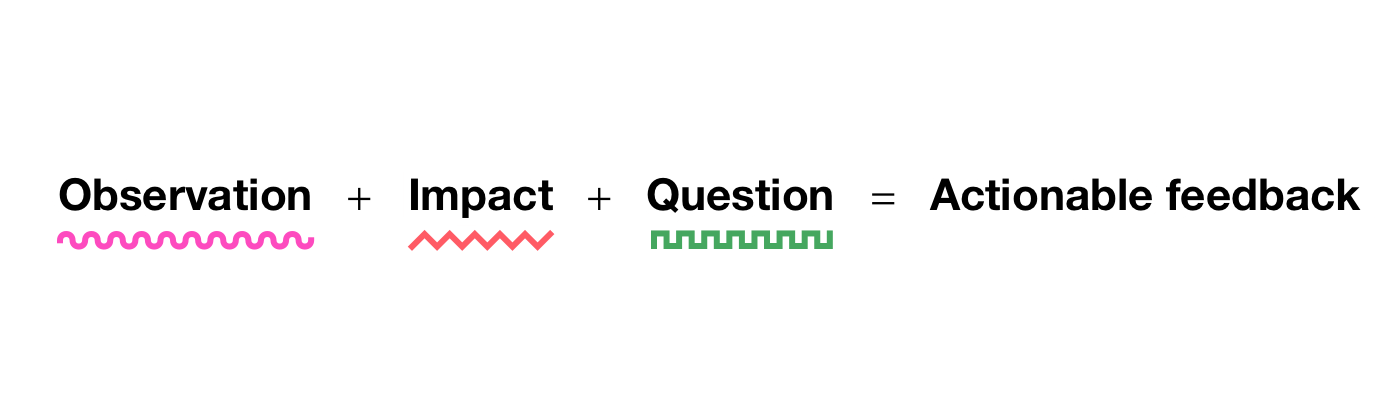
    The foundation of every good critique is the feedback’s content, so that’s where we need to start. There are many models that you can use to shape your content. The one that I personally like best—because it’s clear and actionable—is this one from Lara Hogan.

    While this equation is generally used to give feedback to people, it also fits really well in a design critique because it ultimately answers some of the core questions that we work on: What? Where? Why? How? Imagine that you’re giving some feedback about some design work that spans multiple screens, like an onboarding flow: there are some pages shown, a flow blueprint, and an outline of the decisions made. You spot something that could be improved. If you keep the three elements of the equation in mind, you’ll have a mental model that can help you be more precise and effective.

    Here is a comment that could be given as a part of some feedback, and it might look reasonable at a first glance: it seems to superficially fulfill the elements in the equation. But does it?

    Not sure about the buttons’ styles and hierarchy—it feels off. Can you change them?

    Observation for design feedback doesn’t just mean pointing out which part of the interface your feedback refers to, but it also refers to offering a perspective that’s as specific as possible. Are you providing the user’s perspective? Your expert perspective? A business perspective? The project manager’s perspective? A first-time user’s perspective?

    When I see these two buttons, I expect one to go forward and one to go back.

    Impact is about the why. Just pointing out a UI element might sometimes be enough if the issue may be obvious, but more often than not, you should add an explanation of what you’re pointing out.

    When I see these two buttons, I expect one to go forward and one to go back. But this is the only screen where this happens, as before we just used a single button and an “×” to close. This seems to be breaking the consistency in the flow.

    The question approach is meant to provide open guidance by eliciting the critical thinking in the designer receiving the feedback. Notably, in Lara’s equation she provides a second approach: request, which instead provides guidance toward a specific solution. While that’s a viable option for feedback in general, for design critiques, in my experience, defaulting to the question approach usually reaches the best solutions because designers are generally more comfortable in being given an open space to explore.

    The difference between the two can be exemplified with, for the question approach:

    When I see these two buttons, I expect one to go forward and one to go back. But this is the only screen where this happens, as before we just used a single button and an “×” to close. This seems to be breaking the consistency in the flow. Would it make sense to unify them?

    Or, for the request approach:

    When I see these two buttons, I expect one to go forward and one to go back. But this is the only screen where this happens, as before we just used a single button and an “×” to close. This seems to be breaking the consistency in the flow. Let’s make sure that all screens have the same pair of forward and back buttons.

    At this point in some situations, it might be useful to integrate with an extra why: why you consider the given suggestion to be better.

    When I see these two buttons, I expect one to go forward and one to go back. But this is the only screen where this happens, as before we just used a single button and an “×” to close. This seems to be breaking the consistency in the flow. Let’s make sure that all screens have the same two forward and back buttons so that users don’t get confused.

    Choosing the question approach or the request approach can also at times be a matter of personal preference. A while ago, I was putting a lot of effort into improving my feedback: I did rounds of anonymous feedback, and I reviewed feedback with other people. After a few rounds of this work and a year later, I got a positive response: my feedback came across as effective and grounded. Until I changed teams. To my shock, my next round of feedback from one specific person wasn’t that great. The reason is that I had previously tried not to be prescriptive in my advice—because the people who I was previously working with preferred the open-ended question format over the request style of suggestions. But now in this other team, there was one person who instead preferred specific guidance. So I adapted my feedback for them to include requests.

    One comment that I heard come up a few times is that this kind of feedback is quite long, and it doesn’t seem very efficient. No… but also yes. Let’s explore both sides.

    No, this style of feedback is actually efficient because the length here is a byproduct of clarity, and spending time giving this kind of feedback can provide exactly enough information for a good fix. Also if we zoom out, it can reduce future back-and-forth conversations and misunderstandings, improving the overall efficiency and effectiveness of collaboration beyond the single comment. Imagine that in the example above the feedback were instead just, “Let’s make sure that all screens have the same two forward and back buttons.” The designer receiving this feedback wouldn’t have much to go by, so they might just apply the change. In later iterations, the interface might change or they might introduce new features—and maybe that change might not make sense anymore. Without the why, the designer might imagine that the change is about consistency… but what if it wasn’t? So there could now be an underlying concern that changing the buttons would be perceived as a regression.

    Yes, this style of feedback is not always efficient because the points in some comments don’t always need to be exhaustive, sometimes because certain changes may be obvious (“The font used doesn’t follow our guidelines”) and sometimes because the team may have a lot of internal knowledge such that some of the whys may be implied.

    So the equation above isn’t meant to suggest a strict template for feedback but a mnemonic to reflect and improve the practice. Even after years of active work on my critiques, I still from time to time go back to this formula and reflect on whether what I just wrote is effective.

    The tone

    Well-grounded content is the foundation of feedback, but that’s not really enough. The soft skills of the person who’s providing the critique can multiply the likelihood that the feedback will be well received and understood. Tone alone can make the difference between content that’s rejected or welcomed, and it’s been demonstrated that only positive feedback creates sustained change in people.

    Since our goal is to be understood and to have a positive working environment, tone is essential to work on. Over the years, I’ve tried to summarize the required soft skills in a formula that mirrors the one for content: the receptivity equation.

    Respectful feedback comes across as grounded, solid, and constructive. It’s the kind of feedback that, whether it’s positive or negative, is perceived as useful and fair.

    Timing refers to when the feedback happens. To-the-point feedback doesn’t have much hope of being well received if it’s given at the wrong time. Questioning the entire high-level information architecture of a new feature when it’s about to ship might still be relevant if that questioning highlights a major blocker that nobody saw, but it’s way more likely that those concerns will have to wait for a later rework. So in general, attune your feedback to the stage of the project. Early iteration? Late iteration? Polishing work in progress? These all have different needs. The right timing will make it more likely that your feedback will be well received.

    Attitude is the equivalent of intent, and in the context of person-to-person feedback, it can be referred to as radical candor. That means checking before we write to see whether what we have in mind will truly help the person and make the project better overall. This might be a hard reflection at times because maybe we don’t want to admit that we don’t really appreciate that person. Hopefully that’s not the case, but that can happen, and that’s okay. Acknowledging and owning that can help you make up for that: how would I write if I really cared about them? How can I avoid being passive aggressive? How can I be more constructive?

    Form is relevant especially in a diverse and cross-cultural work environments because having great content, perfect timing, and the right attitude might not come across if the way that we write creates misunderstandings. There might be many reasons for this: sometimes certain words might trigger specific reactions; sometimes nonnative speakers might not understand all the nuances of some sentences; sometimes our brains might just be different and we might perceive the world differently—neurodiversity must be taken into consideration. Whatever the reason, it’s important to review not just what we write but how.

    A few years back, I was asking for some feedback on how I give feedback. I received some good advice but also a comment that surprised me. They pointed out that when I wrote “Oh, […],” I made them feel stupid. That wasn’t my intent! I felt really bad, and I just realized that I provided feedback to them for months, and every time I might have made them feel stupid. I was horrified… but also thankful. I made a quick fix: I added “oh” in my list of replaced words (your choice between: macOS’s text replacement, aText, TextExpander, or others) so that when I typed “oh,” it was instantly deleted. 

    Something to highlight because it’s quite frequent—especially in teams that have a strong group spirit—is that people tend to beat around the bush. It’s important to remember here that a positive attitude doesn’t mean going light on the feedback—it just means that even when you provide hard, difficult, or challenging feedback, you do so in a way that’s respectful and constructive. The nicest thing that you can do for someone is to help them grow.

    We have a great advantage in giving feedback in written form: it can be reviewed by another person who isn’t directly involved, which can help to reduce or remove any bias that might be there. I found that the best, most insightful moments for me have happened when I’ve shared a comment and I’ve asked someone who I highly trusted, “How does this sound?,” “How can I do it better,” and even “How would you have written it?”—and I’ve learned a lot by seeing the two versions side by side.

    The format

    Asynchronous feedback also has a major inherent advantage: we can take more time to refine what we’ve written to make sure that it fulfills two main goals: the clarity of communication and the actionability of the suggestions.

    Let’s imagine that someone shared a design iteration for a project. You are reviewing it and leaving a comment. There are many ways to do this, and of course context matters, but let’s try to think about some elements that may be useful to consider.

    In terms of clarity, start by grounding the critique that you’re about to give by providing context. Specifically, this means describing where you’re coming from: do you have a deep knowledge of the project, or is this the first time that you’re seeing it? Are you coming from a high-level perspective, or are you figuring out the details? Are there regressions? Which user’s perspective are you taking when providing your feedback? Is the design iteration at a point where it would be okay to ship this, or are there major things that need to be addressed first?

    Providing context is helpful even if you’re sharing feedback within a team that already has some information on the project. And context is absolutely essential when giving cross-team feedback. If I were to review a design that might be indirectly related to my work, and if I had no knowledge about how the project arrived at that point, I would say so, highlighting my take as external.

    We often focus on the negatives, trying to outline all the things that could be done better. That’s of course important, but it’s just as important—if not more—to focus on the positives, especially if you saw progress from the previous iteration. This might seem superfluous, but it’s important to keep in mind that design is a discipline where there are hundreds of possible solutions for every problem. So pointing out that the design solution that was chosen is good and explaining why it’s good has two major benefits: it confirms that the approach taken was solid, and it helps to ground your negative feedback. In the longer term, sharing positive feedback can help prevent regressions on things that are going well because those things will have been highlighted as important. As a bonus, positive feedback can also help reduce impostor syndrome.

    There’s one powerful approach that combines both context and a focus on the positives: frame how the design is better than the status quo (compared to a previous iteration, competitors, or benchmarks) and why, and then on that foundation, you can add what could be improved. This is powerful because there’s a big difference between a critique that’s for a design that’s already in good shape and a critique that’s for a design that isn’t quite there yet.

    Another way that you can improve your feedback is to depersonalize the feedback: the comments should always be about the work, never about the person who made it. It’s “This button isn’t well aligned” versus “You haven’t aligned this button well.” This is very easy to change in your writing by reviewing it just before sending.

    In terms of actionability, one of the best approaches to help the designer who’s reading through your feedback is to split it into bullet points or paragraphs, which are easier to review and analyze one by one. For longer pieces of feedback, you might also consider splitting it into sections or even across multiple comments. Of course, adding screenshots or signifying markers of the specific part of the interface you’re referring to can also be especially useful.

    One approach that I’ve personally used effectively in some contexts is to enhance the bullet points with four markers using emojis. So a red square 🟥 means that it’s something that I consider blocking; a yellow diamond 🔶 is something that I can be convinced otherwise, but it seems to me that it should be changed; and a green circle 🟢 is a detailed, positive confirmation. I also use a blue spiral 🌀 for either something that I’m not sure about, an exploration, an open alternative, or just a note. But I’d use this approach only on teams where I’ve already established a good level of trust because if it happens that I have to deliver a lot of red squares, the impact could be quite demoralizing, and I’d reframe how I’d communicate that a bit.

    Let’s see how this would work by reusing the example that we used earlier as the first bullet point in this list:

    • 🔶 Navigation—When I see these two buttons, I expect one to go forward and one to go back. But this is the only screen where this happens, as before we just used a single button and an “×” to close. This seems to be breaking the consistency in the flow. Let’s make sure that all screens have the same two forward and back buttons so that users don’t get confused.
    • 🟢 Overall—I think the page is solid, and this is good enough to be our release candidate for a version 1.0.
    • 🟢 Metrics—Good improvement in the buttons on the metrics area; the improved contrast and new focus style make them more accessible.
    •  🟥  Button Style—Using the green accent in this context creates the impression that it’s a positive action because green is usually perceived as a confirmation color. Do we need to explore a different color?
    • 🔶Tiles—Given the number of items on the page, and the overall page hierarchy, it seems to me that the tiles shouldn’t be using the Subtitle 1 style but the Subtitle 2 style. This will keep the visual hierarchy more consistent.
    • 🌀 Background—Using a light texture works well, but I wonder whether it adds too much noise in this kind of page. What is the thinking in using that?

    What about giving feedback directly in Figma or another design tool that allows in-place feedback? In general, I find these difficult to use because they hide discussions and they’re harder to track, but in the right context, they can be very effective. Just make sure that each of the comments is separate so that it’s easier to match each discussion to a single task, similar to the idea of splitting mentioned above.

    One final note: say the obvious. Sometimes we might feel that something is obviously good or obviously wrong, and so we don’t say it. Or sometimes we might have a doubt that we don’t express because the question might sound stupid. Say it—that’s okay. You might have to reword it a little bit to make the reader feel more comfortable, but don’t hold it back. Good feedback is transparent, even when it may be obvious.

    There’s another advantage of asynchronous feedback: written feedback automatically tracks decisions. Especially in large projects, “Why did we do this?” could be a question that pops up from time to time, and there’s nothing better than open, transparent discussions that can be reviewed at any time. For this reason, I recommend using software that saves these discussions, without hiding them once they are resolved. 

    Content, tone, and format. Each one of these subjects provides a useful model, but working to improve eight areas—observation, impact, question, timing, attitude, form, clarity, and actionability—is a lot of work to put in all at once. One effective approach is to take them one by one: first identify the area that you lack the most (either from your perspective or from feedback from others) and start there. Then the second, then the third, and so on. At first you’ll have to put in extra time for every piece of feedback that you give, but after a while, it’ll become second nature, and your impact on the work will multiply.

    Thanks to Brie Anne Demkiw and Mike Shelton for reviewing the first draft of this article.